
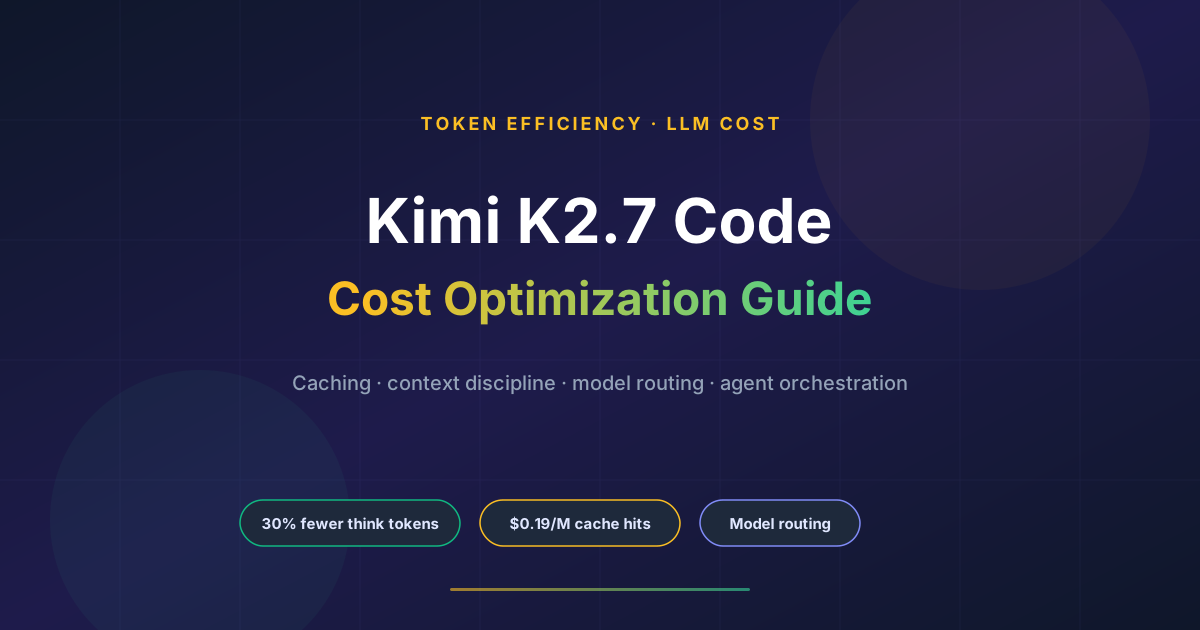
Kimi K2.7 Code is already one of the cheapest capable coding models you can run. Released on June 12, 2026 by Moonshot AI as an open-source (Modified MIT) Mixture-of-Experts model with 1T total and 32B active parameters, it lists at $0.95 per million input tokens and $4.00 per million output tokens. That is a fraction of what frontier closed models charge. So why write a cost optimization guide for a model that is already inexpensive? Because at production scale, an agentic coding workload that re-sends the same context thousands of times a day can still run up a bill that is 2x to 3x larger than it needs to be.
The good news is that the same pricing model that makes Kimi cheap also gives you powerful levers: cache hits cost just $0.19 per million tokens, the always-thinking architecture now spends roughly 30% fewer thinking tokens than K2.6, and the open weights mean you are never locked into a single vendor. Pull these levers correctly and you can cut a real monthly bill close to in half without touching output quality.
This guide is a practical playbook for engineering teams. We walk through the pricing model, the caching strategy that delivers the biggest savings, context discipline, how to exploit the thinking-token reduction, model routing, and orchestration with the open-source Hermes Agent. Every cost figure below is computed with an explicit formula so you can reproduce it. For the full capability picture, see our Kimi K2.7 Code developer guide and benchmarks.
💰 What This Guide Covers
1Why Kimi K2.7 Code Is Already Cheap
Before optimizing, it helps to understand why Kimi K2.7 Code starts from such a strong cost position. Three structural facts drive the economics.
First, it is open-weight. Moonshot AI released the model under a Modified MIT license and published the weights on Hugging Face at moonshotai/Kimi-K2.7-Code. That means the hosted API price has a natural ceiling: if a provider charges too much, you can self-host the same weights, and competition across providers keeps the per-token price low. The model is also available on OpenRouter, Cloudflare Workers AI, and the Vercel AI Gateway, so you can shop the same model across several endpoints.
Second, the hosted pricing is genuinely low: $0.95 per million input tokens and $4.00 per million output tokens, with cache hits at just $0.19 per million. For a Mixture-of-Experts model with 1T total parameters and 32B active, a 256K context window, and multimodal input, that is aggressive pricing.
Third, the always-thinking architecture in K2.7 Code spends roughly 30% fewer thinking tokens than K2.6 on comparable tasks. Since thinking tokens are billed at the output rate, that reduction directly lowers the most expensive component of a typical bill. You get the reasoning quality of an always-thinking model without paying as much for it.
💡 The Optimization Mindset
Cheap per-token pricing does not mean cheap workloads. An agent that re-reads a 40,000-token codebase on every step, thousands of times a day, can spend far more than necessary. Optimization is about sending fewer tokens, sending them as cache hits, and producing fewer output and thinking tokens per task.
2Understand the Pricing Model
Every optimization decision starts with knowing what you are billed for. Moonshot AI charges three distinct rates for Kimi K2.7 Code, and they are an order of magnitude apart.
| Token Type | Price per Million | When You Pay It |
|---|---|---|
| Input (fresh) | $0.95 | New prompt tokens the model has not seen as a cached prefix |
| Cache hit | $0.19 | Stable prefix tokens served from cache (80% cheaper than fresh input) |
| Output + thinking | $4.00 | Every generated token, including internal reasoning tokens |
The key insight: output and thinking tokens dominate the bill. At $4.00 per million, a generated token costs more than 4x a fresh input token and more than 21x a cache hit. For an always-thinking model, that is where the money goes. The general cost formula for any workload is:
cost = (input_tokens x 0.95
        + output_tokens x 4.00
        + cached_tokens x 0.19) / 1,000,000
Read that formula carefully, because every optimization in this guide is a way of shrinking one of its three terms: move tokens from the $0.95 input term into the $0.19 cached term, cut the number of tokens in the input term entirely, or reduce the $4.00 output term by spending fewer thinking and output tokens per task.
3Prompt Caching: The Biggest Lever
If you do one thing from this guide, do this. Cached input tokens cost $0.19 per million versus $0.95 per million for fresh input. Because 0.19 / 0.95 = 0.2, serving stable context as a cache hit is exactly 80% cheaper than re-sending it as fresh input. For agentic workloads that repeat the same system prompt, schemas, and reference docs on every call, this is the difference between a small bill and a large one.
The mechanism is simple: providers cache a prompt prefix and charge the discounted rate when a later request reuses that exact prefix. To benefit, you must structure prompts with a stable prefix and a variable suffix. Put everything that does not change (system instructions, tool definitions, coding standards, API schemas, the repository map) at the very start, byte-for-byte identical across calls. Put the variable user request and the small bit of task-specific context at the end.
STABLE PREFIX (cached at $0.19/M after first call)
  - system instructions
  - tool / function definitions
  - coding standards and schemas
  - repository structure map

VARIABLE SUFFIX (fresh input at $0.95/M)
  - the current user request
  - the specific file or diff in scope
Here is a concrete single-call example. Suppose your stable prefix is 1,000,000 tokens of instructions, schemas, and reference material that you reuse on every request. Using the input portion of the cost formula, cost = tokens x rate / 1,000,000:
- Served as fresh input: 1,000,000 x 0.95 / 1,000,000 = $0.95
- Served as a cache hit: 1,000,000 x 0.19 / 1,000,000 = $0.19
- Saving on that portion: 0.95 - 0.19 = $0.76, which is 80% off (0.19 / 0.95 = 0.2)
That is per call. Multiply by thousands of calls a day and the caching discount becomes the single largest line-item saving in your entire AI budget. The first call pays the full $0.95 to warm the cache, and every subsequent call that reuses the prefix pays $0.19.
✅ Caching Checklist
Keep the prefix byte-for-byte identical (a single changed character breaks the cache). Order content from most stable to most variable. Avoid injecting timestamps, request IDs, or randomized ordering into the prefix. Group requests that share a prefix so cache entries stay warm.
4Context Discipline
The 256K context window is a ceiling, not a target. Just because you can stuff a quarter-million tokens into a prompt does not mean you should. Every token you send is billed, every token the model reads adds latency, and oversized context often hurts answer quality by burying the relevant detail. Context discipline is about sending the model only what it needs to do the task in front of it.
Practical tactics that cut the input term of the cost formula:
- Trim retrieved context. If you use retrieval, tune the number of chunks down to what actually improves the answer. Ten tight, relevant chunks usually beat fifty loosely related ones, and they cost a fifth as much to send.
- Scope agents to relevant files. An autonomous coding agent does not need the whole repository in context for a one-file change. Give it the target file, its direct dependencies, and the relevant tests, not the entire tree.
- Summarize long histories. In long agent runs, periodically compress the conversation history into a short summary rather than re-sending every prior turn verbatim.
- Prefer diffs over full files. When asking for an edit, send a diff or the relevant function rather than re-pasting a 2,000-line file on every iteration.
Context discipline compounds with caching. Once you have trimmed the variable portion of each request to the minimum, the stable cached prefix carries the shared knowledge cheaply, and the small fresh suffix carries only the task at hand. For a deeper walkthrough of scoping autonomous agents, see our Hermes Agent autonomous coding setup guide.
5Exploit the 30% Thinking-Token Reduction
Kimi K2.7 Code is an always-thinking model: it produces internal reasoning tokens before its final answer, and those thinking tokens are billed at the $4.00 output rate. Because output is the most expensive term in the cost formula, reasoning volume has an outsized effect on your bill. This is exactly where K2.7 Code improves on its predecessor.
Moonshot AI reports that K2.7 Code uses roughly 30% fewer thinking tokens than K2.6 for comparable tasks. That reduction does two things at once: it lowers the output charge per request, and it cuts latency because the model spends less time reasoning before it answers. You get the same answer quality for a smaller output bill, with no work on your side beyond using the newer model.
You can amplify the effect with prompt design. Clear, well-scoped tasks need less deliberation than vague ones, so a model spends fewer thinking tokens reasoning about what you actually want. Concrete ways to keep reasoning lean:
- Give the model a precise objective and the exact constraints, so it does not burn tokens exploring options you have already ruled out.
- Break a large, ambiguous task into smaller well-defined steps rather than asking for one sprawling deliverable.
- Provide the relevant schema or function signature up front so the model does not reason its way to assumptions you could have stated.
- Constrain output length when a short answer will do. Fewer output tokens at $4.00 per million is a direct saving.
💡 Why This Matters Most at Scale
On a workload that generates 50M output tokens a month, a 30% reduction in thinking tokens is a real reduction in the $4.00 term. Combined with caching on the input side, you are attacking both ends of the cost formula at the same time.
6Model Routing: Right Model for Each Task
Not every request deserves the same model. A lot of agentic work is cheap, repetitive, and well within Kimi K2.7 Code's comfort zone: formatting, classification, simple refactors, boilerplate generation, retrieval query rewriting, and routine code review. Routing this bulk work to Kimi keeps the blended cost per request low, and you escalate to a more expensive frontier model only for the small fraction of tasks that genuinely need it.
The cleanest way to implement this is an LLM gateway that sits in front of your providers and routes each request by task type, complexity, or a confidence score. Because Kimi K2.7 Code is OpenAI-compatible (base URL https://api.moonshot.ai/v1, model id kimi-k2.7-code) and is also available on OpenRouter, the Vercel AI Gateway, and Cloudflare Workers AI, it slots into a routing layer with no custom client code.
# Default cheap/bulk work -> Kimi K2.7 Code
base_url = "https://api.moonshot.ai/v1"
model    = "kimi-k2.7-code"

# Routing policy (pseudocode)
if task.is_bulk_or_simple():
    route_to("kimi-k2.7-code")     # $0.95 in / $4.00 out
elif task.needs_frontier_reasoning():
    route_to("premium-model")      # escalate selectively
Set Kimi as the default and treat escalation as the exception. In most coding pipelines, the large majority of requests are routine, so defaulting to the cheaper model and escalating selectively can lower blended cost substantially while preserving quality where it counts. Grab API keys at platform.moonshot.ai or use the model through OpenRouter. If you would rather run the weights yourself to remove per-token cost entirely, see our self-hosting guide for vLLM and SGLang.
7Orchestrating Cost with Hermes Agent
Routing decides which model handles a request. Orchestration decides how much work and context each request carries in the first place. The open-source Hermes Agent from Nous Research is a provider-agnostic, self-improving agent that speaks the OpenAI-compatible API, so it drives Kimi K2.7 Code directly without a custom adapter.
Its cost advantage comes from two features. First, persistent memory: Hermes Agent remembers facts, decisions, and project context across runs, so you stop re-sending the same background in every prompt. Re-explaining context is one of the quietest sources of token waste, and persistent memory removes it. Second, skills: reusable capabilities the agent can invoke instead of reasoning a procedure from scratch each time, which trims both thinking and output tokens.
Because it is provider-agnostic, Hermes Agent also makes routing practical. You can point it at Kimi K2.7 Code by default and at a premium model only for the steps that need it, all within one agent loop. The orchestration discipline that saves money:
- Delegate big jobs deliberately. Decide up front which subtasks the agent should take on, rather than letting it loop indefinitely and accumulate output tokens.
- Lean on memory instead of re-sending context. Store stable project knowledge once and reference it, so each request carries a smaller fresh suffix.
- Reuse skills. Encode recurring procedures as skills so the agent executes them instead of re-deriving them token by token.
- Set step and budget limits. Cap the number of iterations so a runaway loop cannot quietly run up the $4.00 output term.
💡 Memory Plus Caching
Persistent memory and prompt caching solve related problems from opposite directions. Caching makes the context you do re-send 80% cheaper, while memory reduces how much you need to re-send at all. Used together, they keep both the cached and fresh input terms small.
8A Worked Monthly Cost Example
Let us put the whole playbook into a single monthly bill. The formula, stated once more so you can reproduce every figure:
monthly cost = (input_tokens x 0.95
              + output_tokens x 4.00
              + cached_tokens x 0.19) / 1,000,000
Assume a mid-size agentic coding team with these monthly volumes after applying caching and context discipline:
- 200M fresh input tokens (the variable suffixes: specific files, diffs, and user requests)
- 50M output tokens (generated code and answers, including thinking tokens)
- 800M cached tokens (the stable prefix reused across calls: system prompts, schemas, repo maps)
Plugging into the formula, term by term:
input  : 200 x 0.95 = $190.00
output :  50 x 4.00 = $200.00
cached : 800 x 0.19 = $152.00
-----------------------------------
total  = 190 + 200 + 152 = $542.00 / month
Now compare against the same workload with no caching, where those 800M stable tokens are billed as fresh input at $0.95 per million instead of $0.19:
input  : (200 + 800) x 0.95 = 1000 x 0.95 = $950.00
output :   50 x 4.00                       = $200.00
-----------------------------------------------------
total  = 950 + 200 = $1,150.00 / month

caching saving = 1150 - 542 = $608.00 / month
Caching alone takes this workload from $1,150 to $542 per month, a saving of $608, while the output cost stays the same. Layer on the 30% thinking-token reduction in K2.7 Code and tighter context, and the output term shrinks further on top of that. The exact numbers will vary with your token mix, but the structure holds: the cached term is cheap, the input term is moderate, and the output term is where you should spend the most effort trimming.
9Why Lushbinary
Getting AI coding costs under control is part architecture, part discipline. The teams that keep agentic workloads affordable are the ones who design caching, context, and routing strategies before the bill gets out of hand, not after. Lushbinary has been building production AI integrations since the GPT-4 era, and we help teams ship fast without writing a blank check to their model provider.
Here is what we bring to a cost-efficient Kimi K2.7 Code deployment:
- Token usage audits - we instrument your workload, find where input, output, and uncached tokens are going, and quantify the savings from each lever in this guide.
- Prompt caching architecture - we restructure your prompts into stable prefixes and variable suffixes so the bulk of your context bills at the $0.19 cache-hit rate.
- Context and retrieval tuning - we trim oversized context and scope agents to the files that matter, cutting the input term without hurting answer quality.
- LLM gateway and routing - we set up routing that defaults bulk work to Kimi and escalates selectively, keeping your blended cost per request low.
- Hermes Agent orchestration - we wire up persistent memory, skills, and budget limits so your agents stop re-sending context and looping past their value.
- Self-hosting when it pays - when your volume justifies it, we deploy the open weights on your own infrastructure to remove per-token cost entirely.
🚀 Free Consultation
Watching your AI coding bill climb? Lushbinary offers a free consultation for teams running Kimi K2.7 Code and other agentic workloads. We'll audit your token usage, identify the caching, context, and routing wins, and give you a concrete savings plan with no obligation. Want to compare Kimi against the alternatives first? Read our Kimi K2.7 Code vs Claude Fable 5 and GPT-5.5 coding comparison.
Ready to Build Something Great?
Get a free 30-minute strategy call. We'll map out your project, timeline, and tech stack - no strings attached.
Prefer email? Reach us directly:
Contact Us
❓ Frequently Asked Questions
How much does Kimi K2.7 Code cost to use?
Moonshot AI prices Kimi K2.7 Code at $0.95 per million input tokens, $4.00 per million output tokens, and $0.19 per million cache-hit (cached input) tokens. Output and thinking tokens dominate most bills because they are billed at the $4.00 output rate. The model is also open-source under a Modified MIT license, so you can self-host the weights and pay only for hardware.
What is the single biggest way to cut Kimi K2.7 Code costs?
Prompt caching. Cached input tokens cost $0.19 per million versus $0.95 per million for fresh input. Because 0.19 / 0.95 = 0.2, serving stable context as a cache hit is 80% cheaper than re-sending it. Structure prompts so the large, stable prefix (system instructions, schemas, docs) stays identical across calls and only the variable user content changes at the end.
How does the 30% thinking-token reduction lower my bill?
Kimi K2.7 Code is an always-thinking model, and thinking tokens are billed at the $4.00 output rate. Moonshot AI reports roughly 30% fewer thinking tokens than K2.6 for comparable tasks, so the most expensive part of the bill shrinks while latency improves. Fewer reasoning tokens means a lower output charge per request.
Should I route all coding work to Kimi K2.7 Code?
Use model routing. Send cheap, high-volume work (formatting, classification, boilerplate, retrieval queries) to Kimi K2.7 Code through an LLM gateway, and escalate to a more expensive frontier model only for the small fraction of tasks that genuinely need it. Routing keeps the blended cost per request low without sacrificing quality on hard problems.
What does a realistic monthly Kimi K2.7 Code bill look like?
Using the formula monthly cost = (input_tokens x 0.95 + output_tokens x 4.00 + cached_tokens x 0.19) / 1,000,000, a workload of 200M input, 50M output, and 800M cached tokens per month costs (200 x 0.95) + (50 x 4.00) + (800 x 0.19) = $190 + $200 + $152 = $542. Serving those 800M cached tokens as fresh input instead would push the bill to $1,150, so caching saves $608 per month on this workload.
📚 Sources
- Moonshot AI Platform - API pricing and keys
- Hugging Face - moonshotai/Kimi-K2.7-Code model card
- OpenRouter - moonshotai/kimi-k2.7-code
- Nous Research - Hermes Agent on GitHub
Content was rephrased for compliance with licensing restrictions. Pricing sourced from Moonshot AI as of June 2026. Token prices may change - always verify on the vendor's website.
Cut Your AI Coding Bill
We audit your token usage and design caching, context, and routing strategies that keep agentic coding affordable.
Ready to Build Something Great?
Get a free 30-minute strategy call. We'll map out your project, timeline, and tech stack - no strings attached.
Prefer email? Reach us directly: