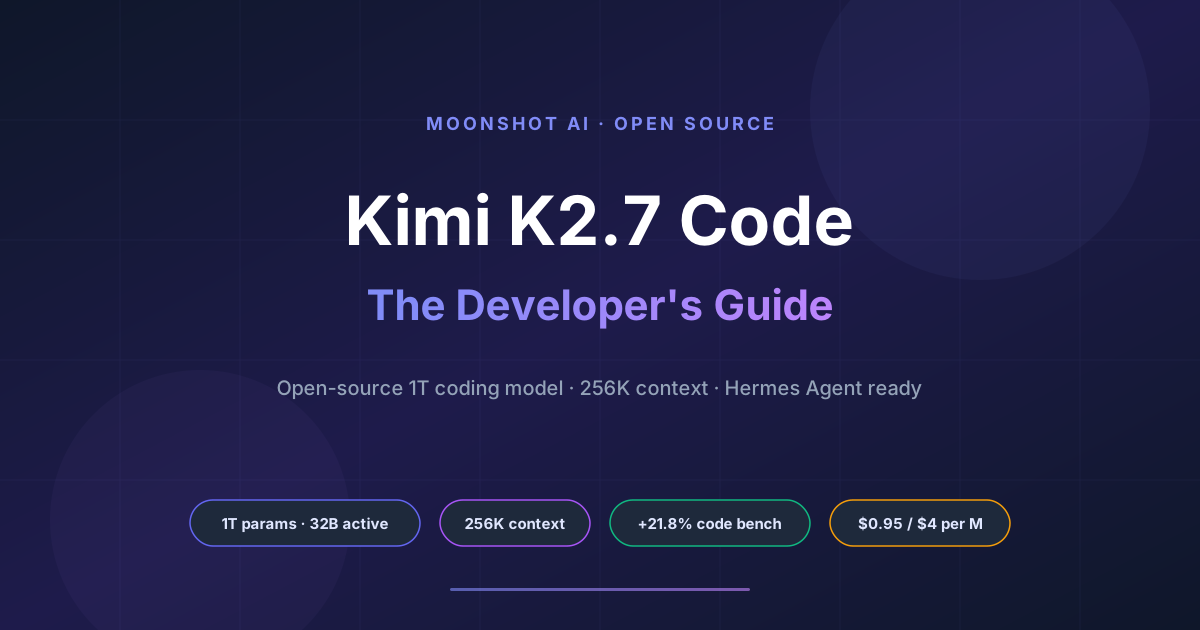

Pairing a strong open coding model with a self-improving agent is one of the most practical ways to get autonomous coding that actually fits your workflow. Kimi K2.7 Code from Moonshot AI brings a 256K context window and an always-thinking design, while Hermes Agent from Nous Research adds a learning loop that builds skills from experience and remembers them across sessions.
This guide is a hands-on setup walkthrough. You will install Hermes Agent, point it at Kimi K2.7 Code through an OpenAI-compatible endpoint (Moonshot directly or via OpenRouter), and learn how the agent's three coding modes, self-improving skills, persistent memory, and MCP support combine into a coding partner that gets better the more you use it.
Both projects are open source, so there is no lock-in. Hermes Agent is provider-agnostic, which means the same setup works whether you run Kimi through Moonshot, route it through OpenRouter, or swap in a different model later. Commands and flags evolve quickly, so treat the official docs as the source of truth and use this guide for the overall shape of the setup.
📋 Table of Contents
- 1.Why Pair Kimi K2.7 Code with Hermes Agent
- 2.Prerequisites
- 3.Install Hermes Agent
- 4.Configure Kimi K2.7 Code as the Model Provider
- 5.The Three Coding Modes
- 6.Self-Improving Skills & Memory
- 7.Connecting Tools via MCP
- 8.A Real Workflow Walkthrough
- 9.Cost & Token Efficiency Tips
- 10.Why Lushbinary
1Why Pair Kimi K2.7 Code with Hermes Agent
Most autonomous coding setups fail in one of two ways: the model is capable but the harness is rigid, or the harness is flexible but the model runs out of context on real codebases. Pairing Kimi K2.7 Code with Hermes Agent addresses both sides at once.
On the model side, Kimi K2.7 Code was released on June 12, 2026 by Moonshot AI under a Modified MIT license. It is a Mixture-of-Experts model with 1 trillion total parameters and 32 billion active parameters per forward pass, a 256K context window, multimodal input, and an always-thinking design. That context window matters for coding: it lets the agent hold whole modules, test files, and dependency code in working memory instead of constantly re-reading files.
On the agent side, Hermes Agent is an open-source, self-improving agent from Nous Research. Rather than treating each task as isolated, it runs a learning loop that turns successful work into reusable skills and persists memory across sessions. The longer you use it, the more it knows about your codebase and conventions.
The combination gives you:
- An open stack: both the model weights and the agent are open source, so you can self-host, audit, and customize without vendor lock-in
- Long-context coding: the 256K window keeps large files, diffs, and test output in scope during multi-step tasks
- Compounding skill: Hermes learns your workflow over time, so repeated tasks get faster and more reliable
- Predictable cost: Kimi uses roughly 30% fewer thinking tokens than K2.6, and cache-hit pricing of $0.19 per million tokens keeps long sessions affordable
A self-improving agent compounds best with a long-context model. A skill Hermes learns once can be applied across an entire repository in a single session because the 256K window holds enough of the codebase for the agent to act with full awareness.
2Prerequisites
Before you install anything, gather the following. The setup is light: Hermes runs on a normal developer machine or a small server, and the model runs through a hosted API, so you do not need local GPUs.
- An API key for Kimi K2.7 Code: create one on the Moonshot platform, or use an OpenRouter key if you prefer routing through a gateway
- A machine or server: any modern laptop, workstation, or small cloud VM works, since the heavy compute happens on the model provider's side
- A runtime: a current Node.js or Python install, depending on how Hermes Agent packages its release for your platform
- A terminal: Hermes ships a terminal UI (TUI), so a standard shell is enough to get started
Keep your API key out of source control. Store it in an environment variable or a secrets manager and reference it by name. Never paste a live key into a committed config file.
3Install Hermes Agent
Hermes Agent is distributed from its GitHub repository and documented at the official docs site. The project ships a one-line installer for the quickest start. Run the current install command from the docs, then verify the binary is on your path.
# Install Hermes Agent (use the exact command from the docs)
curl -fsSL https://hermes-agent.nousresearch.com/install.sh | sh

# Confirm the install
hermes --version

# Launch the terminal UI
hermes
Because the project moves quickly, the install command, package name, and flags can change between releases. Always check the latest version and the install section of the docs before running anything, and prefer a pinned version in scripted environments so your setup is reproducible.
For a deeper tour of the agent itself, including its skill system and configuration model, see our Hermes Agent developer guide.
4Configure Kimi K2.7 Code as the Model Provider
Hermes Agent is provider-agnostic and speaks the OpenAI-compatible API format. That is the key to wiring in Kimi K2.7 Code: you register it as a custom provider with a base URL, an API key, and a model id, then select it. Use the hermes model command to pick the active model, and check the docs for the exact flags your version expects.
Kimi K2.7 Code exposes an OpenAI-compatible endpoint, so two routes work. You can connect to Moonshot directly, or route through OpenRouter if you want a single gateway across providers. Here is a config and environment block covering both.
# Option A: Moonshot direct (OpenAI-compatible endpoint)
export OPENAI_BASE_URL="https://api.moonshot.ai/v1"
export OPENAI_API_KEY="sk-your-moonshot-key"
# Model id on Moonshot:
#   kimi-k2.7-code

# Option B: OpenRouter gateway
export OPENAI_BASE_URL="https://openrouter.ai/api/v1"
export OPENAI_API_KEY="sk-or-your-openrouter-key"
# Model id on OpenRouter:
#   moonshotai/kimi-k2.7-code

# Register Kimi as a custom provider in Hermes config
# (field names follow the current Hermes docs)
provider:
  name: kimi-k2.7-code
  type: openai-compatible
  base_url: https://api.moonshot.ai/v1
  api_key_env: OPENAI_API_KEY
  model: kimi-k2.7-code

# Then select the model in Hermes
#   hermes model
The choice between Moonshot and OpenRouter comes down to billing and routing. Moonshot direct gives you the provider's native pricing and cache behavior. OpenRouter gives you one key and one base URL across many models, which is convenient if you switch models often or want fallback routing.
Field names like provider, type, and model are illustrative. Hermes is configured through its own schema, so confirm the exact keys, the custom-provider syntax, and the current hermes model flags in the docs before you rely on this in automation.
5The Three Coding Modes
Hermes Agent gives you three distinct ways to get code written and changed. You can use them independently or mix them within a single session, letting the agent pick the right tool for each step.
1. Direct execution with execute_code
The execute_code tool lets Hermes run code directly. This is the fastest path for focused edits, running tests, scripting a quick migration, or trying an idea in a sandbox. The agent writes, runs, reads the output, and iterates without leaving the session.
2. Delegation to external coding CLIs
For larger or specialized jobs, Hermes can delegate to dedicated coding CLIs such as Claude Code and OpenCode. The agent acts as an orchestrator: it frames the task, hands it to the external CLI, and folds the result back into its own plan. This is useful when you already have a coding CLI tuned to your repo and want Hermes to coordinate it.
3. Structured planning via bundled skills
Hermes ships with bundled skills that encode structured planning workflows. Instead of one large prompt, the agent breaks a feature into steps, tracks progress, and applies a repeatable method. Paired with Kimi's always-thinking design and large context, structured planning keeps complex, multi-file work coherent from start to finish.
6Self-Improving Skills & Memory
The feature that sets Hermes apart is its built-in learning loop. When the agent completes work successfully, it can distill what it did into a reusable skill. Those skills accumulate, so a workflow you guide it through once becomes something it can repeat on its own later.
Hermes also persists memory across sessions. It remembers context about your project, your preferences, and decisions made in earlier runs. Close the terminal, come back tomorrow, and the agent still knows the shape of your codebase instead of starting cold.
This is where the pairing with a 256K-context coding model compounds. A few concrete effects:
- Skills apply at repo scale: a learned skill can run against many files in one session because the long context holds the relevant code in view
- Memory reduces re-explanation: you stop repeating project conventions, since the agent recalls them from prior sessions
- Each task improves the next: the learning loop turns one-off successes into a growing library of reliable workflows
- Context plus memory beats context alone: the model holds the immediate task, while persistent memory carries the longer arc of the project
If you want to design your own skills rather than rely only on the bundled ones, see our custom skills development guide.
7Connecting Tools via MCP
Hermes Agent supports the Model Context Protocol (MCP), the open standard for connecting agents to external tools and data sources. MCP lets you give Hermes structured access to things like your database, your issue tracker, internal APIs, or documentation, without writing a bespoke integration for each one.
For autonomous coding, MCP is what turns the agent from a code editor into a teammate. With the right MCP servers connected, Hermes can read a ticket, query your schema, run a build, and check a deployment status as part of a single task, all while Kimi reasons over the combined context.
MCP setup has its own moving parts, including server discovery and permissions. For a full walkthrough, see our Hermes Agent MCP integration guide, and confirm the current MCP commands in the official docs.
8A Real Workflow Walkthrough
Here is what a typical autonomous session looks like once Hermes is wired to Kimi K2.7 Code. You give the agent a feature request, and it plans, edits, runs tests, and iterates until the work is done. The session below is illustrative; your exact prompts and output will differ.
$ hermes

[hermes] model: kimi-k2.7-code  |  context: 256K  |  skills: 14

you> Add pagination to the GET /users endpoint. Page size 20,
     return total count in the response, and add tests.

hermes> Planning with skill: feature-implementation
  1. Read users route, controller, and data layer
  2. Add limit/offset query params (default page size 20)
  3. Return { data, page, pageSize, total } shape
  4. Update tests and run the suite

hermes> [execute_code] reading src/routes/users.ts ... done
hermes> [execute_code] editing controller + query layer ... done
hermes> [execute_code] running: npm test

  PASS  test/users.pagination.test.ts
    GET /users
      ok returns first page with pageSize 20
      ok returns correct total count
      ok clamps oversized page size

  Tests: 3 passed, 12 total

hermes> Done. Pagination added with total count and 3 new tests.
        Learned skill updated: api-pagination.
Notice the flow: the agent selected a planning skill, used execute_code to read and edit files, ran the test suite, read the results, and confirmed success. On a failing test it would loop: read the failure, adjust the code, and re-run until green.
The final line matters most. By updating its api-pagination skill, Hermes made the next pagination task faster. That is the self-improving loop in practice, and it is why the pairing gets more valuable the longer you run it.
9Cost & Token Efficiency Tips
Autonomous agents can burn tokens quickly because they read files, reason, and retry. Kimi K2.7 Code helps here, and a few habits keep your bill predictable. Moonshot API pricing for Kimi K2.7 Code is:
| Token type | Price per million tokens |
|---|---|
| Input | $0.95 |
| Output | $4.00 |
| Cache hits | $0.19 |
Two structural advantages help. First, Kimi K2.7 Code uses roughly 30% fewer thinking tokens than K2.6, which directly lowers output costs on reasoning-heavy coding tasks. Second, cache hits are priced at $0.19 per million tokens, far below the $0.95 input rate, so reusing context across turns is much cheaper than re-sending it fresh.
Practical tips to keep costs tight:
- Keep context tight: scope the agent to the files and directories a task actually needs instead of the whole repo
- Lean on caching: structure sessions so stable context (system prompts, project conventions) can be reused and hit the $0.19 cache rate
- Let memory do the work: rely on persistent memory and skills so you are not re-feeding the same background each session
- Delegate big jobs deliberately: route large refactors to a coding CLI when that is more token-efficient than inline reasoning
For a deeper breakdown of pricing math and token-saving strategy, see our Kimi K2.7 Code cost optimization guide.
10Why Lushbinary
Standing up a self-improving coding agent is straightforward to start and easy to misconfigure at scale. Lushbinary helps teams move from a quick install to a tuned, reliable setup that fits how they actually work.
What we deliver:
- Provider setup: wiring Hermes Agent to Kimi K2.7 Code through Moonshot or OpenRouter, with secure key handling and sensible defaults
- Skill and memory design: building custom skills and memory structures around your codebase and conventions so the agent compounds value faster
- MCP integration: connecting your databases, issue trackers, and internal tools so the agent can act on real context
- Cost tuning: structuring sessions and caching to keep token spend predictable as usage grows
- Workflow integration: fitting the agent into your existing CI, review, and deployment process safely
🚀 Want a Self-Improving Coding Agent Set Up Right?
Whether you are evaluating Kimi K2.7 Code, rolling out Hermes Agent across a team, or wiring up MCP and custom skills, we will help you design a setup that fits your workflow and budget. Book a free 30-minute consultation with our team.
Ready to Build Something Great?
Get a free 30-minute strategy call. We'll map out your project, timeline, and tech stack - no strings attached.
Prefer email? Reach us directly:
Contact Us
❓ Frequently Asked Questions
What is Kimi K2.7 Code?
Kimi K2.7 Code is an open-source coding model released by Moonshot AI on June 12, 2026 under a Modified MIT license. It is a Mixture-of-Experts model with 1 trillion total parameters and 32 billion active parameters, a 256K context window, multimodal input, and an always-thinking design. It uses roughly 30% fewer thinking tokens than K2.6 and is available on Hugging Face as moonshotai/Kimi-K2.7-Code.
What is Hermes Agent?
Hermes Agent is an open-source, self-improving AI agent from Nous Research. It runs in the terminal as a TUI, on messaging platforms, and inside IDEs. It is provider-agnostic, supports OpenAI-compatible endpoints through the hermes model command, has a built-in learning loop that creates skills from experience, persists memory across sessions, and supports MCP and cron.
How do I connect Kimi K2.7 Code to Hermes Agent?
Because Hermes Agent is provider-agnostic and supports OpenAI-compatible endpoints, you point it at Kimi K2.7 Code as a custom provider. Use the Moonshot base URL https://api.moonshot.ai/v1 with the model id kimi-k2.7-code, or route through OpenRouter at https://openrouter.ai/api/v1 with moonshotai/kimi-k2.7-code. Set your API key and select the model with the hermes model command. Check the Hermes docs for the current command flags.
What does it cost to run Kimi K2.7 Code through the Moonshot API?
Moonshot API pricing for Kimi K2.7 Code is $0.95 per million input tokens, $4.00 per million output tokens, and $0.19 per million cache-hit tokens. The model also uses roughly 30% fewer thinking tokens than K2.6, which lowers the output-token bill on reasoning-heavy coding work.
What are the three coding modes in Hermes Agent?
Hermes Agent offers direct code execution through its execute_code tool, delegation to external coding CLIs such as Claude Code and OpenCode, and structured planning through its bundled skills. You can mix these modes in a single session, letting the agent plan with a skill, edit directly, and hand larger refactors to a delegated CLI.
📚 Sources
- Nous Research: Hermes Agent on GitHub
- Hermes Agent Documentation
- Moonshot AI Platform: API Keys & Pricing
- Hugging Face: moonshotai/Kimi-K2.7-Code Model Card
- OpenRouter: moonshotai/kimi-k2.7-code
Content was rephrased for compliance with licensing restrictions. Kimi K2.7 Code and Hermes Agent details sourced from Moonshot AI, Hugging Face, and Nous Research as of June 2026. Commands and pricing may change - always verify the official docs.
Ship a Self-Improving Coding Agent
We will set up Hermes Agent with Kimi K2.7 Code on your infrastructure and tune it to your workflow.
Ready to Build Something Great?
Get a free 30-minute strategy call. We'll map out your project, timeline, and tech stack - no strings attached.
Prefer email? Reach us directly: