
On April 16, 2026, MiniMax (HKEX: 00100) launched MaxHermes - the world's first cloud-based AI sandbox with a built-in learning loop. Built on top of the Hermes Agent framework by Nous Research, MaxHermes takes the self-improving agent concept and wraps it in a zero-configuration cloud service that anyone can start using in minutes.
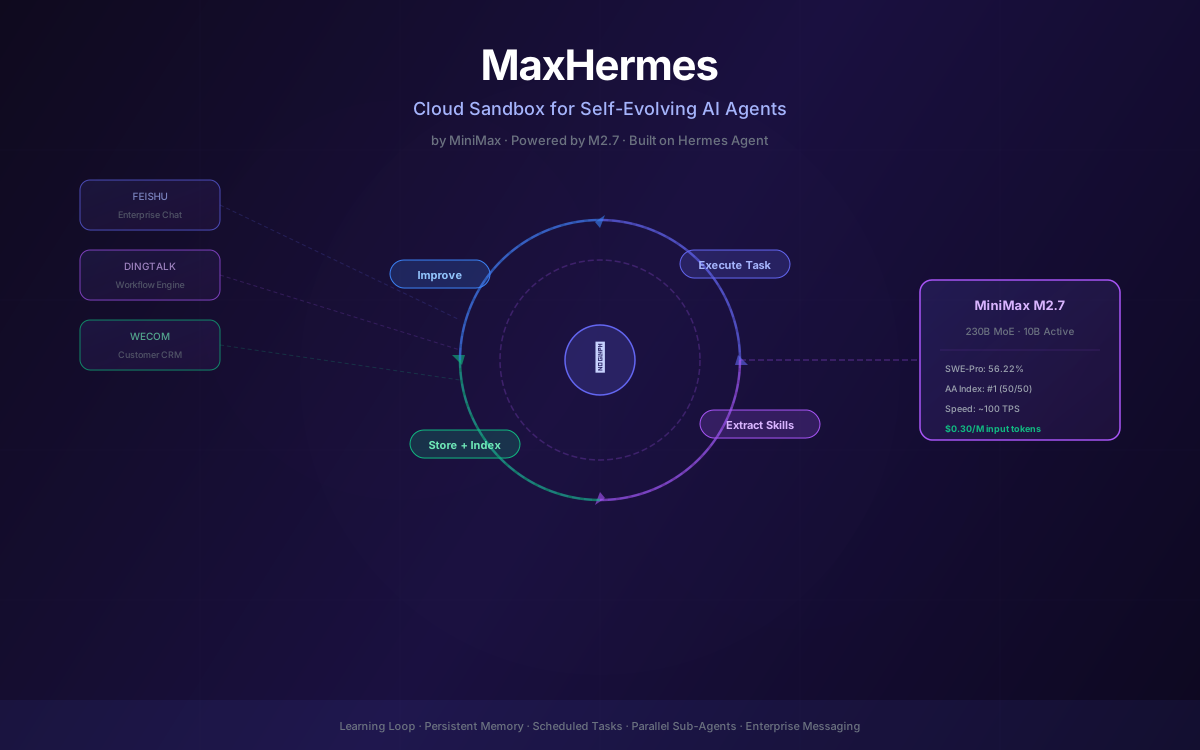
The core breakthrough is what MiniMax calls a "learning loop" - after completing complex tasks, MaxHermes autonomously extracts reusable skill documents and saves them for future use. Unlike tools like OpenClaw that rely on manually predefined capabilities, MaxHermes's skill library grows dynamically during use and self-iterates based on user feedback. Powered by the MiniMax M2.7 model (230B parameters, 10B active per token, $0.30/M input tokens), it delivers frontier-level intelligence at a fraction of the cost.
This guide covers everything developers and teams need to know about MaxHermes: how it works, what makes it different from self-hosted Hermes Agent, the M2.7 model powering it, enterprise integration options, and how to evaluate it for your workflows.
📑 What This Guide Covers
- What Is MaxHermes & Why It Matters
- The Learning Loop: How Self-Evolving Skills Work
- MiniMax M2.7 - The Model Behind MaxHermes
- MaxHermes vs Self-Hosted Hermes Agent
- Architecture & Technical Deep Dive
- Enterprise Integration: Feishu, DingTalk & WeCom
- Pricing & Token Economics
- Getting Started with MaxHermes
- Use Cases & Workflow Examples
- Limitations & What to Watch
- Why Lushbinary for AI Agent Integration
1What Is MaxHermes & Why It Matters
MaxHermes is MiniMax's managed cloud deployment of the Hermes Agent framework. Where Hermes Agent requires you to self-host on a VPS or local machine, MaxHermes runs entirely in MiniMax's cloud infrastructure. No API keys to configure, no servers to maintain, no Docker containers to manage.
MiniMax - founded in 2022 by former SenseTime executive Yan Junjie - went public on the Hong Kong Stock Exchange on January 9, 2026, with shares surging 109% on debut to a market cap exceeding HK$100 billion (~$12.8 billion). The company has raised approximately $1.15 billion in total funding, with Alibaba Group leading a $600 million round in 2024. MaxHermes represents their push into the agentic AI space, combining their foundation model expertise with the most popular open-source agent framework.
💡 Key Distinction
MaxHermes is not a fork of Hermes Agent. It's a cloud-hosted deployment that uses the Hermes Agent runtime with MiniMax's M2.7 model as the default LLM backbone. The open-source Hermes Agent (88K+ GitHub stars, MIT license) remains independently maintained by Nous Research.
The significance of MaxHermes is the shift it represents: AI agents moving from "fixed capability tools" to "self-evolving entities." By combining the learning loop with model iteration, MaxHermes can continuously align with user preferences over time - a capability that static chatbots and manually configured agents simply don't have.
2The Learning Loop: How Self-Evolving Skills Work
The learning loop is MaxHermes's defining feature. It's the same mechanism that made Hermes Agent the fastest-growing agent framework on GitHub, now running in a managed cloud environment.
Here's how it works in practice:
- Task Execution - You give MaxHermes a complex task (e.g., "analyze this CSV, generate a summary report, and email it to the team every Monday").
- Skill Extraction - After completing the task, MaxHermes doesn't just forget. It analyzes what it did, identifies reusable patterns, and writes them as independent skill documents.
- Skill Storage - These skills are saved persistently and indexed for future retrieval. They're not just memory - they're structured procedures the agent can invoke.
- Feedback Refinement - On subsequent uses, MaxHermes loads relevant skills, applies them, and refines them based on outcomes and user feedback.
- Compound Improvement - Over time, the skill library grows and improves. Tasks that took 5 minutes on day one take 30 seconds on day thirty.
This is fundamentally different from how most AI assistants work. ChatGPT, Claude, and Gemini start fresh every conversation (or rely on basic memory features). MaxHermes builds a growing library of battle-tested procedures that compound over time. The more you use it, the more capable it becomes at your specific workflows.
3MiniMax M2.7 - The Model Behind MaxHermes
MaxHermes runs on MiniMax M2.7, the company's flagship model launched on March 18, 2026. M2.7 is a sparse mixture-of-experts (MoE) model with 230 billion total parameters but only 10 billion active per token - a 4.3% activation rate that keeps inference costs dramatically low while maintaining frontier-level reasoning capacity.
| Metric | MiniMax M2.7 | Claude Opus 4.6 | GPT-5 |
|---|---|---|---|
| SWE-Pro | 56.22% | ~55% | ~56% |
| AA Intelligence Index | 50 (#1 of 136) | 48 | 49 |
| Total Parameters | 230B (10B active) | Undisclosed | Undisclosed |
| Speed | ~100 TPS | ~30-50 TPS | ~40-60 TPS |
| Input Price | $0.30/M tokens | $15/M tokens | $10/M tokens |
| Output Price | $1.20/M tokens | $75/M tokens | $30/M tokens |
The cost advantage is staggering. M2.7 delivers roughly 90% of Claude Opus 4.6's quality for about 7% of the total task cost, according to independent benchmarks by Artificial Analysis. For an always-on agent like MaxHermes that processes thousands of tokens per task, this cost differential is the difference between a $5/month bill and a $200/month bill.
M2.7 also introduced what MiniMax calls "self-evolution" capabilities - the model itself participates in its own improvement process. Combined with the Hermes Agent learning loop, this creates a dual-layer improvement system: the agent's skills improve through use, and the underlying model improves through MiniMax's training pipeline.
4MaxHermes vs Self-Hosted Hermes Agent
This is the question most developers will ask: should I use MaxHermes or self-host Hermes Agent directly? The answer depends on your priorities.
| Feature | MaxHermes (Cloud) | Hermes Agent (Self-Hosted) |
|---|---|---|
| Setup Time | Minutes (zero config) | 30-60 min (VPS + config) |
| Server Required | No | Yes ($5+/mo VPS) |
| Default Model | MiniMax M2.7 | Any (200+ via OpenRouter) |
| Model Flexibility | M2.7 only | Full choice (local Ollama, any API) |
| Learning Loop | ✅ Cloud-managed | ✅ Self-managed |
| Messaging Channels | Feishu, DingTalk, WeCom | Telegram, Discord, Slack, WhatsApp, Signal, CLI |
| Data Privacy | MiniMax cloud | Your infrastructure |
| Pricing | Token-based (pay-as-you-go) | Free + LLM API costs |
| Skill Marketplace | Skillhub (upcoming) | agentskills.io / HermesHub |
| License | Proprietary (MiniMax ToS) | MIT (fully open) |
Choose MaxHermes if: You want zero-setup, your team uses Feishu/DingTalk/WeCom, you don't need model flexibility, and you're comfortable with MiniMax handling your data.
Choose self-hosted Hermes Agent if: You need full model choice (including local models via Ollama for zero API cost), Western messaging platforms (Telegram, Discord, Slack), data sovereignty, or you want to customize the agent's behavior at the code level.
5Architecture & Technical Deep Dive
MaxHermes's architecture combines three core systems: the Hermes Agent runtime, MiniMax's cloud infrastructure, and the M2.7 model serving layer. Understanding how these interact helps explain both its capabilities and its constraints.
Persistent Cross-Session Memory
MaxHermes maintains memory across conversations. It remembers your preferences, past tasks, and context from previous sessions. This isn't the basic "memory" feature you see in ChatGPT - it's a structured knowledge graph that the agent actively queries and updates.
Natural Language Scheduled Tasks
You can define recurring tasks in plain language: "Every Monday at 9am, pull the latest sales data from our CRM and send a summary to the #sales channel." MaxHermes converts this to a scheduled job and executes it autonomously.
Parallel Sub-Agent Execution
For complex tasks, MaxHermes can spawn multiple sub-agents that work in parallel. Need to research three competitors simultaneously? The agent splits the work across sub-agents, aggregates results, and presents a unified report. This parallel execution is managed by the cloud infrastructure, so there's no resource contention on your end.
6Enterprise Integration: Feishu, DingTalk & WeCom
MaxHermes's initial integration targets are the three dominant enterprise messaging platforms in the Chinese market: Feishu (Lark), DingTalk (Alibaba), and WeCom (WeChat Work by Tencent). This is a deliberate strategy - MiniMax is a Chinese company (HKEX-listed), and these platforms collectively serve hundreds of millions of enterprise users.
Feishu (Lark)
ByteDance's enterprise suite. Rich bot API, document collaboration, approval workflows. MaxHermes can read/write Feishu docs, respond in group chats, and trigger approval flows.
DingTalk
Alibaba's workplace platform with 700M+ users. MaxHermes integrates as a bot with access to DingTalk's workflow engine, attendance, and project management features.
WeCom
Tencent's enterprise WeChat. MaxHermes operates as a WeCom bot with access to customer contact lists, group messaging, and mini-program triggers.
⚠️ Western Platform Support
As of April 2026, MaxHermes does not natively support Slack, Discord, Telegram, or Microsoft Teams. If your team uses these platforms, self-hosted Hermes Agent remains the better option with support for 6+ messaging backends.
The 7×24 real-time response capability means MaxHermes operates as an always-on team member. Combined with the upcoming Skillhub skill center - where users can share and discover community-created skills - this positions MaxHermes as a personalized AI assistant for every professional in the organization.
7Pricing & Token Economics
MaxHermes uses a token-based consumption model. Instead of a monthly subscription, you purchase Token plans through MiniMax's platform and consume them as MaxHermes processes tasks. This eliminates the need for self-owned servers or complex API configurations.
| Cost Component | MaxHermes | Self-Hosted Hermes + Claude | Self-Hosted Hermes + Ollama |
|---|---|---|---|
| Infrastructure | $0 (included) | $5-20/mo VPS | $5-20/mo VPS |
| LLM Cost (light use) | ~$2-5/mo | $30-65/mo | $0 (local) |
| LLM Cost (heavy use) | ~$10-30/mo | $100-300/mo | $0 (local) |
| Setup Effort | None | Moderate | High (GPU required) |
The M2.7 model's pricing ($0.30/M input, $1.20/M output) makes MaxHermes one of the most cost-effective managed AI agent services available. For comparison, running the same workload on Claude Opus 4.6 would cost roughly 50× more in API fees alone. The trade-off is that you're locked into M2.7 - you can't swap in GPT-5 or Claude for specific tasks the way you can with self-hosted Hermes.
8Getting Started with MaxHermes
MaxHermes is accessible at agent.minimaxi.com/max-hermes. The onboarding process is designed to be as frictionless as possible:
- Create a MiniMax account - Sign up at the MiniMax platform. No credit card required for initial exploration.
- Connect a messaging channel - Link your Feishu, DingTalk, or WeCom workspace. MaxHermes provides step-by-step integration guides for each platform.
- Start chatting - Send your first task. MaxHermes will execute it, and if the task is complex enough, it will automatically extract a skill for future use.
- Purchase Token plans - When you're ready for production use, purchase Token plans to offset task consumption. Plans are available through the MiniMax platform dashboard.
# For developers who prefer the API approach:
# MiniMax also offers Mini-Agent, a minimal single-agent demo
git clone https://github.com/MiniMax-AI/Mini-Agent.git
# Configure with your MiniMax API key
# See: platform.minimax.io/docs/coding-plan/mini-agent
9Use Cases & Workflow Examples
MaxHermes shines in scenarios where tasks are repetitive, complex, or require long-term context. Here are the most compelling use cases based on the platform's capabilities:
📊 Automated Reporting
Pull data from multiple sources, generate formatted reports, and distribute them on a schedule. The agent learns your preferred format and improves report quality over time.
📧 Email & Message Triage
Monitor incoming messages across Feishu/DingTalk/WeCom, categorize by priority, draft responses, and escalate urgent items. Skills compound as the agent learns your communication style.
🔍 Competitive Intelligence
Track competitor announcements, pricing changes, and product updates. MaxHermes builds skills for each competitor and delivers increasingly targeted briefings.
💻 Code Review & Documentation
Review pull requests, generate documentation from code, and maintain changelog entries. The M2.7 model's 56.22% SWE-Pro score makes it capable for most engineering tasks.
📋 Project Management
Create tasks, update statuses, send reminders, and generate progress reports across your team's messaging platform. Parallel sub-agents handle multi-project coordination.
🎓 Onboarding & Training
Build a growing knowledge base that new team members can query. MaxHermes learns from every question and builds skills that make future onboarding faster.
The common thread across all these use cases is compound improvement. A static chatbot gives you the same quality on day 100 as day 1. MaxHermes gets measurably better because every task execution feeds back into the skill library.
10Limitations & What to Watch
MaxHermes is impressive, but it's a v1 product with clear limitations that developers should understand before committing:
- Model lock-in - You're restricted to MiniMax M2.7. While M2.7 is excellent for its price, there are tasks where Claude Opus 4.6 or GPT-5 would perform better. Self-hosted Hermes Agent lets you route different tasks to different models.
- Messaging platform coverage - Feishu, DingTalk, and WeCom are dominant in China but niche globally. No Slack, Discord, Telegram, or Teams support means MaxHermes is primarily useful for teams already on these platforms.
- Data sovereignty - All data flows through MiniMax's cloud infrastructure. For enterprises with strict data residency requirements (GDPR, HIPAA, SOC 2), this may be a non-starter. Self-hosted Hermes keeps everything on your infrastructure.
- Skillhub not yet live - The community skill marketplace is "upcoming" but not launched. Until it ships, you can't share or discover skills the way you can with HermesHub or agentskills.io for the open-source version.
- Limited customization - You can't modify the agent's core behavior, add custom tools, or extend the runtime the way you can with self-hosted Hermes Agent's 40+ integrated tools and MCP server mode.
- New product risk - MaxHermes launched on April 16, 2026. It's brand new. Expect rough edges, missing features, and potential breaking changes as MiniMax iterates.
🔮 What to Watch
MiniMax has signaled that Skillhub will include a "create to earn" model where skill creators earn 100 credits every time someone uses their skill. If this launches successfully, it could create a flywheel effect where the best skills attract users, which attracts more skill creators. Also watch for Western messaging platform support - MiniMax's global ambitions (HKEX listing, NVIDIA partnership) suggest Slack/Teams integration is likely on the roadmap.
11Why Lushbinary for AI Agent Integration
Whether you're evaluating MaxHermes for your team, deploying self-hosted Hermes Agent, or building custom AI agent workflows, Lushbinary has the expertise to help you make the right choice and execute it well.
- AI Agent Architecture - We've deployed Hermes Agent, OpenClaw, and custom agent solutions for clients across industries. We understand the trade-offs between managed and self-hosted, between model providers, and between messaging platforms.
- MiniMax M2 Integration - We've worked with the MiniMax M2 model family since M2.5's launch in February 2026. We know the API, the quirks, and the best practices for production deployment.
- Enterprise Messaging Integration - From Slack bots to Feishu integrations, we build the connective tissue between AI agents and the platforms your team actually uses.
- Cloud & DevOps - Whether you need AWS, Cloudflare, or MiniMax's platform, we handle infrastructure so you can focus on your product.
🚀 Free Consultation
Not sure whether MaxHermes, self-hosted Hermes Agent, or a custom solution is right for your team? Lushbinary will evaluate your requirements, recommend the right architecture, and give you a realistic timeline — no obligation.
❓ Frequently Asked Questions
What is MaxHermes?
MaxHermes is MiniMax's cloud-based AI sandbox built on the open-source Hermes Agent framework. It features a self-evolving learning loop that autonomously extracts reusable skills from complex tasks, persistent cross-session memory, scheduled task execution, and parallel sub-agent orchestration - all powered by the MiniMax M2.7 model.
How is MaxHermes different from Hermes Agent?
Hermes Agent is the open-source, self-hosted framework by Nous Research (MIT license, 88K+ GitHub stars). MaxHermes is MiniMax's managed cloud version that removes the need for self-hosting, API keys, or server configuration. It adds native integration with Feishu, DingTalk, and WeCom, uses MiniMax's M2.7 model, and offers a token-based pay-as-you-go pricing model.
What model does MaxHermes use?
MaxHermes runs on MiniMax M2.7, a 230B-parameter sparse MoE model (10B active per token) launched March 18, 2026. M2.7 scores 56.22% on SWE-Pro, ranks #1 on the Artificial Analysis Intelligence Index (score 50), and costs $0.30 per million input tokens.
How much does MaxHermes cost?
MaxHermes uses a token-based consumption model through MiniMax's platform. The underlying M2.7 model costs $0.30/M input tokens and $1.20/M output tokens. Light usage typically runs $2-5/month, heavy usage $10-30/month.
Can I use MaxHermes for enterprise automation?
Yes. MaxHermes integrates natively with Feishu (Lark), DingTalk, and WeCom. It operates 24/7 with persistent memory, scheduled tasks, and parallel sub-agent execution, making it suitable for enterprise workflow automation.
📚 Sources
- AIBase - MiniMax Launches MaxHermes Cloud Sandbox
- KuCoin News - MaxHermes AI Assistant Launch
- Artificial Analysis - MiniMax M2.7 Benchmarks & Analysis
- MiniMax Official - M2.7 Announcement
- NVIDIA Developer Blog - MiniMax M2.7 on NVIDIA Platforms
- MiniMax API Docs - Hermes Agent Token Plan
Content was rephrased for compliance with licensing restrictions. Benchmark data sourced from official MiniMax announcements and Artificial Analysis as of April 2026. Pricing and features may change - always verify on the vendor's website.
Need Help Choosing the Right AI Agent?
MaxHermes, Hermes Agent, OpenClaw, or a custom solution - we'll help you evaluate, architect, and deploy the right AI agent for your team.
Ready to Build Something Great?
Get a free 30-minute strategy call. We'll map out your project, timeline, and tech stack - no strings attached.
Prefer email? Reach us directly: