
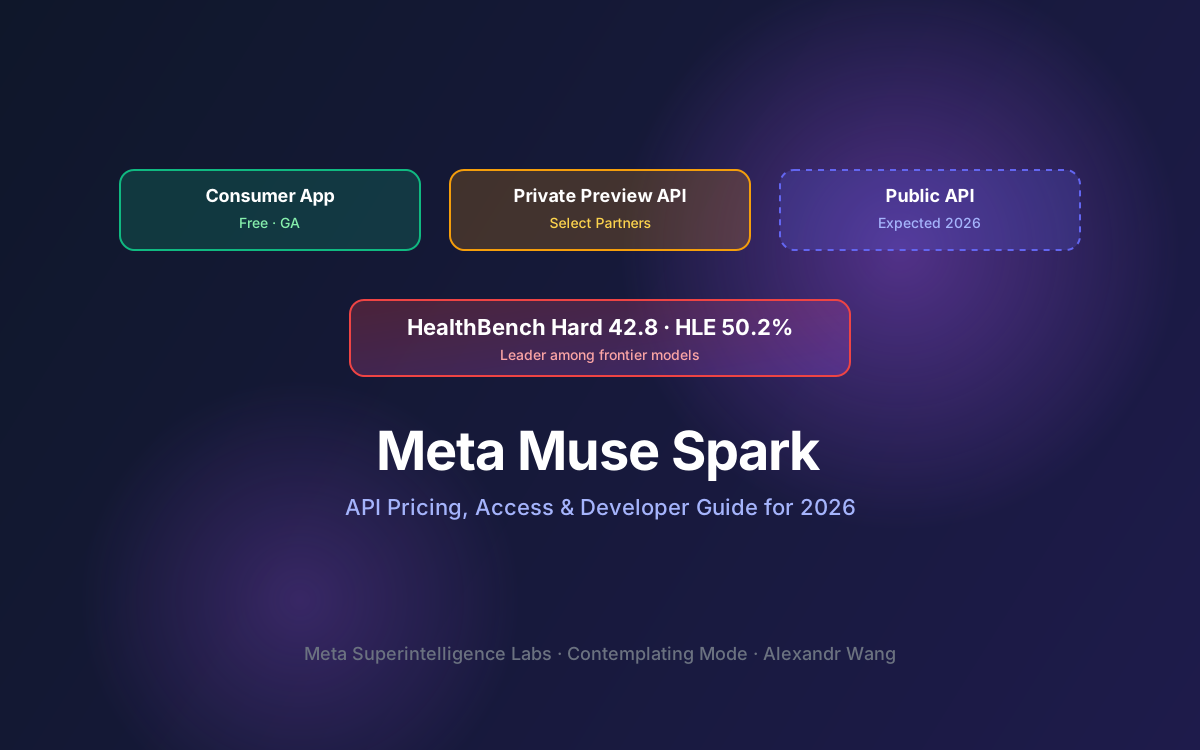
Meta dropped Muse Spark on April 8, 2026: the first model from Meta Superintelligence Labs, the elite research division led by Alexandr Wang after Meta's $14.3 billion investment in Scale AI. On launch it topped HealthBench Hard with 42.8 (the highest of any frontier model) and posted 50.2% on Humanity's Last Exam. It also reversed Meta's open-source Llama strategy. Muse Spark is closed-source, paid API access is coming, and consumer subscriptions are on the table.
So the question every developer is asking: what does Muse Spark actually cost, how do I get access, and is it worth building on today? The short answer: API access is still private preview to select partners. Consumer access is free through the Meta AI app. Public pricing has not been announced. But teams that want to be ready need to understand the full picture now.
This guide covers what we know about Muse Spark API access and pricing, how it compares to GPT-5.5 and Claude Opus 4.7 on cost and capability, how to architect a model-agnostic stack so you can swap in Muse Spark the day access opens up, and where Contemplating Mode actually delivers value today.
📑 What This Guide Covers
- What Muse Spark Is and Why It Matters
- API Access Status in 2026
- Current Pricing: Free Consumer, Private API
- Muse Spark vs GPT-5.5, Claude Opus 4.7, Gemini 3.1 Pro
- Cost Per Task: What to Expect at GA
- Contemplating Mode and Where It Pays Off
- Healthcare and Safety-Critical Workloads
- Model-Agnostic Architecture for Easy Swap-In
- Production Checklist for Muse Spark Readiness
- How Lushbinary Helps Clients Prepare
1What Muse Spark Is and Why It Matters
Muse Spark is Meta's first frontier model built from scratch inside Meta Superintelligence Labs. Three things make it notable:
- HealthBench Hard leader: 42.8 is the highest score from any frontier model on the physician-curated reasoning benchmark. This is not marginal. It's the gap between "nice demo" and "seriously consider for clinical decision support."
- Contemplating Mode: A multi-agent orchestration capability baked into the model. It can spawn internal sub-deliberators that debate before the model commits to an answer. Strong on complex reasoning, research, and analysis tasks.
- Closed-source pivot: Meta was the open-weight leader with Llama. Muse Spark reverses that. Meta will offer the model via API and possibly subscription, not as a download.
📊 Muse Spark at a Glance (May 2026)
Launched April 8, 2026 · Meta Superintelligence Labs · Closed source · HealthBench Hard 42.8 (leader) · HLE 50.2% · Contemplating Mode multi-agent · Rolling out to WhatsApp, Instagram, Messenger, AI glasses · API in private preview
2API Access Status in 2026
As of May 2026, Muse Spark API access is limited to select partners in private preview. Meta has publicly stated they are "experimenting with a new AI model revenue stream by eventually offering third-party developers access to Muse Spark's underlying technology via an API." No GA date, no public rate card.
What you can do today:
- Consumer use: Use Muse Spark free through meta.ai or the Meta AI app. Great for evaluation and prompt engineering research.
- Partner pilots: Meta is accepting partner requests for private preview. Apply through your Meta business rep if you already have a relationship.
- WhatsApp Business integration: Muse Spark is rolling out to WhatsApp, which may open indirect programmatic access for business use cases.
3Current Pricing: Free Consumer, Private API
| Channel | Access | Cost | Status |
|---|---|---|---|
| Meta AI app / meta.ai | Consumer | Free | GA |
| WhatsApp, Instagram, Messenger | Consumer | Free | Rolling out |
| Meta AI Glasses | Consumer / Wearable | Included with hardware | Rolling out |
| API (private preview) | Select partners | Undisclosed | Private preview |
| API (public) | All developers | TBA | Expected later 2026 |
| Consumer subscription | Power users | TBA | Under discussion |
The "consumer free, developer paid" split is the same playbook OpenAI, Anthropic, and Google used. Meta has the advantage of 3 billion-plus consumer users already inside WhatsApp, Instagram, and Messenger. The disadvantage: developers can't build on the API today, which pushes them to use Claude Opus 4.7 or GPT-5.5 instead.
4Muse Spark vs GPT-5.5, Claude Opus 4.7, Gemini 3.1 Pro
| Aspect | Muse Spark | GPT-5.5 | Claude Opus 4.7 | Gemini 3.1 Pro |
|---|---|---|---|---|
| API status | Private preview | GA | GA | GA |
| Input / output ($/M tokens) | TBA | $5 / $30 | $5 / $25 | $1.25 / $10 |
| HealthBench Hard | 42.8 (leader) | Lower | Lower | Lower |
| HLE (no tools) | 50.2% | ~46% | ~49% | ~45% |
| Coding (SWE-Bench) | Competitive | ~89% | ~88% | ~81% |
| Multi-agent | Contemplating Mode | Sub-agents | Sub-agents | Workflows |
| Context window | TBA | ~400K | 200K-1M tier | 1M-2M |
| Open source | No | No | No | No |
For deeper dives on the alternatives, see our GPT-5.5 vs Claude Opus 4.7 comparison and Muse Spark vs GPT/Gemini/Claude comparison.
5Cost Per Task: What to Expect at GA
Meta has not published a rate card. Our conservative estimate, based on Meta's competitive framing and benchmarks on par with GPT-5.5 and Claude Opus 4.7, is that public API pricing will land in the $3-6 per million input tokens and $20-30 per million output tokens range. Meta has an incentive to undercut rivals on input pricing to drive adoption, while charging competitively on output.
⚠️ Do Not Plan Budgets on Estimates
Public Muse Spark API pricing has not been announced. Any number you see quoted before Meta publishes an official rate card is speculation. Use GPT-5.5 or Claude Opus 4.7 pricing as your planning baseline and adjust when Meta publishes rates.
For illustrative cost per task at GPT-5.5-equivalent pricing: single-turn classification (~200 input, 20 output tokens) costs about $0.002. A 10-step agent mission (~5K input, 2K output) costs about $0.085. A deep research task with Contemplating Mode and 30K context costs roughly $0.90-$1.50. Muse Spark pricing will reasonably sit in the same order of magnitude.
6Contemplating Mode and Where It Pays Off
Contemplating Mode is Muse Spark's flagship feature. The model spawns internal sub-deliberators that argue different positions before the model commits to an answer. In practice, it behaves like a built-in multi-agent system without the orchestration overhead.
Where it earns its premium:
- Deep research: Multi-source analysis where conflicting evidence needs to be weighed.
- Policy and legal reasoning: Tasks that benefit from explicit devil's-advocate prompts.
- Healthcare triage: Paired with HealthBench Hard 42.8, this is Muse Spark's strongest lane.
- Scientific review: Evaluating papers or hypotheses against competing interpretations.
Where it does not pay off: simple classification, code generation, and short agentic tool calls. Those don't need internal deliberation, and Contemplating Mode will burn tokens without improving output.
7Healthcare and Safety-Critical Workloads
HealthBench Hard 42.8 is Muse Spark's strongest selling point for developers building in health, clinical decision support, wellness, or safety-critical reasoning. For a deeper breakdown of how to architect a compliant healthcare app with Muse Spark, see our Muse Spark healthcare app guide.
The short version: design your architecture for HIPAA with a de-identification layer, avoid storing PHI inside the model context, and use Muse Spark as the reasoning layer with a strict output filter. Because Muse Spark API access is private today, pair your build with a paid fallback like Claude Opus 4.7, which has strong medical reasoning and is available now.
8Model-Agnostic Architecture for Easy Swap-In
The best way to prepare for Muse Spark GA is to build your app now on a model-agnostic routing layer. That way, the day the API opens, you swap the router config and ship. A practical pattern:
- Centralize model calls behind one provider abstraction (LangChain ModelRouter, LiteLLM, or a hand-rolled TypeScript interface).
- Configure per-task routing: Claude Opus 4.7 for coding, GPT-5.5 for agentic workflows, Gemini 3.1 Pro for long-context multimodal, Muse Spark slot reserved for healthcare and contemplative reasoning.
- Wrap each provider in a uniform response shape so downstream code doesn't care which model replied.
- Feature-flag the router so you can migrate traffic gradually when Muse Spark goes GA.
- Track per-provider cost, latency, and quality metrics so the swap is a data-driven decision, not a guess.
9Production Checklist for Muse Spark Readiness
- Model router in place with at least two providers today (Claude or GPT) and a reserved Muse Spark slot.
- Per-provider evaluation harness running weekly on your real workload, so you have baseline quality scores when Muse Spark arrives.
- Cost ceilings and kill switches per provider, so an untested Muse Spark swap can't run away with your budget.
- Data residency and privacy review updated for Meta as a potential processor, before you send any production data to the Muse Spark API.
- Partner preview application filed if you have a Meta business relationship and a workload that justifies early access.
- Team trained on prompt patterns that benefit from Contemplating Mode and those that do not.
10How Lushbinary Helps Clients Prepare
Lushbinary builds model-agnostic AI stacks for clients who want access to every frontier model without rebuilding when the landscape shifts. For Muse Spark readiness we typically:
- Set up a LiteLLM or custom TypeScript router over Claude Opus 4.7, GPT-5.5, Gemini 3.1 Pro, and Gemma 4 on AWS.
- Reserve a Muse Spark provider slot with the same interface, so GA-day integration is a config change.
- Architect healthcare apps with de-identification layers so the data side is HIPAA-ready before Muse Spark API is production available.
- Run eval harnesses that compare per-provider cost, latency, and quality on your real workload so the Muse Spark swap is data-driven.
🚀 Free Consultation
Want a model-agnostic AI stack that's ready for Muse Spark the moment API access opens? Lushbinary handles provider routing, eval harnesses, cost controls, and healthcare-ready architecture. No obligation.
❓ Frequently Asked Questions
Is there a Meta Muse Spark API in 2026?
Only in private preview to select partners. Consumer access is free through the Meta AI app. Public paid API is expected later in 2026 but has not been announced with a firm date.
How much does Muse Spark cost today?
Free through meta.ai and the Meta AI app. API pricing is not public. Plan budgets using GPT-5.5 or Claude Opus 4.7 rates as a proxy until Meta publishes official API pricing.
How does Muse Spark compare to GPT-5.5 and Claude Opus 4.7?
Muse Spark leads HealthBench Hard at 42.8 and posts 50.2% on HLE. GPT-5.5 is ~$5/M input, $30/M output. Claude Opus 4.7 is ~$5/M input, $25/M output. Muse Spark API pricing has not been published but is expected to be competitive.
When will the Muse Spark API go public?
No firm GA date has been announced. Private preview to select partners is active. Broader paid access is expected later in 2026, possibly alongside consumer subscription tiers.
Can I use Muse Spark in production today?
Not directly via API unless you're a preview partner. Build on Claude Opus 4.7 or GPT-5.5 now with a model-agnostic routing layer, then swap in Muse Spark when API access opens up.
📚 Sources
- Meta: Introducing Muse Spark
- Meta AI: Muse Spark MSL blog post
- Artificial Analysis: Muse Spark provider status
- CNBC: Meta debuts Muse Spark
Content was rephrased for compliance with licensing restrictions. Pricing, benchmark, and access details sourced from official Meta announcements and third-party analysis as of May 2026. Access status and pricing may change, always verify on Meta's developer portal.
Be Muse Spark-Ready on Day One
Lushbinary builds model-agnostic AI stacks with provider routing, cost controls, and eval harnesses. When Muse Spark opens up, you swap config, not code.
Ready to Build Something Great?
Get a free 30-minute strategy call. We'll map out your project, timeline, and tech stack - no strings attached.
Prefer email? Reach us directly: