
April 2026 just became the most competitive week in AI history. On April 16, Anthropic shipped Claude Opus 4.7 — reclaiming the coding crown with 64.3% on SWE-bench Pro and 87.6% on SWE-bench Verified. One week later, OpenAI fired back with GPT-5.5 (codename "Spud"), the first fully retrained base model since GPT-4.5, boasting state-of-the-art agentic performance and dramatically improved token efficiency.
The question every developer is asking right now: which one should I actually use? The answer is more nuanced than the benchmark tables suggest. GPT-5.5 and Opus 4.7 are not competing on the same axis — they're optimized for fundamentally different workflows. Picking the wrong one means paying more for worse results on your specific tasks.
This guide breaks down every dimension that matters: benchmarks, pricing, coding performance, agentic capabilities, vision, context windows, and real-world developer experience. We'll give you a clear decision framework so you can stop guessing and start shipping.
What This Guide Covers
- Release Context & What Changed
- Head-to-Head Benchmark Comparison
- Coding Performance: Where Each Model Wins
- Agentic Workflows & Computer Use
- API Pricing & Token Economics
- Vision & Multimodal Capabilities
- Context Windows & Long-Form Tasks
- Safety, Alignment & Refusal Behavior
- Developer Experience & Ecosystem
- Multi-Model Routing: Using Both
- Decision Framework: Which Model for Your Use Case
- Why Lushbinary for AI Integration
1Release Context & What Changed
The timing tells the story. Anthropic released Claude Opus 4.7 on April 16, 2026 — a focused upgrade that pushed SWE-bench Pro from 53.4% (Opus 4.6) to 64.3%, added high-resolution vision up to 3.75 megapixels, and introduced the xhigh effort level. All at the same $5/$25 per million token pricing as its predecessor.
Exactly one week later, on April 23, OpenAI launched GPT-5.5 — codenamed "Spud." Unlike the incremental GPT-5.1 through 5.4 releases, GPT-5.5 is the first fully retrained base model since GPT-4.5. It's natively omnimodal (text, images, audio, and video processed in a single unified system), dramatically more token-efficient, and designed from the ground up for agentic multi-tool orchestration.
Both models represent genuine leaps over their predecessors, but they're leaping in different directions. Opus 4.7 doubled down on coding precision and instruction-following. GPT-5.5 bet on autonomous workflow execution and efficiency. Understanding this divergence is the key to choosing correctly.
2Head-to-Head Benchmark Comparison
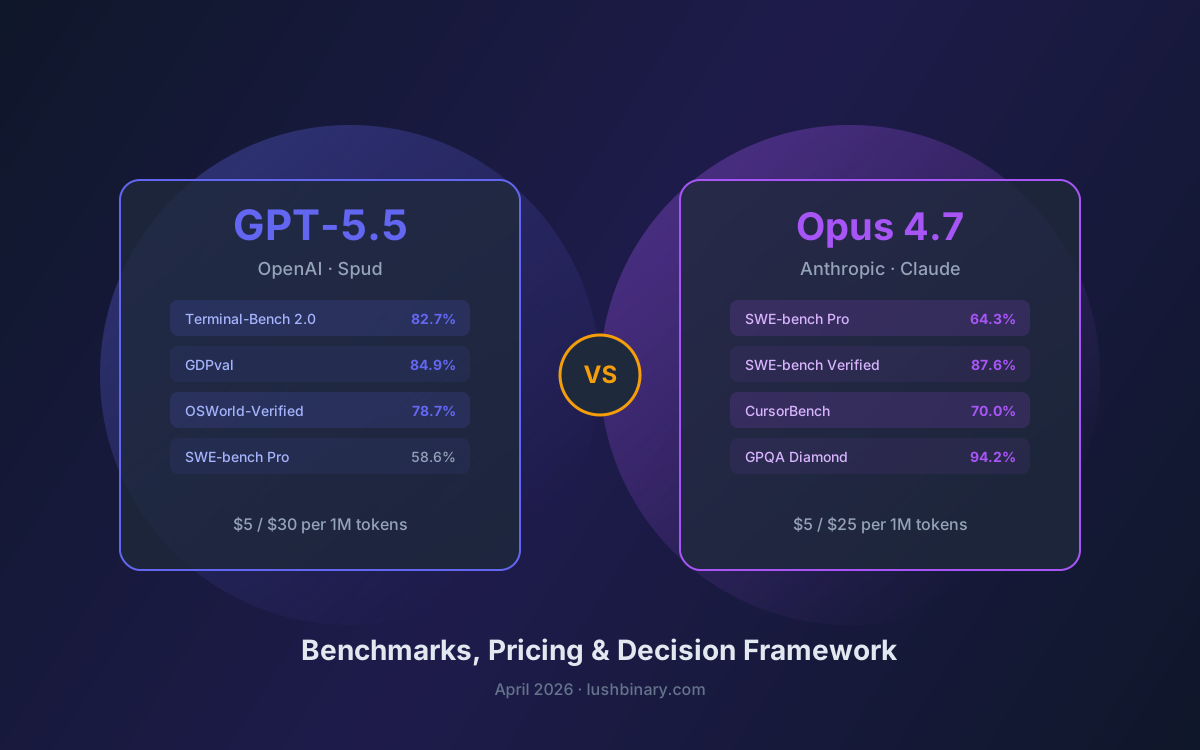
Numbers don't tell the whole story, but they're where every comparison starts. Here's how GPT-5.5 and Claude Opus 4.7 stack up across the benchmarks that matter most for developers, alongside Gemini 3.1 Pro for context.
| Benchmark | GPT-5.5 | Opus 4.7 | Gemini 3.1 Pro |
|---|---|---|---|
| SWE-bench Pro | 58.6% | 64.3% | 54.2% |
| SWE-bench Verified | ~85% | 87.6% | ~80% |
| Terminal-Bench 2.0 | 82.7% | ~72% | ~68% |
| GDPval (Knowledge Work) | 84.9% | ~78% | ~75% |
| OSWorld-Verified (Computer Use) | 78.7% | ~65% | ~60% |
| GPQA Diamond | ~93% | 94.2% | ~91% |
| CursorBench | ~65% | 70% | ~58% |
| Tau2-bench Telecom | 98.0% | ~90% | ~85% |
Key Takeaway
Opus 4.7 wins the coding benchmarks (SWE-bench Pro, SWE-bench Verified, CursorBench, GPQA Diamond). GPT-5.5 wins the agentic and knowledge-work benchmarks (Terminal-Bench, GDPval, OSWorld, Tau2-bench). Neither model dominates across the board — they're optimized for different workloads.
3Coding Performance: Where Each Model Wins
Coding is where most developers will feel the difference. Both models are excellent, but they excel at different types of coding work.
Claude Opus 4.7: The Precision Coder
Opus 4.7's 64.3% on SWE-bench Pro means it resolves more real-world GitHub issues end-to-end than any other generally available model. That's a 10.9-point jump from Opus 4.6 (53.4%) and a 5.7-point lead over GPT-5.5 (58.6%). In practice, this translates to better performance on complex multi-file refactoring, understanding interconnected codebases, and producing changes that pass existing test suites.
Anthropic's partners reported double-digit gains on production workloads. The model's self-verification behavior — proactively checking its own output for logical faults — means fewer broken PRs and less back-and-forth. The new xhigh effort level lets you push the model harder on genuinely difficult problems, with task budgets (in public beta) giving it room to iterate.
GPT-5.5: The Autonomous Engineer
GPT-5.5's coding strength is different. Its 82.7% on Terminal-Bench 2.0 — which tests complex command-line workflows requiring planning, iteration, and tool coordination — is state-of-the-art. On Expert-SWE, OpenAI's internal eval for long-horizon coding tasks with a median estimated human completion time of 20 hours, GPT-5.5 outperforms GPT-5.4 while using fewer tokens.
Early testers described GPT-5.5 as having "serious conceptual clarity" — understanding why something is failing, where the fix needs to land, and what else in the codebase would be affected. Dan Shipper, CEO of Every, tested it by rewinding a debugging session his best engineer had spent days on: GPT-5.4 couldn't reproduce the fix, but GPT-5.5 could.
Pietro Schirano, CEO of MagicPath, saw GPT-5.5 merge a branch with hundreds of frontend and refactor changes into a substantially changed main branch in one shot, in about 20 minutes.
Choose Opus 4.7 for:
- Complex multi-file GitHub issue resolution
- Code review and quality-critical refactoring
- IDE-integrated coding (CursorBench 70%)
- Tasks requiring strict instruction-following
- Long-context code analysis (1M tokens)
Choose GPT-5.5 for:
- Multi-step CLI workflows and DevOps tasks
- Autonomous coding with tool coordination
- Large branch merges and system-level changes
- Codex-powered engineering workflows
- Tasks where token efficiency matters
4Agentic Workflows & Computer Use
This is where GPT-5.5 pulls ahead decisively. OpenAI designed it from the ground up for agentic multi-tool orchestration — the ability to plan, use tools, check its work, navigate ambiguity, and keep going without constant human guidance.
The numbers back this up. GPT-5.5 scores 78.7% on OSWorld-Verified, which measures whether a model can operate real computer environments autonomously. It hits 98.0% on Tau2-bench Telecom for complex customer-service workflows. And on GDPval, which tests agents across 44 occupations, it reaches 84.9%.
In Codex, GPT-5.5 can take on engineering work ranging from implementation and refactors to debugging, testing, and validation. It generates documents, spreadsheets, and presentations. Combined with computer use capabilities, it can see what's on screen, click, type, navigate interfaces, and move across tools with precision.
Claude Opus 4.7 has agentic capabilities too — its self-verification behavior and task budgets enable multi-step workflows. But Anthropic explicitly positions Opus 4.7 as a coding and reasoning model, not an autonomous agent. For computer use, Anthropic still recommends Claude Sonnet 4.6 as the primary option.
Real-World Impact
OpenAI reports that 85%+ of the company uses Codex with GPT-5.5 weekly across engineering, finance, comms, marketing, data science, and product management. Their Finance team used it to review 24,771 K-1 tax forms (71,637 pages), accelerating the task by two weeks. Their Comms team built an automated Slack agent for speaking request triage. These are the kinds of cross-functional workflows where GPT-5.5's agentic strengths shine.
5API Pricing & Token Economics
Pricing is where the comparison gets interesting. The per-token rates tell one story; the actual cost per task tells another.
| Model | Input / 1M | Cached / 1M | Output / 1M | Context |
|---|---|---|---|---|
| GPT-5.5 | $5.00 | $1.25 | $30.00 | 1M |
| GPT-5.5 Pro | $30.00 | — | $180.00 | 1M |
| Claude Opus 4.7 | $5.00 | $1.25 | $25.00 | 1M |
| GPT-5.4 | $2.50 | $0.25 | $15.00 | 1M |
| Gemini 3.1 Pro | $1.25 | $0.31 | $10.00 | 2M |
On paper, Opus 4.7 is 17% cheaper on output tokens ($25 vs $30 per million). Input pricing is identical at $5 per million. But here's the twist: OpenAI claims GPT-5.5 uses "significantly fewer tokens" to complete the same Codex tasks as GPT-5.4. On Artificial Analysis's Coding Agent Index, GPT-5.5 delivers state-of-the-art intelligence at half the cost of competitive frontier coding models.
This means the effective cost per task could be lower with GPT-5.5 despite the higher per-token rate, especially for agentic workflows where the model needs fewer retries and generates more concise output. For pure coding tasks where Opus 4.7 resolves issues in fewer attempts, Opus 4.7's lower output pricing gives it the edge.
Cost Optimization Tip
Both models offer Batch/Flex pricing at 50% off standard rates. GPT-5.5 also offers Priority processing at 2.5x for latency-sensitive workloads. For high-volume production use, prompt caching (75% discount on cached inputs for both) is the single biggest cost lever.
6Vision & Multimodal Capabilities
Both models handle images, but their approaches differ significantly.
Claude Opus 4.7 introduced high-resolution vision support with a maximum image edge of 2,576 pixels (up from 1,568 in Opus 4.6) and total resolution up to 3.75 megapixels. This 3x improvement enables 1:1 pixel coordinate mapping for computer use, making it dramatically better at reading dense UIs, small text, and detailed diagrams. Anthropic reports visual acuity jumped from 54.5% to 98.5% on the XBOW benchmark.
GPT-5.5 is natively omnimodal — text, images, audio, and video are processed in a single unified system, not bolted on after the fact. This architectural difference means GPT-5.5 can reason across modalities more naturally. It excels at computer use scenarios where it needs to see a screen, understand context, and take action. OpenAI's 78.7% on OSWorld-Verified reflects this strength.
Opus 4.7 Vision Strengths
- 3.75 megapixel high-res input
- 98.5% visual acuity (XBOW)
- 1:1 pixel coordinate mapping
- Dense UI and document reading
- Precise screenshot analysis
GPT-5.5 Multimodal Strengths
- Natively omnimodal (text+image+audio+video)
- 78.7% OSWorld computer use
- Cross-modal reasoning
- Screen interaction (click, type, navigate)
- Real-time tool coordination with vision
7Context Windows & Long-Form Tasks
Both GPT-5.5 and Claude Opus 4.7 support 1 million token context windows at standard API pricing. Both support 128K max output tokens. For most practical purposes, context window size is a draw.
The difference is in how they use that context. Opus 4.7's updated tokenizer (which can increase token counts by 1.0-1.35x compared to Opus 4.6) means you're paying slightly more per character of input. GPT-5.5's token efficiency improvements mean it generates more useful output per token, which matters for long-running agentic tasks.
If you need the absolute largest context window, Gemini 3.1 Pro still leads at 2 million tokens — at a significantly lower price point ($1.25/$10 per million tokens). For long-document analysis or massive codebase ingestion, Gemini remains the cost-effective choice.
GPT-5.5 in Codex uses a 400K context window by default, which OpenAI has found sufficient for most engineering workflows. The full 1M context is available via the API.
8Safety, Alignment & Refusal Behavior
Safety posture affects developer experience more than most people realize. Overly cautious models refuse legitimate requests; under-cautious models create liability.
GPT-5.5 is classified as High under OpenAI's Preparedness Framework for both cybersecurity and biological/chemical capabilities. This is a step up from GPT-5.4. OpenAI has deployed stricter classifiers for potential cyber risk, which "some users may find annoying initially." They've also launched a Trusted Access for Cyber program at chatgpt.com/cyber for verified security professionals who need fewer restrictions.
Claude Opus 4.7 takes a different approach. Anthropic's 232-page system card emphasizes "rigor and consistency" with stricter instruction-following. The model interprets prompts more literally than Opus 4.6, which means fewer creative liberties but also fewer surprises. Anthropic continues to position safety as a competitive advantage, with Project Glasswing for cybersecurity and the Cyber Verification Program.
In practice, both models will occasionally refuse legitimate developer requests. GPT-5.5's cyber-specific classifiers may be more aggressive initially. Opus 4.7's literal interpretation can require more precise prompting. Neither is perfect, but both are significantly better than their predecessors at balancing safety with utility.
9Developer Experience & Ecosystem
The model is only as good as the ecosystem around it. Here's how the developer experience compares.
GPT-5.5 Ecosystem
- ChatGPT: Available to Plus ($20/mo), Pro ($100-200/mo), Business ($25/user/mo), and Enterprise users. GPT-5.5 Pro for Pro/Business/Enterprise only.
- Codex: Full integration with 400K context, Fast mode (1.5x speed at 2.5x cost). Available across Plus, Pro, Business, Enterprise, Edu, and Go plans.
- API: Responses API and Chat Completions API. Batch and Flex pricing at 50% off. Priority processing at 2.5x.
- Ecosystem: GitHub Copilot integration, Microsoft Foundry, Azure OpenAI Service.
Claude Opus 4.7 Ecosystem
- Claude Apps: Available across Claude Pro ($20/mo), Team ($30/user/mo), and Enterprise plans.
- Claude Code: Terminal-based coding agent with
/ultrareviewcommand and Auto mode for Max users. - API: Messages API with extended thinking, adaptive effort levels (low to xhigh), task budgets in public beta.
- Ecosystem: Amazon Bedrock, Google Vertex AI, Microsoft Foundry, GitHub Copilot, Cursor, Kiro.
Both models have broad ecosystem support. GPT-5.5's Codex integration gives it an edge for autonomous engineering workflows. Opus 4.7's presence in Claude Code, Cursor, and Kiro makes it the default choice for IDE-integrated coding. The overlap in GitHub Copilot and Microsoft Foundry means you can often use either model in the same toolchain.
10Multi-Model Routing: Using Both
The smartest teams aren't choosing one model — they're routing tasks to the right model. Here's a practical multi-model routing architecture that leverages the strengths of both GPT-5.5 and Opus 4.7.
A practical routing strategy:
- GPT-5.5 (30% of traffic): Agentic workflows, computer use, document generation, multi-tool orchestration, DevOps automation, knowledge work
- Claude Opus 4.7 (30% of traffic): Complex coding tasks, code review, multi-file refactoring, architecture decisions, high-res vision analysis
- Budget models (40% of traffic): Simple queries, classification, summarization, high-volume processing (GPT-5.4 mini at $0.75/M input, Claude Haiku 4.5 at $0.80/M input)
This approach typically reduces costs by 40-60% compared to routing everything to a single frontier model, while maintaining or improving output quality by matching each task to the model best suited for it.
11Decision Framework: Which Model for Your Use Case
Here's a straightforward decision framework based on your primary use case.
| Use Case | Best Model | Why |
|---|---|---|
| Complex multi-file bug fixes | Opus 4.7 | 64.3% SWE-bench Pro, self-verification |
| Autonomous DevOps workflows | GPT-5.5 | 82.7% Terminal-Bench, tool coordination |
| Code review & refactoring | Opus 4.7 | Strict instruction-following, xhigh effort |
| Computer use & UI automation | GPT-5.5 | 78.7% OSWorld, native screen interaction |
| IDE-integrated coding (Cursor/Kiro) | Opus 4.7 | 70% CursorBench, deep IDE integration |
| Document & spreadsheet generation | GPT-5.5 | 84.9% GDPval, Codex integration |
| Scientific research | GPT-5.5 | GeneBench, BixBench, Ramsey number proof |
| High-res image analysis | Opus 4.7 | 3.75MP, 98.5% visual acuity |
| Customer service automation | GPT-5.5 | 98.0% Tau2-bench Telecom |
| Budget-conscious high volume | Gemini 3.1 Pro | $1.25/$10 pricing, 2M context |
12Why Lushbinary for AI Integration
Choosing between GPT-5.5 and Claude Opus 4.7 is just the first decision. Building a production-grade AI integration that routes tasks intelligently, manages costs, handles failovers, and scales with your business requires deep expertise across both ecosystems.
Lushbinary has shipped production integrations with every major frontier model — from GPT-5.4 to Claude Opus 4.7 to Gemini 3.1 Pro. We design multi-model routing architectures, optimize token costs, implement safety guardrails, and deploy on AWS with proper monitoring and fallback chains.
🚀 Free Consultation
Not sure whether GPT-5.5, Claude Opus 4.7, or a multi-model setup is right for your project? Lushbinary will audit your workload, recommend the optimal model routing strategy, and give you a realistic cost estimate — no obligation.
❓ Frequently Asked Questions
Is GPT-5.5 better than Claude Opus 4.7 for coding?
It depends on the task. Claude Opus 4.7 leads on SWE-bench Pro (64.3% vs 58.6%) for complex multi-file GitHub issue resolution. GPT-5.5 leads on Terminal-Bench 2.0 (82.7%) for command-line workflows and uses fewer tokens per task in Codex. For pure code quality on hard problems, Opus 4.7 wins. For agentic coding workflows with tool coordination, GPT-5.5 has the edge.
How much does GPT-5.5 cost compared to Claude Opus 4.7?
GPT-5.5 API pricing is $5 per million input tokens and $30 per million output tokens. Claude Opus 4.7 costs $5 per million input tokens and $25 per million output tokens. Opus 4.7 is 17% cheaper on output tokens. However, GPT-5.5 uses significantly fewer tokens per task, which can offset the higher per-token price.
What is GPT-5.5 Spud?
GPT-5.5, codenamed Spud, is OpenAI's latest frontier model released on April 23, 2026. It is the first fully retrained base model since GPT-4.5, featuring natively omnimodal architecture (text, images, audio, video in one system), improved token efficiency, and state-of-the-art agentic workflow capabilities.
Should I use GPT-5.5 or Claude Opus 4.7 for my project?
Use GPT-5.5 for agentic workflows, computer use, multi-tool orchestration, and knowledge work automation. Use Claude Opus 4.7 for complex multi-file code refactoring, long-context coding tasks, and projects requiring high-resolution vision (3.75 megapixels). Many teams use both in a multi-model routing setup.
Can I use both GPT-5.5 and Claude Opus 4.7 together?
Yes, multi-model routing is the recommended approach. Route agentic tasks and computer use to GPT-5.5, complex coding and code review to Claude Opus 4.7, and simple tasks to cheaper models like GPT-5.4 mini or Claude Haiku 4.5. This optimizes both cost and quality.
Sources
- OpenAI — Introducing GPT-5.5
- OpenAI API Pricing
- Anthropic — Claude Models Documentation
- BuildFastWithAI — Claude Opus 4.7 Review & Benchmarks
- The Next Web — Claude Opus 4.7 Leads on SWE-bench
Content was rephrased for compliance with licensing restrictions. Benchmark data sourced from official OpenAI and Anthropic publications as of April 23, 2026. Pricing and benchmarks may change — always verify on the vendor's website.
Build With the Right AI Model
Whether you need GPT-5.5 for agentic workflows, Claude Opus 4.7 for precision coding, or a multi-model architecture that uses both — Lushbinary will design, build, and deploy it.
Ready to Build Something Great?
Get a free 30-minute strategy call. We'll map out your project, timeline, and tech stack - no strings attached.
Prefer email? Reach us directly: