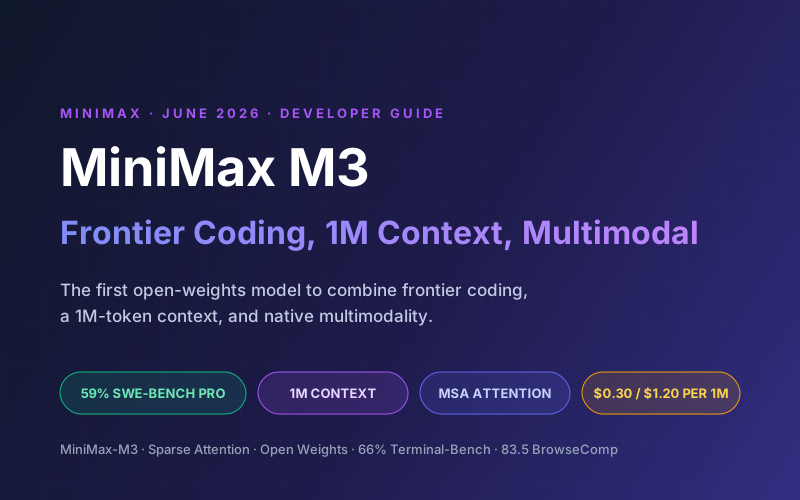

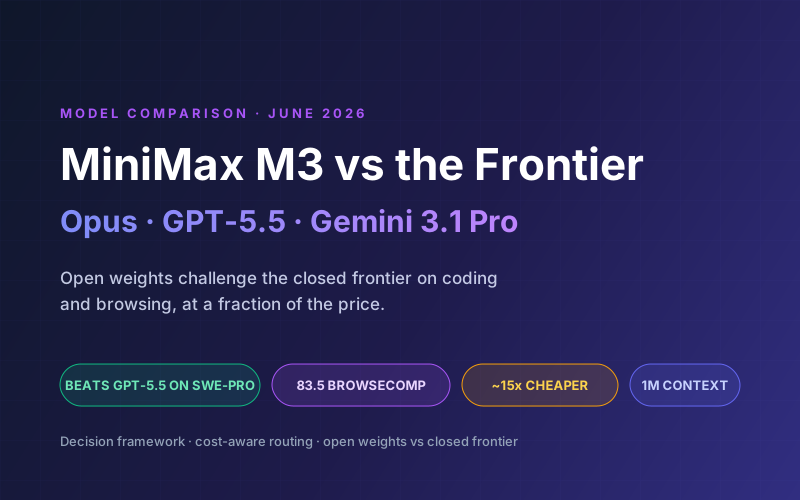
For two years the story was simple: the closed frontier (Claude, GPT, Gemini) led on quality, and open-weights models followed at a discount. MiniMax M3, launched June 1, 2026, is the clearest challenge to that order yet: the first open-weights model to combine frontier coding, a 1M-token context, and native multimodality, and it does it at a price the closed labs cannot touch.
MiniMax reports M3 surpasses GPT-5.5 and Gemini 3.1 Pro on SWE-Bench Pro and approaches Claude Opus 4.7, while beating Opus 4.7 on BrowseComp and SVG-Bench. The catch, as always, is that the leaders still hold the hardest reasoning and some agentic benchmarks, and vendor numbers need independent validation.
This head-to-head covers benchmarks, pricing, context, and multimodality across all four, then gives you a decision framework for production. For the full M3 breakdown alone, see our MiniMax M3 developer guide.
📑 What This Comparison Covers
1The Four Contenders
MiniMax M3
Open-weights, MSA sparse attention, 1M context, multimodal. Coding- and agentic-focused, priced to undercut everything.
Claude Opus 4.x
Anthropic's frontier model. Top-tier coding and agentic reliability, premium pricing. The bar M3 is measured against.
GPT-5.5
OpenAI's flagship. Strong omnimodal reasoning, 1M-class context, tops several intelligence indices.
Gemini 3.1 Pro
Google DeepMind's frontier model. Native multimodal across text, image, video, audio, with a 1M context window.
2Benchmark Head-to-Head
The clearest claim is on SWE-Bench Pro, where MiniMax positions M3 above GPT-5.5 and Gemini 3.1 Pro and just below Claude Opus 4.7. Here is how the published numbers line up. Figures are drawn from each vendor and independent trackers; treat cross-vendor comparisons as directional.
| Benchmark | MiniMax M3 | Frontier reference |
|---|---|---|
| SWE-Bench Pro | 59.0% | Above GPT-5.5 & Gemini 3.1 Pro; approaches Opus 4.7 |
| Terminal-Bench 2.1 | 66.0% | GPT-5.5 leads on TB 2.0 (~82.7%) |
| BrowseComp | 83.5 | Opus 4.7: 79.3 (M3 ahead) |
| SVG-Bench | Surpasses Opus 4.7 | Opus 4.7 reference |
| Hardest reasoning (HLE, GPQA) | Not the lead | Claude / GPT frontier still ahead |
The pattern is consistent: M3 is genuinely competitive (and sometimes ahead) on coding, browsing, and SVG generation, while the closed frontier retains an edge on the hardest reasoning and some agentic terminal tasks. For most product engineering work, the axes M3 wins on are the ones that matter day to day.
3Pricing & Value
This is where the comparison stops being close. M3 is in a different pricing universe:
| Model | Input /M | Output /M | Open weights? |
|---|---|---|---|
| MiniMax M3 (promo) | $0.30 | $1.20 | Yes |
| MiniMax M3 (standard) | $0.60 | $2.40 | Yes |
| Claude Opus 4.x | $5.00 | $25.00 | No |
| GPT-5.5 | ~$10.00 | ~$30.00 | No |
| Gemini 3.1 Pro | Frontier tier | Frontier tier | No |
At promo pricing M3 is roughly 15x cheaper than Opus and over 25x cheaper than GPT-5.5 on input. When M3 delivers 90%+ of frontier quality on your tasks, that price gap is the whole argument. And because M3 is open-weights, high-volume teams have a self-hosting path the closed labs do not offer.
4Context & Multimodality
On raw context length, the four are comparable: M3, GPT-5.5, and Gemini 3.1 Pro all reach 1M-class windows. The differentiator is efficiency. M3's MSA sparse attention is designed specifically to make long context cheap, which matters most for long-horizon agents that keep large contexts resident for hours.
- MiniMax M3: 1M context, text + image + video in, text out, MSA-efficient long context
- Gemini 3.1 Pro: 1M context, native text + image + video + audio, strong multimodal heritage
- GPT-5.5: 1M-class context (large input, capped output), omnimodal
- Claude Opus 4.x: strong multimodal, agentic reliability leader, smaller context than the 1M-class field
5The Real Tradeoffs
What you gain with M3
Frontier-competitive coding and browsing, a cheap 1M context, open weights for self-hosting, and a price that makes high-volume agents viable.
What you give up
The last few points of quality on the hardest reasoning and some agentic terminal tasks, a license with commercial conditions, and the mature tooling and support ecosystems around the closed labs. Promo pricing is also temporary.
6Decision Framework
You rarely have to pick just one. The practical answer for most teams is a routing layer:
- Default to M3 for agentic, long-context, coding, and browsing work where it is competitive and cost dominates
- Escalate to Claude Opus for the hardest multi-file refactors and reasoning where reliability is worth the premium
- Reach for Gemini 3.1 Pro when you need its audio/video multimodal depth
- Use GPT-5.5 where its omnimodal reasoning or ecosystem integrations are the deciding factor
- Let a gateway decide per-request based on task complexity, so you get frontier quality only when you pay for it
A model gateway makes this routing automatic. See our LLM gateway and model routing guide for how to build it, and validate every routing decision with your own evals.
7Why Lushbinary
At Lushbinary, we help teams pick and combine models based on data, not marketing. For a decision like this we deliver:
- Head-to-head evals on your real tasks across M3 and the frontier models
- Cost-aware routing that sends each request to the cheapest model that meets your quality bar
- Self-hosting of open-weights models like M3 when volume justifies it
- Guardrails and observability so multi-model stacks stay reliable in production
🚀 Free Consultation
Not sure whether M3 or a frontier model is right for your product? Lushbinary will benchmark them on your workloads and design a routing strategy that balances quality and cost - no obligation.
❓ Frequently Asked Questions
Is MiniMax M3 better than Claude Opus, GPT-5.5, and Gemini 3.1 Pro?
On coding, MiniMax M3 surpasses GPT-5.5 and Gemini 3.1 Pro on SWE-Bench Pro (59.0%) and approaches Claude Opus 4.7. On autonomous browsing (BrowseComp 83.5) it beats Opus 4.7. The closed frontier models still hold an edge on the hardest reasoning and some agentic benchmarks, but M3 closes most of the gap at a small fraction of the cost.
How much cheaper is MiniMax M3 than frontier models?
At promo pricing (~$0.30 input / $1.20 output per million tokens), M3 is roughly 15x cheaper than Claude Opus ($5/$25) and over 25x cheaper than GPT-5.5 (~$10/$30) on input. Even at standard $0.60/$2.40 pricing it remains far cheaper than any closed frontier model.
Should I use MiniMax M3 or a closed frontier model?
Use M3 for the bulk of agentic, long-context, and coding work where its quality is competitive and cost matters. Reserve a closed frontier model like Claude Opus for the small slice of hardest tasks where the last few points of quality justify 10-25x the price. A routing layer lets you do both automatically.
What context window does MiniMax M3 have versus competitors?
MiniMax M3 offers up to 1M tokens, matching Gemini 3.1 Pro and GPT-5.5's 1M-class windows. Its MSA sparse-attention architecture makes that long context cheaper to use than full-attention competitors, which is a key advantage for long-horizon agents.
📚 Sources
- MiniMax Research - MiniMax M3 Announcement
- OpenRouter - MiniMax M3 Pricing & Providers
- Artificial Analysis - MiniMax Model Tracking
- AI Agent Benchmark Roundup (frontier reference points)
Content was rephrased for compliance with licensing restrictions. Benchmark and pricing data sourced from official vendor publications and independent trackers as of June 2026. Cross-vendor benchmark comparisons are directional, as test versions and conditions vary. Pricing may change - always verify on the vendor's website.
Choose the Right Model for Your Product
We benchmark MiniMax M3 against the closed frontier on your real workloads and design routing that balances quality and cost.
Ready to Build Something Great?
Get a free 30-minute strategy call. We'll map out your project, timeline, and tech stack - no strings attached.
Prefer email? Reach us directly: