
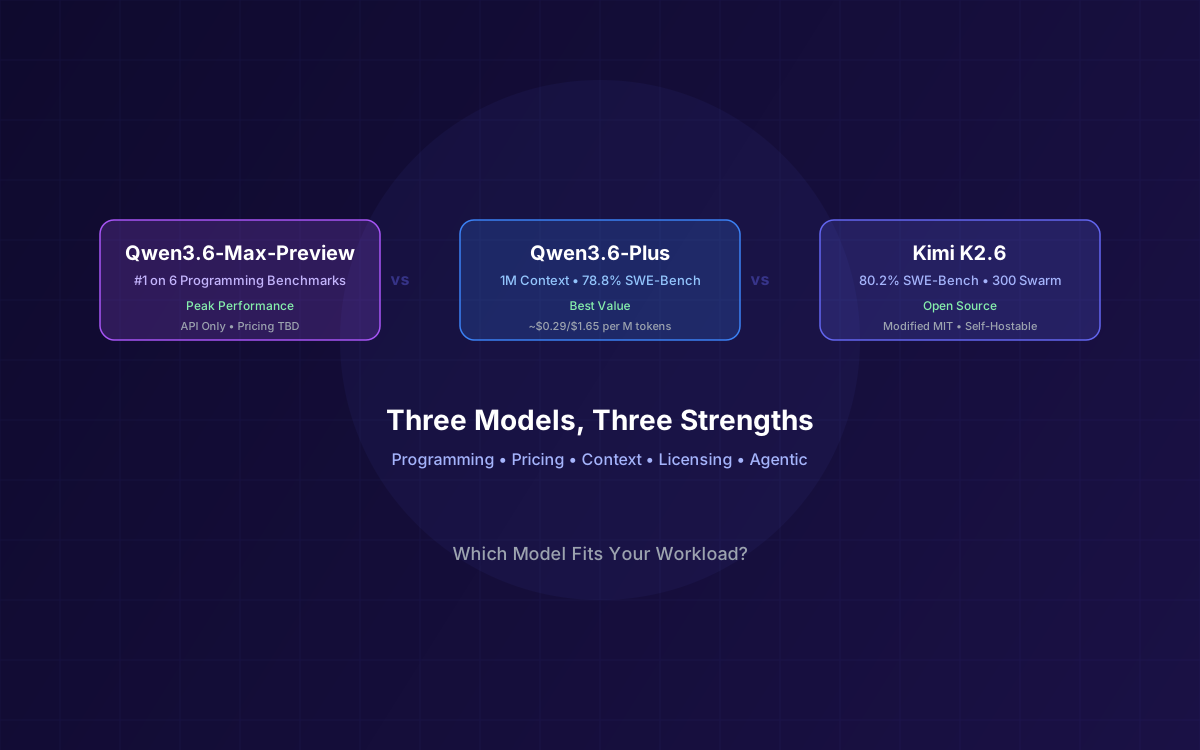
Alibaba's Qwen team shipped two major releases in rapid succession — Qwen3.6-Plus on March 30 and Qwen3.6-Max-Preview on April 20, 2026 — each targeting different segments of the developer market. Meanwhile, Moonshot AI's Kimi K2.6 continues to hold its ground as the strongest open-weight coding model available. For teams evaluating their next production model, the question isn't which one is “best” in the abstract — it's which one fits your workload, budget, and deployment constraints.
Qwen3.6-Max-Preview now claims the top spot on six programming benchmarks, including SWE-benchPro and Terminal-Bench2.0, with substantial improvements over its Plus sibling. Qwen3.6-Plus counters with a massive 1M token context window, always-on chain-of-thought reasoning, and pricing that undercuts nearly every frontier model on the market. Kimi K2.6 brings something neither Qwen model can offer: full self-hosting rights under a Modified MIT License, native multimodal capabilities, and a 300-agent swarm architecture purpose-built for complex agentic workflows.
This guide breaks down the benchmarks, pricing, architecture, and practical trade-offs across all three models so you can make an informed decision for your specific use case.
What This Guide Covers
1Model Overview & Architecture
These three models represent fundamentally different approaches to frontier AI. Qwen3.6-Max-Preview is Alibaba's flagship proprietary model, optimized for peak programming performance. Qwen3.6-Plus is the cost-efficient workhorse with the largest context window in its class. Kimi K2.6 is the open-weight challenger built on a Mixture-of-Experts backbone with native multimodal capabilities and agent swarm support.
| Feature | Qwen3.6-Max-Preview | Qwen3.6-Plus | Kimi K2.6 |
|---|---|---|---|
| Developer | Alibaba (Qwen Team) | Alibaba (Qwen Team) | Moonshot AI |
| Release Date | April 20, 2026 | March 30 – April 2, 2026 | April 2026 |
| Architecture | Undisclosed (proprietary) | Undisclosed (proprietary) | MoE (1T total / ~32B active) |
| Context Window | Not disclosed | 1M tokens | 256K tokens |
| Max Output | Not disclosed | 65,536 tokens | Not disclosed |
| License | Proprietary (API only) | Proprietary (API only) | Modified MIT |
| Pricing (per M tokens) | Not disclosed | ~$0.29 / $1.65 | ~$0.60 / $3.00 |
The Qwen models share a lineage but serve different purposes. Max-Preview is the benchmark king — built to push the limits of what's possible on programming tasks. Plus is the production workhorse with its 1M token context window and aggressive pricing. K2.6 occupies a unique position as the only open-weight option, with its MoE architecture keeping inference costs manageable despite the 1T total parameter count. For a deeper dive into each model individually, see our Qwen3.6-Max-Preview developer guide and Kimi K2.6 developer guide.
2Programming Benchmarks
Programming benchmarks are the primary battleground for these three models. Qwen3.6-Max-Preview was explicitly positioned as a programming-first release, and the numbers back that up — it claims the top score on six programming benchmarks simultaneously. Here's how they stack up on the key metrics.
| Benchmark | Qwen3.6-Max-Preview | Qwen3.6-Plus | Kimi K2.6 |
|---|---|---|---|
| SWE-Bench Verified | - | 78.8% | 80.2% |
| SWE-Bench Pro | #1 (score TBD) | - | 58.6% |
| Terminal-Bench 2.0 | #1 (+3.8 over Plus) | 61.6% | 66.7% |
| SkillsBench | #1 (+9.9 over Plus) | Baseline | - |
| SciCode | #1 (+10.8 over Plus) | Baseline | - |
| NL2Repo | +5.0 over Plus | Baseline | - |
The Max-Preview improvements over Plus are substantial across the board. A +10.8 jump on SciCode and +9.9 on SkillsBench represent meaningful capability gains, not incremental tuning. The +5.0 on NL2Repo — which tests the ability to generate entire repositories from natural language descriptions — suggests Max-Preview handles complex, multi-file code generation significantly better than its predecessor.
Kimi K2.6 holds a notable advantage on SWE-Bench Verified at 80.2% versus Plus's 78.8%, and its 66.7% on Terminal-Bench 2.0 comfortably exceeds Plus's 61.6%. However, Max-Preview claims the overall Terminal-Bench 2.0 crown with a +3.8 improvement over Plus, which would put it in the ~65.4% range or higher — competitive with K2.6's score.
💡 Key Takeaway
Qwen3.6-Max-Preview is the new programming benchmark leader, but Kimi K2.6 remains the strongest option if you need SWE-Bench Verified performance with self-hosting rights. Qwen3.6-Plus is the value play — competitive enough for most workloads at a fraction of the cost. For a full breakdown of the Qwen 3.6 family, see our Qwen 3.6 developer guide.
3Agentic Capabilities
Agentic performance — how well a model plans, uses tools, and executes multi-step tasks autonomously — is increasingly the metric that matters most for production deployments. Each of these models takes a different approach to agent workflows, and the differences are significant.
Kimi K2.6's headline feature is its native agent swarm architecture. It can orchestrate up to 300 parallel sub-agents executing 4,000 coordinated steps, making it uniquely suited for complex research, browsing, and code analysis tasks that benefit from parallelism. This isn't a wrapper or framework — it's built into the model's inference pipeline, which means lower latency and better coordination than external orchestration tools.
Qwen3.6-Max-Preview takes a different approach, excelling on programming-specific agent benchmarks. Its top scores on QwenClawBench and QwenWebBench demonstrate strong performance on tasks that require the model to navigate codebases, interact with web interfaces, and chain multiple tool calls together. The +2.8 improvement over Plus on ToolcallFormatIFBench indicates better structured tool calling — fewer malformed function calls and more reliable parameter extraction.
Qwen3.6-Plus brings always-on chain-of-thought reasoning via the preserve_thinking parameter, which exposes the model's reasoning trace without requiring explicit prompting. This is valuable for debugging agent behavior and understanding why a model made specific tool-calling decisions. Combined with its 1M token context window, Plus can maintain much longer agent conversation histories than K2.6's 256K limit.
🐝 Swarm vs Sequential
K2.6's swarm architecture shines when you need to explore many paths simultaneously — think research agents, competitive analysis, or large-scale code review. The Qwen models are stronger for sequential, deep-dive programming tasks where a single agent needs to reason through complex logic chains. The right choice depends on whether your workload is “wide” (many parallel tasks) or “deep” (single complex task).
4Context Window & Throughput
Context window size and output speed are practical constraints that often matter more than benchmark scores in production. Here, the three models diverge sharply.
Qwen3.6-Plus offers the largest context window at 1M tokens with up to 65,536 output tokens. This is 4× larger than K2.6's 256K context and enables use cases that simply aren't possible with smaller windows: ingesting entire codebases, processing long documents, or maintaining extended multi-turn agent conversations without context truncation.
On throughput, Qwen3.6-Plus claims 2–3× the output speed of Claude Opus 4.6, which is a significant advantage for latency-sensitive applications. Faster token generation means shorter wait times for code completions, quicker agent loop iterations, and better user experience in interactive applications.
Kimi K2.6's 256K context window is still generous by historical standards, and its MoE architecture with only 32B active parameters per forward pass means inference is efficient even on modest hardware. For self-hosted deployments, K2.6's lower active parameter count translates to lower GPU memory requirements and faster inference compared to dense models of similar capability.
Qwen3.6-Max-Preview's context window and throughput specifications haven't been publicly disclosed yet. Given its positioning as the flagship model, it likely matches or exceeds Plus's capabilities, but this remains unconfirmed.
5Pricing & Access
Cost is often the deciding factor for production deployments, especially at scale. The pricing gap between these models is substantial and worth understanding in detail.
| Metric | Qwen3.6-Max-Preview | Qwen3.6-Plus | Kimi K2.6 |
|---|---|---|---|
| Input (per M tokens) | Not disclosed | ~$0.29 | ~$0.60 |
| Output (per M tokens) | Not disclosed | ~$1.65 | ~$3.00 |
| Free Tier | Via QwenStudio | Free on OpenRouter (preview) | Free tier available |
| API Access | QwenStudio, Bailian | QwenStudio, Bailian, OpenRouter | Moonshot API, OpenRouter |
| Self-Hosting | No | No | Yes (Modified MIT) |
At scale, the cost differences are dramatic. Consider a workload processing 100M input tokens and 20M output tokens per month:
- • Qwen3.6-Plus: ~$29 input + ~$33 output = ~$62/month
- • Kimi K2.6 (API): ~$60 input + ~$60 output = ~$120/month
- • Kimi K2.6 (self-hosted): GPU costs only, potentially cheaper at very high volumes
Qwen3.6-Plus is roughly half the cost of K2.6 via API at these volumes. However, K2.6's self-hosting option changes the calculus for teams processing billions of tokens monthly — at that scale, owning the inference infrastructure can be significantly cheaper than any API pricing. The fact that Plus is currently free on OpenRouter during its preview period makes it an easy choice for experimentation and prototyping.
6Open-Source vs Proprietary
The licensing divide between these models is the most consequential architectural decision for many teams. Both Qwen3.6-Max-Preview and Qwen3.6-Plus are proprietary, API-only models with no open-source release. Kimi K2.6 is released under a Modified MIT License that permits full commercial use, with attribution requirements kicking in only above 100M monthly active users or $20M in monthly revenue.
This distinction matters for several practical reasons. Self-hosting K2.6 gives you complete control over data residency — no tokens leave your infrastructure, which is critical for healthcare, finance, government, and any domain with strict compliance requirements. You can also fine-tune K2.6 on proprietary data, creating specialized models that outperform the base model on your specific domain without sharing that data with a third-party API provider.
The trade-off is operational complexity. Running a 1T-parameter MoE model requires significant GPU infrastructure — even with only 32B active parameters per forward pass, you need enough VRAM to hold the full model weights for routing. Teams without dedicated ML infrastructure may find the Qwen API models simpler to integrate and maintain.
K2.6 also includes native multimodal capabilities via MoonViT, a 400M-parameter vision encoder that supports both image and video input. Neither Qwen3.6-Max-Preview nor Plus offer comparable multimodal features, which makes K2.6 the only option if your workflow requires processing visual content alongside code and text.
🔒 Data Sovereignty
If your organization requires that no data leaves your infrastructure, K2.6 is the only viable option among these three models. Both Qwen models require sending data to Alibaba's API endpoints. For teams that need frontier-level performance with full data control, K2.6's Modified MIT License is a genuine differentiator. See our K2.6 self-hosting guide for deployment details.
7When to Choose Each Model
Each model occupies a distinct niche. Here's a decision framework based on your primary requirements.
🟣 Choose Qwen3.6-Max-Preview if…
- • Peak programming performance is your top priority (6 benchmark leader)
- • You need the best SWE-benchPro and SciCode scores available
- • Scientific coding tasks are a core workload (+10.8 SciCode improvement)
- • You're already in the Alibaba / Qwen ecosystem and want the flagship tier
- • Budget is secondary to raw capability
🔵 Choose Qwen3.6-Plus if…
- • Cost efficiency is critical (~$0.29/$1.65 per M tokens)
- • You need a 1M token context window for large codebases or documents
- • Output speed matters (2–3× faster than Claude Opus 4.6)
- • You want always-on chain-of-thought with
preserve_thinking - • You're prototyping and want free access via OpenRouter
🟠 Choose Kimi K2.6 if…
- • You require self-hosting or data sovereignty (Modified MIT License)
- • Agent swarm workflows are your primary pattern (300 sub-agents, 4,000 steps)
- • You need native multimodal capabilities (MoonViT image + video)
- • SWE-Bench Verified performance matters most (80.2%)
- • You want to fine-tune on proprietary data
8Multi-Model Strategy
The most effective production architectures increasingly use multiple models rather than betting everything on a single provider. These three models complement each other well, and a smart routing layer can direct requests to the optimal model based on task characteristics.
A practical multi-model strategy with these three models might look like this:
- • Qwen3.6-Plus as the default router: Handle the majority of requests with Plus's low cost and fast output speed. Its 1M context window means it can handle most tasks without truncation, and at ~$0.29 per million input tokens, it's cheap enough to use liberally.
- • Qwen3.6-Max-Preview for hard programming tasks: Route complex coding challenges — multi-file refactors, scientific code generation, difficult bug fixes — to Max-Preview when Plus's output quality isn't sufficient. Use Plus as a classifier to determine when escalation is needed.
- • Kimi K2.6 for swarm and multimodal workloads: Direct agent swarm tasks, visual code review (screenshot analysis), and any workflow requiring parallel sub-agent coordination to K2.6. Its native swarm architecture handles these patterns more efficiently than orchestrating multiple Qwen API calls.
This routing pattern can reduce costs by 50–70% compared to using Max-Preview for everything, while maintaining peak performance on the tasks that need it. The key is building a lightweight classifier (which Plus itself can power) that identifies task complexity and routes accordingly.
🔀 Routing Pattern
A common pattern: use Qwen3.6-Plus to classify incoming requests into “simple” (handle with Plus), “hard coding” (route to Max-Preview), or “agentic / multimodal” (route to K2.6). The classification call costs fractions of a cent and can save significant money on downstream inference. Teams running self-hosted K2.6 can also use it as a fallback when Qwen API availability is a concern.
For teams that need data sovereignty on some workloads but not others, a hybrid approach works well: route sensitive data through self-hosted K2.6 while using Qwen's API for non-sensitive tasks where cost and speed are the priority. This gives you the best of both worlds without forcing a single-model compromise.
9Why Lushbinary
Choosing between these models — or building a multi-model architecture that uses all three — requires understanding your specific workloads, latency requirements, compliance constraints, and budget. At Lushbinary, we help engineering teams evaluate, integrate, and deploy frontier AI models into production. Whether you're setting up multi-model routing between Qwen and K2.6, self-hosting open-weight models on your own infrastructure, or optimizing API costs at scale, we've done it before and can accelerate your path to production.
🚀 Free Consultation
Not sure which model fits your workload? We offer a free 30-minute consultation to evaluate your use case, benchmark options against your data, and recommend the right approach — whether that's a single model, a multi-model strategy, or a self-hosted deployment.
- • Model evaluation and benchmarking on your data
- • Multi-model routing architecture design
- • Self-hosting setup for K2.6 and other open-weight models
- • Qwen API integration and cost optimization
- • Agent swarm implementation and orchestration
❓ Frequently Asked Questions
Is Qwen3.6-Max-Preview better than Qwen3.6-Plus for programming?
Yes. Max-Preview achieves the highest scores in 6 programming benchmarks including SWE-benchPro, Terminal-Bench2.0, SkillsBench, QwenClawBench, QwenWebBench, and SciCode. It improves over Plus by +9.9 on SkillsBench, +10.8 on SciCode, and +3.8 on Terminal-Bench2.0.
How does Kimi K2.6 compare to Qwen3.6-Plus on SWE-Bench?
K2.6 scores 80.2% on SWE-Bench Verified compared to Plus’s 78.8%. K2.6 also leads on SWE-Bench Pro at 58.6%. However, Plus offers a 1M token context window versus K2.6’s 256K, and is significantly cheaper at ~$0.29/$1.65 per million tokens.
Which model is cheapest for high-volume API usage?
Qwen3.6-Plus is the cheapest at approximately $0.29/$1.65 per million tokens (input/output) via Bailian. K2.6 costs ~$0.60/$3.00, roughly 2× more. Max-Preview pricing has not been publicly disclosed yet.
Can I self-host any of these models?
Kimi K2.6 is the only self-hostable option, released under a Modified MIT License with 1T parameters (32B active MoE). Both Qwen3.6-Max-Preview and Qwen3.6-Plus are API-only and not open-source.
Which model is best for agentic multi-step workflows?
K2.6 leads for agent swarm workflows with native support for 300 parallel sub-agents and 4,000 coordinated steps. Max-Preview leads on programming-specific agent benchmarks like QwenClawBench and QwenWebBench. Plus offers strong tool calling with always-on chain-of-thought reasoning.
📚 Sources
- Qwen Team — Qwen3.6-Max-Preview & Qwen3.6-Plus Announcements & Benchmarks
- Alibaba Cloud Bailian — Qwen3.6 API Pricing & Documentation
- HuggingFace — Moonshot AI / Kimi-K2.6 Model Weights & Benchmarks
- Moonshot AI Platform — Kimi K2.6 API Documentation & Pricing
- OpenRouter — Qwen3.6-Plus Free Preview Access
Content was rephrased for compliance with licensing restrictions. Benchmark data sourced from official Qwen Team, Alibaba Cloud, and Moonshot AI publications. Pricing and availability may change — always verify on the vendor's website.
Need Help Choosing the Right Model?
Let Lushbinary help you evaluate Qwen3.6-Max-Preview, Qwen3.6-Plus, and Kimi K2.6 for your team — from benchmarking to production deployment.
Ready to Build Something Great?
Get a free 30-minute strategy call. We'll map out your project, timeline, and tech stack - no strings attached.
Prefer email? Reach us directly: