
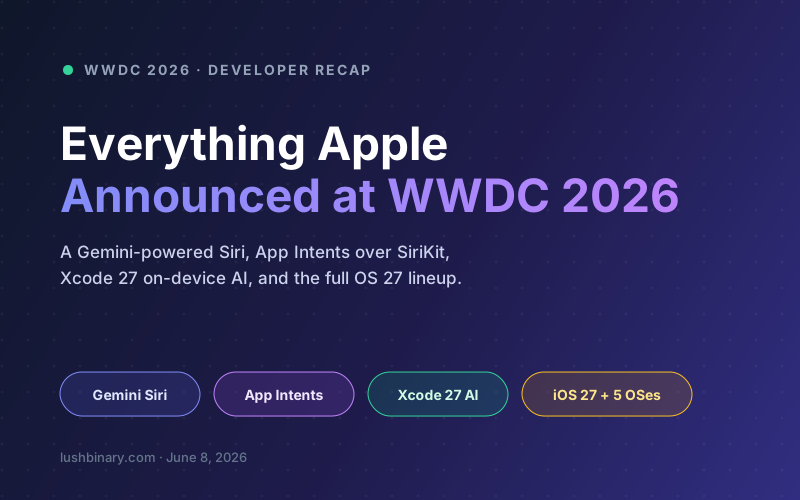
WWDC 2026 opened at Apple Park on June 8 under the tagline "All systems glow," and for once the marketing was honest about the theme: nearly every announcement glowed with Apple Intelligence. After two years of promising a smarter, more personal Siri that never fully shipped, Apple finally delivered a rebuilt assistant - this time powered by a custom Google Gemini model. It was also Tim Cook's final WWDC keynote as CEO before John Ternus takes the role on September 1, 2026.
For consumers, the story is a more capable Siri and a polished iOS 27. For developers, the story is more consequential: App Intents is now the mandatory way Siri talks to your app, SiriKit is on a deprecation clock, Xcode 27 ships on-device AI code completion, and new foldable layout APIs quietly lay the foundation for the iPhone Fold. If you ship on Apple platforms, this is one of the most architecturally significant cycles in years.
This guide walks through everything announced at WWDC 2026 from a builder's perspective: the new Siri and the engineering behind it, the App Intents migration, Xcode 27 and Swift updates, the Foundation Models framework, the full OS 27 lineup, and a concrete checklist for getting your app ready before iOS 27 ships this fall.
What This Guide Covers
- The Headline: Siri Rebuilt on Google Gemini
- How the New Siri Works: Gemini on Blackwell
- App Intents Replaces SiriKit
- Xcode 27: On-Device AI in the IDE
- Swift: Concurrency Without the Boilerplate
- Apple Intelligence & Foundation Models
- iOS 27, macOS Golden Gate & the Rest
- Foldable Layout APIs & Liquid Glass 2
- Your WWDC 2026 Migration Checklist
- Why Lushbinary for Apple Platform Apps
- FAQ
1The Headline: Siri Rebuilt on Google Gemini
The star of WWDC 2026 was the Siri Apple first teased back in 2024 and then quietly delayed. This time it shipped. The rebuilt assistant arrives as a standalone app on iPhone, iPad, and Mac, and it also surfaces inside the Dynamic Island with a "Search or Ask" prompt and a glowing cursor. It supports multi-step commands, persistent conversation history synced across devices via iCloud, and the ability to attach images and documents directly to a request.
On the Mac, the new Siri is built into Spotlight: you can type a question and have it answer with an LLM, or right-click a file (or a selection of files) and have Siri reference them in its output. Siri conversations carry across devices, so you can start on your phone and continue on your Mac. Apple even built a dedicated Siri app for Apple Vision Pro with a 3D visualizer for the model.
Alongside Siri, Apple rolled out Visual Intelligence across its devices - point your camera or share an image and ask questions about it, with a keyboard shortcut to invoke it on Mac. You can also tune Siri's voice with sliders. The capability set is what buyers were promised two years ago: personal context awareness, on-screen understanding, and cross-app automation.
Why this shipped now
In May 2026, Apple reached a reported $250 million class-action settlement with iPhone buyers who said the company advertised AI-powered Siri features that never arrived on time. The Gemini-powered Siri unveiled at WWDC is, quite literally, the product that settlement was waiting on. Apple still emphasized that AI request data is deleted as soon as a request is executed.
2How the New Siri Works: Gemini on Blackwell
The engineering story is more interesting than the marketing. Apple licensed a custom 1.2-trillion-parameter Gemini model from Google, reported at roughly $1 billion per year and confirmed publicly by Google Cloud CEO Thomas Kurian at Google Cloud Next '26. That model is about eight times larger than the largest cloud model Apple had previously built in-house, and it uses a mixture-of-experts design: rather than activating all 1.2 trillion parameters per query, it routes each request to the relevant subset of specialized sub-networks, keeping latency competitive.
Apple originally wanted to run this entirely within its Private Cloud Compute infrastructure, where Apple Silicon servers process queries in stateless, ephemeral sessions with no data retained. But the 1.2-trillion-parameter model was too slow on PCC hardware at Siri's query volumes. So complex queries route to Google's fleet of Nvidia Blackwell B200 chips on Google Cloud instead - a notable departure from Apple's usual insistence on controlling every layer of the stack.
To address the obvious privacy question, Apple enabled Nvidia's hardware-based confidential computing on those Blackwell chips. Confidential compute encrypts the user input, the Gemini model weights, and the inference result inside GPU memory while computation runs, so even the cloud operator cannot read the data in plaintext. Apple's contract with Google also prevents Google from using Siri queries to train future Gemini models.
The practical takeaway for developers: simple requests still run on Apple's on-device Foundation Models, and only complex queries escalate to the cloud. Apple introduced new privacy manifest APIs that let you declare, on a per-intent basis, whether a Siri interaction may route to the cloud or must stay on-device. For teams handling regulated data, that per-intent declaration is a compliance control, not a UX preference.
3App Intents Replaces SiriKit
This is the single most important announcement for developers. In the Platforms State of the Union, Apple confirmed that the expanded App Intents framework is now the mandatory integration surface for Siri, and that SiriKit - which has powered voice-assistant features since 2016 - received a formal deprecation notice. Apps relying on SiriKit have a window of roughly two to three years before they lose voice-assistant functionality entirely.
The migration is not a rename. The two frameworks work on fundamentally different principles, and that gap matters now that Siri has the reasoning capacity to actually chain actions across apps.
| Aspect | SiriKit (2016, deprecated) | App Intents (2022, required) |
|---|---|---|
| Definition | XML intent definition files | Pure Swift, compiler-generated metadata |
| Process | Separate Intent Extension | Direct perform request to the app |
| Discovery | Limited, fixed intent domains | OS reads metadata without launching app |
| Conversation | Single-shot, ends in a Siri card | Streaming, multi-turn follow-up |
App Intents works entirely in Swift. At build time the compiler reads your source and generates compact metadata describing your app's exposed actions, entity types, and query capabilities, stored in the app bundle. The OS can then understand what your app can do without launching it. The expanded release adds richer entity types, streaming response support, and structured conversational follow-up - so an action that used to end in a static Siri card can now continue as a dialogue inside your app's context.
// A minimal App Intent Siri can discover and run
import AppIntents

struct LogWorkoutIntent: AppIntent {
    static let title: LocalizedStringResource = "Log a Workout"

    @Parameter(title: "Activity")
    var activity: String

    @Parameter(title: "Minutes")
    var minutes: Int

    func perform() async throws -> some IntentResult & ProvidesDialog {
        try await WorkoutStore.shared.log(activity, minutes: minutes)
        return .result(dialog: "Logged \(minutes) min of \(activity).")
    }
}
The strategic risk for your app
Apps that do not expose core actions via App Intents become functionally invisible to a Siri that can now chain actions across apps. A banking app without App Intents cannot participate in a Siri workflow that combines it with a messaging thread. Apple has reportedly lined up early partners including Uber, Amazon, YouTube, WhatsApp, and AllTrails - the integration race has already started.
4Xcode 27: On-Device AI in the IDE
Xcode 27 introduces predictive, multi-line code completion powered by an on-device Apple Intelligence model. It surfaces inline suggestions based on surrounding code context without a cloud round-trip - the most direct answer Apple has made yet to the developer adoption of GitHub Copilot and Cursor. Unlike those server-side tools, the Xcode 27 model runs locally on Apple Silicon, consistent with the privacy story Apple has built since the M1 transition.
Teams that prefer alternative providers can configure Xcode 27 to route suggestions to third-party AI models instead. Beyond completion, the release adds faster simulator performance, tighter Git workflow integration, and improved Instruments-based profiling focused on memory and energy optimization - all areas that show up repeatedly in Apple's developer feedback.
If you are weighing on-device assistance against cloud coding agents, our AI coding agents comparison and AI code review tools guide give useful reference points for where Xcode 27 fits in a real workflow.
5Swift: Concurrency Without the Boilerplate
The Swift release announced at WWDC 2026 refines the concurrency model. Strict concurrency in Swift 6 delivered a real correctness benefit but required developers to annotate shared mutable state extensively, which added significant boilerplate to existing codebases. The new release tightens the data-isolation guarantees while reducing that annotation burden, so you get the safety without the ceremony.
- Concurrency: stronger isolation guarantees with less required annotation
- Macros: more ergonomic compile-time code generation
- Swift Package Manager: expanded cross-platform distribution
- Swift Testing & C++ interop: further refinements on both fronts
6Apple Intelligence & Foundation Models
Craig Federighi reintroduced Apple Intelligence with a deliberate framing: the goal is features that are genuinely useful and private, not AI for the sake of AI. Much of the new intelligence is built on Apple's on-device Foundation Models, which now power image understanding across the system. Point your iPhone at a plate of food to get nutritional insights, or snap a photo of a bill and have Siri help split it. For developers, the Foundation Models framework remains the on-device path for adding language and image reasoning to your app without sending data off the device.
Apple Intelligence now reaches into a long list of built-in apps - Phone, Safari, Mail, Messages, Passwords, Photos, Shortcuts, and more:
- Photos: a revamped Clean Up that removes distractions more cleanly, plus two new tools - Extend (generates extra image around the edges) and Spatial Reframe (uses on-device spatial models to change the angle of a shot, filling in only the missing pixels)
- Shortcuts: describe the workflow you want in natural language and Apple Intelligence assembles the shortcut for you
- Safari: AI tab grouping by subject, a "monitor this page for changes" alert, and the ability to vibe-code browser extensions
- Passwords: the app can now change your passwords for you automatically
- Image Playground: more flexible generation, now available across the platform
- Notifications: notifications from the same app coalesce into one updating entry instead of stacking
Watch the rate limits
Apple noted that some of the heavier cloud AI features carry daily limits tied to data bandwidth, and a higher-tier iCloud subscription raises those limits. If your app leans on cloud Apple Intelligence features, design for graceful degradation when a user hits a cap.
7iOS 27, macOS Golden Gate & the Rest
After last year's divisive Liquid Glass redesign, WWDC 2026 was a refinement year for the OS lineup rather than a reinvention. That is good news for developers: fewer breaking UI changes and a focus on performance and plumbing.
- iOS 27: supports the same devices as iOS 26 (iPhone 11 and up), so fewer users are forced off the update. Apps launch up to 30% faster, and an updated CPU scheduler improves multitasking. Apple rebuilt the on-device search index for faster search across apps, messages, files, and emails.
- macOS 27 "Golden Gate": the new Mac release name, with Siri built into Spotlight. Note that macOS 27 also ends support for several older Intel Macs as Apple completes the Apple Silicon transition.
- iPadOS 27: speed and productivity improvements.
- watchOS 27, tvOS 27: refinement updates rolling the new design and Apple Intelligence hooks across the rest of the lineup.
- visionOS 27: new features for Vision Pro, including a dedicated Siri app with a 3D visualizer for the model.
Apple also showed expanded child-safety tooling: a setup assistant that guides parents through which apps and content a child can access, an "ask to browse" web control, and time-allowance limits. Apple provides research-based guidance but leaves the final decisions to parents. If your app targets younger users, expect to interact with the new Child Account flows.
8Foldable Layout APIs & Liquid Glass 2
The iPhone Fold is not expected until fall 2026, but the SDK already lays the groundwork. SwiftUI and UIKit both gained new adaptive layout APIs covering hinge-state detection and multi-configuration display handling. Apple made clear that fluid reflow - not letterboxing - is the expected default on flexible-screen hardware. Adopt these APIs now and your app will reflow cleanly the day the foldable ships.
The Liquid Glass design language introduced last year gets its second iteration, with updated design tokens and material guidelines shipped through the SDK. Apple also addressed the readability complaints by adding a transparency slider so users can dial Liquid Glass back, and refreshed app icons with a more dimensional, almost 3D Liquid Glass look.
9Your WWDC 2026 Migration Checklist
Developer betas began rolling out on June 8, a public beta is expected around mid-July 2026, and the public release is anticipated in September alongside this fall's new iPhones. That is a tight window for a cycle this significant. Here is where to focus.
- Audit SiriKit usage today. Any voice-assistant feature on SiriKit is now on a deprecation clock. Inventory it and plan the App Intents migration.
- Expose your core actions via App Intents. Pick the three to five actions users most want to trigger by voice and ship them as App Intents with streaming, multi-turn support.
- Declare cloud-vs-on-device routing. If you handle regulated data, use the new per-intent privacy manifest declarations to keep sensitive interactions on-device.
- Test on iOS 27 performance changes. The new CPU scheduler and rebuilt search index can shift behavior - profile with Xcode 27's improved Instruments.
- Adopt foldable layout APIs. Add hinge-state handling in SwiftUI/UIKit so your app is ready for the iPhone Fold.
- Revisit Liquid Glass. Update to the second-iteration design tokens and verify readability with the new transparency control.
10Why Lushbinary for Apple Platform Apps
WWDC 2026 just reset the integration bar for every iOS and macOS app. The teams that ship App Intents, on-device intelligence, and foldable-ready layouts early will be the ones Siri can actually use - and the ones that feel native on the next wave of hardware. Lushbinary builds and modernizes Apple platform apps end to end, and we help teams move quickly without betting the product on a beta.
- App Intents migration - moving SiriKit features to App Intents with streaming, multi-turn interactions
- On-device AI features - building with the Foundation Models framework and Apple Intelligence while keeping data private
- Swift & SwiftUI modernization - concurrency cleanups, foldable layouts, and Liquid Glass 2 adoption
- Cross-platform strategy - shipping the same product cleanly across iOS, iPadOS, macOS, and visionOS
🚀 Free Consultation
Want your app ready for iOS 27 and the new Siri before it ships this fall? Lushbinary will scope your App Intents migration, recommend the right architecture, and give you a realistic timeline with no obligation.
11Frequently Asked Questions
What was announced at WWDC 2026?
Apple unveiled iOS 27, iPadOS 27, macOS 27 (Golden Gate), watchOS 27, tvOS 27, and visionOS 27, headlined by a rebuilt Siri powered by a custom Google Gemini model. For developers, the big news is that App Intents is now the mandatory integration surface for Siri, SiriKit received a formal deprecation notice, and Xcode 27 added on-device AI code completion. It was also Tim Cook's final WWDC as CEO before John Ternus takes over on September 1, 2026.
Is SiriKit deprecated after WWDC 2026?
Yes. Apple gave SiriKit a formal deprecation notice at WWDC 2026 and made the expanded App Intents framework the only way Siri can call into a third-party app. SiriKit apps keep working for now but will show compile-time deprecation warnings, and Apple has signaled a roughly two-to-three-year support window. Developers should plan an App Intents migration now.
What model powers the new Siri?
The rebuilt Siri runs on a custom 1.2-trillion-parameter Google Gemini model that Apple licensed for a reported ~$1 billion per year. Complex queries route to Nvidia Blackwell B200 chips on Google Cloud with hardware-based confidential computing enabled, and Apple's contract bars Google from training future Gemini models on Siri queries. Simpler requests still run on Apple's on-device Foundation Models.
What is new in Xcode 27?
Xcode 27 adds predictive, multi-line code completion powered by an on-device Apple Intelligence model that runs on Apple Silicon without a cloud round-trip. It can optionally route suggestions to third-party AI models, and ships with faster simulator performance, tighter Git workflow integration, and improved Instruments profiling for memory and energy.
When will iOS 27 be available?
Developer betas of iOS 27 and the other OS 27 releases began rolling out on June 8, 2026, the day of the keynote. A public beta is expected in mid-July 2026, with the final public release anticipated in September 2026 alongside this fall's new iPhone lineup. iOS 27 supports the same devices as iOS 26, starting from the iPhone 11.
Do developers have to support the iPhone Fold now?
Not yet, but the groundwork is in the SDK. SwiftUI and UIKit gained new adaptive layout APIs for hinge-state detection and multi-configuration display handling. Apple signaled that fluid reflow, not letterboxing, will be the expected default on foldable hardware, so adopting these APIs early means apps are ready when the iPhone Fold ships.
📚 Sources
- Apple Developer - WWDC 2026
- Tech Times - App Intents Replaces SiriKit as Gemini Siri Migration Clock Starts
- 9to5Mac - WWDC 2026 News Hub
- IGN - Everything Announced at WWDC 2026
- Apple Developer Documentation - App Intents
Content was rephrased for compliance with licensing restrictions. Announcement details sourced from official Apple developer materials and live WWDC 2026 keynote coverage as of June 8, 2026. Beta timelines, pricing, and feature availability may change - always verify on Apple's developer site before relying on them.
Get Your App Ready for iOS 27
From App Intents migration to on-device AI features, Lushbinary builds Apple platform apps that are ready for the new Siri. Tell us what you are building.
Ready to Build Something Great?
Get a free 30-minute strategy call. We'll map out your project, timeline, and tech stack - no strings attached.
Prefer email? Reach us directly: