
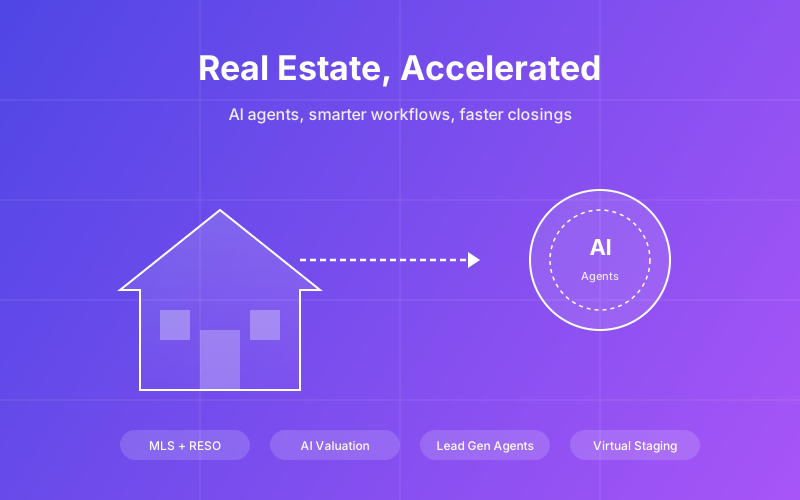
A February 2026 survey from Realtors Property Resource found that 82% of real estate professionals now use AI in some form. Generative AI in real estate is on pace to hit $2.86B by 2030, and Cushman & Wakefield projects AI will generate roughly 330 million square feet of additional commercial real estate demand in the US over the next decade.
But here is the twist. Most agents and brokerages using AI today are using it in the narrowest possible way: typing prompts into ChatGPT to write listing descriptions. That is the floor, not the ceiling. The brokerages pulling ahead are the ones wiring AI agents into MLS data, CRMs, e-signature, call recordings, and listing pipelines so the work happens whether the agent is at the desk or not.
This guide lays out the full map: where AI meaningfully moves the needle in a real estate business, which workflows to automate first, what the stack looks like, and how Lushbinary builds production-grade AI platforms for brokerages, teams, and proptech startups.
📋 Table of Contents
- 1.Where AI Actually Moves the Needle in Real Estate
- 2.The 7 High-ROI AI Workflows for Brokerages
- 3.Reference Architecture: AI-Native Real Estate Stack
- 4.Model Selection: Claude, GPT, Gemini, Open-Weight
- 5.Data Sources: MLS, RESO, IDX, Public Records
- 6.Fair Housing, MLS Compliance & Guardrails
- 7.Rollout Plan: Pilot in 6-10 Weeks
- 8.Cost Model & ROI Benchmarks
- 9.How Lushbinary Builds AI for Real Estate
- 10.FAQ
1Where AI Actually Moves the Needle in Real Estate
Real estate is a data-dense, document-heavy, relationship-driven industry. That combination is exactly the kind of workload large language models and agentic systems are good at. The problem is not whether AI fits, it is picking the workflows that return the biggest dollars per hour of engineering and training investment.
The highest-leverage areas fall into four buckets:
- Lead capture and qualification: 24/7 intake, intent scoring, nurture sequences, and auto-routing to the right agent. AI chatbots in real estate generate roughly 30% more leads than unaided human agents thanks to instant response times.
- Valuation and analysis: AI-powered AVMs now ship with median absolute percentage error around 2.9% and more than 80% of valuations landing within 10% of actual sale price, a level of accuracy that previously required hours of an agent's time.
- Listing production: Virtual staging at under $1 per image versus $1,500-$4,000 for traditional staging, AI-written descriptions tuned for each MLS's character limits, and auto generated social clips.
- Property operations: Tenant screening, maintenance triage, lease workflows, and renewal prediction can cut operating costs 20-35% and boost NOI by around 15% according to McKinsey research cited across 2026 property management studies.
Everything else (transaction coordination, marketing, analytics) is downstream of these four. Nail these and the rest gets easier.
2The 7 High-ROI AI Workflows for Brokerages
These are the workflows Lushbinary ships most often for brokerage clients. None of them require replacing your existing CRM or MLS provider. They sit as an AI layer on top.
| Workflow | What It Does | Typical Impact |
|---|---|---|
| AI Lead Concierge | 24/7 web and SMS chat, qualifies buyer and seller intent, books showings into agent calendars | +25-40% lead-to-appointment rate |
| Automated CMA / AVM | Pulls MLS comps, adjusts for condition, outputs branded PDF in minutes | 4 hrs → <5 min per CMA |
| Listing Production | AI-written descriptions, virtual staging, social clips, multi-MLS publishing | ~95% cost cut vs traditional staging |
| Seller Prospecting Agent | Ranks likely sellers from CRM and public records, triggers personalized outreach | 2-3x listing appointment set rate |
| Inspection & Contract Review | Reads PDFs, surfaces red flags and deadlines, drafts repair addenda | Hours of TC work to minutes |
| Tenant Screening + Leasing | Alt-data scoring, AI leasing agent for tours and applications, fraud detection | 20-35% lower PM operating cost |
| Maintenance & Renewals | 24/7 intake, triage, vendor dispatch, renewal likelihood scoring | 4.6d → <18h response, +15% NOI |
If you are starting from scratch, lead concierge plus automated CMA is usually the fastest payback combo for a brokerage. For property managers, maintenance AI plus tenant screening comes first. We cover both paths in depth in our dedicated guides linked throughout this article.
3Reference Architecture: AI-Native Real Estate Stack
Every real estate AI system Lushbinary ships shares the same core shape: a data ingestion layer, a retrieval-augmented knowledge base, an orchestrator that drives LLMs with function calling, integrations into CRM and messaging, and guardrails for Fair Housing and MLS rules. Here is the reference diagram we use for brokerage builds.
A few decisions shape everything else:
- Store normalized listings locally. Hitting the MLS on every query is slow and violates most MLS rate limits. Pull on RESO schedule, normalize, and serve from your own Postgres.
- Use pgvector over a separate vector DB for most brokerages. You already have Postgres, embeddings stay next to the relational data, and the cost savings are real for sub-10M row workloads.
- Route models by task, not by preference. Long docs go to Claude, agentic to GPT-5.5, bulk tagging to Haiku or GPT-4o Mini, heavy research to Gemini 3.1 Pro.
- Put every outbound action behind a tool, not a free-form prompt. It makes auditing and guardrails possible.
4Model Selection: Claude, GPT, Gemini, Open-Weight
No single model wins across the full real estate workflow. Each has a sweet spot. Based on benchmark data and production deployments as of April 2026:
- Claude Opus 4.7 is the default for document-heavy work: inspection reports, lease abstraction, purchase agreement review, disclosures. Long-context accuracy and fewer math errors on numeric clauses matter here.
- GPT-5.5 is the default for agentic workflows: multi-step lead qualification, computer-use automation in MLS admin portals, omnimodal listing review. Our GPT-5.5 developer guide covers the agent tooling in depth.
- Gemini 3.1 Pro wins on long-context market research pulls and large multi-doc comparisons. Pair it with Google Search grounding for neighborhood and zoning data.
- Open-weight (Qwen 3.6, Gemma 4, GLM 5.1) for high-volume, privacy-sensitive, or cost-sensitive workloads: intake classification, embedding, internal search. Our best open-source LLM comparison is the starting point.
💡 Multi-Model Routing Wins
In our brokerage builds, routing cheap tasks to Haiku 4.5 or GPT-4o Mini and reserving Opus 4.7 and GPT-5.5 for reasoning-heavy steps typically cuts LLM spend 60-80% versus a single-model setup, with no measurable quality drop.
5Data Sources: MLS, RESO, IDX, Public Records
Data is the real moat in real estate AI. Models are cheap, MLS access is not. The four layers you need:
- RESO Web API: the current MLS data transport standard. RETS is deprecated and RESO stopped certifying it back in 2018. Every modern MLS exposes a RESO Web API endpoint. Field names follow the RESO Data Dictionary, which keeps multi-MLS builds sane.
- IDX feeds: consumer-facing listing display. Rules vary by MLS and must be honored (display logic, attribution, refresh cadence). IDX is not a substitute for the RESO API when you need richer data.
- Public records and parcel data: ATTOM, CoreLogic, Regrid, or direct county assessor feeds for ownership, tax, and parcel geometry. Critical for seller prospecting and AVMs.
- First-party signals: call transcripts, email threads, form submissions, website behavior. This is what makes your AI different from the next brokerage's.
⚠️ MLS Access Is Not Free
Getting a RESO Web API token requires a participating broker relationship with the target MLS, a signed data license, and approval of your use case. Budget 4-8 weeks and legal review for each MLS you need. National platforms typically stitch together 50+ MLS licenses behind the scenes.
6Fair Housing, MLS Compliance & Guardrails
Any AI system that generates buyer, seller, or tenant communication has Fair Housing exposure. The US Fair Housing Act protects classes including race, color, national origin, religion, sex, familial status, and disability. Generated listing copy, chat responses, and targeted outreach all need to be filtered. HUD has issued guidance making clear that algorithmic discrimination is still discrimination, and HUD v. Meta (2022) showed that even targeting logic can be actionable.
At a minimum, every AI build should include:
- System prompts that forbid references to protected classes, neighborhood demographics, school quality proxies, or steering language.
- Output filters (a second model pass or pattern match) that flag risky phrases before anything is sent.
- Human approval gates on the first N outbound messages per campaign until a team lead signs off.
- Full audit logs of prompts, model outputs, and actions, stored for the length of your broker's record-retention policy.
- MLS-specific rules around IDX display, listing attribution, and distance-based query caps, encoded as tool-level policies.
This is not a check-the-box exercise. Our AI agent production guardrails guide covers the broader pattern we use on every build. The real estate extension layers Fair Housing and MLS rules on top.
7Rollout Plan: Pilot in 6-10 Weeks
The biggest mistake brokerages make is trying to boil the ocean: picking 12 workflows, hiring a full data team, and spending a year building. The right shape is a tight pilot, instrumented aggressively, shipped in under a quarter.
| Phase | Weeks | Deliverables |
|---|---|---|
| Discovery | 1-2 | Workflow inventory, KPI baseline, MLS & CRM access confirmed, model & infra choices locked |
| Foundation | 3-4 | MLS ingestion, normalized Postgres schema, embeddings, base orchestrator |
| Pilot Workflows | 5-8 | Lead concierge + automated CMA in production for one team, Fair Housing guardrails wired in |
| Measure & Expand | 9-10+ | KPI review, rollout to remaining teams, next workflow (listing production or prospecting agent) |
Pick one team as the pilot group. Instrument everything. Keep an agent-in-the-loop for the first 30 days. Only after you see clean KPI movement do you expand to the rest of the brokerage.
8Cost Model & ROI Benchmarks
Real numbers from brokerage builds we have seen and shipped:
- Build cost: $45K-$120K for a focused pilot (lead concierge + automated CMA + MLS ingestion). $180K-$400K for a full brokerage platform covering prospecting, listing production, and TC assist.
- Ongoing cost: $1,500-$6,000/month hosting + observability for a mid-sized brokerage, plus $0.05-$0.40 per AI-assisted interaction depending on model mix.
- Typical payback: 4-9 months once the pilot is live. Labor savings from CMA automation, TC assist, and after-hours lead capture are the biggest drivers.
- Team structure: a small squad (1 senior full-stack engineer, 1 AI/ML engineer, 1 designer/PM) can ship a pilot in 6-10 weeks. Larger rollouts benefit from a dedicated data engineer for MLS and compliance work.
None of these numbers mean anything without measurement. Tie every deployed workflow to a concrete KPI (appointments booked, CMAs/agent/week, avg response time) and review weekly for the first quarter.
9How Lushbinary Builds AI for Real Estate
Lushbinary is a boutique software and AI team that ships production-grade real estate platforms end-to-end. We do not sell a SaaS, we build the system that fits your brokerage, your MLSes, and your agents' workflows.
What that looks like in practice:
- MLS and data plumbing: RESO Web API clients, IDX compliance, parcel data, normalization into Postgres + pgvector.
- AI orchestration layer: Claude, GPT, Gemini, and open-weight models routed by task with token caching and cost telemetry.
- Agent-facing UX: Next.js 15 dashboards, cross-platform mobile apps (Flutter or React Native), voice and SMS integrations via Twilio.
- Fair Housing and MLS guardrails: prompt hardening, output filters, audit logs, human approval gates shipped by default.
- AWS infrastructure: ECS/Fargate, RDS, S3, CloudFront, Lambda, with cost optimization playbooks from our AWS cost optimization guide.
🚀 Free Real Estate AI Roadmap Session
Want to accelerate your brokerage with AI? Lushbinary scopes your pilot, identifies the 2-3 workflows with the highest payback, and gives you a realistic timeline and cost estimate - no obligation.
❓ Frequently Asked Questions
How are real estate agents actually using AI in 2026?
A February 2026 Realtors Property Resource survey found that 82% of real estate professionals now use AI. Most common uses are listing copy, CMA, lead qualification, and follow-up, but the highest ROI comes from agentic workflows that run end-to-end across MLS data, CRM, and messaging.
What is the ROI of AI for a real estate brokerage?
Brokerages deploying AI report 20-35% reduction in operating costs, 15% NOI lift (McKinsey), 30% more leads from 24/7 chat, and CMA cycle times dropping from 4 hours to under 5 minutes.
Do I need to replace my CRM and MLS tools to use AI?
No. The cleanest path is to keep your system of record and add an AI orchestration layer that reads MLS via RESO, writes back to your CRM, and calls messaging tools.
Which AI model is best for real estate workflows?
A tiered mix. Claude Opus 4.7 for long documents, GPT-5.5 for agentic workflows, Gemini 3.1 Pro for long-context research, cheaper models like GPT-4o Mini or Claude Haiku for high-volume triage.
How long does it take to roll out AI across a brokerage?
Focused pilots ship in 6-10 weeks. Full brokerage-wide rollouts run 3-6 months depending on scope and MLS data readiness.
What about Fair Housing and compliance risks with AI?
Any AI touching listings or buyer communication needs prompt guardrails, output filters for protected class language, audit logs, and human approval gates on outbound messaging. Lushbinary ships these by default.
📚 Sources
- RESO Web API Guide
- Generative AI in Real Estate Market Report
- ATTOM AI-Powered AVM Announcement
- Haven AI Maintenance KPI Benchmarks
- AI for Real Estate Leads - What Works (2026)
- Content was rephrased for compliance with licensing restrictions. Market sizing, benchmark, and pricing data sourced from official research firm reports and vendor pages as of April 2026. Figures may change, always verify on the vendor's website.
Build Your Brokerage's AI Advantage
Tell us about your MLSes, CRM, and the workflow you want to automate first. We will come back with a focused pilot plan and realistic ROI projection within a few days.
Ready to Build Something Great?
Get a free 30-minute strategy call. We'll map out your project, timeline, and tech stack - no strings attached.
Prefer email? Reach us directly: