
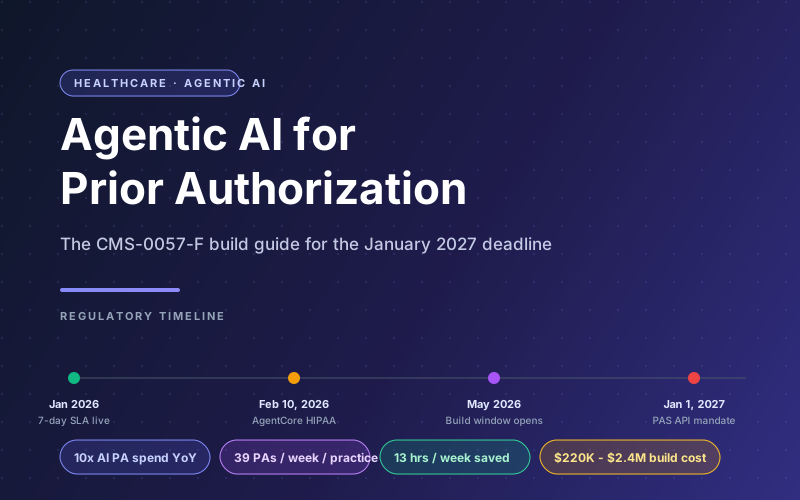
Prior authorization is the most hated workflow in US healthcare. The American Medical Association 2024 survey found physicians and staff spend 13 hours per week on 39 prior auth requests per practice, and 93 percent of physicians say it delays necessary care. Healthcare Huddle reported AI spending on prior auth grew 10x in a single year, from $10 million in 2024 to $100 million in 2025.
The reason this category is exploding right now is a regulatory forcing function. The CMS Interoperability and Prior Authorization Final Rule (CMS-0057-F) requires every Medicare Advantage, Medicaid, CHIP, and qualified health plan issuer to implement four FHIR APIs and accept programmatic prior auth submissions by January 1, 2027. Faxes and portal forms are being legislated out of the loop.
Agentic AI is the technology that turns this regulatory shift into revenue. Instead of a single LLM call, an agent reads the order, pulls clinical evidence from the chart, checks payer policy, submits the request, monitors status, drafts appeals, and writes the decision back into the EHR. This guide covers the architecture, tooling, EHR and payer integrations, BAA stack, and a realistic cost and timeline plan to ship a production agent before the January 2027 deadline. Lushbinary builds these systems for provider groups, payers, and digital health vendors.
📋 Table of Contents
- 1.Why Prior Authorization Is the 2026 Healthcare AI Trend
- 2.The CMS-0057-F Deadline & The Four New APIs
- 3.What Agentic AI Actually Does in a PA Workflow
- 4.End-to-End System Architecture
- 5.Choosing the LLM Stack with a BAA
- 6.Epic, Oracle Health & athenahealth Integration
- 7.Guardrails, Audit & Bias Mitigation
- 8.Cost, Timeline & Realistic ROI
- 9.AWS re:Invent 2025 Announcements You Should Know
- 10.Why Lushbinary for Your PA Agent Build
1Why Prior Authorization Is the 2026 Healthcare AI Trend
Three forces converged in the last 18 months to make agentic AI for prior authorization the most fundable category in healthcare IT:
- Regulatory pressure: CMS-0057-F mandates FHIR APIs, faster decisions, and public denial reporting by January 1, 2027. The fax-and-portal era is ending.
- Burnout data: 89 percent of physicians say PA increases burnout, per the AMA 2024 survey, and 93 percent report care delays caused by PA. Health systems will pay to make this go away.
- Model capability: Claude Opus 4.7, GPT-5.5, and Gemini 3.1 Pro can now plan multi-step workflows, call FHIR tools, and reason over long medical records reliably enough to be production-deployed under human review.
Capital follows: per a Healthcare Huddle analysis, AI prior auth spending jumped from $10M (2024) to $100M (2025), a 10x year over year increase. Cohere Health, Linear Health, Develop Health, Anterior, Innovaccer, Notable, and Olive AI are all racing to build the dominant platform. Provider groups, ASCs, and specialty practices are buying because the math is simple: every PA an agent clears removes 15 to 30 minutes of staff time and reduces denial-related write-offs.
🎯 Why agents, not chatbots
A chatbot answers a question. A PA agent reads the order, pulls evidence, checks policy, submits, watches status, and drafts the appeal. Only an agentic loop can match the structure of a real prior auth workflow. This is why every serious vendor in the space is now multi-step, tool-calling, and FHIR-native.
2The CMS-0057-F Deadline & The Four New APIs
CMS-0057-F applies to Medicare Advantage organizations, state Medicaid and CHIP fee-for-service programs, Medicaid and CHIP managed care plans, and qualified health plan issuers on the federally facilitated exchanges. It requires four FHIR-based APIs by January 1, 2027:
| API | Purpose | Standard |
|---|---|---|
| Patient Access API | Patients pull claims, encounters, and PA decisions | HL7 FHIR R4 + USCDI v3 |
| Provider Access API | Providers pull patient data from payers | Da Vinci PDex |
| Payer-to-Payer API | Records follow the patient between plans | Da Vinci PDex |
| Prior Authorization API | Programmatic submit, status, and outcome | Da Vinci PAS, CRD, DTR |
Decision turnaround tightened too. Effective January 1, 2026 (per the CMS-0057-F summary timeline), payers must respond to standard requests within 7 calendar days and urgent requests within 72 hours, with specific denial reasons attached. The Prior Authorization API requirements take effect January 1, 2027.
Translation for builders: an agent that submits through the new PAS endpoint, parses the structured X12-278 or FHIR Claim response, and loops on denials is no longer a nice-to-have. It is the only way to stay competitive once these endpoints are live across every major plan. Source: CMS-0057-F official rule page.
3What Agentic AI Actually Does in a PA Workflow
A typical PA case touches eight distinct steps. A traditional rules-engine handles two of them. An agent loop handles all eight, with a clinician reviewing the final submission:
- Trigger detection. Listen for a new order in the EHR via FHIR Subscription. Decide if PA is required by querying the payer policy index.
- Evidence gathering. Pull recent encounters, labs, imaging, prior treatments, and ICD-10 history from the patient chart. Summarize into a structured clinical justification.
- Policy matching. Look up the specific payer medical policy for the requested procedure or drug. Identify the criteria the case must meet.
- Gap analysis. Flag missing documentation that would cause a denial (failed step therapy not documented, lab value missing, conservative therapy not tried).
- Submission. Format the request through the Da Vinci PAS endpoint or fall back to legacy X12-278 or portal where the payer is not yet CMS-0057-F compliant.
- Status monitoring. Poll or subscribe to the response. Parse approval, pend, or denial reason codes.
- Appeal drafting. If denied, generate a reconsideration letter citing the medical record and policy language. Route to clinician for sign-off.
- Writeback. Write outcome and supporting trail to the chart so future encounters and the billing team have full visibility.
The clinician never disappears from the loop. The agent prepares the packet, the clinician signs. This is what keeps the system out of FDA Software as a Medical Device territory and inside what payer policy considers acceptable use.
4End-to-End System Architecture
The five layers: trigger and policy lookup, the agent runtime that plans and calls tools, the payer integration with a graceful legacy fallback, the audit and analytics layer, and the clinician review surface. Every PHI byte stays inside the BAA boundary, every tool-call is logged, and every submission is signed by a human.
5Choosing the LLM Stack with a BAA
PHI cannot leave a Business Associate Agreement boundary. That shrinks the model menu to vendors that sign BAAs and self-hosted options inside your VPC. As of May 2026:
| Model | BAA Available | Best For |
|---|---|---|
| Claude Opus 4.7 | Anthropic + AWS Bedrock | Long medical-record reasoning, careful denial parsing |
| GPT-5.5 | OpenAI for Healthcare, Azure OpenAI | Tool calling, structured outputs, computer use |
| Gemini 3.1 Pro | Google Cloud Vertex AI + BAA | 2M-token context, full chart ingestion |
| AWS HealthScribe | HIPAA-eligible AWS service | Clinical conversation transcription if PA spans an encounter |
| Bedrock AgentCore | HIPAA-eligible since Feb 10, 2026 | Agent runtime with managed harness, sessions, memory |
| Llama 4 / MedGemma | Self-hosted inside VPC | Strict data residency, no third-party data sharing |
A common production pattern: Claude Opus 4.7 or GPT-5.5 as the primary planner, a smaller model (Claude Haiku, GPT-5.5 mini, or a self-hosted Llama) for cheap evidence summarization, and Bedrock AgentCore as the orchestration runtime. AgentCore handles short-term and long-term memory, identity, browsers, and tool gateways with a consumption-based price that lines up with PA case volume.
🎤 AWS re:Invent 2025 Update
At re:Invent 2025 AWS announced the AWS HealthLake data transformation agent (preview), which converts legacy CCDA documents into queryable FHIR resources in days instead of months. Combined with AgentCore HIPAA eligibility (effective February 10, 2026), this is the lowest-friction path to a BAA-covered agentic stack on AWS today.
📺 Related re:Invent Sessions
- Healthcare Transformed: Reimagining the Future with Generative AI- Real-world generative AI rollouts at major US health systems
- Building Agents with Amazon Bedrock AgentCore- Managed runtime, identity, memory, and tool gateways
- Reclaiming Clinical Time: Veradigm Uses AI to Transform Workloads- Production lessons applicable to PA workflows
6Epic, Oracle Health & athenahealth Integration
A PA agent has to live where orders are placed. That means SMART on FHIR launches inside the EHR or InBasket-style messages back to the clinician. Per a 2026 KLAS market share analysis cited in industry reporting, Epic now leads US acute care EHR market share around 42 percent and continues to gain ground. Practical integration notes:
- Epic: SMART on FHIR launch with OAuth2, Bulk Data export for chart pulls, In-Basket messaging for clinician review queues, and Epic App Orchard listing for hospital sales. Writeback of decisions uses DocumentReference and CommunicationRequest. February 2026 native AI Charting and ART patient-message drafts mean Epic-shop buyers expect SMART integration as table stakes.
- Oracle Health (Cerner Millennium): Cerner deprecated DSTU2 in December 2025 and is now FHIR R4 native through HealtheLife and Code Console. Strong fit for VA, DoD, and community health systems running Millennium. Writeback flows go through PowerChart Touch or HL7 v2 ORU bridges.
- athenahealth: Marketplace integration with athena's FHIR R4 API, more permissive than Epic for SMB practice sales. Common starting point for specialty groups.
- eClinicalWorks, NextGen, Allscripts: all support FHIR R4 reads with varying writeback maturity. Useful for outpatient specialty rollouts.
For payer-side integration, the four CMS-0057-F APIs ride on FHIR R4 and the Da Vinci implementation guides PAS, CRD, and DTR. Library choices: HAPI FHIR (Java) and Microsoft FHIR Server, both with mature Da Vinci profile support, plus open-source Bonfhir or Medplum if you want a TypeScript path.
7Guardrails, Audit & Bias Mitigation
Health insurer use of AI for utilization management is under federal and state scrutiny. Stanford HAI found that 84 percent of large health insurers in 16 states were using AI for some operational purposes by 2024, and the OIG flagged Medicare Advantage AI denial rates in 2023. Class action settlements like the UnitedHealth nH Predict litigation set a clear precedent: deny-rate models without adequate human review create real legal exposure. Build with that in mind:
- Human-in-the-loop is mandatory. Every submission and every denial appeal must be reviewed and signed by a licensed clinician or appropriately credentialed reviewer. Block automatic denials.
- Cite policy text inside the agent prompt. The model must quote the specific payer policy criterion and the specific note in the chart that satisfies or fails it. Every decision is traceable to source.
- Constrained tool surface. The agent gets read access to FHIR endpoints, write access only to a draft queue, and no shell or arbitrary HTTP. Limits the blast radius if a prompt injection lands.
- Bias monitoring. Track approval and denial rates by demographic strata. If one group is denied at 1.5x the average rate, the audit team gets paged. The Stanford HAI policy paper recommends ongoing monitoring as a core safeguard.
- Six-year audit retention. 45 CFR 164.530(j) requires HIPAA-covered entities to retain records for six years. Persist every prompt, every tool call, every model output to immutable storage like S3 with Object Lock.
- Prompt injection defense. Treat extracted chart text and payer policy text as untrusted input. Strip instruction-like content, use structured tool returns, and run an output classifier before any submission leaves the loop.
We covered the deeper agent security playbook in our AI agent prompt injection defense guide and the broader AI agent production guardrails playbook. Both apply directly to a PA agent build.
8Cost, Timeline & Realistic ROI
Two realistic build profiles for late 2026 delivery, ahead of the January 2027 deadline:
| Profile | Scope | Timeline | Build Cost |
|---|---|---|---|
| Specialty MVP | 1 specialty, 2 to 3 payers, 1 EHR (Epic SMART or athena), Da Vinci PAS submission, clinician review UI | 5 to 8 months | $220K - $480K |
| Multi-payer Platform | 3+ specialties, all four CMS-0057-F APIs, denial appeal workflow, Epic + Oracle Health + athena, analytics, audit | 10 to 16 months | $700K - $2.4M |
Ongoing inference cost: $0.30 to $1.80 per submitted authorization, depending on model selection (Standard tier on Bedrock vs. Pro tier), chart length, and whether the case requires an appeal pass. A 50-clinician group running 1,950 authorizations per week (39 per clinician) lands in the $25,000 to $140,000 per year inference range, well below the staff hours saved.
ROI math, conservative case: a 50-clinician group recovers 600+ staff hours per week (13 hours per practice times the practices covered) and reduces denial-related write-offs by an additional 30 to 60 percent. At a fully loaded $35 per hour staff cost, weekly savings clear $21,000 before any reduction in denial write-offs. Annual savings sit comfortably above $1M for that scale, with payback measured in months not years.
🧠 Buy vs. build framing
Vendors like Cohere Health, Linear Health, and Anterior charge per transaction with multi-year minimums. For groups above 1,500 clinicians, custom builds typically beat buy on cost over a three-year horizon, especially when specialty fit or payer mix is unusual. Below 200 clinicians, off-the-shelf is almost always faster and cheaper to deploy.
9AWS re:Invent 2025 Announcements You Should Know
re:Invent 2025 was healthcare-heavy. The most relevant releases for a PA agent build:
- AWS HealthLake data transformation agent (preview): announced re:Invent 2025, GA timeline being staged through 2026. Converts legacy CCDA documents into queryable FHIR resources, unblocking longitudinal patient record creation for PA evidence gathering.
- Amazon Bedrock AgentCore HIPAA eligibility: effective February 10, 2026 per AWS marketplace listings, the managed agent runtime is now usable on PHI without bespoke compensating controls. Saves months on the security review.
- Amazon Connect Health: announced March 5, 2026 and expanded as one of four agentic AI Connect solutions on April 28, 2026. Purpose-built for clinical documentation, patient insights, and medical coding inside existing EHR workflows. Effectively a managed competitor for parts of the PA agent workload.
- Amazon Nova 2 model family: arrived at re:Invent 2025, including speech-to-speech (Sonic), long-context, and clinical-domain variants. Reasonable lower-cost backbone for evidence summarization in a PA pipeline.
- AWS Clean Rooms privacy-enhancing dataset generation: useful when you need to share denial-pattern data with payers or partners while preserving member privacy.
The AWS healthcare blog re:Invent 2025 healthcare recap is the canonical reference for the full sessions list.
10Why Lushbinary for Your PA Agent Build
Lushbinary builds production AI agents for healthcare and regulated industries. We bring four things to a PA project:
- FHIR and EHR integration depth. Epic SMART launches, Oracle Health Code Console, athenahealth FHIR R4, and Da Vinci PAS profiles in production.
- Agent runtime experience. Bedrock AgentCore, LangGraph, and Hermes Agent deployments under HIPAA boundaries with full audit logs and OpenSearch trace stores.
- BAA-aware AWS architecture. Private VPC, IAM scoping, KMS, S3 Object Lock, OpenSearch, and the rest of the HIPAA-eligible stack wired correctly the first time.
- Regulatory awareness. CMS-0057-F deadlines, 45 CFR 164 retention, OIG and CMS denial-rate scrutiny, and state AI utilization-management laws baked into the design.
We also build adjacent healthcare AI products that reuse the same plumbing. See our work on building an AI medical scribe, the HIPAA-compliant AI healthcare app architecture guide, and AI patient intake and triage chatbots.
🚀 Free Consultation
Want to ship a CMS-0057-F-ready prior authorization agent before January 2027? Lushbinary specializes in agentic AI for regulated healthcare workflows. We will scope your specialty, EHR, and payer mix, recommend the right BAA-covered model stack, and give you a realistic timeline. No obligation.
❓ Frequently Asked Questions
What is agentic AI for prior authorization?
A multi-step AI system that reads the order, pulls clinical evidence via FHIR, checks payer policy, submits through the CMS-0057-F Prior Authorization API, monitors status, drafts appeals, and writes the outcome back to the chart. The clinician signs every submission.
What is the CMS-0057-F deadline and who does it affect?
Medicare Advantage, Medicaid fee-for-service, CHIP, and qualified health plan issuers must implement four FHIR APIs by January 1, 2027. Decision turnaround tightened to 7 days standard and 72 hours urgent starting January 1, 2026.
How much can agentic AI save on prior authorization?
AMA reports 13 hours per practice per week and 39 PA requests per practice. Healthcare Huddle says AI PA spending grew 10x year over year to $100M. A 50-clinician group can save 600+ staff hours weekly and reduce denial write-offs by 30 to 60 percent.
Is agentic AI for prior authorization HIPAA compliant?
Only when every component runs under a BAA. AWS HealthLake, AWS HealthScribe, Bedrock AgentCore (HIPAA-eligible Feb 10, 2026), Anthropic, OpenAI, and Google Cloud Vertex all offer BAAs. Self-hosted Llama 4 or MedGemma in a VPC is the strictest path.
What does it cost to build an agentic AI prior authorization system?
Specialty MVP runs $220K to $480K over 5 to 8 months. Multi-payer multi-specialty platform runs $700K to $2.4M over 10 to 16 months. Inference is $0.30 to $1.80 per submitted authorization.
📚 Sources
- CMS-0057-F Interoperability and Prior Authorization Final Rule
- AMA Prior Authorization Physician Survey 2024
- AWS re:Invent 2025 healthcare and life sciences recap
- AWS HealthLake data transformation agent (preview)
- How Amazon Connect Health brings agentic AI to the point of care
- Stanford HAI: Toward Responsible AI in Health Insurance Decision-Making
- Develop Health: AI Prior Authorization in 2026
- HL7 Da Vinci Prior Authorization Support (PAS) Implementation Guide
Content was rephrased for compliance with licensing restrictions. Pricing, regulatory deadlines, and AWS service eligibility sourced from official vendor and CMS pages as of May 2026. Always verify payer-specific requirements and current model BAA status before contract.
Ship a CMS-0057-F-Ready Prior Auth Agent
Lushbinary builds agentic AI for healthcare under BAA, with Epic, Oracle Health, and athena integrations. Tell us your specialty and payer mix and we will come back with a scoped proposal.
Ready to Build Something Great?
Get a free 30-minute strategy call. We'll map out your project, timeline, and tech stack - no strings attached.
Prefer email? Reach us directly: