
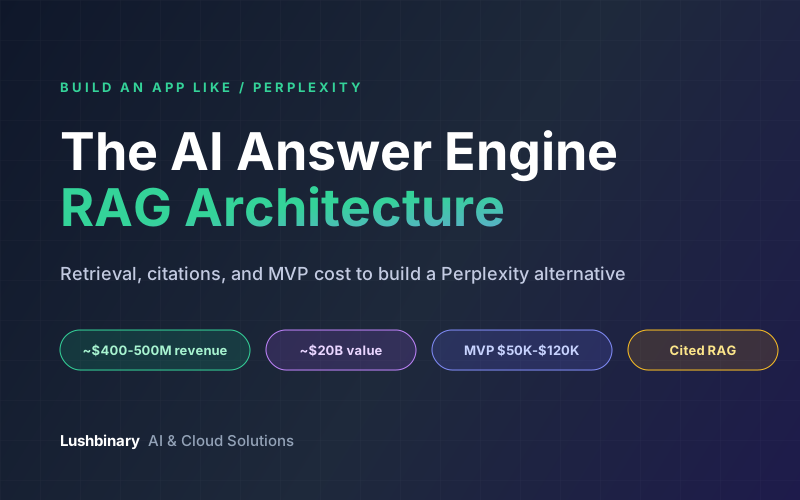
Perplexity reframed search. Instead of ten blue links, you get a direct, cited answer with the sources inline. That single shift took the company from around $10M in revenue in 2023 to roughly $400-500 million in annualized revenue by early 2026, at a valuation near $20 billion. The "answer engine" is now a category, and it is one of the most copyable AI products because the core loop is well understood: retrieve, rank, synthesize, cite.
That copyability is the opportunity. Perplexity users complain about hallucinations, shaky citations, weaker answers in long threads, and Pro usage limits that were quietly slashed. Meanwhile, no generalist can be the most trusted source for every domain. A focused answer engine that owns a curated, authoritative index for one vertical can out-trust the incumbent where it matters.
This guide breaks down what makes Perplexity work, how it monetizes, the gaps you can exploit, the features and RAG architecture of an answer engine, the AI techniques that improve answer trust, what it costs to build, and how Lushbinary can help you ship one.
📋 Table of Contents
- 1.What Makes Perplexity Successful
- 2.Perplexity’s Revenue Model & Pricing
- 3.User Complaints & Market Gaps You Can Exploit
- 4.Core Features for an Answer Engine MVP
- 5.RAG Architecture & Tech Stack
- 6.AI Techniques That Build Answer Trust
- 7.Development Cost & Timeline Breakdown
- 8.Why Lushbinary for Your Answer Engine MVP
1What Makes Perplexity Successful
Perplexity won by making AI answers feel trustworthy. The citations are the product. By showing exactly where each claim comes from, it gave users a reason to believe the answer and a way to verify it, which is precisely what raw chatbots failed to do.
Cited, Synthesized Answers
Every answer is stitched together from live sources with inline citations. This is retrieval-augmented generation done well: search the web, pull the most relevant passages, and have the model write a grounded answer that points back to its evidence.
Follow-Ups and Threads
Search becomes a conversation. Suggested follow-up questions keep users exploring, and the thread preserves context so each answer builds on the last. This is what turns a one-off query into a session.
Fast, Streaming Experience
Answers stream in token by token with sources appearing as they are found. The perceived speed matters as much as the actual latency. A competitor that feels sluggish will lose even with better answers, so streaming and snappy retrieval are non-negotiable.
| Metric | Perplexity |
|---|---|
| Annualized Revenue (early 2026, est.) | ~$400-500M |
| Valuation (late 2025) | ~$20B |
| Total Funding | $1.7B+ across multiple rounds |
| Pro Price | ~$20/month |
| Max Price | ~$200/month |
| Core Tech | Retrieval-augmented generation |
| Founded | 2022 |
| 2026 Focus | AI agents and usage-based pricing |
2Perplexity's Revenue Model & Pricing
Perplexity runs a freemium subscription with a premium tier and, as of 2026, a usage-based layer for agentic features. The free tier drives top-of-funnel growth while Pro and Max monetize power users and professionals.
| Plan | Price | Notes |
|---|---|---|
| Free | $0 | Basic answers with limited advanced searches |
| Pro | ~$20/month ($200/yr) | More advanced-model searches, file uploads, deeper research |
| Max | ~$200/month ($2,000/yr) | Highest limits, early agent features, premium models |
| Enterprise | Custom per seat | Team controls, data privacy, admin features |
The gap between $20 Pro and $200 Max is huge, and the recent quiet reduction of Pro search limits frustrated paying users. That tension is an opening: a competitor with clearer, more honest limits, or a domain where users will happily pay because the answers are authoritative, can convert the disillusioned. The most durable revenue is enterprise knowledge search, where companies pay for a trusted answer engine over their own documents.
💡 Revenue Opportunity
Vertical answer engines monetize better than generalist ones because the value is concrete. A legal, medical, or financial answer engine over a curated, licensed corpus can charge far more per seat than a consumer search tool, and enterprises will pay for an answer engine over their internal knowledge base that actually cites the right document.
3User Complaints & Market Gaps You Can Exploit
We reviewed reviews and community threads across Reddit, Product Hunt, and tech press. These are the recurring complaints, and each is a design goal for a better product.
🌀 Hallucinations
Answers sometimes state things the cited sources do not support. When the synthesis outruns the evidence, trust evaporates.
🔗 Shaky Citations
Citations occasionally point to the wrong passage or a weak source. A claim with a mismatched citation is worse than no citation.
🧵 Weak Long Threads
Quality degrades over long conversations as context gets muddled. Deep research sessions lose the thread.
✂️ Quietly Cut Limits
Pro advanced searches reportedly dropped from around 600 to 200 per week without clear notice, angering paying users.
💰 The $20 to $200 Cliff
There is little between Pro and Max. Users who outgrow Pro feel pushed into a 10x price jump they cannot justify.
📚 Generalist, Not Authoritative
For specialized domains, a broad web index is not enough. Professionals want answers grounded in vetted, domain-specific sources.
💡 The Opportunity
The biggest gap is verifiable trust in a domain. Build an answer engine over a curated, authoritative corpus, enforce that every claim maps to a real cited passage, and refuse to answer when the evidence is thin. In law, medicine, finance, or internal company knowledge, a tool that never bluffs beats a faster generalist that sometimes does.
4Core Features for an Answer Engine MVP
Phase 1: Lean MVP (8-12 weeks)
- Search & Retrieval - Query a search API or your own index, fetch top results, and extract clean passages
- Cited Synthesis - Generate a grounded answer with inline citations that map to specific source passages
- Streaming UI - Stream the answer and reveal sources as they are found, with a clean reading layout
- Follow-Up Questions - Suggest and handle follow-ups that keep conversation context
- Accounts & History - Save threads and let users revisit and continue past searches
- Billing - Free tier plus a paid plan with usage limits and clear quota display
Phase 2: Differentiation (8-12 weeks)
- Source Controls - Let users scope searches to trusted domains, uploaded files, or a curated corpus
- Reranking & Dedup - A reranker and deduplication step to surface the strongest, non-redundant evidence
- Collections & Workspaces - Organize research into shareable collections for teams
- File & PDF Q&A - Upload documents and ask questions grounded in their content
- Answer Confidence - Show how well-supported an answer is and flag when evidence is weak
Phase 3: Agents & Scale (10-14 weeks)
- Deep Research Mode - Multi-step agentic research that plans queries, gathers sources, and writes a structured report
- Domain Index Ingestion - Pipelines to crawl, license, and index a vertical corpus you control
- Enterprise Knowledge Search - Connect internal sources with permissions so answers respect access controls
- API Access - Expose answer and search endpoints for partners to embed
5RAG Architecture & Tech Stack
An answer engine lives or dies on its retrieval pipeline. The model is only as good as the passages you feed it. The three hard parts are finding the right sources, ranking and grounding, and citation fidelity so every claim traces to evidence.
Recommended Tech Stack
| Layer | Technology | Why |
|---|---|---|
| Frontend | Next.js + React + SSE | Streaming answers and an inline citation reading view |
| Search | Brave / Bing API, or own crawler | Fresh web results, or a curated index for a vertical |
| Vector DB | Qdrant, Weaviate, or pgvector | Semantic retrieval over indexed and uploaded content |
| Reranker | Cohere Rerank or a cross-encoder | Promote the most relevant passages before synthesis |
| LLM | Claude / GPT / Gemini | Grounded synthesis with citation-faithful output |
| Backend | Node.js or Python (FastAPI) | Orchestrate the retrieve-rank-synthesize pipeline |
| Data | PostgreSQL + Redis | Threads, history, and aggressive result caching |
| Hosting | AWS | Scalable inference, indexing, and crawling infrastructure |
Retrieval quality is the whole game. Our vector database comparison and our LLM gateway and routing guide cover the two decisions that most affect answer quality and cost.
6AI Techniques That Build Answer Trust
The difference between a credible answer engine and a confident bluffing machine is in these techniques. They are where you earn trust the incumbent keeps losing.
🔍 Query Decomposition
Break complex questions into sub-queries, retrieve for each, then synthesize. This beats a single search for multi-part research questions.
📌 Citation Verification
After generation, check that each cited claim is actually supported by the cited passage. Drop or flag claims that fail the check.
🚫 Honest Refusal
When evidence is thin or conflicting, say so instead of inventing an answer. Refusing to bluff is the strongest trust signal you can ship.
🏅 Source Quality Scoring
Rank sources by authority and recency, not just keyword match. A vetted source should outweigh a random blog every time.
🧮 Reranking
Use a cross-encoder reranker to reorder retrieved passages by true relevance before they reach the model's context.
📊 Continuous Evals
Run an eval harness on answer accuracy and citation fidelity so quality does not silently regress as you change prompts or models.
7Development Cost & Timeline Breakdown
An answer engine MVP is achievable quickly, but the trust and scale work is where the real investment goes. Here is a realistic breakdown.
Get Detailed Cost Breakdown
Fill in your details to unlock pricing and cost information.
8Why Lushbinary for Your Answer Engine MVP
At Lushbinary, we build production RAG systems and AI agents. An answer engine is squarely in our wheelhouse. Here is what we bring:
- RAG expertise - We build retrieval pipelines with reranking, citation verification, and honest refusal so answers stay grounded
- Search & indexing - We design crawl, ingest, and vector-index pipelines for curated vertical corpora you control
- Streaming UX - We build fast, streaming answer interfaces with inline citations that feel instant
- Eval-driven quality - We stand up eval harnesses for answer accuracy and citation fidelity so quality does not regress
- Cost control - We implement caching, reranking, and model routing to keep per-query costs sustainable
🚀 Free Consultation
Want to build an answer engine for your domain? Lushbinary specializes in production RAG and AI agents. We'll scope your project, recommend the right retrieval and model architecture, and give you a realistic timeline with no obligation.
❓ Frequently Asked Questions
How much does it cost to build an AI answer engine like Perplexity?
A focused MVP with search, retrieval, and cited answers costs $50,000-$120,000 over 4-6 months. A full platform with multi-source search, follow-ups, collections, and apps ranges from $150,000-$350,000 over 8-14 months. Search APIs and LLM inference dominate ongoing costs.
How does Perplexity make money?
A free tier, Pro at about $20/month, Max at about $200/month, plus enterprise and a usage-based layer on agentic features. It reached roughly $400-500M annualized revenue in early 2026 at a valuation around $20B.
What tech stack powers an AI answer engine?
A retrieval layer (search API or crawler plus a reranker), a vector database, an LLM for cited synthesis, a streaming frontend, and a backend in Node.js or Python with PostgreSQL and Redis. RAG pipeline quality determines answer quality.
What are the biggest complaints about Perplexity?
Occasional hallucinations, shaky or mismatched citations, weaker performance in long threads, and Pro usage limits quietly cut from around 600 to 200 advanced searches per week, plus a large gap between the $20 Pro and $200 Max tiers.
Can a niche answer engine compete with Perplexity?
Yes. Vertical answer engines for law, medicine, finance, or internal company knowledge can beat a generalist on accuracy and citation trust. Owning a curated, authoritative index is the durable advantage.
📚 Sources
- Sacra - Perplexity revenue and valuation - Revenue and funding data
- Perplexity official site - Product and pricing reference
- Android Authority - Pro usage limit changes - User complaints on quota cuts
Content was rephrased for compliance with licensing restrictions. Revenue, valuation, and pricing data sourced from public reporting and official sources as of May 2026. Figures may change - always verify current numbers before relying on them.
Build an Answer Engine Your Users Can Trust
Grounded answers, verified citations, and a curated index for your domain. Let Lushbinary build your Perplexity alternative on a RAG pipeline that never bluffs.
Ready to Build Something Great?
Get a free 30-minute strategy call. We'll map out your project, timeline, and tech stack - no strings attached.
Prefer email? Reach us directly: