
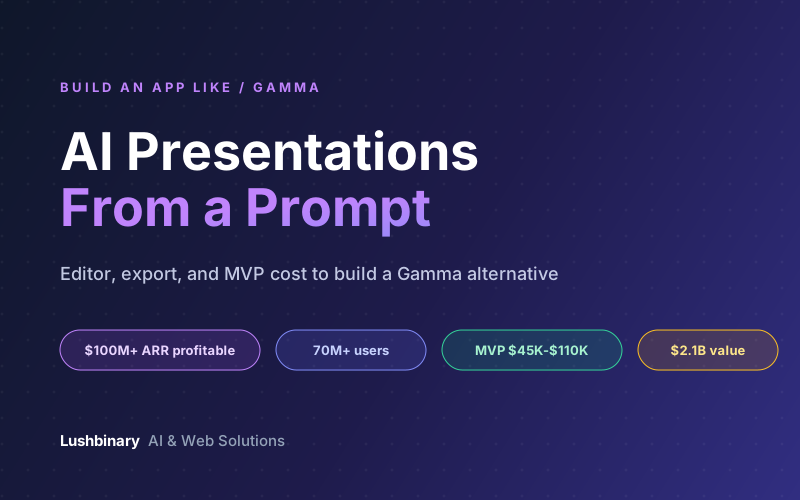
Gamma crossed $100 million in ARR, profitably, with a team of roughly 52 people, over 70 million users, and a $2.1 billion valuation. It did it by killing the blank slide. You type a prompt, Gamma generates a full, designed deck of cards, and you refine it by editing rather than fighting with formatting. While competitors chased enterprise or pivoted away from slides, Gamma stayed focused and rode the AI presentation wave to category leadership.
That focus also left gaps. Users complain about credits running out mid-project, limited fine-grained design control, imperfect PowerPoint export, and decks that all start to look the same. None of those are fatal for Gamma, but each is an opening for a tool built for a specific audience: sales teams, investors, educators, or enterprises that need brand-locked, on-message decks at scale.
This guide breaks down what makes Gamma work, how it monetizes, the gaps you can exploit, the features and architecture of an AI presentation tool, the AI capabilities that differentiate, what it costs to build, and how Lushbinary can help you ship it.
📋 Table of Contents
- 1.What Makes Gamma Successful
- 2.Gamma’s Revenue Model & Pricing
- 3.User Complaints & Market Gaps You Can Exploit
- 4.Core Features for an AI Presentation MVP
- 5.System Architecture & Tech Stack
- 6.AI-Powered Features That Differentiate
- 7.Development Cost & Timeline Breakdown
- 8.Why Lushbinary for Your AI Presentation MVP
1What Makes Gamma Successful
Gamma succeeded because it removed the worst part of making a deck: the blank canvas and the formatting busywork. The first draft is generated for you, designed, and good enough to edit rather than rebuild. That is the whole magic, and everything else supports it.
Prompt-to-Deck Generation
Type a topic or paste a document, and Gamma produces a structured, visually coherent deck in seconds. It handles layout, hierarchy, and imagery so the user starts from something presentable. Nailing this first-draft quality is the single most important thing a competitor must match.
Card-Based Editing, Not Slides
Gamma rethought the document model. Content lives in flexible "cards" that adapt rather than rigid fixed-size slides. This makes editing feel like working in a modern doc, and it is why output can become a presentation, a webpage, or a document from the same source.
Capital-Efficient, Product-Led Growth
Gamma reached $100M+ ARR profitably on a tiny team by leaning on product-led growth and a free tier that carries a subtle "Made with Gamma" signal. Every shared deck markets the product. A competitor needs the same kind of built-in distribution loop, not just a paid acquisition budget.
| Metric | Gamma |
|---|---|
| ARR | $100M+ (profitable) |
| Valuation (Series B) | $2.1B |
| Series B Raise | $68M (led by a16z) |
| Users | 70M+ |
| Paying Subscribers | 600,000+ |
| Team Size | ~52 people |
| Founded | 2020 |
| Category | AI presentation / document maker |
2Gamma's Revenue Model & Pricing
Gamma runs a credit-based freemium model with several individual tiers and team plans. AI generation consumes credits, which ties cost to the real inference expense while keeping a genuinely useful free tier.
| Plan | Price | Notes |
|---|---|---|
| Free | $0 | Up to ~10 cards per prompt, Gamma branding |
| Plus | ~$12/month | More cards per prompt, removes branding |
| Pro | ~$25/month | Premium AI image models, API, more cards |
| Ultra | ~$100/month | 20x more AI usage, most advanced models |
| Team / Business | ~$20-$40/seat/mo | Collaboration and admin controls |
The model proves you can be profitable in AI tooling with discipline: a free tier for growth, mid-tier plans for individuals, and seats for teams. The expansion path a competitor can attack is the enterprise and vertical market, where brand consistency, SSO, and content governance justify much higher per-seat prices than a consumer plan.
💡 Revenue Opportunity
Enterprises will pay a premium for a presentation generator locked to their brand, fed by their approved content, and governed for compliance. A vertical tool for sales decks, investor decks, or education that generates on-message material from a company's own library can command seat prices well above Gamma's consumer tiers.
3User Complaints & Market Gaps You Can Exploit
We reviewed reviews, comparison articles, and community threads. These are the recurring complaints, and each one is a feature opportunity.
🪙 Credits Run Out Fast
Heavy users hit credit limits mid-project and feel the meter running. Pricing predictability is a recurring frustration.
🎨 Limited Design Control
Compared to PowerPoint or Figma, fine-grained control over layout, spacing, and typography is limited. Designers feel boxed in.
📤 PPTX Export Fidelity
Exports to PowerPoint and Google Slides do not always preserve layout perfectly, which matters for teams that live in those tools.
👯 Templated Look
Generated decks share a recognizable Gamma aesthetic. Brands that want a distinct identity have to work against the defaults.
📱 Weak Mobile Editing
There is no fully native mobile editing experience. On-the-go editing and presenting are awkward.
🏢 Thin Enterprise Governance
Content approval, brand locking, and compliance controls are limited for organizations that need on-message decks at scale.
💡 The Opportunity
The biggest gap is brand-true output for a vertical. A tool that generates decks locked to a company's brand, drawn from approved content, with clean PPTX export and real design control, beats a generalist for any team that presents professionally. Pick sales, investor, or education decks and own that workflow end to end.
4Core Features for an AI Presentation MVP
Phase 1: Lean MVP (8-12 weeks)
- Prompt-to-Deck - Generate a structured, designed deck from a topic, outline, or pasted document
- Card Editor - A flexible, block-based editor for text, images, and layouts that feels like a modern doc
- Themes - A set of polished themes that apply consistent typography, color, and spacing
- AI Images - Generate or source visuals that match each card's content
- Export & Share - PDF and PPTX export plus a shareable link with present mode
- Accounts & Credits - Auth and credit-based usage metering tied to billing
Phase 2: Differentiation (8-12 weeks)
- Brand Kits - Upload logos, fonts, and colors so every generated deck is on-brand by default
- High-Fidelity Export - PPTX and Google Slides export that preserves layout accurately
- Real-Time Collaboration - Multiplayer editing, comments, and version history
- Document & Web Output - Turn the same content into a doc or a published webpage
- Analytics - Track views and engagement on shared decks
Phase 3: Enterprise & Scale (10-14 weeks)
- Content Governance - Approved content libraries, brand locking, and review workflows
- SSO & Admin - SAML SSO, roles, and audit logs for organizations
- Native Mobile - A mobile app for editing and presenting on the go
- API & Integrations - Generate decks programmatically from CRM, analytics, or internal data
5System Architecture & Tech Stack
An AI presentation tool has three hard parts: content generation (outline plus per-card content and imagery), a flexible document model and editor (the card canvas with real-time collaboration), and faithful export (turning that model into PPTX, PDF, and web). Here is the architecture we recommend.
Recommended Tech Stack
| Layer | Technology | Why |
|---|---|---|
| Frontend | Next.js + React | The editor canvas, present mode, and shared views |
| Editor | TipTap / ProseMirror or Lexical | Block-based rich editing for the card model |
| Text AI | Claude / GPT / Gemini | Outline and per-card content generation |
| Image AI | Flux, Ideogram, or DALL-E class models | On-topic visuals and backgrounds |
| Collaboration | CRDT (Yjs / Liveblocks) | Real-time multiplayer editing and history |
| Export | PptxGenJS, headless render to PDF | Faithful PPTX, PDF, and image export |
| Backend | Node.js + PostgreSQL | Documents, assets, and metadata |
| Billing | Stripe + credit metering | Freemium tiers and seat plans tied to inference |
The image and text generation both consume inference, so route by need. Our AI image generation comparison and our LLM routing guide cover how to keep generation costs in check.
6AI-Powered Features That Differentiate
The generation is the product. These are the AI capabilities that separate a deck tool people love from one they tolerate.
🧱 Brand-Aware Generation
Generate decks that respect uploaded brand kits, approved imagery, and tone of voice, so the first draft is already on-brand.
📄 Document-to-Deck
Turn a report, spec, or transcript into a tight deck by summarizing and structuring the source, not just paraphrasing it.
🎯 Audience Tuning
Regenerate the same content for a different audience (executive, technical, sales) with the right depth and framing.
📊 Data-to-Chart
Take pasted numbers or a connected data source and produce accurate charts with clear takeaways, not decorative visuals.
✍️ Inline AI Editing
Select any card and ask for a rewrite, a shorter version, or a different layout without leaving the canvas.
🌐 Multilingual Decks
Generate and translate decks across languages while preserving layout and design, useful for global teams.
7Development Cost & Timeline Breakdown
The editor and export engine are the heaviest lifts, and export fidelity in particular is where many clones cut corners. Here is a realistic breakdown.
Get Detailed Cost Breakdown
Fill in your details to unlock pricing and cost information.
8Why Lushbinary for Your AI Presentation MVP
At Lushbinary, we build AI-powered web products with rich editors and generation pipelines. Here is what we bring to a presentation tool:
- Rich editors - We build block-based, collaborative editors with CRDT-backed real-time editing and version history
- Generation pipelines - We design outline-to-content generation with brand awareness and structured, reliable output
- Export fidelity - We build PPTX, PDF, and web export that preserves layout, the detail most clones get wrong
- Cost-aware AI - We meter credits to real inference spend and route text and image generation to keep margins healthy
- Speed - We use AI coding tools to ship MVPs 30-40% faster without sacrificing quality
🚀 Free Consultation
Want to build an AI presentation tool that competes? Lushbinary specializes in AI-powered web apps with rich editors. We'll scope your project, recommend the right editor and generation architecture, and give you a realistic timeline with no obligation.
❓ Frequently Asked Questions
How much does it cost to build an AI presentation tool like Gamma?
An MVP that turns a prompt into an editable deck costs $45,000-$110,000 over 4-7 months. A full platform with real-time editing, PPTX and Google Slides export, websites, and analytics ranges from $130,000-$300,000 over 8-14 months.
How does Gamma make money?
A credit-based freemium model: free, Plus around $12/month, Pro around $25/month, Ultra around $100/month, plus Team and Business seats. It crossed $100M+ ARR profitably at a $2.1B valuation with 70M+ users on a team of about 52.
What tech stack should I use to build a Gamma alternative?
Next.js with a block editor (TipTap or Lexical) for the canvas, an LLM for content, an image model for visuals, CRDT for collaboration, PptxGenJS for export, Node.js and PostgreSQL for the backend, and Stripe with credit metering.
What are the biggest complaints about Gamma?
Credits running out quickly, limited fine-grained design control, imperfect PPTX export fidelity, a recognizable templated look, and the lack of a fully native mobile editing app.
Is the AI presentation market still open after Gamma's lead?
Yes. Vertical decks (sales, investor, education, medical), brand-locked enterprise generators, and tools with better export fidelity or real design control are underserved. Gamma proved the market; niches remain open.
📚 Sources
- Gamma pricing page - Plan and pricing data
- Sacra - AI slides market analysis - ARR history and market context
- Gamma - How we built a $100M business - ARR, valuation, and team size
Content was rephrased for compliance with licensing restrictions. Revenue, valuation, user, and pricing data sourced from public reporting and official sources as of May 2026. Figures may change - always verify current numbers before relying on them.
Build an AI Presentation Tool That Stays On Brand
Brand-true generation, faithful PPTX export, and real design control. Let Lushbinary build your Gamma alternative for the vertical you know best.
Ready to Build Something Great?
Get a free 30-minute strategy call. We'll map out your project, timeline, and tech stack - no strings attached.
Prefer email? Reach us directly: