
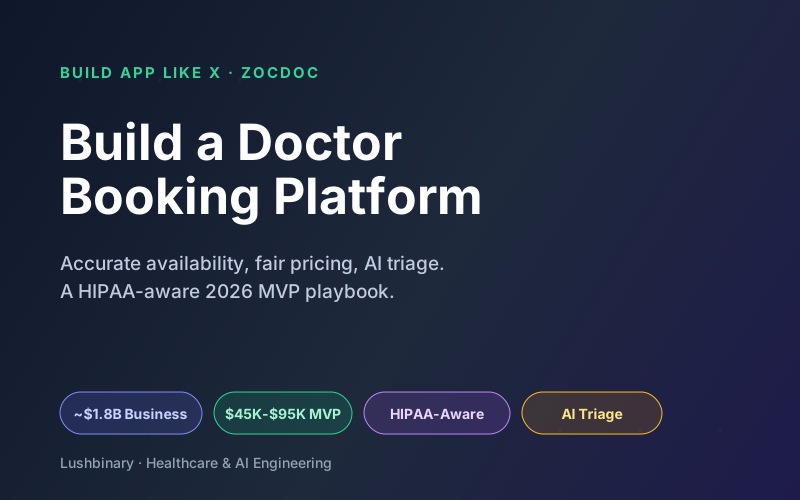
Booking a doctor used to mean phone tag and voicemail. Zocdoc fixed that by turning appointment scheduling into a real-time marketplace, and it grew into a roughly $1.8 billion business where more than 6 million patients search every month. It is free for patients and monetizes the provider side, which is exactly where its model has been reinvented over the years.
The patient scheduling market is large and growing as more health systems offer online booking and more patients expect it. But Zocdoc is not without friction. Providers debate whether per-booking costs are worth it, value skews toward high-demand specialties, patients sometimes hit inaccurate availability or insurance data, and coverage is thin in some regions. Each gap is room for a more accurate, fairer, or specialty-focused booking platform, especially one with AI triage and reminders that cut no-shows.
This guide breaks down what makes Zocdoc work, how it monetizes, the gaps you can exploit, the MVP feature set, the HIPAA-aware architecture and tech stack, the AI features that differentiate, real cost and timeline, and how Lushbinary can help you build it.
📋 Table of Contents
- 1.What Makes Zocdoc Successful
- 2.Zocdoc’s Revenue Model & Network Effects
- 3.Complaints & Market Gaps You Can Exploit
- 4.Core Features for a Booking MVP
- 5.HIPAA-Aware Architecture & Tech Stack
- 6.AI-Powered Features That Differentiate
- 7.Development Cost & Timeline Breakdown
- 8.Why Lushbinary for Your Healthcare Booking MVP
1What Makes Zocdoc Successful
Zocdoc solved a two-sided problem: patients could not easily find open appointments, and providers had empty slots and high no-show rates. Three things made the marketplace work.
Real-Time Availability
Showing actual open slots, not a request form, is the core magic. Real-time availability synced from provider calendars is what turns browsing into booking.
Insurance-Aware Search
Patients filter by insurance, specialty, location, and availability. Matching patients to in-network providers removes a major source of friction and surprise bills.
Reminders That Cut No-Shows
Automated reminders and easy rescheduling reduce no-shows, which is a direct revenue win for providers and a key part of Zocdoc's value proposition.
| Metric | Zocdoc |
|---|---|
| Valuation (reported) | ~$1.8 billion |
| Monthly Patient Searches | 6 million+ |
| Patient Cost | Free |
| Provider Model | Per-booking (evolved from subscription) |
| Core Value | Real-time availability + insurance match |
| Compliance | HIPAA-regulated (US PHI) |
2Zocdoc's Revenue Model & Network Effects
Zocdoc keeps the platform free for patients to maximize demand, then charges providers for the new patients that demand generates. Its model has shifted over time, and that history is instructive.
💡 Model Evolution
Zocdoc historically charged providers a flat annual subscription, but that under-served high-demand providers and over-charged low-demand ones. It moved toward a per-booking model that ties cost to value delivered. Designing fair, value-aligned provider pricing from day one is a real advantage for a new entrant.
| Revenue Stream | How It Works |
|---|---|
| Per-Booking Fees | Providers pay for new patients booked through the marketplace |
| Provider Tools | Scheduling, reminders, and intake software for practices |
| Health Plan Partnerships | Partnerships that route members to in-network providers |
| Enterprise / Health Systems | Platform deals with large provider groups and systems |
3Complaints & Market Gaps You Can Exploit
We reviewed provider and patient feedback across forums, reviews, and industry analysis. These are the recurring issues, each a feature or positioning opportunity.
💸 Per-Booking Costs Add Up
Some providers feel booking fees get expensive. Transparent, value-aligned pricing is a strong pitch to practices.
⚖️ Uneven Value by Specialty
High-demand specialties get more value than low-demand ones. Specialty-specific platforms can price fairly for their niche.
📅 Inaccurate Availability
Patients report booking slots that turn out unavailable. Tight, real-time calendar and EHR sync builds trust.
🧾 Insurance Confusion
Insurance and coverage info is not always accurate. Reliable eligibility checks reduce surprise bills.
🌍 Coverage Gaps
Provider density is thin in some regions and specialties. A regional or vertical focus can dominate an underserved area.
🩺 Limited Care Continuity
Booking ends at the appointment. Tighter follow-up, telehealth, and intake create a fuller patient experience.
💡 The Opportunity
Win a vertical or region. A booking platform focused on dentistry, mental health, dermatology, or a specific metro, with accurate availability, fair provider pricing, AI triage, and integrated telehealth, can out-serve a broad marketplace in that niche.
4Core Features for a Booking MVP
Phase 1: Lean MVP (10-14 weeks)
- Provider Search - Filter by specialty, location, insurance, and availability
- Real-Time Availability - Open slots synced from provider calendars
- Online Booking - Book, reschedule, and cancel with confirmation
- Reminders - SMS and email reminders to reduce no-shows
- Provider Dashboard - Manage calendar, slots, and patient bookings
- HIPAA Foundations - Encryption, access control, and audit logging from day one
Phase 2: Differentiation (10-12 weeks)
- Insurance Eligibility - Verify coverage and in-network status before booking
- Digital Intake - Pre-visit forms and history collection
- Telehealth Video - Integrated, compliant video visits
- Reviews & Ratings - Verified post-visit reviews to build trust
- EHR / Calendar Sync - Two-way sync with practice systems to keep availability accurate
Phase 3: AI & Scale (10-14 weeks)
- AI Symptom Triage - Guide patients to the right specialty and urgency level
- Smart Matching - Recommend providers by fit, availability, and patient preferences
- No-Show Prediction - Predict and reduce no-shows with targeted reminders and waitlists
- Multi-Region Operations - Manage specialties, networks, and compliance per region
5HIPAA-Aware Architecture & Tech Stack
A healthcare booking platform must protect patient data, sync availability accurately, and support compliant telehealth. Here is the architecture we recommend.
Recommended Tech Stack
| Layer | Technology | Why |
|---|---|---|
| Web | Next.js + React | SEO-friendly provider search and fast booking UX |
| Mobile | React Native or Flutter | Cross-platform patient app with reminders |
| Backend | Node.js (Express/Fastify) | Webhooks, integrations, and booking logic |
| Database | PostgreSQL | Relational data for providers, slots, and bookings |
| Cache | Redis | Availability caching and rate limiting |
| Cloud | HIPAA-eligible AWS | BAAs, encryption, audit logging, scalable services |
| Telehealth | Compliant video SDK | HIPAA-eligible video visits with recording controls |
| AI | LLM + guardrails | Symptom triage, smart matching, no-show prediction |
💡 Related Reading
For a deeper dive on compliance, see our guide on building a HIPAA-compliant AI healthcare app.
6AI-Powered Features That Differentiate
AI can make booking smarter and care more accessible, as long as it stays within clear clinical and compliance guardrails.
🩺 Symptom Triage
Guide patients to the right specialty and urgency level with a conversational intake, always deferring to clinicians for diagnosis.
🎯 Smart Provider Matching
Recommend providers by fit, availability, insurance, and patient preferences to speed booking.
📉 No-Show Prediction
Predict likely no-shows and trigger smart reminders or waitlist fills to keep schedules full.
📝 Intake Summarization
Summarize patient-submitted history into a concise pre-visit brief for the provider.
🌐 Multilingual Access
Translate search, intake, and reminders so non-English speakers can book care easily.
💬 Booking Assistant
An assistant that answers coverage and scheduling questions and completes bookings by chat.
7Development Cost & Timeline Breakdown
Healthcare booking costs more than a generic marketplace because of HIPAA compliance, accurate calendar and EHR sync, and telehealth. Here is what to budget.
Get Detailed Cost Breakdown
Fill in your details to unlock pricing and cost information.
8Why Lushbinary for Your Healthcare Booking MVP
At Lushbinary, we build HIPAA-aware healthcare platforms and AI-powered products. Here is what we bring to a booking marketplace:
- Healthcare compliance - We build with encryption, access controls, audit logging, and BAAs for HIPAA-regulated data
- Marketplace engineering - We build real-time availability, search, and matching at scale
- Integrations - We connect calendars, EHR systems, insurance eligibility, and compliant telehealth video
- AI with guardrails - We build symptom triage and matching that defer to clinicians and respect compliance
- AI-accelerated delivery - We use AI coding tools to ship MVPs 30-40% faster without cutting quality
🚀 Free Consultation
Want to build a doctor booking platform that actually competes? Lushbinary specializes in HIPAA-aware, AI-powered healthcare products. We'll scope your project, recommend the right tech stack, and give you a realistic timeline with no obligation.
❓ Frequently Asked Questions
How much does it cost to build a doctor booking app like Zocdoc?
An MVP with provider search, real-time availability, online booking, and reminders costs $45,000-$95,000 over 10-14 weeks. A full HIPAA platform with insurance checks, telehealth, and AI triage ranges from $130,000-$300,000.
How does Zocdoc make money?
It is free for patients and charges providers, historically via subscriptions and now largely per-booking for new patients. It is valued around $1.8 billion with 6 million-plus monthly patient searches.
What are the biggest complaints about Zocdoc?
Per-booking costs adding up, uneven value across specialties, occasionally inaccurate availability or insurance data, and thin coverage in some regions. Each is an opening for a fairer or vertical platform.
Do I need HIPAA compliance to build a doctor booking app?
Yes. If you handle protected health information in the US, you need encryption in transit and at rest, access controls, audit logging, signed BAAs with vendors, and a HIPAA-eligible cloud setup such as AWS.
What tech stack should I use to build a doctor booking app?
Next.js or React for web, React Native or Flutter for mobile, Node.js for the backend, PostgreSQL, Redis for availability, HIPAA-eligible AWS, and integrations for calendars, EHR, and telehealth video.
📚 Sources
- Zocdoc for Enterprise Providers - Patient search volume and provider model
- How Zocdoc Evolved Its Business Model - Subscription to per-booking analysis
- HHS HIPAA Resources - Compliance requirements for PHI
Content was rephrased for compliance with licensing restrictions. Business model and valuation data sourced from public reporting and official Zocdoc pages as of early 2026. Figures may change - always verify on the vendor's website.
Build a Doctor Booking Platform That Patients Trust
Accurate availability, fair provider pricing, HIPAA-aware architecture, and AI triage. Let Lushbinary build your Zocdoc alternative for the specialty or region you want to own.
Ready to Build Something Great?
Get a free 30-minute strategy call. We'll map out your project, timeline, and tech stack - no strings attached.
Prefer email? Reach us directly: