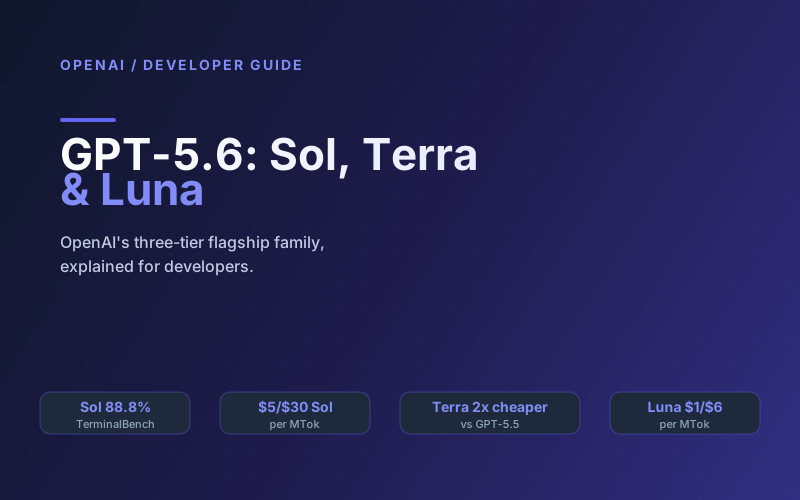

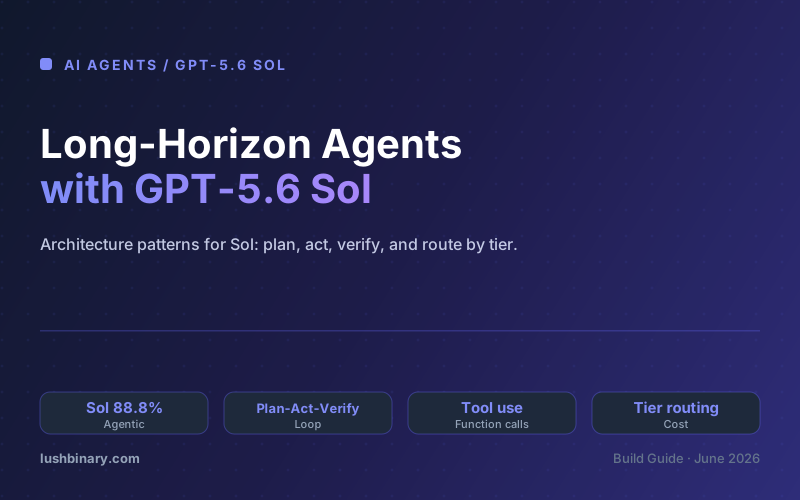

Most AI agents are sprinters. They answer one prompt, fire one tool call, and stop. A long-horizon agent is a marathon runner: it holds a goal across many steps and an extended time window, recovers from its own mistakes, and decides what to do next with little supervision. GPT-5.6 Sol, announced on June 26, 2026, is built for exactly that. OpenAI positions Sol as the flagship of the GPT-5.6 family, tuned for frontier reasoning and long-horizon agentic work across coding, biology, and cybersecurity.
The capability is real and so is the cost. Sol runs at $5 per million input tokens and $30 per million output tokens, and a long-horizon agent that fans one instruction into dozens of model calls adds up fast. The teams that get the most out of Sol pair its reasoning with disciplined architecture: a clear plan-act-verify loop, smart tier routing, external memory, guardrails, and observability.
This guide is a practical blueprint for building a production long-horizon agent on Sol. For the autonomous coding angle, see our GPT-5.6 Codex autonomous coding guide, and for the loop mindset behind agentic development read our loop engineering guide.
What This Guide Covers
- What Long-Horizon Agents Are and Why Sol Fits
- The Agent Architecture
- The Plan-Act-Verify Loop
- Tool Use and Function Calling
- Memory and State Across Long Runs
- Guardrails and Human-in-the-Loop
- Cost Control via Tier Routing
- Evaluation and Observability
- The Limited Preview Caveat and Fallbacks
- Why Lushbinary for Agent Builds
- FAQ
1What Long-Horizon Agents Are and Why Sol Fits
A long-horizon agent works toward a goal across many steps and an extended time window, maintaining state, recovering from errors, and choosing its next action with minimal oversight. Think framework migrations across thousands of files, multi-stage research and synthesis pipelines, or a feature built end to end with its own tests. What these share is that the cost of a missed detail outweighs the token bill, and the work genuinely benefits from sustained autonomy.
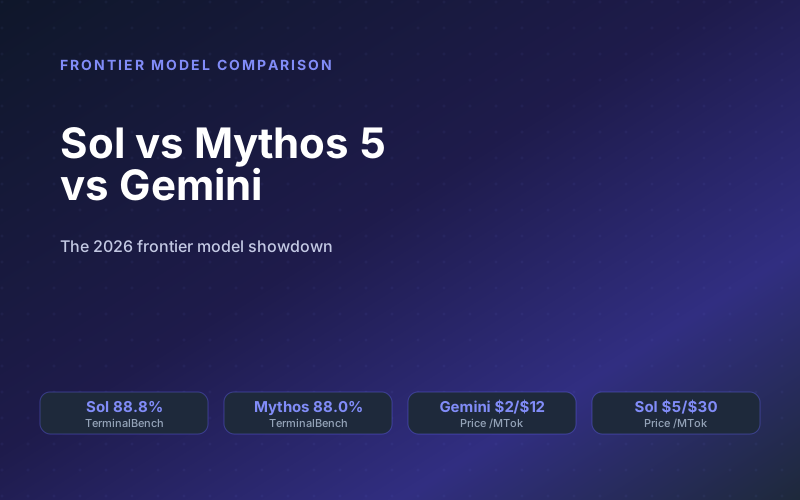
That is where Sol earns its place. OpenAI tunes Sol for frontier reasoning and long-horizon agentic work, and the public benchmark numbers back the positioning. On TerminalBench 2.1, an agentic terminal benchmark, Sol reported 88.8% and the compute-intensive Sol Ultra mode reported 91.9%. For comparison, Mythos 5 sat at 88.0%, Luna at 82.5%, and Opus 4.8 at 78.9%. OpenAI also reports token efficiency gains of roughly 10 to 15 percent over GPT-5.5, which compounds across a long run.
Reasoning headroom is the point
A long run fails when a single bad decision cascades. The value of a stronger reasoning model on the planning and verification steps is fewer of those cascading failures, which means fewer wasted tool calls and less human cleanup. That is why Sol belongs on the hard steps even when cheaper tiers cover the rest.
2The Agent Architecture
A robust long-horizon agent is not one giant prompt. It is a small set of roles that cooperate: a planner that decomposes the goal, an executor that carries out steps and calls tools, a verifier that checks results before they are accepted, and a memory store that persists state so a long run can resume. Here is the shape:
The planner runs on Sol because decomposition and replanning are where its reasoning advantage pays off. The executor carries out scoped steps and is where most tool calls happen. The verifier gates output with deterministic checks and a critic pass. The memory store holds the plan and progress so a multi-step run survives a restart. Crucially the verifier feeds back to the planner, which is what turns a one-shot pipeline into a loop that can correct itself.
3The Plan-Act-Verify Loop
The engine of a long-horizon agent is a simple loop run many times: plan the next step, act on it, verify the result, then update the plan. Each pass narrows the gap between the current state and the goal, and the loop exits when the verifier confirms the goal is met or a budget is hit.
- Plan - the planner reads current state from memory and chooses the next concrete step, or revises the plan when the verifier reports a problem.
- Act - the executor performs the step, usually by calling one or more tools, and writes the raw result back to memory.
- Verify - deterministic checks run first, then a critic pass on anything they cannot catch. Failures route back to the planner instead of being silently accepted.
// loop sketch, model id is a placeholder
// confirm the exact id in the OpenAI docs
let state = await memory.load(goal);
while (!state.done && state.budgetLeft > 0) {
  const step = await plan({
    model: "gpt-5.6-sol",   // hard reasoning on the planner
    goal,
    state,
  });
  const result = await execute(step);   // tools run here
  const check = await verify(step, result);
  state = await memory.update(state, result, check);
}
Note that "gpt-5.6-sol" above is a placeholder. Confirm the exact model identifier in the OpenAI documentation before you ship, since model ids and aliases change between releases.
4Tool Use and Function Calling
Tools are how the agent touches the world: reading and writing files, querying a database, running tests, searching a codebase, or calling an internal API. Function calling lets Sol pick a tool and supply structured arguments, and your runtime executes the call and returns the result for the next turn. A few habits keep tool use reliable on long runs:
- Keep tool schemas tight - narrow, well-described parameters reduce malformed calls and make the model's intent easier to validate before you execute.
- Validate before executing - treat every tool call as untrusted input. Check arguments against a schema and reject calls that fall outside expected bounds.
- Return compact results - hand back a short, relevant summary rather than a giant blob. This controls token cost and keeps the context focused on what the next step needs.
- Make tools idempotent where you can - a long run that retries a step should not double-charge a payment or duplicate a record. Idempotency makes recovery safe.
Gate the dangerous tools
Separate read-only tools from tools that mutate state or spend money. Read-only tools can run freely; mutating tools should require a verification step or human approval proportional to how hard the action is to reverse.
5Memory and State Across Long Runs
A run that spans many steps cannot keep everything in the model's context window. OpenAI has not officially confirmed the context window for GPT-5.6. The prior GPT-5.5 generation offered a 1 million token window, so a comparable size is expected but unconfirmed, and you should not hardcode a specific length into your design. External memory is the durable answer:
- Working state - persist the plan, completed steps, and open tasks to a store the agent reads at the start of each turn, so a restart resumes instead of starting over.
- Summarize aggressively - compress finished workstreams into short summaries rather than carrying full transcripts forward. This fights context bloat and controls cost.
- Retrieval over recall - store artifacts externally and retrieve only what the current step needs. A dedicated memory layer beats stuffing the entire history into the prompt.
The reported 10 to 15 percent token efficiency gain over GPT-5.5 helps here, but architecture matters more than any single model number. Treat context as a scarce budget you spend deliberately, not a bucket you fill until it overflows.
6Guardrails and Human-in-the-Loop
Autonomy should scale with reversibility. A step that is cheap to undo can run unattended; a step that touches production, money, or data should pause for a human. Build the guardrails into the loop rather than bolting them on later:
| Action class | Guardrail |
|---|---|
| Read-only | Run freely. Log the call and result for the audit trail. |
| Reversible writes | Require a verifier pass before accepting. Keep an undo path. |
| Irreversible or costly | Require explicit human approval before the agent proceeds. |
| Out of scope | Block at the tool layer. The model cannot call what it cannot reach. |
Treat tool output and retrieved content as untrusted data. If an agent reads a file or web page that contains text resembling instructions, those instructions must not override your system prompt or guardrails. Prompt injection is a real risk for any agent that reads external content, so keep the trust boundary explicit.
7Cost Control via Tier Routing
The single biggest cost lever in a long-horizon agent is which tier runs each step. The GPT-5.6 family gives you a natural ladder: Sol for hard reasoning, Terra for mid-tier work, and Luna for routine, high-volume steps. A step using 200,000 input and 50,000 output tokens costs 0.2 * 5 + 0.05 * 30 = $2.50 on Sol, about 0.2 * 2.50 + 0.05 * 15 = $1.25 on Terra, and 0.2 * 1 + 0.05 * 6 = $0.50 on Luna. Route deliberately:
| Tier | Price per MTok (in / out) | Agent role |
|---|---|---|
| Sol (and Sol Ultra) | $5 / $30 | Planner and verifier, the hard reasoning steps. Sol Ultra for the toughest cases. |
| Terra | $2.50 / $15 | Mid-tier executor work that needs solid reasoning but not the flagship. |
| Luna | $1 / $6 | Routine, high-volume steps: edits, search, summaries, simple tool calls. |
Escalate, do not default up
Start a step on the cheapest tier that can plausibly handle it. If a sub-task turns out to be genuinely hard, promote it to Sol for that step only. Combined with per-task and per-day token caps, this keeps the flagship rate on the work that justifies it. For deeper routing patterns, our model gateway guides cover the mechanics.
8Evaluation and Observability
You cannot improve what you cannot see. A long-horizon agent makes dozens of decisions per run, so per-step observability is not optional. Capture enough to reconstruct any run after the fact:
- Per-step traces - tier used, token counts, tool calls, latency, and the verifier verdict for each step.
- Outcome evals - a suite of representative tasks with known-good outcomes you can run against a candidate prompt or routing change before it reaches production.
- Cost and budget alerts - track spend per run and alert when a run approaches its cap, so a stuck loop surfaces early.
- Failure taxonomy - tag why steps fail (bad plan, tool error, verifier catch) so you know whether to fix the prompt, the tools, or the routing.
Benchmarks like the reported 88.8% on TerminalBench 2.1 tell you about the model in general. Your own evals tell you whether the agent works on your tasks, which is the number that actually matters.
9The Limited Preview Caveat and Fallbacks
One important reality check before you build a business on Sol: it launched as a limited preview. GPT-5.6 was announced on June 26, 2026 and rolled out to ChatGPT and Codex rather than as a broad general release. The prior generation, GPT-5.5, had shipped on April 23, 2026.
Plan for limited and changing access
Per tech press reporting, the limited rollout followed a request from the US government, which OpenAI complied with while warning that such restrictions should not become the norm. Availability and access terms can change, so design your agent to fall back to another tier or a different model if Sol is unavailable, and confirm current access terms before depending on it for a production workload.
Practically, that means your routing layer should treat the model choice as configuration, not a hardcoded constant. If Sol is throttled or unavailable, the planner can degrade gracefully to Terra or another frontier model, and your evals tell you how much quality you lose when it does.
10Why Lushbinary for Agent Builds
Building a long-horizon agent that survives contact with production is less about the model and more about the architecture around it: the plan-act-verify loop, tier routing, durable memory, guardrails, and observability. Lushbinary builds production long-horizon agents end to end, from the orchestration layer and tool integrations to the cost controls and human-in-the-loop checkpoints that keep them safe to run unattended.
Whether you are prototyping an agent on Sol or hardening one for real workloads, we can help you ship it with the guardrails and evals that make it trustworthy. Tell us what you are building and we will map out the architecture, the routing, and the path to production.
11Frequently Asked Questions
What makes GPT-5.6 Sol good for long-horizon agents?
OpenAI positions Sol as the flagship of the GPT-5.6 family, built for frontier reasoning and long-horizon agentic work across coding, biology, and cybersecurity. On the TerminalBench 2.1 agentic benchmark, Sol reported 88.8% and the compute-intensive Sol Ultra mode reported 91.9%, ahead of Opus 4.8 at 78.9% and just above Mythos 5 at 88.0%. For agents that plan across many steps, call tools, and check their own work, that reasoning headroom is what keeps a long run on track.
How do I control costs across a long agent run on Sol?
Sol costs $5 per million input tokens and $30 per million output tokens, so a single step using 200,000 input and 50,000 output tokens costs about 0.2 times 5 plus 0.05 times 30, which is $2.50 before any caching. Route only the hard reasoning steps, planning and verification, to Sol, and send routine sub-tasks to Terra at $2.50/$15 or Luna at $1/$6. The same example step costs about $1.25 on Terra and $0.50 on Luna. Add per-task and per-day token caps so a runaway loop cannot become a runaway invoice.
What context window does GPT-5.6 Sol support for long sessions?
OpenAI has not officially confirmed the context window for the GPT-5.6 family. The prior GPT-5.5 generation offered a 1 million token window, so a comparable size is expected but unconfirmed. Do not hardcode a specific length into your architecture. For multi-step runs, lean on external memory and summarization rather than trying to hold everything in context, and verify the current limit in the OpenAI documentation before you build around it.
Can I rely on GPT-5.6 Sol being available in production?
Not without a fallback. GPT-5.6 launched on June 26, 2026 as a limited preview rolled out to ChatGPT and Codex. Per tech press reporting, the limited rollout followed a request from the US government, which OpenAI complied with while warning that such restrictions should not become the norm. Access and availability can change, so design your agent to fall back to another tier or model if Sol is unavailable, and confirm access terms before depending on it for a production workload.
Should every step in a long-horizon agent use Sol?
No. A cost-effective pattern uses Sol as the planner and verifier where its reasoning advantage pays off, and delegates mechanical steps such as file edits, test runs, and search to Terra or Luna. Reserving the flagship for high-leverage steps keeps quality high on the decisions that matter while avoiding the Sol rate on routine work that a cheaper tier handles well.
Sources
- OpenAI - official model family, pricing, and capability announcements.
- 9to5Mac - GPT-5.6 limited release to ChatGPT and Codex.
- Wikipedia: GPT-5.6 - overview and timeline.
- TechCrunch - limited rollout after a government request.
Content was rephrased for compliance with licensing restrictions. Pricing and benchmark data sourced from official OpenAI announcements and reputable tech press as of June 27, 2026. Figures may change, always verify with the vendor.
Build a Production Long-Horizon Agent
Lushbinary designs and ships long-horizon agents with the loop, tier routing, memory, guardrails, and observability that make them safe to run in production.
Ready to Build Something Great?
Get a free 30-minute strategy call. We'll map out your project, timeline, and tech stack - no strings attached.
Prefer email? Reach us directly: