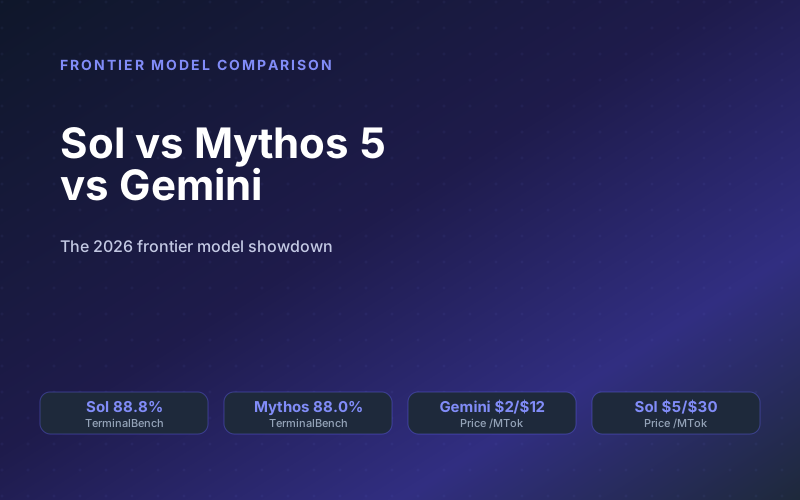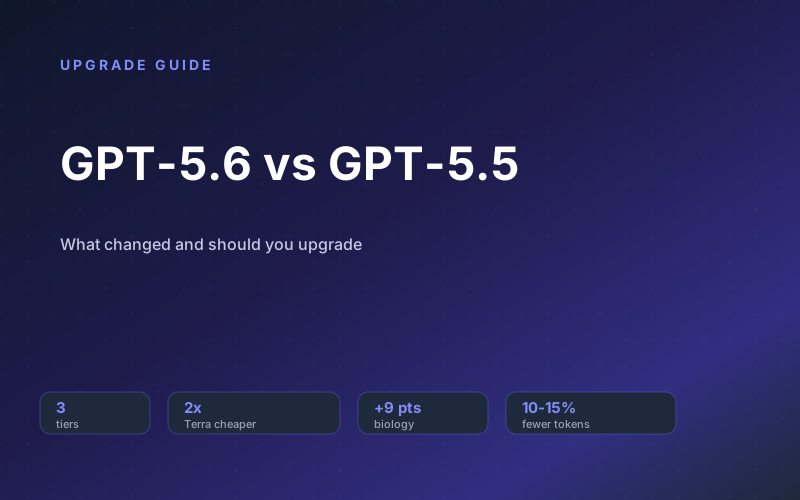

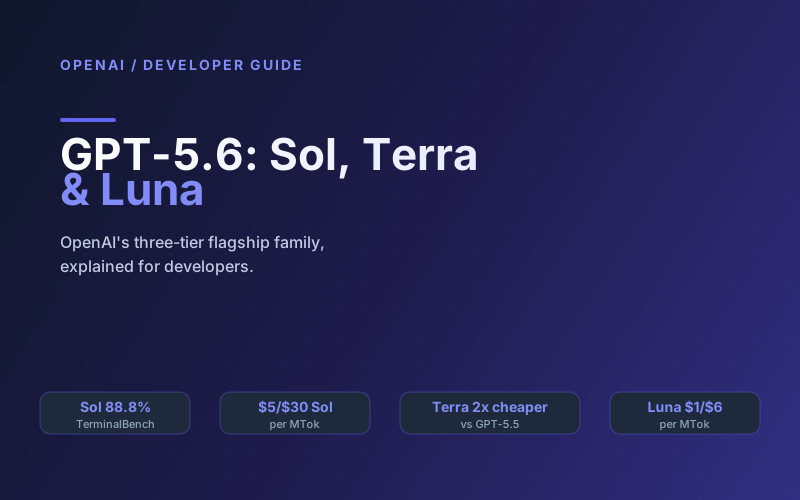

On June 26, 2026, OpenAI announced GPT-5.6, a flagship family split into three named tiers: Sol, Terra, and Luna. Rather than shipping one model with a dial, OpenAI is selling three models tuned for different points on the cost, speed, and capability curve, plus a compute-intensive high-effort mode of the flagship called Sol Ultra.
The release arrived as a limited preview, not a general launch. The US government requested that OpenAI restrict the rollout of all three models, OpenAI complied, and the company said publicly that such restrictions should not become the norm. That regulatory backdrop is part of the story for any team planning to build on these models.
This guide walks through what shipped, how the three tiers and Sol Ultra differ, the verified TerminalBench 2.1 and SecureBio biology numbers, full pricing for every tier, how to pick a tier, the access situation, the agentic and coding and cyber gains, and the API notes you need before you wire GPT-5.6 into production.
What This Guide Covers
1What Shipped on June 26, 2026
GPT-5.6 is the successor to GPT-5.5, which OpenAI released on April 23, 2026. The headline change is structural: instead of one frontier model with effort settings, OpenAI now publishes three distinct tiers under a single family name, each with its own rate card and target workload.
The three tiers are Sol (frontier reasoning and long-horizon agentic work), Terra (the balanced everyday model), and Luna (the fastest and cheapest tier). On top of Sol sits Sol Ultra, a compute-intensive high-effort mode that pushes the flagship harder on the most demanding tasks.
Two framing points matter before you read the numbers. First, this is a limited preview, so availability is staged and subject to change. Second, OpenAI is positioning the family explicitly around coding, biology, and cybersecurity, which is why the published benchmarks lean toward agentic terminal work and biology capability tests rather than a broad spread of academic evals.
Naming, not effort dials
If you came from GPT-5.5, the mental model shifts from "one model, choose an effort level" to "three models, choose a tier." Sol Ultra is the closest thing to a high-effort dial, and it applies to the Sol flagship rather than to Terra or Luna.
2The Three Tiers and Sol Ultra Explained
Each tier targets a different job. Here is how OpenAI frames them and where each one fits in a production stack.
- Sol: the flagship. Built for frontier reasoning and long-horizon agentic tasks across coding, biology, and cybersecurity. This is the tier you reach for when a task spans many steps and correctness matters more than cost.
- Sol Ultra: a compute-intensive, high-effort mode of Sol. It spends more compute per request to squeeze out the top of the capability curve, which is why it leads the flagship on TerminalBench 2.1. Treat it as the setting for the hardest problems, not the default.
- Terra: the balanced everyday model. OpenAI describes it as competitive with GPT-5.5 at roughly half the cost, which makes it the natural default for most application traffic.
- Luna: the fastest and cheapest tier, tuned for high-volume routine tasks like classification, extraction, routing, and short replies where latency and unit economics dominate.
| Tier | Role | Best for |
|---|---|---|
| Sol | Frontier flagship | Long-horizon agentic coding, biology, security |
| Sol Ultra | High-effort mode of Sol | The hardest multi-step problems, top accuracy |
| Terra | Balanced everyday | Most application traffic at a lower cost |
| Luna | Fast and cheap | High-volume routine tasks, low latency |
If you have built on the GPT-5.5 family, our GPT-5.5 developer guide is a useful baseline for understanding what Terra now matches at half the price.
3Benchmarks: TerminalBench 2.1 and SecureBio Biology
OpenAI leaned on two benchmark families for this release: TerminalBench 2.1 for agentic, terminal-driven engineering, and SecureBio for biology capability. Here is the verified TerminalBench 2.1 table.
| Model | TerminalBench 2.1 |
|---|---|
| Sol Ultra | 91.9% |
| Sol | 88.8% |
| Claude Mythos 5 | 88.0% |
| GPT-5.6 Terra | 84.3% |
| Claude Fable 5 | 84.3% |
| GPT-5.5 | 83.4% |
| Luna | 82.5% |
| Claude Opus 4.8 | 78.9% |
| Gemini 3.1 Pro Preview | 70.7% |
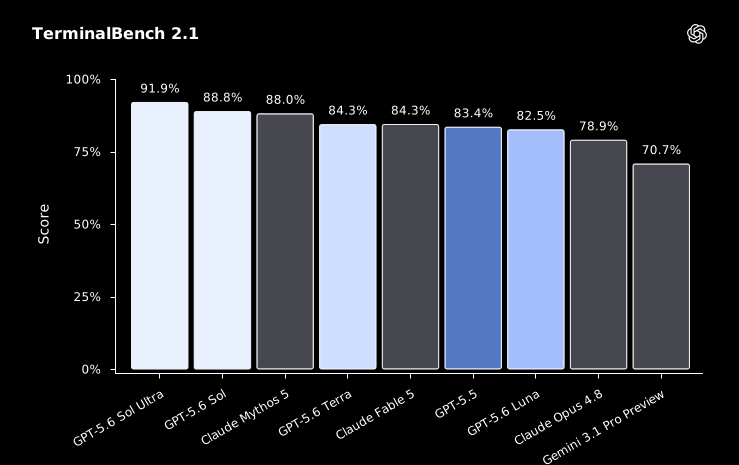
Sol Ultra leads at 91.9% and Sol at 88.8% edges out Claude Mythos 5 at 88.0%. Even Luna, the cheapest tier, posts 82.5%, which is above Claude Opus 4.8 at 78.9%. OpenAI also notes that Terra matches Claude Fable 5, both at 84.3% on TerminalBench 2.1, with Terra edging GPT-5.5 at 83.4%, so the balanced tier is no slouch on agentic terminal work. For a direct comparison point on the Opus side, see our Claude Opus 4.8 versus GPT-5.5 comparison.
On biology, OpenAI reported SecureBio results in its announcement. These are capability measurements, not safety scores, and they are part of why the rollout drew government attention.
| SecureBio test | Score |
|---|---|
| Virology Capabilities Test | 53.5% |
| Molecular Biology | 60.0% |
| Human Pathogen Capabilities | 68.4% |
| World-Class Bio | 68.3% |
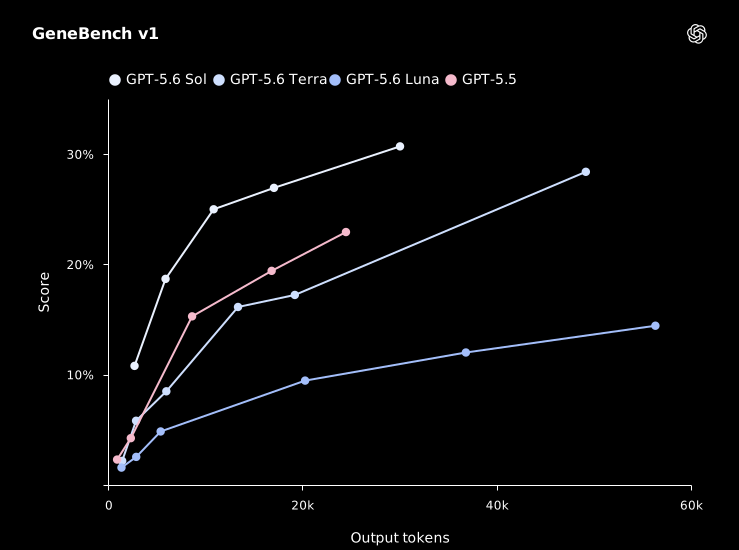
OpenAI frames the biology results as roughly nine points above GPT-5.5. On token efficiency, the reported improvement over GPT-5.5 is about 10 to 15 percent, which we present as reported rather than an official headline metric. Treat efficiency gains as directional until OpenAI publishes final numbers.
On context length
GPT-5.6's context window is not officially confirmed at preview. GPT-5.5 shipped a 1 million token window, and GPT-5.6 is expected to match it, but treat that as unconfirmed until OpenAI publishes final specifications. Do not hard-code a 5.6 context assumption into capacity planning yet.
4Pricing for All Tiers
Pricing is per million tokens (MTok), split into input and output rates. The spread across tiers is wide, which is the whole point of the three-tier design: you match the model to the unit economics of the workload.
| Tier | Input / MTok | Output / MTok |
|---|---|---|
| Sol | $5.00 | $30.00 |
| Sol Ultra | High-effort mode of Sol | High-effort mode of Sol |
| Terra | $2.50 | $15.00 |
| Luna | $1.00 | $6.00 |
Sol Ultra is a high-effort mode of Sol rather than a separate published rate, so plan for it to consume more tokens and compute per request than standard Sol. The practical cost lever across tiers is the output rate, since output tokens are six times the price of input on Sol and Luna and six times on Terra as well.
For competitive context, here is how Sol's pricing sits against other frontier models. Sol at $5 input and $30 output is priced roughly half of Claude Fable 5.
| Model | Input / MTok | Output / MTok |
|---|---|---|
| Sol (GPT-5.6) | $5.00 | $30.00 |
| Claude Fable 5 | $10.00 | $50.00 |
| Claude Opus 4.8 | ~$5.00 | ~$25.00 |
| Gemini 3.1 Pro | $2.00 | $12.00 |
A worked example for budgeting on Terra: a workload pushing 2 million tokens per day split 70 percent input and 30 percent output costs 2 * (0.7 * $2.50 + 0.3 * $15.00) / 1 = 2 * ($1.75 + $4.50) = $12.50 per day. The same volume on Sol costs 2 * (0.7 * $5.00 + 0.3 * $30.00) = 2 * ($3.50 + $9.00) = $25.00 per day, and on Luna it costs 2 * (0.7 * $1.00 + 0.3 * $6.00) = 2 * ($0.70 + $1.80) = $5.00 per day. The tier you pick moves the bill by 5x at constant volume.
5How to Choose a Tier
The decision comes down to how much reasoning the task needs versus how sensitive it is to cost and latency. A simple routing policy:
- Start with Luna for anything routine and high-volume: classification, tagging, extraction, short summaries, and first-pass routing. At $1 input and $6 output it is the cheapest way to handle traffic that does not need deep reasoning.
- Default to Terra for general application traffic. It matches GPT-5.5 capability at about half the cost, so it is the sensible baseline for chat, drafting, and most tool-using flows.
- Escalate to Sol when a task is long-horizon or correctness-critical: multi-step agentic coding, security analysis, or biology research where a wrong answer is expensive.
- Enable Sol Ultra only for the hardest problems where the extra compute pays for itself, such as deep autonomous coding runs or research that benefits from maximum effort.
A common production pattern is to cascade: Luna handles the easy majority, Terra takes the middle, and Sol or Sol Ultra catches the hard tail flagged by a confidence check or an explicit complexity signal. This keeps the blended cost close to Luna while preserving Sol-grade quality where it counts.
6Access and the Rollout Restriction
GPT-5.6 launched as a limited preview, and the access story is unusual. The US government requested that OpenAI limit the rollout of all three models. OpenAI complied, but said publicly that restrictions like this should not become the norm for frontier model releases.
For developers, the practical implication is that availability is staged and may differ by account, region, and product surface. OpenAI is bringing the models into ChatGPT and Codex as part of the limited release, so your first exposure may be through those products before broad API access settles.
Plan for staged access
Because this is a preview shaped by a government request, do not assume production-grade SLAs or stable quotas yet. Build behind an abstraction so you can fall back to GPT-5.5 or another model if your access to a given tier changes during the preview window.
7Agentic, Coding, and Cyber Gains
The clearest gains in this release are in agentic and terminal-driven engineering. Sol Ultra at 91.9% and Sol at 88.8% on TerminalBench 2.1 point to a model family that holds up across long tool-using sequences, which is exactly where earlier models tended to drift or stall.
OpenAI explicitly positions the family around coding, biology, and cybersecurity. The biology capability scores on SecureBio, about nine points above GPT-5.5, and the cyber framing are why the release drew regulatory attention in the first place. For most teams the day-to-day value shows up in coding agents and autonomous workflows rather than in biology benchmarks.
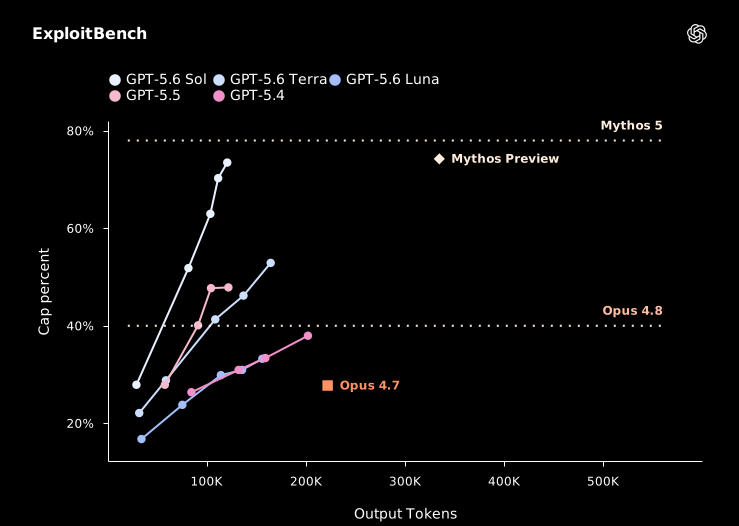
If you are building autonomous coding agents, the patterns we covered for the previous generation still apply. Our GPT-5.5 Codex autonomous agents guide covers orchestration, verification gates, and cost control that carry over cleanly to Sol and Terra.
8API Usage Notes
A few things to keep in mind before you integrate GPT-5.6 into a codebase:
- Confirm the exact model string in OpenAI's docs. Because this is a preview, the canonical model identifiers for Sol, Sol Ultra, Terra, and Luna are the ones published in OpenAI's API documentation. Read them from the docs rather than guessing a string, since preview identifiers can change.
- Treat Sol Ultra as an effort setting on Sol rather than a separate model wherever the API exposes it that way, and budget for higher token and compute usage per request.
- Do not hard-code a context window. Read the maximum context and output limits from the model metadata rather than assuming the unconfirmed 1 million token figure.
- Abstract the tier behind a config value. Given staged preview access, route through a single switch so you can promote or demote tiers, or fall back to GPT-5.5, without code changes.
- Watch output token spend. Output is the dominant cost on every tier, so cap response length and stream where possible.
9Why Lushbinary for GPT-5.6 Integration
A three-tier family is a routing problem as much as a model problem. Getting real value from GPT-5.6 means matching Luna, Terra, Sol, and Sol Ultra to the right slices of your traffic, instrumenting cost per request, and keeping a clean fallback path while access is still staged.
Lushbinary builds that layer for teams. We design the cascade that sends routine traffic to Luna and escalates only the hard tail to Sol, wire up verification gates for agentic coding runs, and put cost and quality telemetry in place so you can see exactly what each tier is doing to your bill. Because we abstract the model behind config, you stay portable as the preview matures and pricing or access shifts.
Whether you are migrating from GPT-5.5, evaluating Sol against Claude Fable 5, or standing up your first production agent, Lushbinary handles the integration, evaluation, and guardrails so your team can focus on the product rather than the plumbing.
Frequently Asked Questions
What is GPT-5.6 and what are Sol, Terra, and Luna?
GPT-5.6 is OpenAI's flagship model family announced on June 26, 2026 in a limited preview. It ships as three tiers: Sol is the frontier reasoning and long-horizon agentic model for coding, biology, and cybersecurity; Terra is the balanced everyday model competitive with GPT-5.5 at about half the cost; and Luna is the fastest and cheapest tier for high-volume routine tasks. Sol also has a compute-intensive high-effort variant called Sol Ultra.
How much does each GPT-5.6 tier cost?
Per million tokens: Sol is $5 input and $30 output, Terra is $2.50 input and $15 output, and Luna is $1 input and $6 output. Sol Ultra is a high-effort mode of Sol rather than a separate rate card. Sol is priced roughly half of Claude Fable 5, which lists at $10 input and $50 output.
How does GPT-5.6 perform on TerminalBench 2.1?
On TerminalBench 2.1, Sol Ultra scores 91.9%, Sol scores 88.8%, Claude Mythos 5 scores 88.0%, Luna scores 82.5%, and Claude Opus 4.8 scores 78.9%. Terra matches Claude Fable 5, both at 84.3% on TerminalBench 2.1, and Terra edges GPT-5.5 at 83.4%. OpenAI also reported strong SecureBio biology results, including 68.4% on the Human Pathogen Capabilities test, about nine points above GPT-5.5.
Why did OpenAI limit the GPT-5.6 rollout?
The US government requested that OpenAI limit the rollout of all three models. OpenAI complied and shipped GPT-5.6 as a limited preview, but stated that such restrictions should not become the norm. This is why access is staged rather than generally available at launch.
What context window does GPT-5.6 support?
The context window for GPT-5.6 is not officially confirmed at preview. GPT-5.5 shipped a 1 million token context window, and GPT-5.6 is expected to match that, but you should treat the number as unconfirmed until OpenAI publishes final specifications. Reported token efficiency is about 10 to 15 percent better than GPT-5.5.
Which GPT-5.6 tier should I use?
Use Luna for high-volume routine tasks like classification, extraction, and short replies where cost and latency dominate. Use Terra as the default everyday model for most application traffic. Reserve Sol for frontier reasoning and long-horizon agentic work, and enable Sol Ultra only when a task justifies the extra compute, such as complex multi-step coding or research.
10Sources
- OpenAI announcement
- The Verge: GPT-5.6 limited preview and the government request
- MacRumors: OpenAI GPT-5.6 Sol
- 9to5Mac: ChatGPT and Codex get GPT-5.6 in limited release
- TechCrunch: OpenAI limits rollout after government request
- Wikipedia: GPT-5.6
Content was rephrased for compliance with licensing restrictions. Pricing and benchmark data sourced from official OpenAI announcements and reputable tech press as of June 27, 2026. Figures may change, always verify with the vendor.
Ship GPT-5.6 Into Production With Lushbinary
We help teams adopt and integrate GPT-5.6 into production: tier routing across Sol, Terra, and Luna, agentic guardrails, and cost telemetry that keeps your bill honest.
Ready to Build Something Great?
Get a free 30-minute strategy call. We'll map out your project, timeline, and tech stack - no strings attached.
Prefer email? Reach us directly: