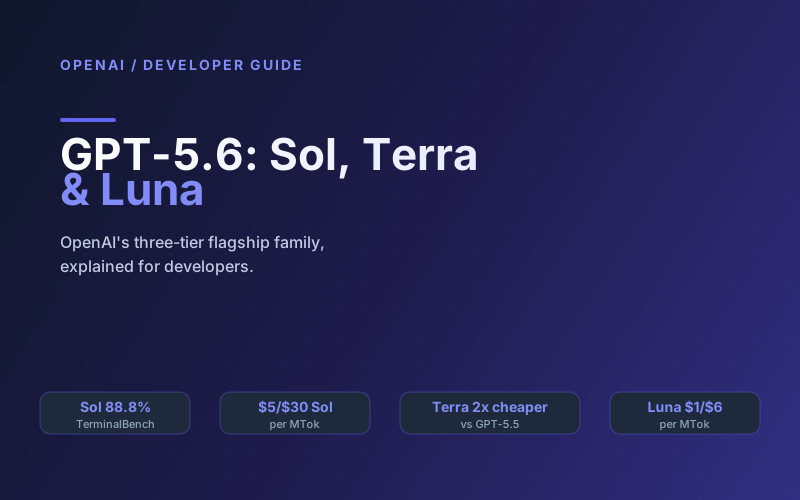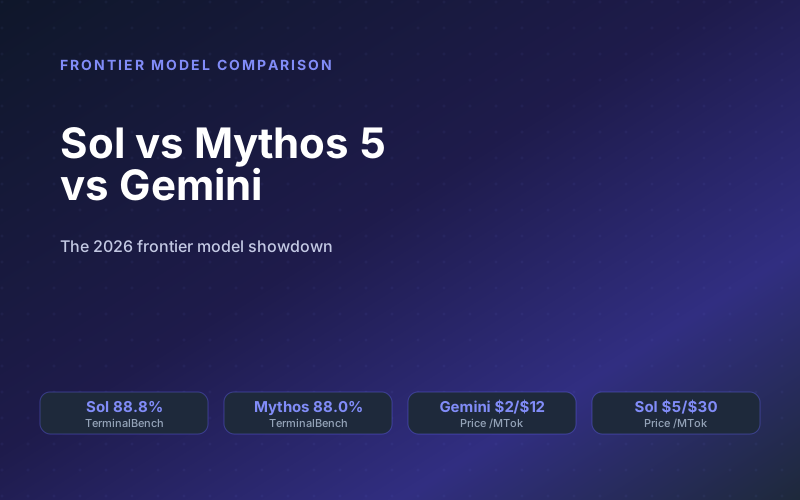

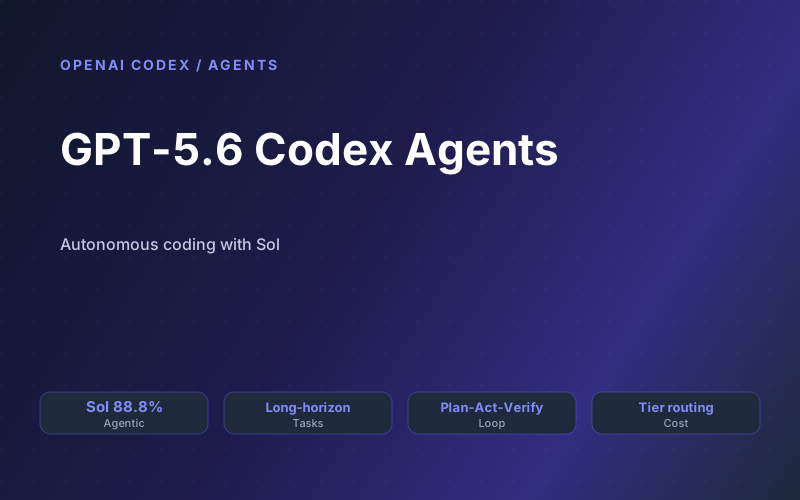

On June 26, 2026, OpenAI began rolling GPT-5.6 into ChatGPT and Codex as a limited release. The headline for builders is the flagship tier, codenamed Sol, which is tuned for long-horizon agentic coding: the kind of work where an agent plans a change, edits multiple files, runs a test suite, reads the failures, and tries again without a human driving every keystroke.
That shift matters because autonomous coding agents live or die on reliability across long sequences of terminal actions. A model that is brilliant in a single turn but flaky over fifty steps is not an agent, it is a very good autocomplete. GPT-5.6 leans directly into the long-horizon problem, and the early TerminalBench 2.1 numbers reflect that focus.
This is a practical guide to building autonomous coding agents on GPT-5.6. We cover what Sol brings to Codex, the plan-act-verify loop, why TerminalBench 2.1 is the benchmark to watch, how to route work across the Sol, Terra, and Luna tiers, a concrete agent workflow with code, and the guardrails, cost controls, and preview caveats you need before you trust an agent to run unattended. If you are coming from the previous generation, our GPT-5.5 Codex agents guide is a useful companion.
What This Guide Covers
1What GPT-5.6 Brings to Codex
GPT-5.6 is a tiered family. The flagship, Sol, is positioned for frontier reasoning and long-horizon agentic tasks spanning coding, biology, and cybersecurity. For Codex specifically, the interesting part is the long-horizon framing. Sol is built to hold context and intent across an extended sequence of actions rather than just producing a single strong answer and stopping.
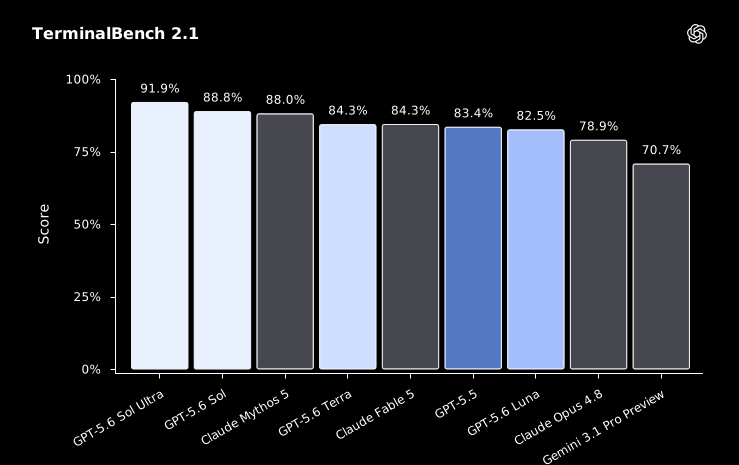
Below Sol sit two more tiers. Terra is the balanced workhorse, and per the announcement it matches Claude Fable 5, with both tied at 84.3 percent on TerminalBench 2.1 and edging out GPT-5.5 at 83.4 percent. Luna is the cheap, fast tier for high-volume subtasks. There is also a Sol Ultra mode, a compute-intensive setting reserved for the hardest problems where you are willing to spend more reasoning budget for a higher success rate.
OpenAI also reports token efficiency gains of roughly 10 to 15 percent over GPT-5.5. Treat that as a reported figure rather than a verified benchmark you can reproduce, but if it holds it directly lowers the effective cost per agent task, since agents tend to generate a lot of intermediate reasoning and tool-call tokens.
Context window note
GPT-5.5 shipped with a 1M token context window. The context window for GPT-5.6 has not been officially confirmed at the time of writing, so it is expected but unconfirmed. Do not hard-code assumptions about maximum context into your agent. Read the limit from the official documentation and degrade gracefully if it differs from what you expect.
2The Agent Loop: Plan, Act, Verify
Every autonomous coding agent, regardless of vendor, runs some version of the same loop. A task comes in, the agent forms a plan, it acts by editing files and running commands, then it verifies the result by reading test output or build logs. If verification fails, it loops back to planning with the new information. GPT-5.6 does not replace this loop, it makes each pass more reliable over a longer horizon.
- Plan: the agent reads the task and relevant code, then decides what to change and in what order. Long-horizon strength shows up here, because a weak planner forgets earlier decisions halfway through a multi-file change.
- Act: the agent writes files, runs shell commands, installs dependencies, and executes the build. This is where terminal reliability matters most, since a single malformed command can derail the run.
- Verify: the agent runs tests and linters, reads the output, and decides whether the task is done. Honest verification is what separates a trustworthy agent from one that declares victory on broken code.
For a deeper treatment of how to structure this loop, including state management and retry strategy, see our loop engineering guide for AI coding agents.
3Why TerminalBench 2.1 Matters
TerminalBench 2.1 evaluates how reliably a model carries out multi-step command-line workflows. That is a close proxy for the act stage of an autonomous agent, where the model edits files, runs builds, manages packages, and executes tests inside a sandbox. A high TerminalBench score means fewer broken steps per run, which compounds over a long horizon: an agent that gets each step right 95 percent of the time fails far less often across fifty steps than one at 80 percent.
| Model | TerminalBench 2.1 |
|---|---|
| Sol Ultra | 91.9% |
| Sol | 88.8% |
| Mythos 5 | 88.0% |
| Terra | 84.3% |
| Fable 5 | 84.3% |
| GPT-5.5 | 83.4% |
| Luna | 82.5% |
| Opus 4.8 | 78.9% |
Sol at 88.8 percent and Sol Ultra at 91.9 percent put the flagship tier at the top of this comparison, ahead of Mythos 5 at 88.0 percent and Opus 4.8 at 78.9 percent. Even Luna, the budget tier, lands at 82.5 percent, which is high enough to handle simpler terminal subtasks inside a larger agent run.
Read benchmarks as directional
Benchmark scores describe controlled conditions. Your real success rate depends on repository complexity, test coverage, and how clearly you scope tasks. Use these numbers to choose a tier and to set expectations, not as a guarantee for your specific codebase.
4Tier Selection for Agents
The single biggest cost and quality lever in an agent is which tier handles which step. You do not need Sol to summarize a diff or classify whether a file is a test. You do need it for the genuinely hard reasoning. A well-built agent routes each step to the cheapest tier that can do it correctly.
| Tier | Price (in / out per MTok) | Agent Role |
|---|---|---|
| Sol | $5 / $30 | Hard, long-horizon tasks: multi-file refactors, deep debugging, architecture-level changes |
| Terra | $2.50 / $15 | Routine coding: standard endpoints, unit tests, small bug fixes, code review passes |
| Luna | $1 / $6 | Cheap subtasks: classification, summarization, routing, formatting, log triage |
A common pattern is to make Sol the planner and verifier, Terra the primary code writer, and Luna the utility worker for the dozens of small classification and summarization calls an agent makes per task. For the rare task that defeats Sol, escalate to Sol Ultra rather than looping forever on the standard tier.
5Example Codex Agent Workflow
The example below sketches a minimal plan-act-verify agent using the OpenAI Python SDK pattern. It routes the plan to Sol, executes file edits and tests, then asks Sol to verify the result. The model identifier here is a placeholder. Confirm the exact GPT-5.6 model names in the OpenAI documentation, since this is a limited preview and identifiers can change.
from openai import OpenAI

client = OpenAI()

# Placeholder identifiers. Confirm the real GPT-5.6 names in OpenAI docs.
TIER = {
    "plan": "gpt-5.6-sol",      # hard reasoning, long horizon
    "code": "gpt-5.6-terra",    # routine code generation
    "util": "gpt-5.6-luna",     # cheap classification and summaries
}

def ask(model, system, user):
    resp = client.responses.create(
        model=model,
        input=[
            {"role": "system", "content": system},
            {"role": "user", "content": user},
        ],
    )
    return resp.output_text

def run_agent(task, repo_context, run_tests):
    # 1. Plan with Sol
    plan = ask(TIER["plan"],
               "You are a senior engineer. Produce a step-by-step plan.",
               f"Task: {task}\n\nRepo context:\n{repo_context}")

    # 2. Act: generate edits with Terra
    edits = ask(TIER["code"],
                "Return unified diffs only. Keep changes minimal.",
                f"Plan:\n{plan}\n\nApply it to the repo.")
    apply_diffs(edits)  # your sandboxed file writer

    # 3. Verify: run tests, let Sol judge the output
    test_output = run_tests()
    verdict = ask(TIER["plan"],
                  "Decide PASS or REPLAN. Be strict about failing tests.",
                  f"Test output:\n{test_output}")
    return plan, edits, verdict
In production you wrap this in a retry loop that feeds the test output back into a new planning call when the verdict is REPLAN, with a hard cap on iterations. The sandbox that runs apply_diffs and run_tests is the security boundary, which brings us to guardrails.
6Guardrails and Human in the Loop
An autonomous agent that can write files and run shell commands is a powerful tool and a real liability if it runs without limits. The goal is not to remove humans, it is to put them at the decisions that matter and automate everything else.
- Sandbox everything: run agent actions in an isolated environment with a clone of the repo, no production credentials, and no network access to internal systems unless explicitly granted.
- Diffs, not direct commits: have the agent open a pull request rather than push to main. A human reviews before merge, which keeps oversight in the loop without slowing routine work.
- Approval gates: require explicit human approval for high-impact actions such as dependency changes, schema migrations, infrastructure edits, or anything touching authentication.
- Iteration caps: bound the loop. If the agent has not passed verification after a set number of attempts, stop and escalate to a person instead of burning tokens indefinitely.
Treat agent output as untrusted
Code an agent writes can carry the same bugs and security issues as code a person writes, and an agent can be steered by malicious content in the files it reads. Keep your normal review, testing, and secret-scanning gates in place. The agent speeds up the work, it does not absorb the responsibility.
7Cost Control for Agent Fleets
Agents are token-hungry because they generate plans, reasoning, and many tool calls per task. The reported 10 to 15 percent token efficiency gain over GPT-5.5 helps, but the bigger savings come from how you architect the work. A few habits keep costs predictable.
- Route by difficulty: reserve Sol for planning and verification, push routine generation to Terra, and send the long tail of small subtasks to Luna. The price gap between Luna at 1 dollar input and Sol at 5 dollars input is large enough that misrouting is the main source of waste.
- Trim context: feed the agent only the files it needs, not the whole repo. Retrieval and scoping cut input tokens directly.
- Cap iterations: the same iteration cap that protects quality also protects your budget. Runaway loops are expensive.
- Reserve Sol Ultra: the compute-intensive mode earns its cost only on the hardest tasks. Use it as a deliberate escalation, not a default.
Always confirm current pricing against the official OpenAI pricing page before you forecast spend. Preview pricing can change, and the figures here are sourced from the announcement as of late June 2026.
8Limitations and the Preview Caveat
GPT-5.6 is a limited release, not a general launch. Per TechCrunch reporting, the US government requested a limited rollout, and OpenAI complied while warning publicly that such restrictions should not become the norm. For builders that means access, quotas, and even model identifiers may be constrained or may shift during the preview.
- Unconfirmed context window: GPT-5.5 had a 1M token window. The GPT-5.6 figure is expected but unconfirmed, so do not design around a fixed number.
- Reported, not reproduced, efficiency: the 10 to 15 percent token efficiency improvement is a reported figure. Measure it on your own workloads before you bank the savings.
- Identifiers may change: the model names in this guide are placeholders. Confirm them in the OpenAI documentation.
- Plan a fallback: build your agent so it can run on GPT-5.5 tiers if GPT-5.6 access is restricted or revoked during the preview.
9Why Lushbinary for Autonomous Agents
Lushbinary builds autonomous coding agents and agentic workflows for teams that want the productivity of GPT-5.6 without the foot-guns. We design the plan-act-verify loop, the tier routing across Sol, Terra, and Luna, the sandbox and approval gates, and the cost controls that keep an agent fleet predictable in production.
Because GPT-5.6 is a preview, we build with portability in mind, so your agent can fall back to a stable model tier and keep shipping. If you are evaluating autonomous coding agents for your codebase, we can help you scope a pilot that proves value before you commit.
10Frequently Asked Questions
What is GPT-5.6 and when was it announced?
GPT-5.6 is OpenAI's June 26, 2026 model update, rolled out to ChatGPT and Codex in a limited release. The flagship tier is codenamed Sol and targets frontier reasoning plus long-horizon agentic work across coding, biology, and cybersecurity. It follows GPT-5.5, which launched April 23, 2026. Because the rollout is a limited preview, availability and exact model identifiers should be confirmed in the OpenAI documentation.
Which GPT-5.6 tier should an autonomous coding agent use?
Use Sol for hard, long-horizon tasks like multi-file refactors and complex debugging where reasoning depth pays off. Use Terra for routine coding work such as standard endpoints, tests, and small fixes, where it offers a strong balance of capability and cost. Use Luna for cheap, high-volume subtasks like classification, summarization, and routing inside an agent loop. Many production agents route across all three tiers in a single workflow.
Why does TerminalBench 2.1 matter for autonomous coding agents?
TerminalBench 2.1 measures how reliably a model can carry out multi-step command-line workflows, which is exactly what an autonomous agent does when it edits files, runs builds, and executes tests in a sandbox. On this benchmark Sol scored 88.8 percent and Sol Ultra reached 91.9 percent, with Luna at 82.5 percent. Higher terminal reliability means fewer broken steps in an unattended agent run, which directly affects how much you can trust the loop without a human watching every action.
How much do the GPT-5.6 tiers cost?
Per the announcement, Sol is priced at 5 dollars per million input tokens and 30 dollars per million output tokens. Terra is 2.50 dollars input and 15 dollars output, and Luna is 1 dollar input and 6 dollars output. A Sol Ultra compute-intensive mode is also available for the hardest tasks. Reported token efficiency is roughly 10 to 15 percent better than GPT-5.5, though you should treat that as a reported figure and verify against live pricing.
Is GPT-5.6 generally available for production agents?
Not yet. GPT-5.6 shipped as a limited release, and per tech press reporting the US government requested a limited rollout, which OpenAI followed while warning that such restrictions should not become the norm. Treat GPT-5.6 as a preview: prototype against it, but design your agent so it can fall back to GPT-5.5 tiers and confirm model identifiers, context limits, and quotas in the official documentation before shipping.
Sources
- OpenAI official announcements, model and pricing information.
- 9to5Mac on GPT-5.6 reaching ChatGPT and Codex in limited release.
- TechCrunch on the limited rollout and the government request.
- Wikipedia overview of GPT-5.6.
Content was rephrased for compliance with licensing restrictions. Pricing and benchmark data sourced from official OpenAI announcements and reputable tech press as of June 27, 2026. Figures may change, always verify with the vendor.
Build Autonomous Coding Agents With Lushbinary
We design plan-act-verify agents on GPT-5.6, with tier routing, sandboxed guardrails, and cost controls that hold up in production. Tell us about your codebase and we will scope a pilot.
Ready to Build Something Great?
Get a free 30-minute strategy call. We'll map out your project, timeline, and tech stack - no strings attached.
Prefer email? Reach us directly: