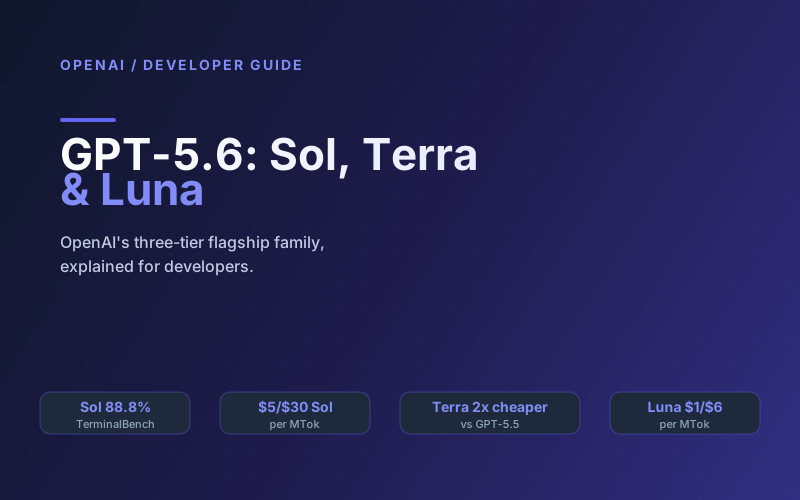

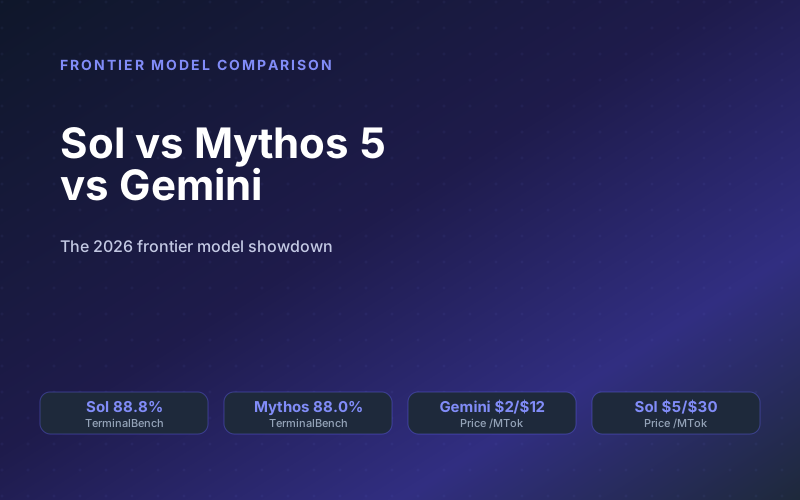

On June 26, 2026, OpenAI announced GPT-5.6 and its flagship mode, Sol, as a limited preview. The headline number landed fast: 88.8% on TerminalBench 2.1, just ahead of Claude Mythos 5 at 88.0%. With Google's Gemini 3.5 line as the third contender, the frontier now has three credible leaders, and choosing between them is no longer a matter of picking the single "best" model.
This guide compares GPT-5.6 Sol, Claude Mythos 5, and Gemini 3.5 on agentic coding, reasoning, pricing, availability, and context. One note up front: OpenAI's TerminalBench 2.1 chart now includes Gemini 3.1 Pro Preview at 70.7%, the lowest of the charted models, while Google did not publish broader head-to-head coding figures for its latest Gemini line. We use only verified numbers and keep everything else qualitative or attributed.
The practical takeaway is that Sol and Mythos 5 trade the coding crown by fractions of a point, while Gemini competes hardest on price and availability. Where you land depends on access, budget, and the kind of work you run.
What This Guide Covers
- The Three Contenders: Quick Overview
- Agentic & Coding Benchmarks
- Reasoning & Knowledge
- Pricing & Cost Comparison
- Availability & Access
- Context Windows
- Use-Case Decision Matrix
- Multi-Model Routing Strategy
- Why Lushbinary for AI Model Strategy
1The Three Contenders: Quick Overview
GPT-5.6 is OpenAI's newest line, following GPT-5.5 which shipped April 23, 2026. It ships in tiers: Sol is the flagship, Terra and Luna sit below it, and Sol Ultra is a compute-intensive mode that pushes benchmark scores higher at higher cost. Claude Mythos 5 is Anthropic's frontier model, currently restricted to partners. Gemini 3.5 is Google's latest line, generally available.
| GPT-5.6 Sol | Claude Mythos 5 | Gemini 3.5 | |
|---|---|---|---|
| Company | OpenAI | Anthropic | Google DeepMind |
| Tier | Flagship (Sol) | Frontier | Latest line |
| Public Access | Limited preview | Partners only | Generally available |
| Top Strength | Agentic coding | Coding & safety work | Price-performance |
2Agentic & Coding Benchmarks
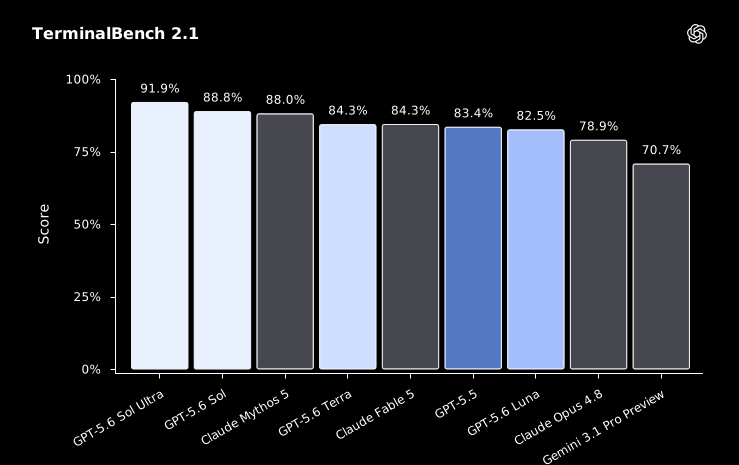
TerminalBench 2.1 tests agentic, terminal-driven engineering work: running commands, editing code, and completing multi-step tasks. This is the benchmark OpenAI led with for Sol, and the gap at the top is narrow.
| Model | TerminalBench 2.1 |
|---|---|
| GPT-5.6 Sol Ultra | 91.9% |
| GPT-5.6 Sol | 88.8% |
| Claude Mythos 5 | 88.0% |
| GPT-5.6 Terra | 84.3% |
| Claude Fable 5 | 84.3% |
| GPT-5.5 | 83.4% |
| GPT-5.6 Luna | 82.5% |
| Claude Opus 4.8 | 78.9% |
| Gemini 3.1 Pro Preview | 70.7% |
Key Takeaway
Sol leads Mythos 5 by 0.8 of a point on TerminalBench 2.1, which is close to a tie for practical purposes. The larger jump comes from Sol Ultra at 91.9%, but that mode spends more compute per task. OpenAI's chart now places Gemini 3.1 Pro Preview at 70.7%, the lowest of the charted models on this axis.
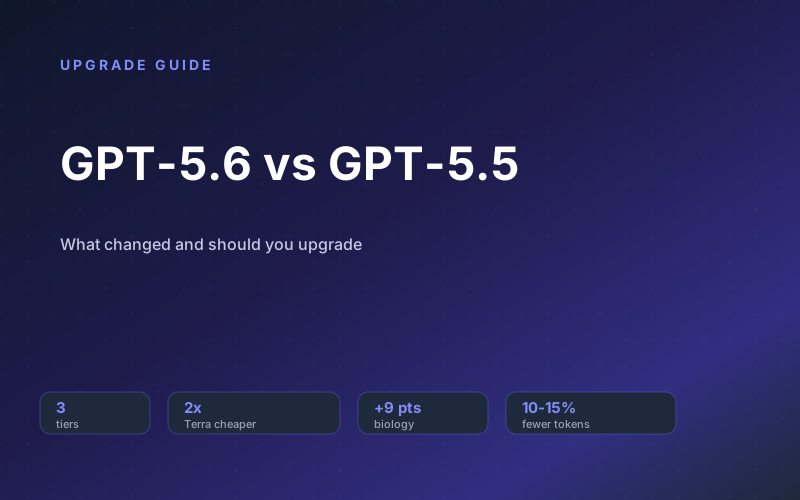
OpenAI also reports token efficiency gains of roughly 10 to 15% over GPT-5.5, framed as a reported improvement rather than an independently verified one. Terra, the mid tier, matches Claude Fable 5, both at 84.3% on TerminalBench 2.1. For a deeper look at the prior generation, see our GPT-5.5 developer guide.
3Reasoning & Knowledge
Beyond coding, OpenAI highlighted GPT-5.6's gains in scientific and biology reasoning. On the SecureBio evaluations, Sol posts measurable improvements over GPT-5.5, reported at around 9 points higher overall:
- Virology Capabilities Test: 53.5%
- Molecular Biology: 60.0%
- Human Pathogen Capabilities: 68.4%
- World-Class Biology: 68.3%
On qualitative reasoning, all three models operate at a near-expert level, and the differences are subtle. Mythos 5 is regarded for careful, safety-aware reasoning, Sol for tool-using agentic chains, and Gemini for strong long-context analysis at low cost. We avoid attaching a single reasoning leaderboard number here because the published evaluations differ across labs and are not directly comparable. For Anthropic's side of this story, see our Claude Mythos vs GPT-5.5 comparison.
4Pricing & Cost Comparison
Price is where the picture inverts. Sol is premium, but it undercuts Claude Fable 5 by roughly half, while Gemini 3.1 Pro remains the cheapest published option for high-volume work.
| Model | Input (per MTok) | Output (per MTok) |
|---|---|---|
| GPT-5.6 Sol | $5 | $30 |
| GPT-5.6 Terra | $2.50 | $15 |
| GPT-5.6 Luna | $1 | $6 |
| Claude Fable 5 | $10 | $50 |
| Claude Opus 4.8 | ~$5 | ~$25 |
| Gemini 3.1 Pro | $2 | $12 |
Cost Context
At $5/$30, Sol sits at about half the price of Claude Fable 5 ($10/$50). For reference, GPT-5.5 reached up to $30 output at its top tier. Gemini 3.1 Pro at $2/$12 is still the value pick when raw price per token is the deciding factor. We list Gemini 3.1 Pro pricing because it is the verified published figure for Google's line.
5Availability & Access
Benchmarks mean little if you cannot call the model. Access is the sharpest differentiator in this comparison.
GPT-5.6 Sol
Limited preview as of June 26, 2026. The US government requested a limited rollout, which OpenAI followed while cautioning that restrictions should not be the norm.
Claude Mythos 5
Restricted to partners. No general API access. Strong on coding, but availability is the gating factor for most teams.
Gemini 3.5
Generally available via Google AI Studio and Vertex AI. The most accessible option here, with enterprise plans and clear pricing.
Regulatory Note
The US government requested a limited rollout across all three frontier lines. OpenAI complied for GPT-5.6 while publicly warning that such restrictions should not become standard practice. For teams, the lesson is to plan for access that can change, not just for benchmark scores.
6Context Windows
- GPT-5.6: Context is not officially confirmed. GPT-5.5 offered up to 1M tokens, and GPT-5.6 is expected to match that, but treat the figure as unconfirmed until OpenAI states it.
- Claude Opus 4.8: 1M token context, with prompt caching to reduce cost on repeated context.
- Gemini 3.1 Pro: 1M token context, paired with the lowest published price, which makes it strong for long-context analysis.
7Use-Case Decision Matrix
The right model depends on your constraints. Since Sol and Mythos 5 are gated, the best choice often comes down to what you can actually access:
| Use Case | Best Model | Why |
|---|---|---|
| Hardest agentic coding tasks | GPT-5.6 Sol (or Sol Ultra) | 88.8% TerminalBench 2.1, 91.9% in Ultra mode |
| Coding with partner access | Claude Mythos 5 | 88.0% TerminalBench 2.1, very close to Sol |
| Cost-sensitive, high-volume work | Gemini 3.1 Pro | $2/$12 per MTok, lowest published price |
| Generally available premium coding | Claude Opus 4.8 | Public access at about $5/$25, 78.9% TerminalBench 2.1 |
| Budget tier for simple calls | GPT-5.6 Luna | $1/$6 per MTok, 82.5% TerminalBench 2.1 |
For a closely related public matchup, our Claude Opus 4.8 vs GPT-5.5 benchmarks and pricing guide covers the generally available options in more depth.
8Multi-Model Routing Strategy
With the top three so close on quality and so different on price and access, committing to one model is the wrong default. A routing layer lets you send each request to the model that fits its difficulty, budget, and availability.
- Cheap tier: route simple calls to Luna ($1/$6) or Gemini for cost control.
- Mid tier: use Terra ($2.50/$15) or Gemini 3.1 Pro for balanced work.
- Premium tier: reserve Sol or Mythos 5 for the hardest agentic and reasoning tasks, and keep a generally available fallback like Opus 4.8 for when gated models are unreachable.
9Why Lushbinary for AI Model Strategy
Picking a frontier model is the easy part. Wiring it into production with sensible routing, cost controls, and a fallback for gated previews is the work that actually ships. Lushbinary helps teams evaluate Sol, Mythos 5, Gemini, and the rest against real workloads, then build the routing and observability layer that keeps quality high and spend predictable.
Whether you are testing a limited-preview model or standardizing on a generally available one, we help you avoid lock-in and keep options open as the frontier keeps moving.
Frequently Asked Questions
Which model wins on agentic coding in 2026?
On TerminalBench 2.1, GPT-5.6 Sol scores 88.8% and edges Claude Mythos 5 at 88.0%. Sol Ultra, the compute-intensive mode, reaches 91.9%. OpenAI's TerminalBench 2.1 chart now includes Gemini 3.1 Pro Preview at 70.7%, the lowest of the charted models. For agentic coding, Sol and Mythos 5 are effectively tied at the top.
How much does GPT-5.6 Sol cost compared to Claude and Gemini?
Sol is priced at $5 input and $30 output per million tokens. That is roughly half the price of Claude Fable 5 at $10/$50. Claude Opus 4.8 is about $5/$25 and Gemini 3.1 Pro is $2/$12, which remains the lowest published price among these frontier options.
Can I use GPT-5.6 Sol today?
Not generally. GPT-5.6 launched June 26, 2026 as a limited preview, and the US government requested a limited rollout. OpenAI complied while warning that such restrictions should not become the norm. Claude Mythos 5 is restricted to partners, while Gemini is generally available.
What is the context window of GPT-5.6?
OpenAI has not officially confirmed a context window for GPT-5.6. GPT-5.5 offered up to 1M tokens, and GPT-5.6 is widely expected to match that, but the figure is unconfirmed. Gemini 3.1 Pro and Claude Opus 4.8 both offer 1M token context.
Should I commit to one model or route across several?
Multi-model routing is the practical 2026 strategy. Use a low-cost tier such as Luna or Gemini for simple tasks, a mid tier for balanced work, and a premium tier such as Sol or Mythos 5 for hard agentic and reasoning jobs. Routing balances quality, cost, and availability when any single model is gated.
Sources
- OpenAI
- The Verge: OpenAI GPT-5.6 preview and the administration request
- MacRumors: OpenAI GPT-5.6 Sol
- TechCrunch: OpenAI limits GPT-5.6 rollout after government request
- Wikipedia: GPT-5.6
Content was rephrased for compliance with licensing restrictions. Pricing and benchmark data sourced from official OpenAI announcements and reputable tech press as of June 27, 2026. Figures may change, always verify with the vendor.
Pick and Wire the Right Frontier Model
Lushbinary helps teams evaluate Sol, Mythos 5, and Gemini against real workloads, then build the routing and cost controls that keep quality high and spend predictable.
Ready to Build Something Great?
Get a free 30-minute strategy call. We'll map out your project, timeline, and tech stack - no strings attached.
Prefer email? Reach us directly: