
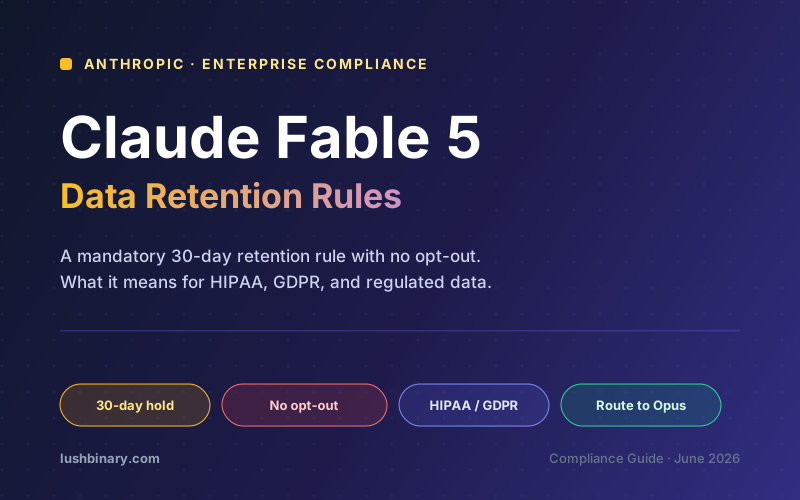
When Anthropic released Claude Fable 5 on June 9, 2026, the benchmark numbers got the headlines. For enterprise and regulated teams, a quieter change matters more: a mandatory 30-day data retention requirement that applies to all Fable 5 traffic, on both Anthropic's own surfaces and third-party platforms.
This is not the usual opt-in telemetry. It is a condition of shipping a Mythos-class model to the public. Because Fable 5 carries capabilities that are dangerous if misused, Anthropic retains inputs and outputs to detect novel attacks and jailbreaks that span many requests. For most teams that is a reasonable trade. For teams handling regulated health, financial, or personal data, it is a governance decision that needs to be made deliberately, not by default.
This guide explains the retention rule, what it does and does not cover, how it interacts with HIPAA and GDPR obligations, and a concrete checklist for deploying Fable 5 compliantly. For the safeguard mechanics behind it, see our Fable 5 safety split guide.
⚠️ Not legal advice
This article is technical guidance, not legal or compliance advice. Validate any deployment touching regulated data with your own compliance, privacy, and legal teams, and rely on your signed agreements with the vendor rather than a blog post.
📌 What This Guide Covers
1What the Retention Rule Actually Says
Anthropic will require 30-day retention for all traffic on Fable 5, Mythos 5, and future models at this capability level, across both first-party and third-party surfaces. The key terms, as stated at launch:
- Scope - all inputs and outputs, on Anthropic's own platforms and on partner platforms that serve the model.
- Purpose limit - the data will not be used for training or any non-safety purpose.
- Access logging - all human access to retained data is logged.
- Deletion - data is deleted after 30 days, except where a safety investigation or legal obligation requires holding it longer.
- Enforcement on AWS - on Amazon Bedrock, retention is enforced through a
provider_data_sharingsetting that must be enabled before the model can be invoked.
The practical headline: you cannot use Fable 5 without accepting the retention window. There is no opt-out, because the retention is part of the safety system that makes a public Mythos-class model possible.
2Why Anthropic Requires It
The reasoning is defensive, and it follows from the model's capability. Fable 5 is the safeguarded public version of a Mythos-class model; its restricted twin, Mythos 5, is strong enough at finding and exploiting software vulnerabilities that Anthropic calls it the strongest cybersecurity model in the world. Capability like that is a target for abuse.
Single-request filtering misses attacks that are spread across many innocuous-looking requests. Retaining a window of traffic lets Anthropic detect those multi-request patterns, novel jailbreaks, and coordinated misuse after the fact, and feed what it learns back into the classifiers. The 30-day window, logged access, and purpose limit are the guardrails it puts around that retention.
💡 Retention is paired with the fallback system
The retention rule does not stand alone. It sits alongside the classifier-and-fallback system that routes flagged cybersecurity, biology, chemistry, and distillation requests to Opus 4.8. Together they are how Anthropic justifies releasing a Mythos-class model to the public at all. Our safety split guide covers the full architecture.
3What It Means for Regulated Data
For teams under HIPAA, GDPR, or sector-specific rules, the retention requirement introduces factors to assess, not an automatic disqualification:
- Business Associate Agreements - if you process PHI, confirm how a 30-day retention with logged human access maps to your BAA terms and whether the vendor offering covers Fable 5 specifically.
- Data Processing Agreements and lawful basis - under GDPR, document the retention as a processing activity, confirm the lawful basis, and assess whether logged human access affects your data-minimization and purpose-limitation commitments.
- Data residency - retained data location matters. On Bedrock, Fable 5 launched in specific regions; confirm the region and retention storage meet your residency obligations.
- Subject rights and deletion - a fixed 30-day retention window can interact with deletion or erasure requests. Understand how a safety or legal hold could extend it.
None of this is unique to Fable 5 in kind, but the mandatory, no-opt-out nature raises the bar for review. The safest posture is to treat any regulated workload on Fable 5 as a decision that needs sign- off from compliance and legal, with the retention behavior documented.
4A Routing Decision, Not a Blanket Ban
The pragmatic answer for most enterprises is not all-or-nothing. It is to classify workloads and route them, sending only what is appropriate to Fable 5 and keeping sensitive data on a model without the retention requirement.
A classifier tags each request by sensitivity, redacts identifiers, and routes accordingly: non-sensitive, high-value reasoning to Fable 5 under the retention rule, and regulated or high-sensitivity data to Opus 4.8, which does not carry the same requirement. This gets you Fable 5's capability where it is appropriate without forcing every workload through the retention window. The pattern overlaps with cost routing; our API and cost-optimization guide covers the implementation.
5Compliant Deployment Checklist
Before routing any meaningful traffic through Fable 5 in a regulated environment, confirm:
- Data classification at the boundary - every request is tagged for sensitivity before it can reach the model.
- Redaction and minimization - strip or tokenize identifiers and send the minimum data needed, regardless of model.
- Routing rules - regulated and high-sensitivity workloads go to a model without the retention requirement.
- Agreements reviewed - BAAs, DPAs, and vendor terms checked against the 30-day retention with logged human access, for Fable 5 specifically.
- Region and residency confirmed - on Bedrock, the deployment region and the
provider_data_sharingsetting meet your residency obligations. - Logging and audit - the safeguard fallback, model used, and provider settings are logged per request for your own audit trail.
- Documented in records of processing - the retention behavior is written into your data-processing documentation, not left implicit.
6Why Lushbinary
Deploying a frontier model in a regulated environment is an architecture and governance problem before it is a prompting one. Lushbinary builds AI systems for healthcare, fintech, and enterprise where data handling, auditability, and access control are non-negotiable.
- Data-aware routing - classification, redaction, and model routing so sensitive data avoids the retention window.
- Compliance-ready architecture - region selection, provider settings, encryption, and audit logging built in.
- Governance documentation - the artifacts your compliance and legal teams need to sign off.
- AWS infrastructure - VPC isolation, key management, and monitoring for production deployments on Bedrock.
🚀 Free Consultation
Need Fable 5's capability without compromising on data governance? We will design the classification, routing, and audit-ready architecture so your deployment holds up to review, with no obligation.
7Frequently Asked Questions
What is the Claude Fable 5 30-day data retention requirement?
Anthropic requires 30-day retention of all inputs and outputs for Fable 5, Mythos 5, and future models at this capability level, across both first-party and third-party surfaces. It says the data will not be used for training or any non-safety purpose, all human access is logged, and the data is deleted after 30 days unless a safety investigation or legal obligation requires holding it longer. The stated reason is detecting novel attacks and jailbreaks that span many requests.
Can I opt out of Claude Fable 5 data retention?
No. The retention requirement is mandatory for all Fable 5 traffic and is the condition under which Anthropic ships a Mythos-class model publicly. On Amazon Bedrock it is enforced through a provider_data_sharing setting that must be enabled before the model can be invoked. If your data-handling policy cannot accommodate a 30-day retention window with logged human access, you should route that workload to a model without the requirement, such as Claude Opus 4.8.
Is Claude Fable 5 safe for HIPAA or GDPR-regulated data?
It depends on your controls and agreements. The 30-day retention with logged human access is a new factor regulated teams must assess against their BAAs, data processing agreements, and data residency obligations. It is not automatically disqualifying, but it requires review with your compliance and legal teams, and you should minimize or redact sensitive identifiers before sending data, regardless of the model.
Why does Anthropic retain Claude Fable 5 data?
Anthropic frames it as defensive. Because Fable 5 is a Mythos-class model with capabilities that are dangerous if misused, the retained data helps it detect novel attacks and jailbreaks that operate across many requests, which single-request filtering would miss. It pairs the retention with logged human access and a commitment not to use the data for training or other non-safety purposes.
How do I deploy Claude Fable 5 compliantly in an enterprise?
Classify data before it reaches the model, redact or tokenize sensitive identifiers, route regulated or high-sensitivity workloads to Opus 4.8 where the retention rule does not apply, log the safeguard fallback and provider settings, and document the retention window in your data processing records. On Bedrock, confirm the provider_data_sharing setting and your region meet your residency requirements.
📚 Sources
- Anthropic - Claude Fable 5 and Claude Mythos 5
- Anthropic Support - Real-time cyber safeguards on Claude
Content was rephrased for compliance with licensing restrictions. The retention terms, scope, and Bedrock enforcement detail are sourced from Anthropic's June 9, 2026 announcement and reporting on the launch. Compliance guidance is general and is not legal advice. Policies and platform settings may change - always verify on Anthropic's website and with your own compliance team.
Deploying Fable 5 With Regulated Data?
Lushbinary designs data-aware, audit-ready AI architectures for healthcare, fintech, and enterprise. Let's scope your deployment.
Ready to Build Something Great?
Get a free 30-minute strategy call. We'll map out your project, timeline, and tech stack - no strings attached.
Prefer email? Reach us directly: