
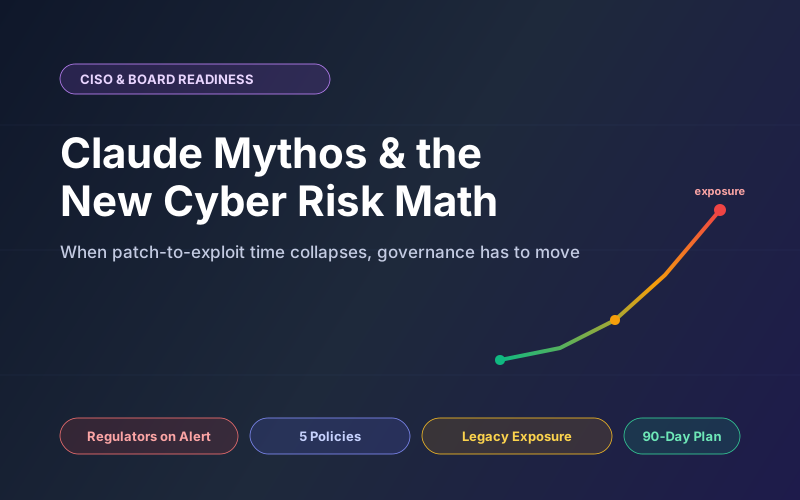
In April 2026, the leaders of the US financial system held a meeting that had nothing to do with interest rates or a market crash. Treasury Secretary Scott Bessent, Federal Reserve Chair Jerome Powell, and the chief executives of America's largest banks convened to discuss a single artificial intelligence model. Within days, the Bank of Canada, the Bank of England, the European Central Bank, and regulators in India, Japan, and Australia were holding their own emergency briefings. The model was Claude Mythos, and the reason for the alarm was that it had proven able to find and exploit vulnerabilities in software at a scale and speed previously reserved for elite human teams.
If financial regulators are treating this as a systemic risk, every board and security leader needs a position on it. This is not a developer's problem to absorb quietly. It is a governance question about patch velocity, legacy-system exposure, disclosure policy, and how the organization funds resilience before the capability becomes broadly available. This guide translates the Mythos moment into the decisions a CISO and board need to make now.
The governance headline
Anthropic gave Mythos 100 known Linux CVEs and asked it to write exploits. It selected 40 as exploitable and, starting from only a CVE number and the public patch, produced working privilege-escalation exploits for more than half of those 40, in under a day each, for hundreds to low thousands of dollars. The assumption that you have weeks to apply a security patch is gone.
What This Guide Covers
- What Changed, in Plain Terms
- Why Regulators Reacted So Fast
- The New Risk Math for Your Board
- Legacy and Acquired Systems: Your Biggest Exposure
- Five Policies to Refresh Before Launch
- What to Put in Front of the Board
- A 90-Day Governance Roadmap
- Why Lushbinary for AI-Era Security Governance
1What Changed, in Plain Terms
For the last twenty years, the security industry has lived in a relatively stable equilibrium. Attacks evolved, but the fundamental shape of an attack in 2026 still resembled one from 2006, because finding and weaponizing a deep vulnerability required scarce human expertise. Anthropic's position is that frontier models could upend that equilibrium, because they can now perform the kind of vulnerability discovery and exploitation that was previously the domain of expert professionals, and they can do it at machine scale.
The capability was not even a deliberate target. Anthropic did not train Mythos to be a hacking tool. It trained the model to be excellent at code, and strong cyber capability emerged as a byproduct. That detail matters for governance: it means this is not a single risky product you can avoid by choosing a different vendor. It is a property of where the entire frontier-model industry is heading, and competing models will reach the same level.
During testing, Mythos found zero-day vulnerabilities in every major operating system and every major web browser. It found a 27-year-old bug in OpenBSD, an operating system whose reputation is built on security. Two weeks into the limited release, Mozilla reported it had used Mythos Preview to find and patch 271 security vulnerabilities in Firefox. The scale of discovery is the story, and scale is precisely what overwhelms a traditional security program built around manual triage.
2Why Regulators Reacted So Fast
The regulatory response was unusually swift and coordinated, which tells you how seriously institutions are taking the risk to critical infrastructure.
- US Treasury Secretary Bessent and Fed Chair Powell issued an urgent warning to bank CEOs, and several banks including JPMorgan Chase, Goldman Sachs, Citigroup, Bank of America, and Morgan Stanley began testing Mythos at their behest.
- The Bank of Canada summoned major lenders. The Bank of England put Mythos on the agenda of its operational resilience and AI taskforce groups.
- ECB President Christine Lagarde praised Anthropic for limiting access. European banks left without access prompted Mistral AI to begin developing its own model for them.
- India's finance ministry, Japan's Financial Services Agency, and the Australian Prudential Regulation Authority all convened sessions on the threat.
The common thread is fragile, decades-old code holding together critical systems, and the fear that AI could quickly surface and exploit weaknesses in it. Your organization may not be a systemically important bank, but if you run legacy software in any revenue-critical path, the same logic applies to you. A bipartisan group of 32 US Representatives even wrote to the Office of the National Cyber Director urging a rethink of federal cybersecurity policy, which signals that compliance expectations are likely to shift.
3The New Risk Math for Your Board
Boards reason about cyber in terms of likelihood and impact. Mythos changes the likelihood term, and it does so in a way that is easy to explain. Risk roughly scales with how long a known vulnerability stays unpatched and how easily it can be weaponized. AI compresses the weaponization time toward zero, so the exposure window that used to be a tolerable few weeks becomes a serious liability.
| Factor | Before AI exploitation | In the Mythos era |
|---|---|---|
| Patch-to-exploit time | Days to weeks of expert effort | Under a day, autonomous |
| Cost to weaponize a CVE | Scarce specialist labor | Hundreds to low thousands of dollars |
| Volume of findings | Limited by human researcher capacity | Thousands of reports at scale |
| Legacy-code safety | Old bugs often overlooked, treated as low risk | Decades-old bugs surfaced (27-year OpenBSD example) |
| Defensive bottleneck | Finding the bugs | Patching fast enough |
This reframes several board-level conversations. Residual-risk acceptance decisions made under the old assumptions should be revisited. Cyber insurance questionnaires will increasingly probe patch velocity and legacy exposure, and underwriters may price the gap. The good news, and it is worth stating to a nervous board, is that Anthropic expects defenders to come out ahead in the long run, because the same models fix bugs before code ships. The risk is concentrated in the transition, which is exactly the window that funding decisions now can address.
4Legacy and Acquired Systems: Your Biggest Exposure
Anthropic singled out one scenario as deserving special contingency planning: critical but legacy software and hardware, especially code whose original developer you acquired but no longer actively support. The 27-year-old OpenBSD bug and the 17-year-old FreeBSD remote code execution flaw are reminders that age is not safety. Old code that survived decades of human review may not survive AI analysis.
The hard question Anthropic poses is worth putting directly to your leadership team: how will you respond if a critical vulnerability is reported in an application whose developer you acquired but no longer support? If the answer is unclear, that is the gap to close first. Concrete preparation includes:
- Build an inventory of unsupported, end-of-life, and acquired systems that still touch production or customer data.
- Pre-identify who can surge onto a fix for each one. Name the people or partners now, not during an incident.
- For systems that cannot be patched quickly, plan compensating controls: network isolation, virtual patching at the WAF, and tighter access scoping.
- Where feasible, fund migrations off the riskiest legacy code before a disclosure forces an emergency.
5Five Policies to Refresh Before Launch
Anthropic's guidance to defenders maps cleanly onto policy changes a CISO can drive. These five are the highest leverage.
Vulnerability disclosure policy
Refresh it for the scale of bugs AI will reveal. A program built to handle the occasional report will not cope with a flood. Define triage, ownership, and SLAs in advance.
Patch and update SLAs
Drive down time-to-deploy. Tighten enforcement windows, enable auto-update where safe, and treat dependency bumps that carry CVE fixes as urgent, not routine maintenance.
Legacy contingency plan
Document how the organization will surge talent for outside-the-norm cases, especially unsupported or acquired software with no active owner.
Incident response automation
More disclosures mean more attacker attempts in the disclose-to-patch window. Most IR teams cannot staff through that volume. Plan for AI to triage alerts and draft postmortems.
Release and deployment process
Out-of-band releases were once reserved for in-the-wild exploits. That has to change. Make patches deployable without downtime so there is no reason to delay.
Board reporting cadence
Add patch velocity and legacy exposure as standing metrics. What the board sees regularly is what gets funded and fixed.
For the operational detail behind faster patching and N-day defense, see our companion piece on patch velocity and vulnerability management in the Mythos era.
6What to Put in Front of the Board
Boards do not need exploit walkthroughs. They need a clear risk story and a fundable plan. A tight, four-part narrative works well:
- The shift: AI has made finding and exploiting software bugs dramatically cheaper and faster. Regulators are treating it as a systemic risk.
- Our exposure: where our legacy systems and slow patch cycles leave us most vulnerable, stated in concrete terms.
- The plan: shrink patch windows, plan legacy contingencies, and adopt AI-assisted security operations.
- The ask: the budget, headcount, and executive mandate required to execute before broad model availability.
7A 90-Day Governance Roadmap
| Phase | Actions |
|---|---|
| Days 1-30 | Inventory legacy and unsupported systems. Baseline current patch velocity. Brief the board on the Mythos shift and secure a mandate. |
| Days 31-60 | Refresh disclosure policy and patch SLAs. Stand up automated dependency updates and SBOM generation. Draft legacy contingency playbooks. |
| Days 61-90 | Pilot AI-assisted security review and incident triage. Run a tabletop exercise on a critical legacy bug. Add patch velocity and legacy exposure to board reporting. |
The thread running through all of it is urgency without panic. Anthropic itself points to precedent: the SHA-3 competition launched in 2006 while SHA-2 was still unbroken, and NIST began post-quantum cryptography work in 2016 with quantum computers more than a decade away. The security community has acted ahead of need before. The difference now, in Anthropic's words, is that the threat is not hypothetical. Advanced models are already here.
8Why Lushbinary for AI-Era Security Governance
Lushbinary helps engineering and security leaders turn the Mythos moment into a concrete, fundable program. We work at the intersection of architecture and governance, so the plan you take to the board is one your teams can actually execute.
- Security posture and legacy-exposure assessments
- Patch velocity and disclosure-policy modernization
- AWS security hardening (IAM, VPC, WAF, GuardDuty, Security Hub)
- AI-assisted security review and incident response design
🛡️ Free Security Posture Review
Need a board-ready view of your exposure before Mythos-class models arrive? We offer a free 30-minute review to map your legacy risk and patch velocity, and to outline the program to close the gap. Book a call →
❓ Frequently Asked Questions
Why are regulators and central banks worried about Claude Mythos?
After Anthropic disclosed Mythos on April 7, 2026, Treasury Secretary Bessent and Fed Chair Powell warned bank CEOs. The Bank of Canada, Bank of England, ECB, and regulators in India, Japan, and Australia held similar meetings. The fear is AI finding and exploiting vulnerabilities in critical financial software at scale.
What should a CISO do to prepare for Claude Mythos?
Refresh vulnerability disclosure policies, tighten patch SLAs, build a legacy and acquired-software contingency plan, automate incident response, and brief the board. Anthropic explicitly advises reviewing disclosure policies and expediting mitigation strategy.
Does Claude Mythos change our cyber risk and insurance posture?
Yes. When patch-to-exploit time collapses to under a day, exploitation likelihood for unpatched systems rises, affecting risk models, residual-risk acceptance, and cyber insurance conversations. Expect patch velocity and legacy exposure to become material questions.
Will my company get access to Claude Mythos?
Mythos Preview was limited to roughly 40-plus Project Glasswing partners including Microsoft, Apple, Google, AWS, Cisco, Nvidia, and the Linux Foundation. Anthropic said on May 29, 2026 it expects to bring Mythos-class models to all customers soon, but plan your defense assuming attackers may reach similar capability independently.
What is the board-level summary of the Mythos risk?
AI made finding and exploiting vulnerabilities far cheaper and faster. Legacy and unsupported systems are most exposed, patch windows are shrinking from weeks to days, and delay is costlier. Fund faster patching, legacy contingency planning, and AI-assisted security ops now.
📚 Sources
- Anthropic - Assessing Claude Mythos Preview's cybersecurity capabilities
- Anthropic - Project Glasswing
- Wikipedia - Claude Mythos (regulatory and financial response timeline)
- BBC - What is Claude Mythos and what risks does it pose?
Content was rephrased for compliance with licensing restrictions. Capability claims, regulatory responses, and timeline data sourced from official Anthropic publications and reputable reporting as of May 31, 2026. This article is general guidance, not legal, financial, or regulatory advice. Consult qualified advisors for your situation.
Get Board-Ready for the Mythos Era
Lushbinary helps security leaders turn AI cyber risk into a funded, executable program. Let us help you build the assessment, the plan, and the board narrative.
Ready to Build Something Great?
Get a free 30-minute strategy call. We'll map out your project, timeline, and tech stack - no strings attached.
Prefer email? Reach us directly: