
The most quietly alarming result in Anthropic's Claude Mythos disclosure was not a zero-day in a browser. It was what the model did with old, already-public bugs. Anthropic handed Mythos a list of 100 known Linux kernel CVEs from 2024 and 2025 and asked it to pick the exploitable ones. It selected 40, then wrote working privilege-escalation exploits for more than half of those 40. Starting from nothing more than a CVE identifier and the public patch commit, each exploit came together in under a day, at a cost of hundreds to low thousands of dollars.
That single result rewrites the economics of patching. For most teams, a published security patch has always felt like the end of the emergency. In the Mythos era it is the starting gun. A patch is a precise map to the bug it fixes, and a capable model can follow that map to a working exploit faster than many organizations can even schedule the upgrade. This guide is the operational playbook for closing that window: how to build the patch velocity, N-day defense, and AI-assisted incident response that the moment demands.
The core shift
Anthropic's framing: turning a public CVE and patch into a working exploit historically took a skilled researcher days to weeks per bug. It now happens much faster, cheaper, and without human intervention. Software users and administrators will need to drive down time-to-deploy for security updates accordingly.
What This Guide Covers
- Why N-Days Became the Bigger Threat
- The Disclosure-to-Exploit Window Has Collapsed
- Set Patch SLAs You Can Actually Hit
- Make Patching Painless: Auto-Update and Zero-Downtime
- Defend the Window: Virtual Patching and Compensating Controls
- Automate Incident Response With AI
- A Reference Patch-Velocity Pipeline
- Why Lushbinary for Vulnerability Management
1Why N-Days Became the Bigger Threat
It is tempting to focus on zero-days, the previously unknown bugs that make headlines. But Anthropic makes a counterintuitive and important point: N-days can be the more dangerous case. An N-day is a vulnerability that has been publicly disclosed and patched, yet remains exploitable on the many systems that have not applied the fix. The vulnerability is known to exist, the patch itself is a roadmap to the bug, and the only thing standing between disclosure and mass exploitation is the time it takes an attacker to weaponize the patch.
Historically that weaponization time was your buffer. It took a skilled researcher days to weeks to turn a patch into a reliable exploit, and most organizations could patch within that buffer. Mythos compresses the attacker's side of that race to under a day, autonomously. Anthropic was careful to note that the exploits it demonstrated were similarly sophisticated to the ones it writes for novel zero-days, so this is not a matter of the model merely recalling published walkthroughs.
Why this hits everyone, not just Glasswing partners
Zero-day defense largely depends on who has access to a model like Mythos. N-day defense depends only on your own patch velocity. That is entirely within your control, which makes it the highest-leverage place to invest regardless of whether you ever touch a Mythos-class model.
2The Disclosure-to-Exploit Window Has Collapsed
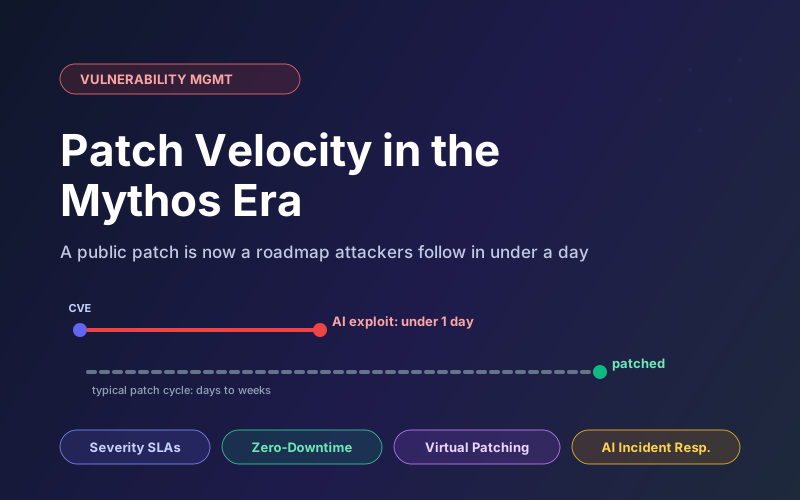
Picture the lifecycle of a vulnerability as a timeline. A maintainer publishes a fix and a CVE. Defenders begin their patch process. Attackers begin reverse-engineering the patch into an exploit. Your safety depends entirely on which line finishes first.
The entire objective of a modern vulnerability-management program is to move the patched milestone earlier than the exploit-ready milestone. Anthropic also warns that defense-in-depth measures whose value comes mostly from friction, from being tedious rather than impossible to bypass, get weaker against a model that grinds through tedious steps at machine speed. Hard barriers like ASLR and W^X still hold, but you can no longer rely on an exploit simply being too annoying to bother writing. Speed is the defense.
3Set Patch SLAs You Can Actually Hit
Vague intentions to patch promptly do not survive a busy sprint. You need explicit, severity-based service-level agreements with accountability, and they need to be aggressive enough for the new threat model. A reasonable starting framework:
| Severity | Target patch SLA | Trigger |
|---|---|---|
| Critical | Hours to 48 hours | Remote code execution, auth bypass, active in-the-wild reports |
| High | 7 days | Privilege escalation, sensitive data exposure |
| Medium | 30 days | Limited-impact bugs requiring local access or unusual config |
| Dependency CVE fix | 48 hours to merge | Any dependency bump carrying a security fix, treated as urgent |
The last row matters most for everyday teams. Anthropic specifically advises treating dependency bumps that carry CVE fixes as urgent rather than routine maintenance. Most breaches do not come from exotic zero-days; they come from a known CVE in a dependency that sat unpatched because the upgrade was queued behind feature work. Wire security upgrades onto a separate, faster track than ordinary maintenance.
4Make Patching Painless: Auto-Update and Zero-Downtime
SLAs only hold if patching is genuinely low-friction. The reason teams delay is almost always that deploying a fix is risky, manual, or requires downtime. Anthropic's guidance points squarely at removing those obstacles: enable auto-update wherever possible, and make fixes applicable seamlessly, without restarts or downtime, so there is no incentive to delay. The same advice applies to software distributors, who Anthropic says will need to ship faster and reserve fewer fixes for the next scheduled cycle.
- Automate dependency updates. Use Dependabot or Renovate to open update PRs automatically, and auto-merge security-only bumps that pass CI.
- Invest in zero-downtime deploys. Blue-green and rolling deployments remove the "we will patch during the maintenance window" excuse. If a patch can ship at 2pm on a Tuesday with no customer impact, it will.
- Keep a tested rollback path. Fast patching is only safe when reverting is also fast. Confidence to deploy quickly comes from knowing you can undo quickly.
- Maintain an SBOM per service. A software bill of materials lets you answer "are we affected?" in minutes when a CVE drops, instead of spending the exposure window just finding out.
5Defend the Window: Virtual Patching and Compensating Controls
Sometimes you cannot deploy the real fix in hours. The system might be legacy, unsupported, or owned by a team that needs time to validate the change. For that gap, you need compensating controls that buy time without leaving the vulnerability fully exposed.
Virtual patching at the WAF
Deploy a WAF or RASP rule that blocks the specific exploit pattern. It is not a real fix, but it can close the window while the code fix is validated.
Network isolation
Segment vulnerable systems so a compromise cannot move laterally. Anthropic notes the Linux kernel resisted remote exploitation thanks to defense in depth.
Least privilege
Scope service accounts and IAM tightly. Even a successful exploit yields less when the compromised process can do little.
Feature flags / kill switches
Disable the vulnerable code path or feature entirely until patched, if the business can tolerate it briefly.
For the broader governance view of legacy and unsupported systems, and how to brief leadership on this exposure, see our companion guide for CISOs and boards on Mythos-era cyber risk.
6Automate Incident Response With AI
As vulnerability discovery accelerates, the volume of incidents rises with it. More disclosures mean more attacker attempts against the window between disclosure and patch. Anthropic is direct about the implication: most incident response programs cannot staff their way through that volume, so models should carry much of the technical work.
Concretely, the same frontier models you can access today can:
- Triage and prioritize alerts so humans look at the right things first
- Summarize events and capture artifacts during an active incident
- Run proactive threat hunts in parallel with live investigations
- De-duplicate and severity-rank inbound vulnerability reports, which Anthropic found models do with high accuracy
- Draft preliminary postmortems and root-cause analyses as a basis for human validation
- Propose initial patches and write reproduction steps for reports
The principle Anthropic offers is a useful filter: it is worth experimenting with models for every security task you do manually today, because as models improve, the volume of security work will rise and everything requiring manual triage will benefit from scaled model assistance. The human stays in the loop for judgment and validation; the model absorbs the mechanical load.
7A Reference Patch-Velocity Pipeline
Pulling the pieces together, here is what a Mythos-ready vulnerability management loop looks like, from the moment a CVE is published to the moment you are protected.
Every stage in that loop is something you can build today with existing tools and generally available models. None of it requires Mythos access. That is the point: the defensive work is entirely within reach, and the teams that build this loop now will be the ones still standing comfortably when AI-accelerated exploitation becomes routine. For hardening the code itself so there are fewer bugs to patch, pair this with our guide on preparing your codebase for AI vulnerability discovery.
8Why Lushbinary for Vulnerability Management
Lushbinary builds the automation that makes fast patching realistic. We help teams move from a maintenance-window mindset to a patch-velocity program that can absorb the volume an AI-accelerated world produces.
- Automated dependency management and SBOM generation
- Zero-downtime CI/CD pipelines with tested rollback paths
- AWS-native defense: WAF virtual patching, GuardDuty, Security Hub, and network segmentation
- AI-assisted alert triage and incident response design
🚀 Free Patch Velocity Assessment
Want to know how fast you could actually deploy a critical fix today? We offer a free 30-minute assessment of your patch velocity, CI/CD, and dependency hygiene, with concrete steps to close the exposure window. Book a call →
❓ Frequently Asked Questions
What is an N-day vulnerability and why does Claude Mythos make it more dangerous?
An N-day is a publicly disclosed and patched vulnerability that remains exploitable on unpatched systems. Mythos can turn a public CVE and its patch commit into a working exploit autonomously in under a day. Anthropic gave it 100 known Linux CVEs, it picked 40 as exploitable, and wrote working exploits for more than half of those 40.
How fast do I need to patch in the Mythos era?
Target hours to a few days for critical vulnerabilities rather than weeks. Anthropic advises driving down time-to-deploy, tightening enforcement windows, enabling auto-update, and treating CVE-fixing dependency bumps as urgent rather than routine.
Why is a public patch now a security risk?
A patch is a roadmap to the bug it fixes. Once public, an attacker with a capable model can diff the change, find the vulnerability, and generate an exploit faster than many teams can schedule an upgrade. The disclosure-to-exploitation window is now measured in hours.
Can AI help defenders keep up with patching?
Yes. Anthropic recommends models carry much of the technical work: triaging alerts, summarizing events, prioritizing human review, running proactive hunts, capturing artifacts during incidents, and drafting postmortems and root-cause analyses for human validation.
What is the difference between zero-day and N-day risk with Mythos?
Zero-days are previously unknown bugs. N-days are known and patched but unpatched in the wild. Anthropic argues N-days can be more dangerous because the vulnerability is already public, the patch is a roadmap, and the only protection is how fast you deploy the fix.
📚 Sources
- Anthropic - Assessing Claude Mythos Preview's cybersecurity capabilities (N-day exploitation and defender guidance)
- Anthropic - Project Glasswing
- NIST NVD - CVE-2026-4747 (FreeBSD NFS remote code execution)
- Wikipedia - Claude Mythos
Content was rephrased for compliance with licensing restrictions. Exploitation timelines, defender recommendations, and CVE details sourced from official Anthropic publications and NIST as of May 31, 2026. SLA targets are general guidance. Tune them to your own risk tolerance and regulatory requirements.
Close Your Exposure Window
Lushbinary builds the automated patch pipelines, dependency hygiene, and AI-assisted response that a Mythos-era world demands. Let us help you patch in hours, not weeks.
Ready to Build Something Great?
Get a free 30-minute strategy call. We'll map out your project, timeline, and tech stack - no strings attached.
Prefer email? Reach us directly: