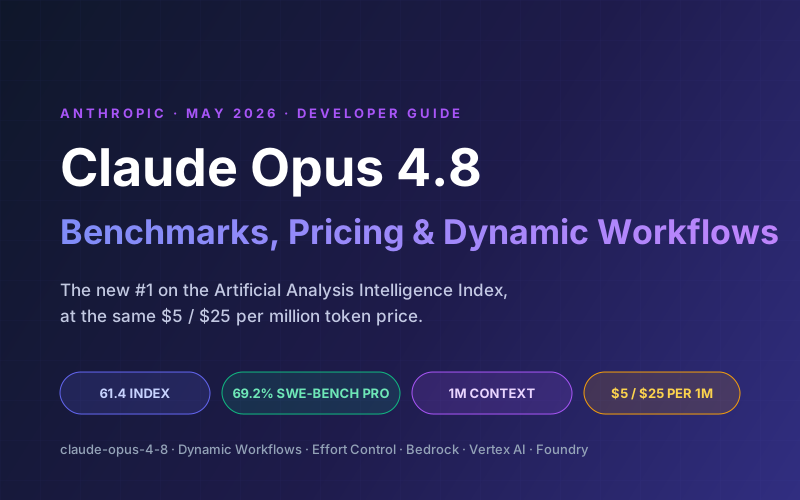

When a frontier lab ships a point release at the same price as the last one, the question is simple: is it worth flipping production traffic? For Claude Opus 4.8 over Opus 4.7, the short answer is yes. Coding, agentic, knowledge work, and math benchmarks all improve, the price did not move, and there is no cost reason to stay on 4.7.
But a responsible upgrade is more than swapping a string. This guide gives you the exact before-and-after numbers, the one place 4.7 still ties or wins, the verbosity tradeoff to watch, and a step-by-step migration checklist so you can move with confidence.
What This Guide Covers
1The 30-Second Verdict
Verdict
Upgrade. Same $5/$25 pricing, same 1M context, broad benchmark gains, and a major honesty improvement. The only watch-item is verbosity: Opus 4.8 generates more tokens per response, so cap output and use prompt caching on cost-sensitive paths.
Anthropic itself put it plainly: coding benchmarks improve by 5 to 8 points, knowledge work jumps 137 Elo, alignment improves dramatically, and the price is unchanged. The upgrade is a drop-in model ID swap from claude-opus-4-7 to claude-opus-4-8.
2Benchmark Deltas, Before and After
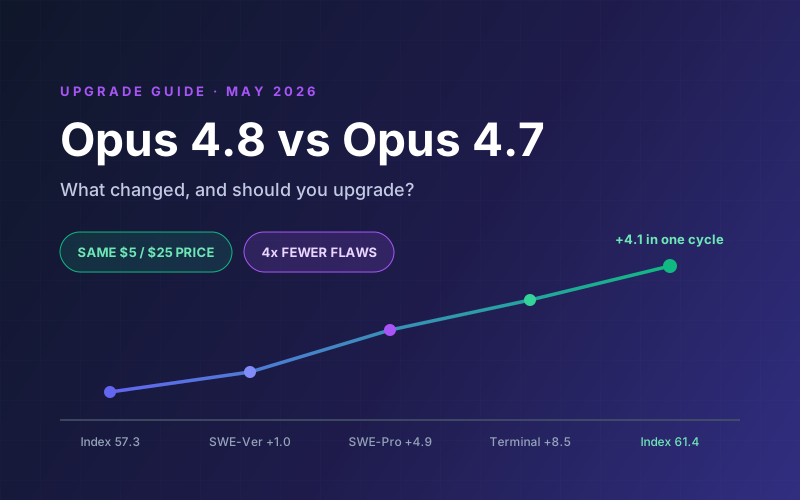
Here is the head-to-head. Every coding and reasoning benchmark moves up except GPQA Diamond, which dips a statistically negligible 0.6 points.
| Benchmark | Opus 4.7 | Opus 4.8 | Delta |
|---|---|---|---|
| Intelligence Index | 57.3 | 61.4 | +4.1 |
| SWE-bench Pro | 64.3% | 69.2% | +4.9 |
| SWE-bench Verified | 87.6% | 88.6% | +1.0 |
| Terminal-Bench 2.1 | 66.1% | 74.6% | +8.5 |
| OSWorld-Verified | 82.8% | 83.4% | +0.6 |
| MCP-Atlas | 77.3% | 82.2% | +4.9 |
| HLE (with tools) | 54.7% | 57.9% | +3.2 |
| BrowseComp | 79.3% | 84.3% | +5.0 |
| GDPval-AA (Elo) | 1,753 | 1,890 | +137 |
| GPQA Diamond | 94.2% | 93.6% | -0.6 |
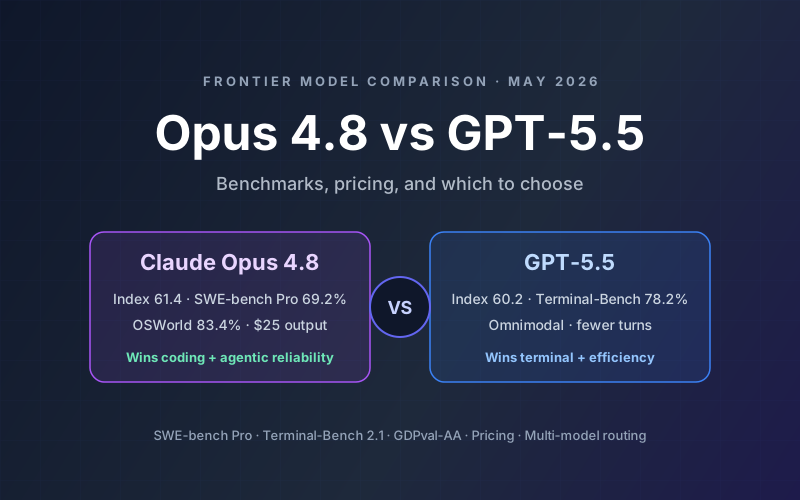
The biggest jumps are Terminal-Bench 2.1 (+8.5), which closes most of the gap to GPT-5.5, and GDPval-AA (+137 Elo), the benchmark that measures economically valuable real-world knowledge work. That GDPval gain implies roughly a 67% head-to-head win rate against GPT-5.5. Just as notable: Opus 4.8 hits these scores using 15% fewer turns and 35% fewer output tokens than 4.7 on GDPval-AA, so it is both smarter and leaner on that task.
3The Honesty Upgrade
The change that does not show up as a single benchmark number may be the most valuable for teams running unattended agents. Opus 4.8 is far less likely to confidently ship or report something wrong.
fewer unflagged code flaws vs Opus 4.7
rate of uncritically reporting flawed results (a first for Claude)
reduction in overconfidence vs Opus 4.7
fewer dishonest agentic code summaries vs Sonnet 4.6
Anthropic's alignment team reports misaligned behavior rates, including deception, are substantially lower than 4.7 and now comparable to the restricted Claude Mythos Preview. For autonomous engineering, Cognition reported that 4.8 fixed the comment-verbosity and tool-calling issues they saw in 4.7.
4New Platform Features
Three features shipped alongside the model that 4.7 never had:
- Dynamic Workflows: orchestrate hundreds of parallel subagents inside one Claude Code session for codebase-scale migrations. See our Dynamic Workflows guide.
- Effort control: low, high, extra, and maximum effort levels across all claude.ai plans, replacing the single fixed default of 4.7.
- Messages API enhancement: inject system directives mid-conversation without breaking prompt cache, ideal for long agent runs that need to adjust permissions or budgets on the fly.
5The Verbosity Tradeoff
The one place to be careful is token spend. Artificial Analysis found Opus 4.8 is very verbose and slower than average, producing roughly 110 million tokens during the full Intelligence Index evaluation versus a 35 million token average. On a fixed $25 per million output rate, more tokens means more cost per task on output-heavy workloads.
The good news is this is controllable. Set output-token caps, choose a lower effort level for routine work, and enable prompt caching (the $0.50 per million cache-hit rate is a 90% discount on repeated input). On GDPval-style knowledge work, 4.8 is actually leaner than 4.7, so the verbosity concern is workload-specific, not universal.
6Migration Checklist
// Anthropic Messages API
- model: "claude-opus-4-7"
+ model: "claude-opus-4-8"
- Re-run evals. Coding and math should improve; verify your prompt formats still parse and structured outputs still validate.
- Set an explicit effort level. If you relied on 4.7's default, the new high setting is the closest analog at similar token budgets.
- Confirm prompt caching is enabled on hot paths to offset verbosity.
- Add output-token caps where cost is sensitive to response length.
- Test your deployment surface. Validate on Bedrock, Vertex AI, or Microsoft Foundry if you do not call the direct API.
- Roll out gradually. Canary a slice of traffic, watch cost and latency dashboards, then ramp.
7Why Lushbinary for the Migration
A clean model upgrade needs eval coverage to catch regressions, caching and effort tuning to control cost, and a gradual rollout plan with monitoring. Lushbinary has migrated production workloads across every major frontier model and can run your Opus 4.7 to 4.8 cutover without surprises.
🚀 Free Consultation
Moving from Opus 4.7 to 4.8? Lushbinary will review your prompts, evals, and cost profile, then plan a safe migration with caching and effort tuning, no obligation.
❓ Frequently Asked Questions
Should I upgrade from Claude Opus 4.7 to Opus 4.8?
Yes. Opus 4.8 improves coding, agentic, knowledge work, and math benchmarks across the board at the exact same $5/$25 per million token pricing. There is no cost reason to stay on 4.7. The only thing to validate before flipping production traffic is the verbosity profile against your token budget.
What changed between Claude Opus 4.7 and Opus 4.8?
SWE-bench Pro rose from 64.3% to 69.2%, Terminal-Bench 2.1 from 66.1% to 74.6%, GDPval-AA from 1,753 to 1,890 Elo, and the Intelligence Index from 57.3 to 61.4. Opus 4.8 is also 4x less likely to let code flaws pass unflagged, the first Claude model to score 0% on reporting flawed results, and ships Dynamic Workflows and effort control.
Is Claude Opus 4.8 more expensive than Opus 4.7?
No. Standard pricing is identical at $5 per million input and $25 per million output tokens. Fast mode is actually 3x cheaper than the previous generation's fast mode. Opus 4.8 is more verbose per response, so total spend can rise on output-heavy workloads unless you cap output tokens.
How do I migrate from Opus 4.7 to Opus 4.8?
Change the model ID from claude-opus-4-7 to claude-opus-4-8, re-run your eval suite, set an explicit effort level (high is the closest analog to 4.7's default), confirm prompt caching on hot paths, and add output-token caps if cost is sensitive to verbosity. It is a drop-in replacement.
Does Opus 4.8 keep the 1 million token context window?
Yes. Opus 4.8 keeps the same 1 million token context window and 128K maximum output as Opus 4.7, with improved long-context retrieval accuracy.
Sources
- Anthropic - Introducing Claude Opus 4.8
- Artificial Analysis - Claude Opus 4.8 Analysis & Benchmarks
- Anthropic - Claude Models Documentation
Content was rephrased for compliance with licensing restrictions. Benchmark and pricing data sourced from official Anthropic publications and Artificial Analysis as of May 28, 2026. Pricing and benchmarks may change, always verify on the vendor's website.
Upgrade to Opus 4.8 Without Surprises
Lushbinary plans and runs frontier-model migrations with eval coverage, caching strategy, and gradual rollout so your costs and quality stay predictable.
Ready to Build Something Great?
Get a free 30-minute strategy call. We'll map out your project, timeline, and tech stack - no strings attached.
Prefer email? Reach us directly: