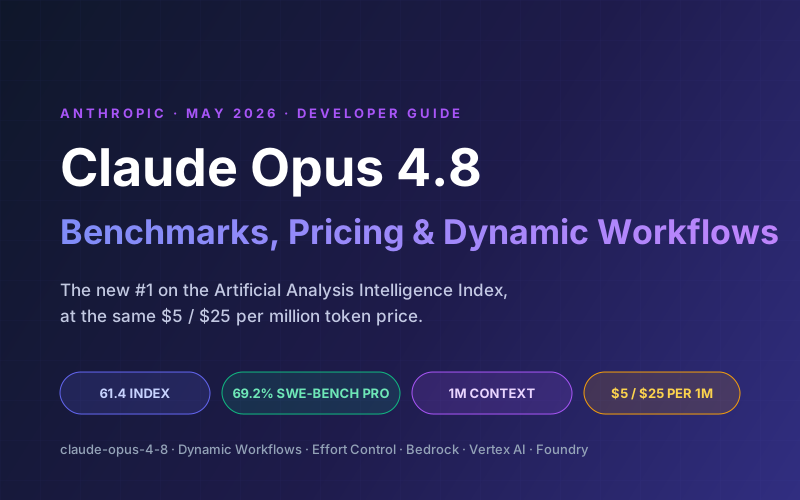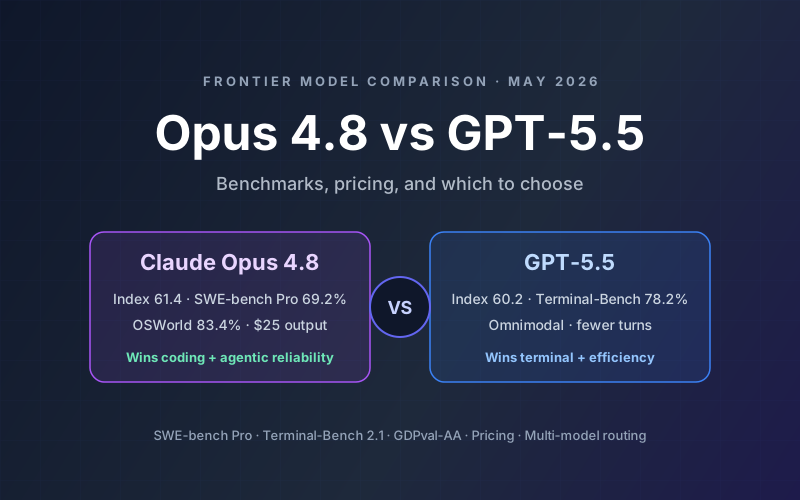

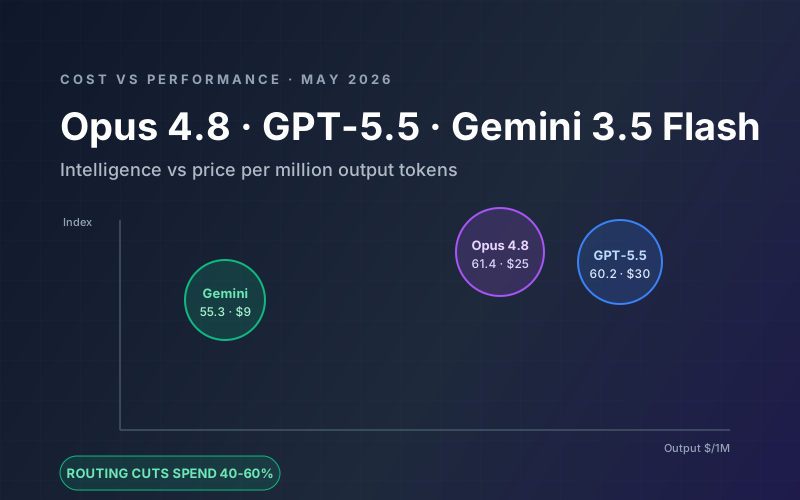
As of late May 2026, the three models most production teams weigh against each other are Claude Opus 4.8, GPT-5.5, and Gemini 3.5 Flash. They are not really competing on the same axis. Opus 4.8 is the intelligence leader, GPT-5.5 is the efficient agentic workhorse, and Gemini 3.5 Flash is the budget-and-speed champion.
That spread is the whole point. Opus 4.8 tops the Artificial Analysis Intelligence Index at 61.4, but Gemini 3.5 Flash hits 55.3 at roughly 70% lower cost and about 4x the speed. The right answer for your workload depends entirely on whether you are paying for peak capability or optimizing a per-request budget.
This guide puts the three side by side on intelligence, coding, pricing, speed, and context, runs the cost math, and gives you a routing strategy so each request goes to the model that delivers the best result per dollar.
What This Guide Covers
1Three Models, Three Philosophies
Claude Opus 4.8
- Intelligence leader (61.4)
- Best real-world coding
- Agentic reliability + honesty
- Verbose, premium price
GPT-5.5
- Efficient agentic workhorse
- Leads Terminal-Bench 2.1
- Natively omnimodal
- Fewer turns per task
Gemini 3.5 Flash
- Budget and speed champion
- ~70% cheaper than Opus
- ~4x faster output
- 1M context window
2Intelligence & Coding Benchmarks
The aggregate Intelligence Index tells the high-level story; the coding numbers tell the practical one.
| Metric | Opus 4.8 | GPT-5.5 | Gemini 3.5 Flash |
|---|---|---|---|
| Intelligence Index | 61.4 | 60.2 | 55.3 |
| SWE-bench Pro | 69.2% | 58.6% | N/A |
| Terminal-Bench 2.1 | 74.6% | 78.2% | 76.2% |
| Output speed | Slower | Fast | ~4x faster |
| Verbosity | High | Low | Low |
Opus 4.8 owns the hardest coding benchmark (SWE-bench Pro) and the aggregate index. GPT-5.5 keeps the Terminal-Bench 2.1 crown and runs leaner. Gemini 3.5 Flash is the surprise: it posts a 76.2% on Terminal-Bench 2.1, ahead of Opus 4.8 on that single benchmark, while costing a fraction as much and running roughly four times faster. For agentic-first, latency-sensitive work, Flash punches well above its price.
3Pricing & Cost Math
| Model | Input / 1M | Output / 1M | Context |
|---|---|---|---|
| Claude Opus 4.8 | $5.00 | $25.00 | 1M |
| GPT-5.5 | $5.00 | $30.00 | 922K |
| Gemini 3.5 Flash | $1.50 | $9.00 | 1M |
To make the gap concrete, consider a workload of 10 million tokens per day split 70% input and 30% output. Using the formula cost = tokens x (0.7 x input_price + 0.3 x output_price) / 1,000,000:
- Opus 4.8: 10,000,000 x (0.7 x $5 + 0.3 x $25) / 1,000,000 = 10 x ($3.50 + $7.50) = $110/day
- GPT-5.5: 10 x (0.7 x $5 + 0.3 x $30) = 10 x ($3.50 + $9.00) = $125/day
- Gemini 3.5 Flash: 10 x (0.7 x $1.50 + 0.3 x $9) = 10 x ($1.05 + $2.70) = $37.50/day
At this blend, Gemini 3.5 Flash costs about 34% of Opus 4.8 per token, before factoring in that Flash is less verbose and produces fewer output tokens per task. The real-world savings are typically larger than the per-token table suggests. These are list-price calculations; prompt caching reduces all three further on repeated context.
4Intelligence per Dollar
A simple way to frame value is intelligence index points per dollar of output cost. This is a rough heuristic, not a benchmark, but it makes the tradeoff visible.
| Model | Index | Output $/1M | Index per $ output |
|---|---|---|---|
| Gemini 3.5 Flash | 55.3 | $9.00 | 6.1 |
| GPT-5.5 | 60.2 | $30.00 | 2.0 |
| Claude Opus 4.8 | 61.4 | $25.00 | 2.5 |
Gemini 3.5 Flash delivers roughly 6.1 index points per output dollar versus 2.5 for Opus 4.8, about 2.4x more raw capability per dollar. Opus 4.8 edges GPT-5.5 on value because it hits a higher score at a lower output price. The lesson is not that one model is best; it is that paying frontier prices only makes sense when the marginal intelligence actually changes the outcome.
5The Routing Strategy
The cost-optimal architecture sends each request to the cheapest model that can do the job well. A practical three-tier split:
- Opus 4.8 (premium tier): complex coding, code review, reliability-critical and unattended agents, codebase migrations via Dynamic Workflows
- GPT-5.5 (efficient agentic tier): terminal-heavy automation, CI fixers, token-sensitive multi-step agents, omnimodal input
- Gemini 3.5 Flash (volume tier): classification, summarization, drafting, latency-sensitive UX, and the large majority of routine requests
Teams that route this way typically cut total model spend 40 to 60% compared to sending everything to a single frontier model, while keeping or improving quality by matching each task to the right tool. We detail the head-to-head between the two premium options in our Opus 4.8 vs GPT-5.5 comparison.
6Decision Framework
| Priority | Best Model | Why |
|---|---|---|
| Peak coding quality | Opus 4.8 | 69.2% SWE-bench Pro |
| Lowest cost per request | Gemini 3.5 Flash | $1.50/$9, less verbose |
| Lowest latency | Gemini 3.5 Flash | ~4x faster output |
| Terminal & DevOps agents | GPT-5.5 | 78.2% Terminal-Bench 2.1 |
| Unattended reliability | Opus 4.8 | 0% on reporting flawed results |
| High-volume routine tasks | Gemini 3.5 Flash | Best intelligence per dollar |
7Why Lushbinary for Multi-Model Architecture
The highest-leverage AI cost decision most teams make is not which single model to standardize on, it is how to route intelligently across a premium, an efficient, and a volume tier. Done well, that is where the 40 to 60% savings come from without sacrificing quality.
Lushbinary builds production multi-model routing layers with cost tracking, automatic failover, prompt caching, and per-task model selection, deployed on AWS with full monitoring. We have integrated Opus 4.8, GPT-5.5, and Gemini 3.5 Flash into real workloads.
🚀 Free Consultation
Want to cut your AI bill without losing quality? Lushbinary will model your token mix, design a routing strategy across Opus 4.8, GPT-5.5, and Gemini 3.5 Flash, and give you a projected savings estimate, no obligation.
❓ Frequently Asked Questions
Which is the best value: Claude Opus 4.8, GPT-5.5, or Gemini 3.5 Flash?
It depends on whether you optimize for intelligence or cost. Opus 4.8 leads the Intelligence Index at 61.4 but costs $5/$25 per million tokens and is verbose. Gemini 3.5 Flash scores 55.3 at $1.50/$9, roughly 70% cheaper and about 4x faster. GPT-5.5 sits between at 60.2 and $5/$30. For budget and latency, Flash wins; for peak intelligence and agentic reliability, Opus 4.8.
How much cheaper is Gemini 3.5 Flash than Claude Opus 4.8?
Gemini 3.5 Flash costs $1.50 per million input and $9 per million output tokens, versus $5 and $25 for Opus 4.8. That is roughly 70% cheaper on input and 64% cheaper on output per token, before accounting for Flash being less verbose and faster, which widens the real-world cost gap further.
Is Claude Opus 4.8 worth the higher price over Gemini 3.5 Flash?
For complex coding, agentic reliability, and hard reasoning, yes. Opus 4.8 leads SWE-bench Pro at 69.2% and tops the Intelligence Index. For high-volume, latency-sensitive, or budget-constrained work where good-enough quality is fine, Gemini 3.5 Flash delivers most of the capability at a fraction of the cost.
What is the best multi-model routing strategy across these three?
Route complex coding, code review, and reliability-critical agents to Opus 4.8, terminal-heavy and token-sensitive agentic work to GPT-5.5, and high-volume simple or latency-sensitive tasks to Gemini 3.5 Flash. This blended approach typically cuts costs 40 to 60% versus sending everything to a single frontier model.
Do all three models have a 1 million token context window?
Opus 4.8 and Gemini 3.5 Flash both offer 1 million token context windows. GPT-5.5 offers 922K. All three are large enough for most long-context coding and document workloads.
Sources
- Anthropic - Introducing Claude Opus 4.8
- Artificial Analysis - Claude Opus 4.8 Analysis & Benchmarks
- Google - Gemini API Pricing
Content was rephrased for compliance with licensing restrictions. Benchmark and pricing data sourced from official Anthropic, OpenAI, and Google publications and Artificial Analysis as of May 28, 2026. Cost calculations use list prices and are illustrative. Pricing and benchmarks may change, always verify on the vendor's website.
Cut Your AI Bill, Keep the Quality
Lushbinary designs multi-model routing across Opus 4.8, GPT-5.5, and Gemini 3.5 Flash so every request lands on the model with the best result per dollar.
Ready to Build Something Great?
Get a free 30-minute strategy call. We'll map out your project, timeline, and tech stack - no strings attached.
Prefer email? Reach us directly: