
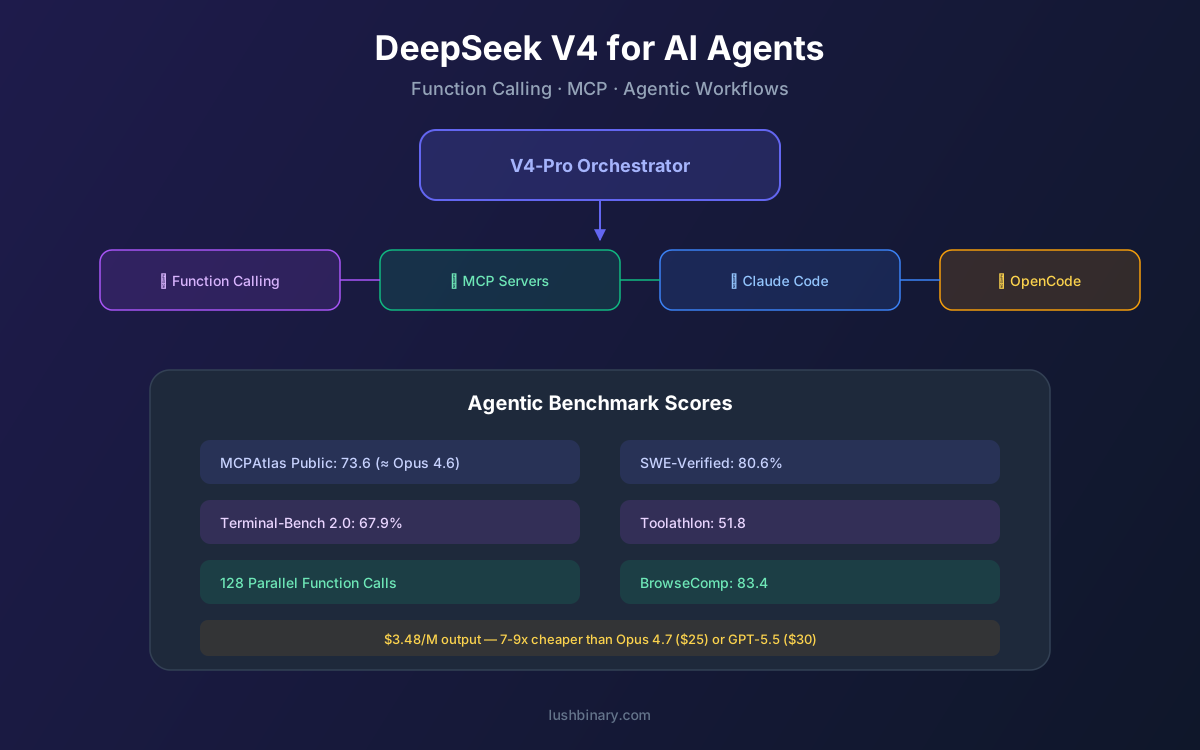
DeepSeek V4-Pro is the best open-weight model for agentic AI workflows as of April 2026. It scores 73.6 on MCPAtlas Public (tied with Claude Opus 4.6), supports up to 128 parallel function calls, and ships with pre-tuned adapters for Claude Code, OpenCode, OpenClaw, and CodeBuddy, all at $3.48/M output tokens, a fraction of what closed-source competitors charge.
This guide covers V4's agentic capabilities, function calling patterns, MCP integration, coding agent setup, multi-agent architectures, and production deployment patterns. Whether you're building a coding agent, a customer support bot, or a multi-tool orchestration system, V4 gives you frontier-adjacent agentic performance with open weights.
What This Guide Covers
- V4 Agentic Benchmark Results
- Function Calling: 128 Parallel Tool Calls
- Pre-Tuned Adapters: Claude Code, OpenCode & More
- MCP Integration Patterns
- Reasoning Modes for Agent Workflows
- Coding Agent Architecture with V4
- Multi-Agent Orchestration
- V4-Pro vs V4-Flash for Agents
- Cost Optimization for Agent Workloads
- Why Lushbinary for AI Agent Development
1V4 Agentic Benchmark Results
V4-Pro-Max is the strongest open-weight model on agentic benchmarks. Here's how it stacks up against the competition:
| Benchmark | V4-Pro Max | Opus 4.6 Max | GPT-5.4 xHigh |
|---|---|---|---|
| SWE-Verified | 80.6% | 80.8% | - |
| Terminal-Bench 2.0 | 67.9% | 65.4% | 75.1% |
| MCPAtlas Public | 73.6 | 73.8 | 67.2 |
| Toolathlon | 51.8 | 47.2 | 54.6 |
| BrowseComp | 83.4 | 83.7 | - |
V4-Pro is competitive with or ahead of Opus 4.6 on most agentic benchmarks (the comparison model DeepSeek benchmarked against at V4 launch). It leads on Toolathlon (multi-tool orchestration) and Terminal-Bench (CLI workflows) vs Opus 4.6, while trailing GPT-5.4 on Terminal-Bench. The MCPAtlas score of 73.6 is essentially tied with Opus 4.6 (73.8), confirming strong MCP tool integration capabilities. Note: Anthropic released Opus 4.7 on April 16, 2026 with improved SWE-bench numbers; expect the gap to widen on real-world software engineering benchmarks.
2Function Calling: 128 Parallel Tool Calls
V4 supports up to 128 functions in a single call, with parallel execution. This is critical for agents that need to gather information from multiple sources simultaneously, the difference between a fast agent and one that serializes everything.
// Example: Parallel function calling with V4
const response = await client.chat.completions.create({
model: 'deepseek-v4-pro',
messages: [{ role: 'user', content: 'Check weather in NYC, SF, and London' }],
tools: [weatherTool, stockTool, newsTool],
tool_choice: 'auto',
});
// V4 will call weatherTool 3x in parallel
V4 also supports JSON mode for structured output, chat-prefix completion (beta) for guided generation, and FIM (fill-in-the-middle, beta, non-thinking only) for code completion. The OpenAI-compatible API means existing tool definitions work without modification.
3Pre-Tuned Adapters: Claude Code, OpenCode & More
V4 ships with pre-tuned adapters for four major coding agent harnesses:
Claude Code
Drop-in replacement. Swap base URL to api.deepseek.com, set model to deepseek-v4-pro. Thinking auto-upgrades to max.
OpenCode
Native support via OpenAI-compatible endpoint. Thinking auto-upgrades to max for OpenCode requests.
OpenClaw
Compatible via the standard API. Works with OpenClaw's tool calling and agent loop patterns.
CodeBuddy
Pre-tuned adapter included. Supports CodeBuddy's edit and review workflows.
The auto-upgrade to Think Max for Claude Code and OpenCode requests is a smart design choice. Agentic coding tasks benefit most from maximum reasoning effort, and DeepSeek handles this automatically so developers don't need to configure it.
4MCP Integration Patterns
V4's MCPAtlas score of 73.6 confirms strong compatibility with the Model Context Protocol. Since V4 exposes an OpenAI-compatible API, it works with any MCP client that supports the OpenAI function calling format. Here's a typical integration pattern:
- MCP servers expose tools (file system, database, API calls) via the standard MCP protocol
- MCP client translates MCP tool definitions into OpenAI-format function schemas
- V4 receives the function schemas, decides which tools to call, and returns structured tool call requests
- MCP client executes the tool calls against MCP servers and feeds results back to V4
This architecture works identically whether V4 is accessed via the DeepSeek API or self-hosted via vLLM. The OpenAI-compatible interface is the key enabler: any MCP client built for GPT or Claude works with V4 out of the box.
5Reasoning Modes for Agent Workflows
Choosing the right reasoning mode per agent step is critical for both quality and cost:
| Agent Step | Reasoning Mode | Why |
|---|---|---|
| Tool selection | Non-think | Fast, low-cost routing decision |
| Parameter extraction | Non-think | Structured output, no reasoning needed |
| Planning & decomposition | Think High | Needs logical analysis, not max depth |
| Code generation | Think Max | Complex reasoning improves code quality |
| Error recovery | Think Max | Needs deep analysis of failure modes |
| Result summarization | Non-think | Formatting task, no reasoning needed |
6Coding Agent Architecture with V4
V4-Pro is DeepSeek's own engineers' preferred model for internal agentic coding. Here's a production-ready architecture for a coding agent:
- Orchestrator: V4-Pro (Think High) for task planning and decomposition
- Code generator: V4-Pro (Think Max) for writing and modifying code
- Code reviewer: V4-Flash (Think High) for reviewing generated code (cost-effective)
- Test runner: Shell tool execution via MCP server
- Error handler: V4-Pro (Think Max) for diagnosing and fixing test failures
This architecture uses V4-Pro for the high-stakes steps (code generation, error recovery) and V4-Flash for lower-stakes steps (code review, summarization), optimizing cost without sacrificing quality where it matters.
7Multi-Agent Orchestration
V4's 1M-token context window enables multi-agent patterns where a coordinator agent maintains full conversation history across multiple specialist agents. The hybrid attention architecture keeps this affordable: V4-Pro uses 10% of V3.2's KV cache at 1M context; V4-Flash drops to about 7%.
A practical multi-agent setup: one V4-Pro coordinator that plans and delegates, multiple V4-Flash workers that execute specific tasks (file operations, API calls, data processing), and a V4-Pro reviewer that validates the combined output. The coordinator uses the full 1M context to track state across all workers.
8V4-Pro vs V4-Flash for Agents
DeepSeek confirms that V4-Flash “performs on par with V4-Pro on simple agent tasks.” The gap widens on complex, long-horizon workflows:
- Use V4-Flash: Simple tool calls, single-step tasks, high-volume agent interactions, cost-sensitive deployments
- Use V4-Pro: Multi-step planning, 10+ tool call chains, complex error recovery, tasks requiring deep domain knowledge
The optimal pattern: start every agent request on V4-Flash. If the task requires more than 3 tool calls or the agent detects it needs deeper reasoning, escalate to V4-Pro. This keeps costs low for the 70–80% of requests that V4-Flash handles well.
9Cost Optimization for Agent Workloads
Agent workloads are token-intensive: each tool call round-trip adds input and output tokens. V4's pricing makes this manageable:
- Context caching: Automatic, no code changes. System prompts and tool definitions are cached at $0.028/M (Flash) or $0.145/M (Pro), 90% cheaper than cache misses.
- Off-peak pricing: 50% discount during Beijing nighttime. Schedule batch agent jobs during this window.
- Model tiering: Route simple steps to V4-Flash ($0.28/M output) and complex steps to V4-Pro ($3.48/M output).
- Reasoning mode selection: Use Non-think for tool routing and parameter extraction. Reserve Think Max for code generation and error recovery.
A well-optimized agent pipeline using V4-Flash for 80% of steps and V4-Pro for 20% can process a typical 10-step agent workflow for under $0.05, compared to $0.50+ with Opus 4.7 or GPT-5.5.
10Why Lushbinary for AI Agent Development
Lushbinary builds production AI agents powered by DeepSeek V4, Claude, and GPT. We handle the full stack: agent architecture design, function calling integration, MCP server development, multi-model routing, and deployment on AWS.
🚀 Free Consultation
Want to build AI agents with DeepSeek V4? Lushbinary specializes in agentic AI architectures, MCP integration, and multi-model routing. We'll design your agent pipeline and get you to production, no obligation.
❓ Frequently Asked Questions
Does DeepSeek V4 support function calling?
Yes. Both V4-Pro and V4-Flash support up to 128 parallel function calls, JSON mode, and chat-prefix completion. V4-Pro ships with pre-tuned adapters for Claude Code, OpenCode, OpenClaw, and CodeBuddy.
How does DeepSeek V4 perform on agentic benchmarks?
V4-Pro-Max scores 73.6 on MCPAtlas (tied with Opus 4.6), 80.6% on SWE-Verified, 67.9% on Terminal-Bench 2.0, and 51.8 on Toolathlon. It leads open-source models on agentic tasks.
Can I use DeepSeek V4 with Claude Code?
Yes. Swap the base URL to api.deepseek.com and set model to deepseek-v4-pro. Thinking effort auto-upgrades to max for Claude Code requests.
What is the cost of running AI agents with DeepSeek V4?
V4-Pro output costs $3.48/M tokens - 7-9x cheaper than Opus 4.7 or GPT-5.5. A typical 10-step agent workflow costs under $0.05 with optimized V4-Flash/Pro routing.
Does DeepSeek V4 support MCP?
Yes. V4-Pro scores 73.6 on MCPAtlas Public. The OpenAI-compatible API makes it compatible with any MCP client built for GPT or Claude.
Sources
- DeepSeek V4-Pro Model Card on Hugging Face
- DeepSeek API Pricing
- DeepSeek V4-Pro vs V4-Flash Comparison on Lushbinary
Content was rephrased for compliance with licensing restrictions. Benchmark data sourced from official DeepSeek model cards as of April 24, 2026. Pricing may change, always verify on vendor websites.
Build AI Agents with DeepSeek V4
Lushbinary designs agentic AI architectures with multi-model routing, MCP integration, and production deployment.
Ready to Build Something Great?
Get a free 30-minute strategy call. We'll map out your project, timeline, and tech stack - no strings attached.
Prefer email? Reach us directly: