
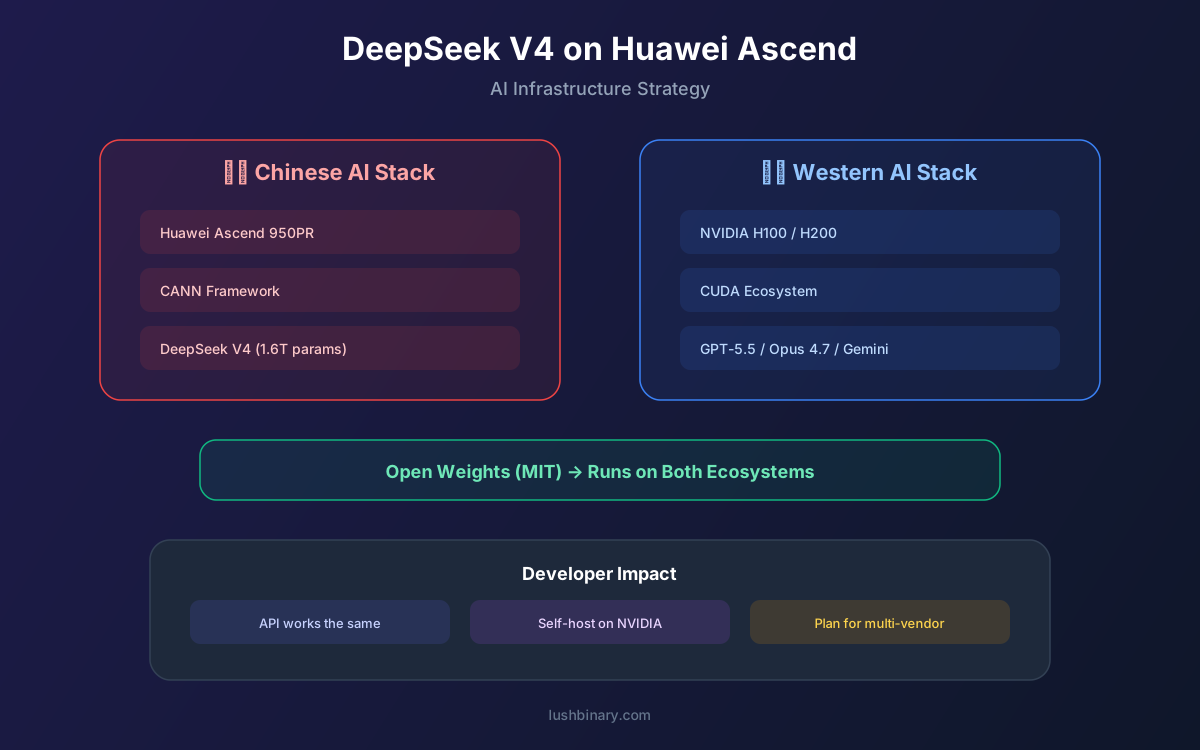
DeepSeek V4 isn't just a model release, it's a geopolitical statement. Reuters confirmed in April 2026 that V4 runs on Huawei's Ascend 950PR chips, making it the first frontier-class AI model built entirely on Chinese domestic semiconductor infrastructure. DeepSeek deliberately gave Huawei early optimization access while denying it to NVIDIA and AMD.
For developers, the immediate impact is minimal, the open weights work on NVIDIA GPUs, and the API works the same regardless of what hardware runs it. But the strategic implications are significant: China can now train frontier AI without American chips, and the AI hardware landscape is fragmenting into competing ecosystems.
This guide analyzes what the Huawei Ascend strategy means for AI infrastructure planning, hardware diversification, and the future of the AI chip market.
What This Guide Covers
- The Ascend 950PR: Huawei's Answer to H100
- Why DeepSeek Chose Huawei Over NVIDIA
- US Export Controls & the China AI Gap
- CANN vs CUDA: The Software Ecosystem Battle
- What This Means for V4 Performance
- Impact on Open-Weight Model Deployment
- The Parallel AI Hardware Ecosystem
- Multi-Vendor Infrastructure Strategy
- What Developers Should Do Now
- Why Lushbinary for AI Infrastructure Planning
1The Ascend 950PR: Huawei's Answer to H100
The Ascend 950PR is Huawei's latest AI accelerator, designed to compete with NVIDIA's H100 and H200 for large-scale model training and inference. While Huawei hasn't published full specifications publicly, industry reports indicate it uses Huawei's Da Vinci architecture with HBM3 memory and supports the CANN (Compute Architecture for Neural Networks) software framework.
The fact that DeepSeek trained a 1.6T-parameter model on Ascend chips and achieved benchmark results competitive with NVIDIA-trained models (LiveCodeBench 93.5, Codeforces 3206) is the strongest evidence yet that Chinese AI accelerators have reached frontier-training capability. The performance gap between Ascend and NVIDIA, if it exists, isn't showing up in the model's output quality.
2Why DeepSeek Chose Huawei Over NVIDIA
DeepSeek's choice wasn't purely technical, it was strategic. Three factors drove the decision:
- Supply chain security: US export controls have repeatedly restricted Chinese access to NVIDIA's top-tier chips. Building on Huawei eliminates this dependency entirely.
- Early optimization access: DeepSeek reportedly gave Huawei early access to V4's architecture for hardware optimization while denying the same to NVIDIA and AMD. This creates a feedback loop where Ascend chips get better at running DeepSeek models.
- National strategy alignment: China's government has made AI hardware independence a strategic priority. DeepSeek's choice positions it favorably within China's tech ecosystem.
The message to the industry is clear: a frontier-class lab can build competitive models without NVIDIA. Whether other Chinese labs follow DeepSeek's lead will determine how quickly the AI hardware market fragments.
3US Export Controls & the China AI Gap
US export controls on advanced AI chips to China have been a defining feature of the AI landscape since 2022. The controls aimed to slow China's AI development by restricting access to NVIDIA's A100, H100, and subsequent chips.
V4's release on Huawei chips suggests the controls have had a different effect than intended: rather than stopping Chinese AI development, they accelerated the development of domestic alternatives. DeepSeek V4's benchmark results, competitive with models trained on NVIDIA hardware, demonstrate that the performance gap between Chinese and American AI chips has narrowed significantly.
Strategic Implication
If Chinese labs can train frontier models on domestic chips, the leverage of US export controls diminishes. This doesn't mean the controls are irrelevant, NVIDIA hardware likely still offers efficiency advantages, but the “China can't build frontier AI without American chips” assumption no longer holds.
4CANN vs CUDA: The Software Ecosystem Battle
Hardware is only half the story. NVIDIA's dominance isn't just about chip performance, it's about CUDA, the software ecosystem that every ML framework, inference engine, and training pipeline is built on. Huawei's CANN framework is the alternative, but it's far less mature.
For DeepSeek's own infrastructure, CANN works because they control the full stack. For the broader developer community, CUDA compatibility remains essential. This is why V4's open weights are released in standard formats that work with vLLM, SGLang, and other CUDA-based inference frameworks, the Huawei optimization is for DeepSeek's internal infrastructure, not for end users.
The long-term question: will CANN develop a large enough ecosystem to become a viable alternative to CUDA for third-party developers? If Huawei can attract enough Chinese AI labs to build on CANN, a parallel software ecosystem could emerge, but that's a multi-year effort.
5What This Means for V4 Performance
V4's benchmark results suggest the Ascend 950PR is capable of training frontier models without meaningful quality loss. Key data points:
- LiveCodeBench 93.5, highest among all models evaluated
- Codeforces 3206, ahead of GPT-5.4 (3168), trained on NVIDIA
- MMLU-Pro 87.5, matching GPT-5.4
- SWE-Verified 80.6%, within 0.2 points of Opus 4.6
These numbers are competitive with models trained on NVIDIA's best hardware. The areas where V4 trails (SimpleQA-Verified at 57.9 vs Gemini's 75.6, SWE-bench Pro at 55.4 vs Opus 4.7's 64.3) appear to be model architecture and training data choices, not hardware limitations.
6Impact on Open-Weight Model Deployment
For developers self-hosting V4, the Huawei training hardware is irrelevant. The open weights are released in standard formats (FP4+FP8 mixed precision) that work on any NVIDIA GPU via vLLM, SGLang, or other inference frameworks. You don't need Huawei hardware to run V4.
The MIT license means you can deploy V4 on AWS (NVIDIA GPUs), GCP, Azure, or any cloud provider. The model doesn't carry any hardware-specific dependencies in its released form. This is a deliberate choice by DeepSeek: train on Huawei for strategic reasons, release in universal formats for maximum adoption.
7The Parallel AI Hardware Ecosystem
V4 on Ascend chips signals the emergence of a parallel AI hardware ecosystem. The implications:
- For NVIDIA: The monopoly on frontier AI training hardware is no longer absolute. Competition from Huawei (and potentially other Chinese chipmakers) could pressure pricing and accelerate innovation.
- For cloud providers: AWS, GCP, and Azure may eventually need to offer Ascend-based instances alongside NVIDIA to serve customers who want hardware diversification.
- For developers: In the near term, nothing changes. NVIDIA GPUs remain the standard for inference. In the medium term, hardware-agnostic inference frameworks (vLLM, SGLang) become more important as insurance against ecosystem fragmentation.
The AI industry is moving from a single-vendor hardware world to a multi-vendor one. Teams that build hardware-agnostic infrastructure now will be better positioned as this transition accelerates.
8Multi-Vendor Infrastructure Strategy
Smart infrastructure planning in 2026 means reducing single-vendor dependencies. Here's a practical framework:
- Use hardware-agnostic inference frameworks: vLLM, SGLang, and TensorRT-LLM abstract away GPU-specific details. Build on these rather than raw CUDA.
- Prefer open-weight models: Models like V4 (MIT license) give you deployment flexibility. Closed-source models lock you into specific API providers.
- Design for model portability: Use OpenAI-compatible APIs as your interface layer. This lets you swap between DeepSeek, self-hosted models, and closed-source APIs without changing application code.
- Monitor the Ascend ecosystem: If Huawei-based cloud instances become available outside China, they could offer cost advantages for inference workloads.
The goal isn't to abandon NVIDIA, it's to ensure your infrastructure can adapt as the hardware landscape evolves.
9What Developers Should Do Now
Practical steps for developers in light of V4's Huawei strategy:
- Evaluate V4 on its merits: The Huawei training hardware doesn't affect model quality. Judge V4 by its benchmarks, pricing, and fit for your use case.
- Consider data sovereignty: If sending data to Chinese-hosted APIs is a concern, self-host V4's MIT-licensed weights on your own infrastructure.
- Build on OpenAI-compatible APIs: V4's API is OpenAI-compatible. Building on this standard interface gives you maximum flexibility to switch providers.
- Watch for ecosystem developments: As the Ascend ecosystem matures, new deployment options may emerge. Stay informed but don't make premature infrastructure bets.
The bottom line: V4 on Huawei chips is strategically significant but operationally transparent. For most developers, the model works the same regardless of what trained it.
10Why Lushbinary for AI Infrastructure Planning
Lushbinary helps teams build AI infrastructure that's resilient to hardware ecosystem changes. We design multi-model, multi-vendor architectures on AWS that give you flexibility without complexity.
🚀 Free Consultation
Need help planning your AI infrastructure strategy? Lushbinary specializes in hardware-agnostic AI deployment, multi-model routing, and cloud GPU optimization. We'll help you build infrastructure that adapts as the landscape evolves, no obligation.
❓ Frequently Asked Questions
Does DeepSeek V4 run on Huawei chips instead of NVIDIA?
Yes. Reuters confirmed V4 runs on Huawei's Ascend 950PR chips, making it the first frontier model built on Chinese domestic semiconductor infrastructure.
What is the Huawei Ascend 950PR chip?
Huawei's latest AI accelerator, designed as a domestic alternative to NVIDIA's H100/H200. It uses the CANN software framework instead of CUDA.
Can I still run DeepSeek V4 on NVIDIA GPUs?
Yes. The open weights on Hugging Face work on standard NVIDIA GPUs via vLLM and other frameworks. The Huawei optimization is for DeepSeek's internal infrastructure.
Does the Huawei chip choice affect V4's performance?
V4's benchmarks (LiveCodeBench 93.5, Codeforces 3206) are competitive with NVIDIA-trained models. The hardware choice doesn't appear to have limited quality.
What does this mean for developers?
For most developers, nothing changes operationally. The strategic implication is that China can train frontier AI without NVIDIA, potentially creating a parallel hardware ecosystem.
Sources
- DeepSeek V4-Pro Model Card on Hugging Face
- TrendForce: Decoding DeepSeek V4 & Huawei Ascend 950PR
- DeepSeek V4 Developer Guide on Lushbinary
Content was rephrased for compliance with licensing restrictions. Hardware and geopolitical analysis sourced from Reuters, TrendForce, and official model cards as of April 24, 2026. Specifications may change, always verify with official sources.
Plan Your AI Infrastructure Strategy
Lushbinary builds hardware-agnostic AI infrastructure on AWS. Future-proof your stack as the hardware landscape evolves.
Ready to Build Something Great?
Get a free 30-minute strategy call. We'll map out your project, timeline, and tech stack - no strings attached.
Prefer email? Reach us directly: