
Three frontier models launched in the same week of April 2026. Claude Opus 4.7 shipped on April 16. GPT-5.5 (“Spud”) dropped on April 23. DeepSeek V4-Pro and V4-Flash landed the same day. For the first time, developers have three genuinely competitive options from three different labs, each with distinct strengths, pricing, and licensing models.
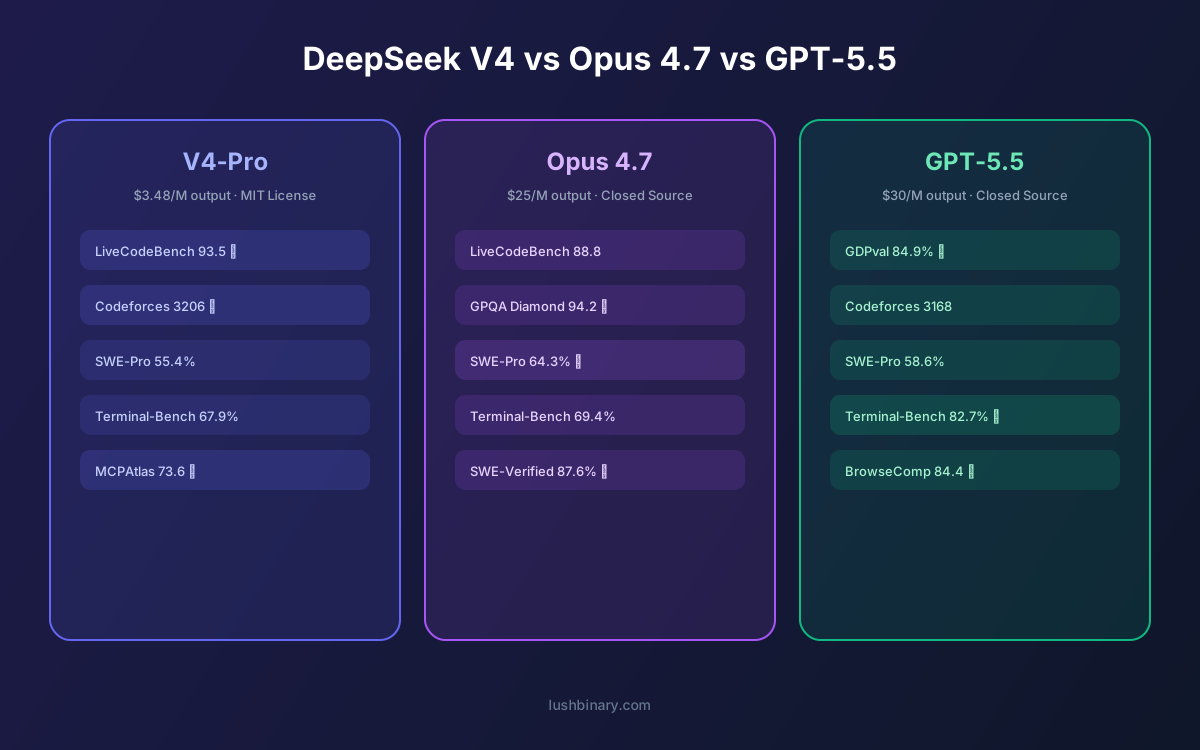
The headline numbers: V4-Pro output costs $3.48/M tokens vs $25/M for Opus 4.7 and $30/M for GPT-5.5. But cheaper doesn't mean better. On SWE-bench Pro, Opus 4.7 leads at 64.3% vs V4-Pro's 55.4% and GPT-5.5's 58.6%. On Terminal-Bench 2.0, GPT-5.5 leads at 82.7% vs V4-Pro's 67.9%.
This guide breaks down where each model wins, where it loses, and how to build a multi-model routing strategy that gets you the best of all three.
What This Guide Covers
- The April 2026 Frontier Landscape
- Benchmark Head-to-Head: All Three Models
- Coding Performance Deep Dive
- Agentic Capabilities Compared
- Reasoning & Knowledge
- Pricing & Cost Analysis
- Context Windows & Long-Document Work
- Licensing, Privacy & Deployment
- Multi-Model Routing Strategy
- Why Lushbinary for Multi-Model Architecture
1The April 2026 Frontier Landscape
The AI model market has never been this competitive. Anthropic's ARR reportedly grew from $9B to $30B in early 2026. OpenAI shipped GPT-5.5 as a natively omnimodal model with computer use capabilities. And DeepSeek proved that a Chinese lab can deliver frontier-adjacent performance at a fraction of the cost, with open weights under MIT license.
Each model represents a different philosophy: Opus 4.7 optimizes for coding precision and safety (Project Glasswing). GPT-5.5 optimizes for agentic versatility and knowledge work. V4-Pro optimizes for cost efficiency and open-source accessibility. Understanding these philosophies is key to choosing the right model for each task.
2Benchmark Head-to-Head: All Three Models
| Benchmark | V4-Pro Max | Opus 4.7 | GPT-5.5 |
|---|---|---|---|
| SWE-bench Pro | 55.4% | 64.3% | 58.6% |
| SWE-bench Verified | 80.6% | 87.6% | - |
| Terminal-Bench 2.0 | 67.9% | 69.4% | 82.7% |
| LiveCodeBench | 93.5 | 88.8 | - |
| GPQA Diamond | 90.1 | 94.2 | - |
| BrowseComp | 83.4 | 83.7 | 84.4 |
| MCPAtlas Public | 73.6 | 73.8 | 67.2 |
| Codeforces Rating | 3206 | - | 3168 |
| Output Cost (/M tokens) | $3.48 | $25.00 | $30.00 |
Pattern
No single model dominates. Opus 4.7 leads coding. GPT-5.5 leads agentic and knowledge work. V4-Pro leads competitive programming and cost efficiency. The 7–9x price gap makes V4-Pro the default choice for cost-sensitive teams, with Opus 4.7 and GPT-5.5 reserved for tasks where the quality gap justifies the premium.
3Coding Performance Deep Dive
Coding is where the models diverge most. Claude Opus 4.7 dominates real-world software engineering: 64.3% on SWE-bench Pro (multi-file GitHub issue resolution) and 87.6% on SWE-bench Verified. Its self-verification behavior, proactively validating outputs and detecting logical faults during planning, makes it the strongest choice for production code changes.
V4-Pro excels at algorithmic and competitive programming: LiveCodeBench 93.5 (best among all models) and Codeforces 3206. These are tasks where raw reasoning power matters more than codebase familiarity. For teams building coding agents that solve well-defined algorithmic problems, V4-Pro is the better choice.
GPT-5.5 sits between them on coding benchmarks (58.6% SWE-bench Pro) but shines on autonomous CLI workflows via Terminal-Bench 2.0 (82.7%). If your coding agent needs to navigate file systems, run build tools, and orchestrate shell commands, GPT-5.5 is the strongest option.
4Agentic Capabilities Compared
GPT-5.5 was designed from the ground up for agentic workflows. It leads on Terminal-Bench 2.0 (82.7%), Toolathlon (54.6), and GDPval (84.9% across 44 occupations). OpenAI reports 85%+ internal adoption for agentic tasks. Its computer use capabilities, GUI navigation, CRM data entry, spreadsheet workflows, are unmatched.
V4-Pro is competitive on MCPAtlas Public (73.6, essentially tied with Opus 4.6's 73.8) and Toolathlon (51.8), but trails GPT-5.5 by 15 points on Terminal-Bench. The gap is real for long-horizon, multi-tool orchestration tasks. For simpler agent workflows with fewer tool calls, V4-Pro performs well at a fraction of the cost.
Opus 4.7 is the specialist: strongest on coding-specific agentic tasks (SWE-bench Pro 64.3%) but not designed for general desktop automation. Its stricter instruction-following and Project Glasswing cybersecurity safeguards make it the safest choice for security-sensitive agent deployments.
5Reasoning & Knowledge
On MMLU-Pro, V4-Pro scores 87.5, matching GPT-5.4 exactly but trailing Opus 4.7 (89.1) and Gemini 3.1 Pro (91.0). The biggest knowledge gap is SimpleQA-Verified: V4-Pro scores 57.9 vs Gemini's 75.6, an 18-point deficit on factual recall.
On math, V4-Pro is world-class: IMOAnswerBench 89.8 (ahead of Opus 4.6's 75.3), Apex Shortlist 90.2 (new state of the art). GPQA Diamond at 90.1 trails Opus 4.7's 94.2 but is still strong.
The pattern: V4-Pro excels at mathematical and logical reasoning but lags on factual world knowledge. If your application requires precise factual recall (e.g., customer support, knowledge bases), consider routing those queries to a model with stronger SimpleQA scores.
6Pricing & Cost Analysis
| Model | Input (/M) | Output (/M) | Context |
|---|---|---|---|
| V4-Pro | $1.74 | $3.48 | 1M |
| V4-Flash | $0.14 | $0.28 | 1M |
| Claude Opus 4.7 | $15.00 | $25.00 | 1M |
| GPT-5.5 | $5.00 | $30.00 | 1M |
The cost math is stark. Processing 10M output tokens costs $34.80 with V4-Pro, $250 with Opus 4.7, and $300 with GPT-5.5. For teams processing millions of tokens daily, V4-Pro's pricing is transformative, and V4-Flash at $2.80 for the same volume makes high-volume production use cases viable that simply weren't before.
7Context Windows & Long-Document Work
All three models support 1M-token context windows (Gemini 3.1 Pro offers 2M). The difference is pricing: V4-Pro and V4-Flash include 1M context as the default with no surcharge. Opus 4.7 and GPT-5.5 charge standard per-token rates for the full context.
V4-Pro's hybrid CSA+HCA attention reduces KV cache to 10% of V3.2's footprint at 1M context, making long-context inference dramatically more efficient. For document-heavy workloads, legal review, codebase analysis, research synthesis, V4-Pro offers the best cost-per-context-token ratio of any frontier model.
8Licensing, Privacy & Deployment
This is where V4 has an unmatched advantage: MIT license with open weights. You can self-host V4-Pro or V4-Flash on your own infrastructure, fine-tune for your domain, and keep all data on-premise. Neither Opus 4.7 nor GPT-5.5 offers this.
For enterprises with data sovereignty requirements, regulated industries (healthcare, finance, defense), or teams that simply don't want to send prompts to external APIs, V4's open weights are the deciding factor regardless of benchmark scores.
The trade-off: DeepSeek's hosted API routes through Chinese infrastructure. If that's a concern, self-hosting the MIT-licensed weights on your own cloud is the intended solution.
9Multi-Model Routing Strategy
The optimal approach for most teams isn't choosing one model, it's routing to the right model per task. Here's a practical routing framework:
| Task Type | Route To | Why |
|---|---|---|
| Chat, Q&A, summarization | V4-Flash | 90-107x cheaper, sufficient quality |
| Complex coding (multi-file) | Opus 4.7 | 64.3% SWE-bench Pro, self-verification |
| Desktop automation | GPT-5.5 | 82.7% Terminal-Bench, computer use |
| Math & algorithms | V4-Pro | IMOAnswerBench 89.8, Codeforces 3206 |
| Long-document analysis | V4-Pro | Best cost/context ratio, 1M default |
| On-premise / regulated | V4-Pro (self-hosted) | MIT license, open weights |
| Security-sensitive agents | Opus 4.7 | Project Glasswing, strict guardrails |
A well-designed routing layer that sends 60–70% of traffic to V4-Flash, escalates coding to Opus 4.7, and uses GPT-5.5 for agentic desktop tasks can reduce costs 40–60% compared to a single-model approach while maintaining or improving quality across all task types.
10Why Lushbinary for Multi-Model Architecture
Lushbinary builds production multi-model architectures that route between DeepSeek V4, Claude, and GPT based on task complexity, cost constraints, and quality requirements. We've shipped routing layers for startups and enterprises that cut AI costs by 40–60% without sacrificing output quality.
Our team handles the full stack: API integration, model routing logic, fallback chains, observability, and cost monitoring. Whether you're migrating from a single-model setup or building from scratch, we can get you to production fast.
🚀 Free Consultation
Want to build a multi-model AI architecture with DeepSeek V4, Claude, and GPT? Lushbinary specializes in model routing, cost optimization, and production AI deployment. We'll design your routing strategy and give you a realistic timeline, no obligation.
❓ Frequently Asked Questions
How does DeepSeek V4-Pro compare to Claude Opus 4.7 on coding benchmarks?
Opus 4.7 leads on SWE-bench Pro (64.3% vs 55.4%) and SWE-bench Verified (87.6% vs 80.6%). V4-Pro leads on LiveCodeBench (93.5 vs 88.8) and Codeforces (3206). Opus is stronger for real-world software engineering; V4-Pro excels at competitive programming.
Is DeepSeek V4 cheaper than GPT-5.5 and Claude Opus 4.7?
Yes, significantly. V4-Pro output costs $3.48/M tokens vs $25/M for Opus 4.7 and $30/M for GPT-5.5 - a 7-9x cost reduction. V4-Flash at $0.28/M output is 90-107x cheaper.
Which model is best for agentic AI workflows in April 2026?
GPT-5.5 leads on Terminal-Bench 2.0 (82.7%) and general agentic tasks. Opus 4.7 leads on SWE-bench Pro (64.3%) for coding agents. V4-Pro is competitive on MCPAtlas (73.6) but trails on the hardest agentic benchmarks.
Can DeepSeek V4 replace Claude Opus 4.7 or GPT-5.5?
For many workloads, yes - especially cost-sensitive ones. V4-Pro scores within 5-10 points on most benchmarks at 7-9x lower cost. For the most demanding agentic coding and factual recall, Opus 4.7 and GPT-5.5 still lead.
What is the best multi-model routing strategy for 2026?
Route 60-70% of traffic to V4-Flash, escalate complex coding to Opus 4.7, use GPT-5.5 for agentic desktop automation, and keep V4-Pro for open-weight or on-premise needs. This can reduce costs 40-60%.
Sources
- DeepSeek V4-Pro Model Card on Hugging Face
- DeepSeek API Pricing
- GPT-5.5 vs Claude Opus 4.7 Comparison on Lushbinary
Content was rephrased for compliance with licensing restrictions. Benchmark data sourced from official model cards and technical reports as of April 24, 2026. Pricing may change, always verify on vendor websites.
Build a Multi-Model AI Architecture
Lushbinary designs routing layers that pick the right model per task. Cut costs 40–60% without sacrificing quality.
Ready to Build Something Great?
Get a free 30-minute strategy call. We'll map out your project, timeline, and tech stack - no strings attached.
Prefer email? Reach us directly: