
On June 12, 2026, the US Commerce Department issued an export-control directive suspending foreign access to Anthropic's frontier models, Fable 5 and Mythos 5. Unable to verify nationality at scale, Anthropic pulled both worldwide within hours, cutting off users outside the US, including allies, researchers, and its own foreign-national staff.
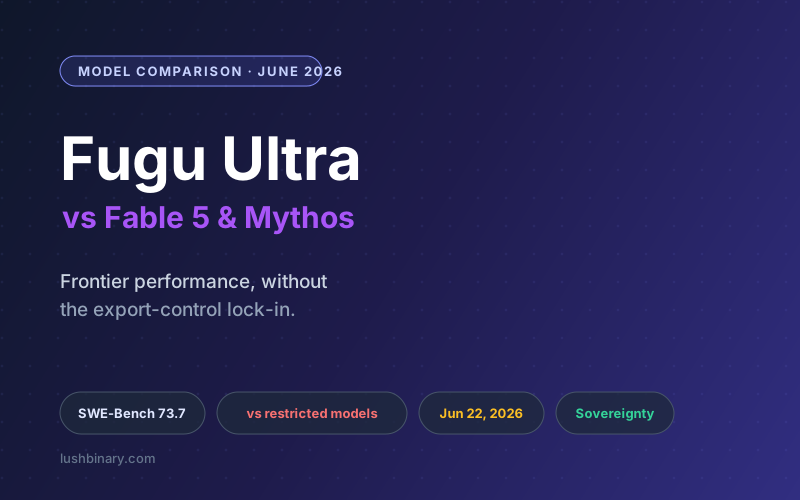
Ten days later, Sakana AI shipped Fugu Ultra with a pointed pitch: frontier-level performance without depending on any single model that could be restricted out from under you. Instead of training one giant model, Fugu Ultra orchestrates a pool of strong models behind one OpenAI-compatible API, and Sakana says it benchmarks shoulder to shoulder with the very models that just went dark for most of the world.
This comparison covers the benchmark claims and their caveats, the real architectural difference, the sovereignty and lock-in argument, where it holds and where it does not, and what teams outside the US should actually do about it.
What This Guide Covers
- The Context: Why Fable 5 and Mythos Went Dark
- Two Different Things Being Compared
- The Benchmark Claims, Side by Side
- The Sovereignty and Lock-In Argument
- Where the Argument Holds, and Where It Does Not
- Cost: Headline Rate vs Total Per Task
- What Teams Outside the US Should Do
- Why Lushbinary for a Resilient Model Stack
1The Context: Why Fable 5 and Mythos Went Dark
Anthropic confirmed that a US government directive, citing national security authorities, required it to suspend all access to Fable 5 and Mythos 5 by foreign nationals, inside or outside the United States. Because verifying nationality per request is not practical at scale, the result was a global shutdown of both models on short notice.
For any team outside the US that had built on those models, this was a hard lesson in concentration risk: a single policy decision removed a core dependency overnight. That is the backdrop against which Fugu Ultra's pitch lands, and why an orchestration model's provider diversification suddenly reads as a feature rather than a nicety. For more on Anthropic's lineup, see our Claude Fable 5 developer guide.
2Two Different Things Being Compared
Before the numbers, it helps to be precise about what is on each side of the comparison, because they are not the same kind of thing.
- Fable 5 and Mythos are single frontier models from Anthropic. One set of weights, one model answering.
- Fugu Ultra is an orchestration model: it routes, delegates, verifies, and synthesizes across a pool of models behind one API, as explained in our Sakana Fugu orchestration guide. Its result is a property of the system, not one model.
3The Benchmark Claims, Side by Side
Sakana's launch framing puts Fugu Ultra level with Fable 5 and Mythos Preview and ahead of GPT-5.5 and Claude Opus 4.8 on these tests. The Fugu Ultra figures below are vendor-reported as of June 2026 and not independently reproduced.
| Dimension | Fugu Ultra | Fable 5 / Mythos |
|---|---|---|
| Type | Orchestration model over a pool | Single frontier model |
| SWE-Bench Pro | 73.7 (reported) | Frontier-class |
| TerminalBench 2.1 | 82.1 (reported) | Frontier-class |
| GPQA-Diamond | 95.5 (reported) | Frontier-class |
| Global access | Available via API, region limits apply | Restricted by US export controls |
For a benchmark-by-benchmark explanation of what these scores do and do not prove, and the caveats around comparing to models that are hard to re-test, see our Fugu Ultra benchmarks explained guide. The short version: parity claims against models the rest of the world cannot currently run are, by nature, difficult to independently check.
4The Sovereignty and Lock-In Argument
The strongest part of Fugu's pitch is not the benchmark, it is the structure. If your capability comes from one vendor's one model, you inherit that vendor's commercial decisions and that government's policy decisions. The Fable 5 and Mythos shutdown showed how fast that can hurt.
An orchestration model spreads the dependency across a pool. If one underlying model becomes unavailable or too expensive, the system can lean on others, ideally without you rewriting anything. For teams that got burned in June, that resilience is the headline feature, arguably more than any single score.
The reframe
Fugu changes the unit of competition from one model to the system that routes across many. In a world where access to a single model can change overnight, routing flexibility is a form of risk management, not just a performance trick.
5Where the Argument Holds, and Where It Does Not
It is worth being honest about the limits of the sovereignty story:
- You still depend on Sakana. You reduce dependence on any single underlying model, but you add a dependence on the orchestration provider. That is a better-diversified position, not a dependency-free one.
- The pool can include restricted models. If the pool ever leaned on a model that itself faced restrictions, the orchestration layer would route around it, but the available capability could shift. Treat the pool composition as something that can change.
- Fugu has its own regional availability. Reporting around launch noted availability gaps, including in the EU and EEA. Routing around one vendor's controls does not exempt Fugu from its own.
- Parity is claimed, not proven. Matching restricted models is exactly the claim that is hardest for outsiders to verify right now.
6Cost: Headline Rate vs Total Per Task
As of June 2026, Fugu Ultra pay-as-you-go is listed at about $5 per million input tokens and $30 per million output tokens, with subscription plans around $20, $100, and $200 per month. On paper that output rate sits below some single frontier models. The honest comparison is per task, not per token.
Because an orchestration call can fan out across several models and verify intermediate work, a single hard request can consume more tokens than one call to a single model. So a lower per-token rate can still produce a similar or higher per-task cost. Measure total tokens per completed task across both options before concluding which is cheaper.
7What Teams Outside the US Should Do
- If you lost Fable 5 or Mythos, put Fugu Ultra on your shortlist alongside other frontier-class options you can actually access.
- Run your own evaluation on real tasks for quality, latency, and total cost. Do not switch on a launch benchmark.
- Keep your integration provider-agnostic, behind a swappable interface with a fallback, so the next policy or pricing shock is a config change.
- For workloads with hard residency requirements, also weigh an open-weight model you host yourself. See our open-weight model comparison.
The real lesson from June 2026
The takeaway is not "pick Fugu" or "pick Anthropic." It is that single-vendor, single-model dependence is now a measurable risk. Whatever you choose, design so that losing any one model does not take down your product.
8Why Lushbinary for a Resilient Model Stack
The teams that handled the June shutdown best were the ones whose AI features were not welded to a single model. That resilience is an architecture choice you make before you need it, and it is the kind of work we do.
Lushbinary builds provider-agnostic AI architectures: swappable model interfaces, routing and fallback, evaluation harnesses, and cost observability. We will help you assess Fugu Ultra against your alternatives and design a stack that survives the next vendor or policy shock without a rewrite.
🚀 Free Consultation
Lost access to a model you depended on, or want to make sure you never will? Lushbinary will review your AI stack, evaluate alternatives like Fugu Ultra, and design a resilient, provider-agnostic architecture with no obligation.
❓ Frequently Asked Questions
How does Fugu Ultra compare to Fable 5 and Mythos?
Sakana reports Fugu Ultra level with Fable 5 and Mythos Preview on key benchmarks (SWE-Bench Pro 73.7, TerminalBench 2.1 82.1, GPQA-Diamond 95.5). The difference is approach: Fugu Ultra orchestrates a pool behind one API, while Fable 5 and Mythos are single frontier models. These figures are vendor-reported pending independent verification.
Why are Fable 5 and Mythos hard to access?
On June 12, 2026, a US Commerce Department export-control directive suspended foreign access to Anthropic's Fable 5 and Mythos 5. Unable to verify nationality at scale, Anthropic pulled both worldwide, cutting off users outside the US.
Does Fugu Ultra route around export controls?
Sakana positions Fugu as reaching frontier-level capability without depending on any single vendor or model that could be restricted. It reduces single-provider exposure by orchestrating a pool, but Fugu has its own regional availability, so confirm access for your location.
Should teams outside the US switch to Fugu Ultra?
It is a strong candidate to evaluate, especially if you lost access to Fable 5 or Mythos. Decide on your own evaluation of quality, latency, and cost, and keep your integration provider-agnostic so you are not trading one dependency for another.
Is Fugu Ultra cheaper than frontier single models?
Fugu Ultra pay-as-you-go is about $5 per million input tokens and $30 per million output tokens as of June 2026. Whether it is cheaper depends on internal fan-out, since an orchestration call can use more tokens than a single model. Compare total cost per task.
Sources
- Sakana AI, Sakana Fugu release page
- Anthropic statement on the US directive to suspend Fable 5 and Mythos 5 access
- Sakana Fugu: pricing, API, and benchmarks
Content was rephrased for compliance with licensing restrictions. Benchmark figures are vendor-reported by Sakana AI as of June 2026 and have not been independently reproduced. Export-control details sourced from Anthropic's public statement. Pricing, availability, and policy may change, so verify with each vendor.
Build an AI Stack That Survives Shocks
We design provider-agnostic architectures with routing, fallback, and evals, so losing any one model never takes down your product.
Ready to Build Something Great?
Get a free 30-minute strategy call. We'll map out your project, timeline, and tech stack - no strings attached.
Prefer email? Reach us directly: