
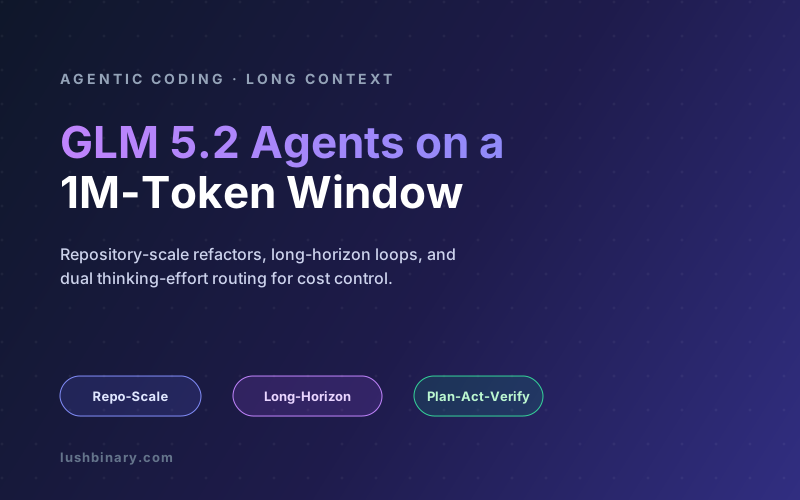
Updated June 16, 2026. GLM 5.2 (June 13) pairs a usable 1M-token context window with a dual thinking-effort system and 131,072 output tokens, a combination built for repository-scale agentic coding. Patterns below are framework-agnostic and apply whether you use the GLM Coding Plan, the API, or a self-hosted endpoint.
A 1-million-token context window is not just a bigger number. It changes what kinds of agents are practical to build. When the model can hold a whole repository, a long task transcript, and the relevant design docs at once, you can stop fighting the chunking and retrieval-stitching that breaks most coding agents past a few hundred thousand tokens.
GLM 5.2 is built for exactly this. This guide covers the agent patterns the 1M window unlocks, how to combine it with the dual thinking-effort system to control cost, when to still reach for retrieval, and how to keep long-running agents reliable. For the full model overview, see our GLM 5.2 developer guide.
📋 Table of Contents
- 1.What the 1M Window Unlocks
- 2.The Long-Context Agent Loop
- 3.Routing With Dual Thinking-Effort
- 4.Large Context vs RAG
- 5.Keeping Long Agents Reliable
- 6.Cost Control for Big Contexts
- 7.Frequently Asked Questions
- 8.How Lushbinary Helps
1What the 1M Window Unlocks
- Repository-scale refactors: load tens of thousands of lines across many files and refactor with full cross-file awareness, no lossy chunking.
- Long-horizon tasks: multi-hour agent runs that remember decisions made hundreds of steps earlier in the transcript.
- Spec-grounded generation: hold a full specification and the code that implements it in context for grounded, consistent changes.
- Whole-PR review: review a large diff alongside the surrounding code it touches, not just the changed lines.
2The Long-Context Agent Loop
A long-context coding agent follows a plan-act-observe loop, with the 1M window holding the working set across iterations:
The window persists the working set so the agent never loses earlier context, while the thinking-effort level shifts per step to balance cost against reliability.
3Routing With Dual Thinking-Effort
The dual thinking-effort system is the cost lever for agents. The rule of thumb:
- Lower effort for the high-volume action loop: file reads, edits, test runs, and routine tool calls.
- Higher effort for planning at the start, verifying before a commit, and recovering from failures.
4Large Context vs RAG
A 1M window does not retire retrieval; it changes when you need it.
| Use the 1M window when | Use RAG when |
|---|---|
| The working set fits in ~1M tokens | The corpus is far larger than 1M tokens |
| You need cross-file reasoning with no retrieval gaps | Content changes constantly and must stay fresh |
| Simplicity matters more than per-call cost | Per-call cost matters more than recall completeness |
The strongest agents combine both: retrieve the relevant slice of a huge codebase, then load it into the large window for grounded reasoning.
5Keeping Long Agents Reliable
- Checkpoint state so a long run can resume after a failure instead of restarting.
- Summarize stale transcript periodically to keep the signal-to-noise ratio high even inside a big window.
- Verify before committing: run tests and a higher-effort review pass before any write to the repository.
- Bound the loop: cap iterations and tool calls so a confused agent cannot burn budget indefinitely.
6Cost Control for Big Contexts
A full window on every call is expensive. Keep spend sane:
- Prompt caching for the stable parts of context (system prompt, unchanged files) cuts effective input cost sharply.
- Load only what the task needs rather than filling the window because it is available.
- Prune the transcript with summaries so it does not grow unbounded across a long run.
For the underlying token economics, see our GLM 5.2 pricing guide.
7Frequently Asked Questions
What can you do with GLM 5.2's 1M-token context window?
A 1-million-token window lets an agent hold a mid-sized repository, a long task transcript, and the relevant docs in context at once. That enables repository-scale refactors, multi-hour long-horizon tasks that remember early decisions, and grounded code generation against a full spec without aggressive chunking or lossy retrieval.
Is a 1M context window better than RAG for code?
They solve different problems. A large window removes retrieval errors for code that fits inside it and is simpler to build. RAG still wins when your corpus is far larger than 1M tokens or changes constantly. The strongest agents combine both: retrieve the relevant slice, then load it into the large window for grounded reasoning.
How does the dual thinking-effort system help agents?
Route the high-volume tool-calling loop to the fast, cheap effort level and escalate to the higher effort level only for planning and verification steps. This keeps cost and latency low for routine actions while reserving deep reasoning for the decisions where a mistake is expensive.
Does a bigger context window cost more?
Yes. You pay for every token in context on each call, and KV-cache memory grows with sequence length when self-hosting. Use prompt caching for stable context, prune transcripts aggressively, and only load the parts of the repository the current task needs rather than filling the window because you can.
What tools work with GLM 5.2 for agentic coding?
GLM 5.2 is available across the GLM Coding Plan inside supported coding agents and IDEs, and open-source harnesses can target it through the API or a self-hosted endpoint. Any agent framework that speaks an OpenAI-compatible API can drive GLM 5.2's tool-calling loop.
8How Lushbinary Helps
Lushbinary builds long-horizon coding agents that ship. We design the context strategy, wire up the plan-act-observe loop with the right thinking-effort routing, blend large-context and retrieval where each wins, and add the verification and cost guardrails that keep production agents reliable.
🚀 Free Consultation
Want a repository-scale coding agent on GLM 5.2's 1M window? We'll design the architecture and cost controls. No obligation.
9Sources
Content was rephrased for compliance with licensing restrictions. GLM 5.2 capabilities sourced from Z.ai announcements as of June 16, 2026. Agent patterns are framework-agnostic engineering guidance. Always verify model limits and pricing on Z.ai's website.
Build a Repository-Scale Coding Agent
Lushbinary designs long-horizon agents on GLM 5.2's 1M window with the routing and guardrails to keep them reliable. Let's build it.
Ready to Build Something Great?
Get a free 30-minute strategy call. We'll map out your project, timeline, and tech stack - no strings attached.
Prefer email? Reach us directly: