
GPT-5.5 (codename "Spud") launched on April 23, 2026 as the first fully retrained base model since GPT-4.5 — and OpenAI is being unusually transparent about its risk profile. The model carries a "High" cybersecurity risk classification, underwent red teaming from nearly 200 trusted partners, and had its API rollout deliberately delayed because "API deployments require different safeguards." For enterprise teams evaluating GPT-5.5, the safety story is just as important as the capability story.
This guide covers everything security-conscious engineering teams need to know: what the "High" classification actually means, how OpenAI's red teaming process worked, what the stricter classifiers do in practice, and how to architect production guardrails that satisfy compliance requirements without crippling developer velocity. If you're building with GPT-5.5 — or evaluating whether you should — this is the security deep-dive you need.
For a broader look at GPT-5.5's capabilities, pricing, and competitive positioning, see our GPT-5.5 developer guide.
🔒 What This Guide Covers
- Why GPT-5.5 Safety Matters More Than Previous Models
- The "High" Cybersecurity Classification Explained
- Red Teaming: Internal, External & Partner Testing
- Stricter Classifiers: What Enterprise Teams Should Expect
- API Delay: Why Safety Drove the Rollout Strategy
- Production Guardrails for GPT-5.5 Deployments
- Compliance Considerations: SOC 2, HIPAA & Industry Standards
- Building a Safety-First GPT-5.5 Architecture
- Why Lushbinary for Secure AI Deployments
- FAQ
1Why GPT-5.5 Safety Matters More Than Previous Models
Every GPT release since GPT-4 has come with safety disclosures, but GPT-5.5 is different in a way that matters for production deployments. This is the first fully retrained base model since GPT-4.5 — not another fine-tuned iteration of the GPT-5 family. When OpenAI retrains from scratch, the model's capability surface changes in ways that incremental updates don't. New emergent behaviors appear. Old guardrails may not transfer cleanly. The attack surface shifts.
OpenAI acknowledged this directly: GPT-5.5 represents a "meaningful jump in cyber capability." That's not marketing language — it's a safety disclosure. The model is materially better at understanding code, identifying vulnerabilities, and reasoning about system architectures than GPT-5.4. Those same capabilities that make it a powerful coding assistant also make it a more capable tool for adversarial use if deployed without proper controls.
⚠️ Key Context
GPT-5.5 was evaluated across OpenAI's "full suite of safety and preparedness frameworks" — the most comprehensive evaluation process OpenAI has disclosed for any model release. This included targeted testing for advanced cybersecurity and biology capabilities that weren't part of earlier GPT-5.x evaluations.
The broader AI safety landscape adds urgency. Anthropic recently limited Claude Mythos Preview's rollout due to its ability to identify software security flaws. OpenAI responded with GPT-5.4-Cyber, a model specifically trained for defensive cybersecurity. And independent red teaming from firms like promptfoo found that GPT-5 had 3 critical, 5 high, 15 medium, and 16 low severity findings during structured adversarial testing. GPT-5.5's expanded capabilities mean the stakes are higher.
For enterprise teams, this creates a dual mandate: you need GPT-5.5's capabilities to stay competitive, but you also need a security posture that accounts for its elevated risk profile. The teams that get this right will have a significant advantage. The teams that skip the guardrails will eventually have an incident.
For a comprehensive look at AI agent security fundamentals, see our AI agent security guide for autonomous coding in production.
2The "High" Cybersecurity Classification Explained
OpenAI's Preparedness Framework uses a four-tier risk classification system for evaluating model capabilities across different harm categories. Understanding where GPT-5.5 falls — and what each tier actually means — is essential for making informed deployment decisions.
| Risk Level | Definition | Deployment Policy |
|---|---|---|
| Low | Minimal uplift over existing tools | Standard deployment |
| Medium | Meaningful uplift but within existing risk landscape | Deploy with monitoring |
| High ← GPT-5.5 | Could amplify existing pathways to severe harm | Deploy with significant mitigations |
| Critical | Unprecedented new pathways to severe harm | Do not deploy without board-level review |
The "High" classification is significant because it sits one tier below the threshold that would trigger OpenAI's most restrictive deployment policies. At the "Critical" level, OpenAI's framework requires board-level approval before any deployment. GPT-5.5 doesn't reach that bar, but it's closer than any previous publicly released model.
What "amplify existing pathways to severe harm" means in practice: GPT-5.5 doesn't create entirely new attack vectors that didn't exist before. Instead, it makes existing attack techniques more accessible, more efficient, or more scalable. A skilled attacker could already do what GPT-5.5 enables — but GPT-5.5 lowers the skill barrier and increases the speed of execution.
💡 What This Means for Your Team
The "High" classification doesn't mean GPT-5.5 is unsafe to deploy. It means you need "significant mitigations" — output filtering, audit logging, rate limiting, and content moderation. If you're already running GPT-5.4 in production with proper guardrails, you have a foundation to build on. If you're deploying a frontier model for the first time, treat the "High" classification as a mandate to invest in your security layer before going live.
OpenAI's Deployment Safety Hub provides additional documentation on their red teaming methodology and external assessment processes. Enterprise teams should review this documentation as part of their GPT-5.5 risk assessment.
3Red Teaming: Internal, External & Partner Testing
OpenAI's red teaming process for GPT-5.5 was the most extensive the company has disclosed for any model release. It operated across three distinct layers, each designed to catch different categories of risk.
Internal Red Teaming
OpenAI's internal safety team conducted the first pass, running the model through their full suite of safety and preparedness frameworks. This includes automated adversarial testing, capability evaluations across cybersecurity and biology domains, and structured attempts to elicit harmful outputs. The internal team has the deepest understanding of the model's architecture and training data, which lets them target known weak points.
External Red Teaming
OpenAI worked with external red-teamers — independent security researchers and domain experts who don't have insider knowledge of the model's internals. External red-teamers bring fresh perspectives and adversarial creativity that internal teams can miss. For GPT-5.5, OpenAI specifically added targeted testing for advanced cybersecurity capabilities and biology-related risks, reflecting the model's expanded capability surface.
For context on what structured red teaming uncovers: independent testing of GPT-5 by promptfoo found 3 critical, 5 high, 15 medium, and 16 low severity findings. These included prompt injection vulnerabilities, jailbreak techniques, and information disclosure risks. GPT-5.5's expanded capabilities likely mean a larger attack surface, which is why the red teaming scope was broadened.
Trusted Partner Testing
The third layer is what sets GPT-5.5 apart: OpenAI collected feedback from nearly 200 trusted early-access partners before the public release. These partners represent real-world deployment scenarios — enterprise applications, consumer products, developer tools — and their feedback captures failure modes that lab-based testing misses.
| Red Teaming Layer | Focus Areas | What It Catches |
|---|---|---|
| Internal | Automated adversarial testing, capability evals, cyber & bio | Known vulnerability patterns, architecture-specific risks |
| External | Independent security research, domain-specific probing | Novel attack vectors, creative jailbreaks, blind spots |
| ~200 Partners | Real-world deployment scenarios, production workloads | Edge cases in production, user behavior patterns, integration risks |
The three-layer approach is important because each layer catches different things. Internal teams find systematic vulnerabilities. External researchers find creative exploits. Partners find the messy, real-world failure modes that only emerge when actual users interact with the model in production contexts. If you're building your own red teaming process for GPT-5.5 deployments, this layered approach is worth emulating.
4Stricter Classifiers: What Enterprise Teams Should Expect
OpenAI deployed "stricter classifiers for potential cyber risk which some users may find annoying initially." That's a direct quote, and the candor is notable. OpenAI is telling you upfront that GPT-5.5 will refuse some requests that GPT-5.4 would have handled, and that the false positive rate on the safety classifiers is higher than they'd like.
In practice, this means enterprise teams should expect:
- More refusals on security-adjacent prompts — legitimate security research, penetration testing discussions, and vulnerability analysis may trigger the stricter classifiers more frequently than with GPT-5.4
- Code generation guardrails — requests that involve network scanning, exploit development, or system administration commands may face additional scrutiny or be blocked entirely
- Context-dependent behavior — the same prompt may be allowed in one context (e.g., a security research conversation) and blocked in another (e.g., a general chat), as the classifiers consider conversation history
- Iterative loosening — OpenAI has historically tightened classifiers at launch and loosened them over time as they gather real-world data. Expect the false positive rate to decrease in the weeks after release
⚠️ Practical Impact
If your application involves cybersecurity tooling, code analysis, or security research workflows, budget extra time for testing GPT-5.5's classifier behavior against your specific use cases. Prompts that worked with GPT-5.4 may need restructuring. Consider OpenAI's Trusted Access for Cyber program if you need cyber-permissive model access for legitimate security operations.
For teams building security-focused applications, the stricter classifiers create a tension: GPT-5.5 is more capable at security tasks, but also more restrictive about performing them. The resolution is to use structured system prompts that clearly establish the legitimate security context, leverage OpenAI's Trusted Access program where applicable, and implement your own application-layer controls rather than relying solely on the model's built-in classifiers.
For more on securing AI-powered coding workflows, see our guide to vulnerability scanning in AI coding environments.
5API Delay: Why Safety Drove the Rollout Strategy
GPT-5.5 launched to ChatGPT Plus, Pro, Business, and Enterprise users on April 23, 2026 — but API access was deliberately held back. OpenAI stated explicitly that "API deployments require different safeguards" and that they're working closely with partners on "safety and security requirements for serving it at scale." This is the first time OpenAI has staggered a major model release specifically for safety reasons rather than capacity constraints.
The distinction between ChatGPT and API deployments is important for understanding the risk calculus:
| Dimension | ChatGPT Deployment | API Deployment |
|---|---|---|
| User Interface | Controlled by OpenAI | Controlled by developer |
| System Prompts | OpenAI-managed safety prompts | Developer-defined (can override) |
| Output Filtering | Built-in content moderation | Developer responsibility |
| Usage Patterns | Individual users, observable | Programmatic, high-volume, automated |
| Abuse Potential | Lower (human-in-the-loop) | Higher (automated, scalable) |
| Risk Surface | Contained | Amplified by scale |
The API delay reflects a real engineering challenge: when a model with "High" cybersecurity risk is accessible programmatically at scale, the potential for misuse increases exponentially. A single ChatGPT user can only generate harmful content at human speed. An API integration can generate it at machine speed, across thousands of concurrent requests, with custom system prompts that may attempt to bypass safety controls.
OpenAI's approach suggests they're implementing additional API-specific safeguards before release:
- Enhanced rate limiting — likely tighter per-organization and per-endpoint limits during the initial rollout period
- Usage monitoring — automated detection of suspicious usage patterns, especially around cybersecurity-related prompts
- Mandatory safety headers — API requests may require additional metadata about the use case or deployment context
- Tiered access — organizations with established safety track records may get earlier or less restricted access
For teams planning GPT-5.5 API integrations, the delay is actually useful. It gives you time to build your guardrail layer, test your safety controls against GPT-5.4, and have your architecture ready before API access opens. Don't wait for the API — build your safety infrastructure now.
6Production Guardrails for GPT-5.5 Deployments
Given GPT-5.5's "High" cybersecurity classification, production deployments need defense-in-depth. Relying solely on OpenAI's built-in safety classifiers is insufficient — you need application-layer controls that you own and can tune for your specific use case.
Input Validation & Prompt Injection Defense
Prompt injection remains the most common attack vector against LLM applications. With GPT-5.5's expanded capabilities, successful prompt injections are potentially more damaging.
// Input validation layer for GPT-5.5
const INPUT_GUARDRAILS = {
  // Maximum input length to prevent context stuffing
  maxInputTokens: 50_000,
  // Block known prompt injection patterns
  injectionPatterns: [
    /ignore\s+(previous|above|all)\s+instructions/i,
    /you\s+are\s+now\s+(a|an|the)/i,
    /system\s*:\s*/i,
    /\[INST\]/i,
  ],
  // Sanitize user input before sending to model
  sanitize: (input: string) => {
    // Strip control characters
    let clean = input.replace(/[\x00-\x08\x0B\x0C\x0E-\x1F]/g, "");
    // Escape delimiter-like sequences
    clean = clean.replace(/```/g, "\u0060\u0060\u0060");
    return clean;
  },
  // Rate limit per user session
  maxRequestsPerMinute: 20,
  maxRequestsPerHour: 200,
};
Output Filtering & Content Moderation
Even with OpenAI's stricter classifiers, you should implement your own output filtering. The model's built-in safety is a first line of defense, not the only one.
// Output filtering for GPT-5.5 responses
const OUTPUT_GUARDRAILS = {
  // Use OpenAI's Moderation API on all outputs
  moderationEndpoint: true,
  // Custom content filters for your domain
  blockedPatterns: [
    // Block executable code in non-code contexts
    /\b(exec|eval|system|subprocess)\s*\(/i,
    // Block credential-like strings
    /\b(password|secret|api_key)\s*[:=]\s*['"][^'"]+['"]/i,
  ],
  // PII detection and redaction
  piiDetection: true,
  // Maximum output length
  maxOutputTokens: 16_000,
  // Log all outputs for audit trail
  auditLog: true,
};
Audit Logging & Anomaly Detection
Comprehensive logging is non-negotiable for a "High" risk model. You need to be able to reconstruct any interaction after the fact, detect unusual patterns in real-time, and demonstrate compliance to auditors.
// Audit logging configuration
const AUDIT_CONFIG = {
  // Log every request and response
  logAllInteractions: true,
  // Include metadata for forensic analysis
  metadata: [
    "userId", "sessionId", "timestamp",
    "modelVersion", "inputTokens", "outputTokens",
    "moderationScore", "latencyMs",
  ],
  // Retention policy (align with compliance reqs)
  retentionDays: 90,
  // Real-time anomaly detection thresholds
  anomalyThresholds: {
    // Flag users exceeding normal usage patterns
    requestsPerHour: 100,
    // Flag high moderation scores
    moderationScoreThreshold: 0.7,
    // Flag unusual token consumption
    tokenBudgetExceeded: true,
  },
  // Alert channels
  alertChannels: ["slack", "pagerduty"],
};
Data Loss Prevention
GPT-5.5's improved reasoning capabilities mean it's better at extracting and synthesizing information from context. This makes data loss prevention (DLP) controls more important than ever:
- Input DLP — scan user inputs for sensitive data (SSNs, card numbers, API keys) before they reach the model. Redact or block as appropriate
- Output DLP — scan model outputs for inadvertent disclosure of training data, PII, or sensitive patterns
- Context isolation — ensure that data from one user's session cannot leak into another user's context through shared caching or conversation history
- Encryption at rest and in transit — all logged interactions should be encrypted, with access controls limiting who can view raw prompts and responses
7Compliance Considerations: SOC 2, HIPAA & Industry Standards
GPT-5.5's "High" cybersecurity classification adds a new dimension to compliance conversations. If you're operating in a regulated industry — healthcare, finance, government, or any sector with data protection requirements — you need to document how your GPT-5.5 deployment addresses the elevated risk profile.
SOC 2 Type II
OpenAI's Enterprise and Business tiers include SOC 2 Type II compliance for their infrastructure. However, your SOC 2 audit covers your entire system, not just OpenAI's portion. For GPT-5.5 deployments, auditors will want to see:
- Documented risk assessment that addresses the "High" cybersecurity classification
- Input validation and output filtering controls with evidence of testing
- Audit logging with appropriate retention and access controls
- Incident response procedures specific to AI-related security events
- Change management processes for model version updates and prompt changes
HIPAA
OpenAI offers HIPAA-eligible configurations through Business Associate Agreements (BAAs) on Enterprise and Business tiers. For GPT-5.5 specifically, HIPAA compliance requires additional attention:
- PHI (Protected Health Information) must never be included in prompts without a BAA in place and appropriate technical safeguards
- Output filtering must detect and prevent inadvertent PHI disclosure
- Audit trails must meet HIPAA's minimum necessary standard
- The "High" risk classification should be documented in your HIPAA risk analysis
Industry-Specific Frameworks
| Framework | GPT-5.5 Considerations | Key Controls |
|---|---|---|
| SOC 2 Type II | Document "High" risk in vendor assessment | Audit logging, access controls, incident response |
| HIPAA | BAA required, PHI handling controls | DLP, encryption, minimum necessary access |
| PCI DSS | Cardholder data must not reach the model | Input sanitization, tokenization, network segmentation |
| EU AI Act | "High" risk may trigger additional obligations | Risk assessment, transparency, human oversight |
| NIST AI RMF | Align with Govern, Map, Measure, Manage functions | Risk identification, impact assessment, monitoring |
💡 Compliance Tip
The most common compliance gap we see in AI deployments is treating the LLM provider's compliance certifications as sufficient for the entire system. OpenAI's SOC 2 covers their infrastructure. Your SOC 2 covers your application, your guardrails, your logging, and your incident response. The "High" risk classification makes this distinction even more important — auditors will expect to see controls that specifically address the elevated risk.
8Building a Safety-First GPT-5.5 Architecture
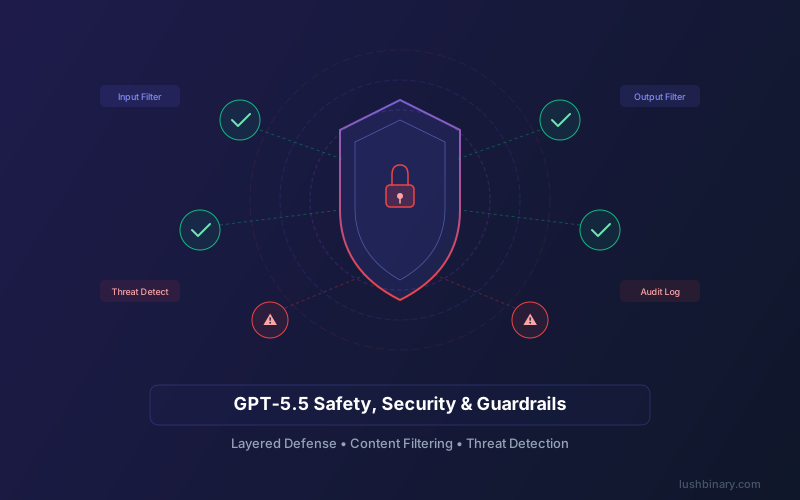
Here's a production architecture that puts safety at the center of a GPT-5.5 deployment. Every request passes through multiple validation layers before reaching the model, and every response is filtered before reaching the user.
The key principle is defense-in-depth: no single layer is responsible for safety. If the input guardrails miss a prompt injection, the model's built-in classifiers may catch it. If the model generates something problematic, the output guardrails filter it. If something slips through everything, the audit logging captures it for investigation.
Implementation Checklist
Here's a practical checklist for teams deploying GPT-5.5 in production:
// GPT-5.5 Production Safety Checklist
const SAFETY_CHECKLIST = {
  inputLayer: {
    promptInjectionDefense: true,
    inputLengthLimits: true,
    rateLimiting: true,
    dlpScanning: true,
    inputSanitization: true,
  },
  authLayer: {
    rbacEnforcement: true,
    sessionIsolation: true,
    apiKeyRotation: true,
    mfaForAdminAccess: true,
  },
  modelLayer: {
    systemPromptHardening: true,
    temperatureControls: true,
    maxTokenLimits: true,
    toolUseRestrictions: true,
  },
  outputLayer: {
    contentModeration: true,
    piiRedaction: true,
    outputDlp: true,
    responseValidation: true,
  },
  monitoringLayer: {
    auditLogging: true,
    anomalyDetection: true,
    realTimeAlerting: true,
    incidentResponseRunbook: true,
    complianceReporting: true,
  },
};
Each layer should be independently testable and deployable. Use feature flags to enable or disable specific controls without redeploying your entire application. This lets you tune your safety posture in response to new threats or changing compliance requirements without downtime.
For a deeper dive into securing AI agents in production, including OWASP LLM Top 10 considerations, see our AI agent security guide. For vulnerability scanning in AI-assisted coding environments, check our vulnerability scanning guide.
9Why Lushbinary for Secure AI Deployments
Deploying GPT-5.5 with proper safety guardrails isn't just about writing a few input validators. It's about designing a defense-in-depth architecture that satisfies compliance requirements, handles edge cases gracefully, and doesn't cripple the developer experience. Lushbinary has been building production AI integrations since the GPT-4 era, and we've shipped secure GPT-5.x deployments for enterprise clients across healthcare, fintech, SaaS, and e-commerce.
Here's what we bring to a secure GPT-5.5 deployment:
- Security architecture design — we build the input validation, output filtering, audit logging, and anomaly detection layers that GPT-5.5's "High" risk classification demands
- Compliance alignment — SOC 2, HIPAA, PCI DSS, EU AI Act — we document your AI governance posture and implement the controls auditors expect to see
- Red teaming & adversarial testing — we test your GPT-5.5 integration against prompt injection, jailbreak techniques, and data exfiltration scenarios before your users do
- Multi-model safety routing — we design systems that route sensitive requests to more restricted model configurations while keeping the user experience smooth
- AWS infrastructure — production deployment on AWS with VPC isolation, encryption at rest and in transit, CloudWatch monitoring, and auto-scaling that maintains your safety posture under load
- Incident response planning — we build the runbooks, alerting pipelines, and escalation procedures for AI-specific security incidents
🚀 Free Security Assessment
Planning a GPT-5.5 deployment and need to get the security story right? Lushbinary offers a free security assessment for enterprise AI integrations. We'll review your architecture, identify gaps in your guardrail layer, and recommend a compliance-aligned safety strategy — no obligation.
10Frequently Asked Questions
What is GPT-5.5's cybersecurity risk classification?
OpenAI classifies GPT-5.5 as 'High' risk for cybersecurity. This means the model could amplify existing pathways to severe harm but does not cross the 'Critical' threshold, which would indicate unprecedented new pathways to severe harm. The classification was determined through OpenAI's full suite of safety and preparedness frameworks.
How was GPT-5.5 red-teamed before release?
GPT-5.5 underwent extensive red teaming with both internal and external red-teamers. OpenAI added targeted testing for advanced cybersecurity and biology capabilities, collected feedback from nearly 200 trusted early-access partners, and evaluated the model across their full suite of safety and preparedness frameworks before the April 23, 2026 release.
Why was GPT-5.5 API access delayed?
OpenAI delayed GPT-5.5 API access specifically because API deployments require different safeguards than consumer ChatGPT deployments. The company is working closely with partners on safety and security requirements for serving GPT-5.5 at scale, and deployed stricter classifiers for potential cyber risk in the meantime.
What production guardrails should enterprises deploy with GPT-5.5?
Enterprises should implement input validation and prompt injection defense, output content filtering and moderation, comprehensive audit logging for all API calls, rate limiting per user and session, anomaly detection for unusual usage patterns, and data loss prevention controls. OpenAI has also deployed stricter classifiers for potential cyber risk which some users may find restrictive initially.
Is GPT-5.5 compliant with SOC 2 and HIPAA requirements?
OpenAI's Enterprise and Business tiers include SOC 2 Type II compliance and offer HIPAA-eligible configurations through Business Associate Agreements. However, GPT-5.5's 'High' cybersecurity classification means organizations should conduct additional risk assessments, implement defense-in-depth guardrails, and document their AI governance policies before deploying in regulated environments.
📚 Sources
- OpenAI Research — Introducing GPT-5.5
- OpenAI Deployment Safety Hub — Red Teaming & External Assessments
- OpenAI — Lockdown Mode and Elevated Risk Labels
- OpenAI — Trusted Access for Cyber Defense
- promptfoo — GPT-5 Red Teaming Results
- OpenAI — Preparedness Framework
- NIST — AI Risk Management Framework
Content was rephrased for compliance with licensing restrictions. Safety classifications, red teaming details, and deployment policies sourced from official OpenAI announcements and documentation as of April 23, 2026. Risk classifications and compliance requirements may change — always verify on the vendor's website and consult your compliance team.
Need a Secure GPT-5.5 Deployment?
From defense-in-depth guardrails to compliance-aligned architectures, Lushbinary builds AI integrations that are secure by design. Let's talk about your GPT-5.5 security requirements.
Ready to Build Something Great?
Get a free 30-minute strategy call. We'll map out your project, timeline, and tech stack - no strings attached.
Prefer email? Reach us directly: