

Open the billing settings of almost any team building with AI today and you will find the same pattern: a ChatGPT seat here, a Claude plan there, a Gemini subscription somewhere else, plus a couple of per-model API keys nobody fully tracks. Each one made sense on its own. Together they create cost you cannot see clearly, logins you cannot consolidate, and a nagging feeling that you are still using the wrong model for half your work.
The problem is not that any single model is bad. It is that no single model wins everything. One is stronger at long-context reasoning, another at code, another at fast and cheap drafting, another at multimodal input. Paying for them in separate silos means you either overpay for capacity you do not use or settle for whichever model you happen to have open.
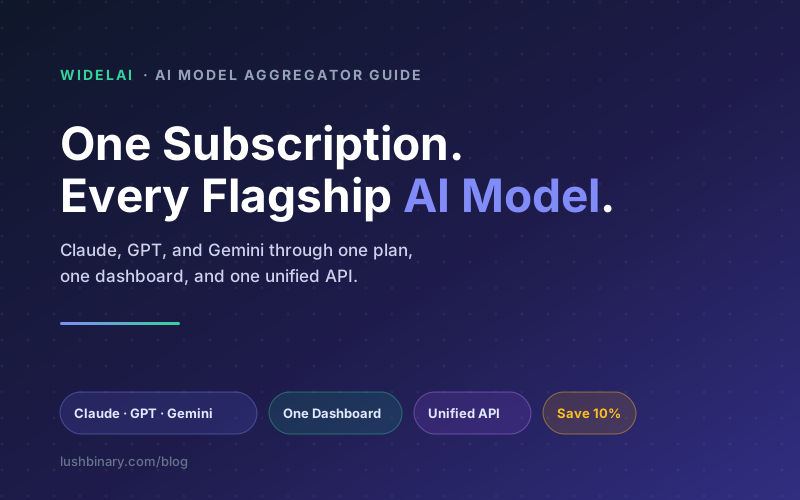
AI model aggregators exist to fix exactly this. They put Claude, GPT, Gemini, and other flagship models behind one subscription, one dashboard, and one API. This guide breaks down how aggregation works, the real cost of subscription sprawl, when an aggregator is the right call (and when it is not), how to evaluate one, and where WidelAI fits.
📋 What This Guide Covers
- What an AI Model Aggregator Actually Is
- The Hidden Cost of Subscription Sprawl
- How Aggregation Works Under the Hood
- One Dashboard Instead of Ten Tabs
- One API, Every Model: The Developer Win
- When an Aggregator Makes Sense (And When It Does Not)
- How to Evaluate an AI Aggregator
- WidelAI: One Subscription, Every Flagship Model
1What an AI Model Aggregator Actually Is
An AI model aggregator is a single platform that sits in front of multiple model providers and lets you use all of them from one account. Rather than holding separate relationships with OpenAI, Anthropic, and Google, you hold one relationship with the aggregator, and it handles the connections to each underlying model on your behalf.
In practice that means two surfaces. There is a chat interface, where you pick a model from a dropdown and talk to it the way you would in any assistant app. And there is an API, where your code sends a request with a model name and the aggregator routes it to the right provider. The same account, billing, and history span both.
The core idea
An aggregator decouples your workflow from any single vendor. You commit to a way of working, not to one company's roadmap, and you can move between models as the leaderboard changes month to month.
2The Hidden Cost of Subscription Sprawl
The obvious cost of running multiple AI subscriptions is the line items. The flagship consumer chat plans tend to cluster around the same price point. A simple illustration: three popular plans at about $20 per month is $60 per month, which is $720 per year (3 × $20 × 12). For a five-person team that each need two of those plans, the math compounds quickly. These are illustrative list prices that vary by provider and change over time, so always confirm current pricing on each vendor's page.
But the bill is the smaller half of the problem. The hidden costs are the ones that do not show up on an invoice:
- Wasted capacity. Every separate plan includes usage you paid for and did not touch because your attention was split across tools.
- Context switching. Moving a prompt and its history between three different apps to compare answers is friction that quietly taxes every task.
- Procurement and admin overhead. Separate invoices, separate renewals, separate seat management, and separate access reviews multiply the work for whoever owns the budget.
- Default-model bias. When switching is annoying, people stop switching. They use whatever is already open, even when a different model would do the job better.
Subscription sprawl is the AI version of a problem teams already know from SaaS: many small, reasonable purchases that add up to a large, hard-to-see total. For more on trimming AI spend, see our AI cost optimization guide.
3How Aggregation Works Under the Hood
From the outside an aggregator feels like a single app. Inside, it is a routing layer that normalizes requests and forwards them to whichever provider you selected. The flow looks like this:
The routing layer typically handles:
- Authentication. One credential for you, with the aggregator holding the provider relationships behind the scenes.
- Request normalization. A consistent request and response shape so a single integration can target different models.
- Model selection. You name the model; the platform sends the call to the matching provider.
- Usage and billing. One meter and one bill across every model you touch.
This is the same architectural idea behind an LLM gateway, packaged as a product you can subscribe to rather than infrastructure you have to run yourself.
4One Dashboard Instead of Ten Tabs
For non-developers, the dashboard is where an aggregator earns its keep. Instead of three browser tabs and three logins, you get one place to chat with any model and switch between them mid-task. That unlocks a workflow that is awkward with separate subscriptions:
- Draft with a fast, inexpensive model, then send the same thread to a stronger reasoning model for a final pass.
- Ask the same question to two models side by side and keep the better answer, without copying text between apps.
- Keep one searchable history across every model rather than fragments scattered across vendors.
The win is not a single feature. It is the removal of friction that made you stop reaching for the best tool for each job.
5One API, Every Model: The Developer Win
For engineers, the headline benefit is a unified API. With separate providers, adding a model means a new SDK, a new auth flow, and a new response shape to parse. With an aggregator, you integrate once and switch models by changing a string.
// One client, many models. Switch by changing "model".
const res = await fetch("https://api.aggregator.example/v1/chat", {
  method: "POST",
  headers: {
    "Authorization": "Bearer YOUR_SINGLE_KEY",
    "Content-Type": "application/json",
  },
  body: JSON.stringify({
    model: "claude-opus",     // or "gpt-5.5", or "gemini-pro"
    messages: [
      { role: "user", content: "Summarize this contract." },
    ],
  }),
});
Many aggregators expose an OpenAI-compatible request format, so existing code and libraries work with little change. That compatibility is what makes the practical patterns below cheap to build:
- A/B testing. Route a percentage of traffic to a new model and compare quality without a second integration.
- Fallbacks. If one provider is slow or unavailable, retry the request against another model automatically.
- Cost and latency routing. Send simple requests to a cheaper model and reserve the flagship for the hard ones.
Worth checking
Aggregators normalize the common parts of each API. Provider-specific features (certain tool-calling formats, caching controls, or beta endpoints) may lag the direct API. If you depend on a cutting-edge provider feature, confirm the aggregator supports it before you commit.
6When an Aggregator Makes Sense (And When It Does Not)
An aggregator is not automatically the right answer. Here is the honest split.
Good fit
- You use more than one model regularly.
- You want to avoid juggling separate plans and bills.
- You build software and want to switch or compare models in code.
- You want to adopt new flagship models quickly as they ship.
Maybe not
- You only ever use one model from one provider.
- You depend heavily on one vendor's ecosystem extras.
- You need a brand-new provider feature the day it launches.
- Your compliance rules require a direct contract with each model provider.
7How to Evaluate an AI Aggregator
If an aggregator fits, judge candidates on these questions rather than the length of the model list alone:
| What to check | Why it matters |
|---|---|
| Model coverage | Does it carry the flagship models you actually use: Claude, GPT, Gemini, and the rest? |
| Time to new models | How fast are new releases added after launch? |
| Pricing model | Flat subscription, usage-based, or both? Is it predictable for your volume? |
| API compatibility | OpenAI-compatible endpoints reduce integration work to nearly zero. |
| Dashboard quality | Is switching models, comparing answers, and finding history genuinely fast? |
| Data handling | How is your data routed and retained, and is it used for training? |
8WidelAI: One Subscription, Every Flagship Model
WidelAI is an AI model aggregator built around exactly the problem this guide describes. Its pitch is simple: one subscription, every flagship AI model. Instead of separate plans for each provider, you reach Claude, GPT, Gemini, and more from a single account.
What you get with a WidelAI subscription:
- Access to Claude Opus and Sonnet for long-context reasoning and writing.
- GPT-5.5 and o3 for general reasoning and agentic workloads.
- Gemini Pro for multimodal and large-context tasks.
- A single dashboard to chat with and switch between every model in one place.
- API access so your applications can reach the same models through one integration.
🎁 Lushbinary reader offer
Use code LUSHBINARY10 at checkout for 10% off your WidelAI subscription. Consolidate your AI plans, keep every flagship model in one place, and stop paying for capacity you do not use.
❓ Frequently Asked Questions
What is an AI model aggregator?
An AI model aggregator is a platform that gives you access to many flagship models, such as Claude, GPT, and Gemini, through a single subscription, one dashboard, and one API key. Instead of signing up and paying for each provider separately, you reach all of them through one account and pick the right model for each task.
Is an aggregator cheaper than paying for ChatGPT, Claude, and Gemini separately?
It can be. Three separate consumer chat plans at roughly $20 each run about $60 per month, or $720 per year, and you still cannot reach all of them from one place. A single aggregator plan consolidates that spend and removes duplicate seats. Whether it is strictly cheaper depends on your usage, but it almost always reduces overhead and unused capacity.
Do I lose access to the newest models if I use an aggregator?
A good aggregator adds new flagship models shortly after they launch, so you get Claude, GPT, and Gemini updates without managing separate upgrades. The trade-off to check is timing: confirm how quickly the platform onboards brand-new releases and whether any models are behind a higher tier.
Can developers use one API for multiple models?
Yes. The main developer benefit of an aggregator is a unified API: one key and one request format that can target different models. You switch models by changing a parameter rather than integrating each provider's SDK, which makes A/B testing and fallbacks far simpler.
When does an aggregator not make sense?
If you only ever use one model and one provider's ecosystem features deeply, a single direct subscription may be simpler. Aggregators shine when you want choice across providers, want to avoid subscription sprawl, or need to route different tasks to the model that handles them best.
What is WidelAI?
WidelAI is an AI model aggregator that bundles Claude, GPT, Gemini, and more into one subscription with a single dashboard and API access. Lushbinary readers can use code LUSHBINARY10 for 10% off a WidelAI subscription.
Sources
- WidelAI - product positioning, model coverage, and subscription details.
- Pricing illustrations use commonly published consumer chat-plan list prices. Provider pricing changes over time; verify current figures on each vendor's official pricing page.
Content was rephrased for compliance with licensing restrictions. Product and pricing details sourced from official vendor pages as of June 2026. Details may change - always verify on the vendor's website.
Building With Multiple AI Models?
Lushbinary helps teams design model-routing, fallbacks, and cost controls into their products so they use the right model for every job. Tell us what you are building and we will map the approach.
Ready to Build Something Great?
Get a free 30-minute strategy call. We'll map out your project, timeline, and tech stack - no strings attached.
Prefer email? Reach us directly: