
AI is no longer the cheap experiment line on the cloud bill. It is the fastest-growing one. The State of FinOps 2026 report found that 98 percent of organizations now manage AI spend, up from 31 percent two years earlier, and named AI the fastest-growing new spend category, with many teams reporting that AI costs blew past their original budget projections (FinOps Foundation). For a growing share of companies the AI line is now the single biggest overage on the engineering budget, and the CFO has noticed.
The problem is that most teams have no systematic way to control it. They hardcode a single frontier model, send every request to it regardless of difficulty, skip the caching and batching discounts the providers already offer, and let agents loop without a token budget. The bill climbs faster than usage, and nobody can say which feature or customer is driving it. Flexera reported that wasted cloud spend rose to 29 percent in 2026, climbing for the first time in five years, with surging AI workloads a major cause (Flexera).
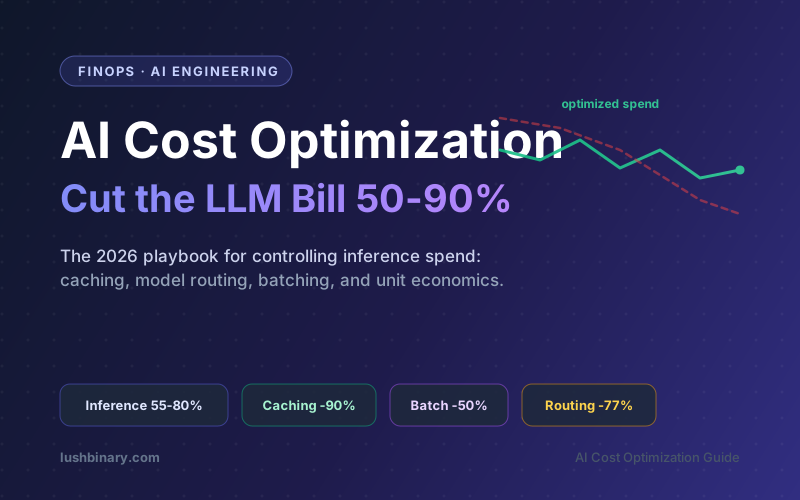
The good news: AI cost is one of the most controllable lines you have. Caching, batching, model routing, and quantization can cut managed API spend by 50 to 90 percent on typical production workloads without touching model quality. This guide walks through where the money actually goes, how to get visibility, and the specific engineering levers that bring the bill down, with the real math so you can size the savings for your own workload.
💸 What This Guide Covers
- Why AI Spend Became the Runaway Bill
- Where the Money Actually Goes
- Step 1: Get Visibility and Unit Economics
- Prompt Caching: The 90% Lever Most Teams Skip
- Model Routing and Cascading
- Batching, Semantic Caching, and Output Discipline
- Self-Host vs API and the Savings Stack
- Why Lushbinary for Cost-Aware AI
- FAQ
1Why AI Spend Became the Runaway Bill
Three structural shifts turned AI from a manageable cost into a CFO agenda item. Understanding them tells you where to aim.
- Inference recurs, training does not. Training a model is a one-time cost. Serving it is a cost that accumulates every hour, every day, indefinitely. Once a feature ships, its serving cost never stops, and it scales with usage.
- Agents make spend unbounded. A traditional API has predictable request volume. An autonomous agent decides at runtime how many tokens to consume, which models to invoke, and how many reasoning loops to run. One agent task can quietly cost 50x a single prompt, and a fleet of them defies static budgets.
- Forecasting broke. GPU training jobs, inference endpoints, and agent pipelines produce sporadic spikes and a new cost baseline every time a model ships. Historical averages cannot follow that curve, so finance teams get surprised at the end of every month.
💡 The headline number
Multiple FinOps analyses converge on the same finding: roughly 55 to 80 percent of enterprise AI GPU spend now goes to inference, not training. That means the lever that matters is not how you train, it is how you serve. Optimizing inference is optimizing the AI bill.
2Where the Money Actually Goes
Before you cut, map the spend. A typical production AI bill breaks down into four buckets, and they are not equal. Inference dominates, which is why the rest of this guide focuses there. The proportions below are illustrative of a common production mix, your split will differ, which is exactly why visibility (Section 3) comes first.
The takeaway is blunt: if inference is the majority of the bill, then token spend per request is the number to attack. Everything that follows is about reducing the tokens you pay for, the price you pay per token, or the number of requests you make at all, without the user noticing a drop in quality.
3Step 1: Get Visibility and Unit Economics
You cannot optimize what you cannot see. The most common failure mode is a single undifferentiated AI invoice with no idea which feature, team, or customer drives it. CloudZero found that 40 percent of companies now spend $10M or more a year on AI, and most cannot say whether it is worth it (CloudZero). Fix that before you touch any optimization lever.
Instrument every model call to emit, at minimum:
- Tokens in and out, and dollar cost per request, computed from the live rate card for the model used.
- Attribution tags: feature, team, environment, and ideally the customer or tenant, so you can compute cost per customer and protect your gross margin.
- Model and cache status: which model served the request and whether it hit a cache, so you can measure your routing and caching effectiveness.
The unit-economics metric that matters is cost per request (or cost per task, for agents), tracked over time and per feature. It turns an abstract monthly bill into a number you can target. When a feature's cost per request creeps up, you see it immediately instead of at invoice time. This is the same discipline a well-instrumented LLM gateway gives you for free, which is why a gateway is often the first piece of cost infrastructure teams add.
⚠️ Kill the obvious waste first
Before any clever optimization, visibility usually surfaces 10 to 20 percent of pure waste: idle GPU endpoints left running, retries that double-bill, debug logging that re-sends full prompts, and abandoned experiments still calling the API. These are free wins that require no quality tradeoff at all.
4Prompt Caching: The 90% Lever Most Teams Skip
Prompt caching is the highest-ROI lever for most input-heavy workloads, and it is the one teams most often leave on the table. Provider-side caching stores the expensive prefill computation for a stable prompt prefix (system prompt, tool definitions, retrieved context, few-shot examples) so repeated requests skip recomputing it and pay a steep discount on those tokens.
| Provider behavior | Discount on cached input |
|---|---|
| Anthropic (explicit, via cache_control) | Cache reads at ~10% of base (a 90% discount); writes cost ~25% more |
| OpenAI (automatic when enabled) | ~50% discount on cached input tokens |
The advertised discount is the ceiling, not the result. A peer-reviewed evaluation of prompt caching on long-horizon agentic tasks measured real-world API cost reductions of 41 to 80 percent and improvements in time to first token of 13 to 31 percent across providers (arXiv 2601.06007). Your actual savings depend on two things: how large and stable your prompt prefix is, and your cache hit rate.
The catch with Anthropic-style explicit caching is that writes cost more than normal input. If a cache entry is written but rarely read again before it expires, you pay the 25 percent write premium for no benefit. Caching pays off when the same prefix is reused many times within the cache lifetime. To make it work:
- Put the stable content first (system prompt, tools, shared context) and the variable content last, so the cacheable prefix is as long as possible.
- Do not churn the prefix. Reordering tools or tweaking the system prompt per request invalidates the cache and turns every call into an expensive write.
- Measure your read-to-write ratio. If reads do not comfortably outnumber writes, the cache is costing you, not saving you.
5Model Routing and Cascading
Most teams send every request to one frontier model. But most requests are not hard. Model routing directs each request to the cheapest model that can handle it: routine queries to a small or cheap model, genuinely hard ones to a frontier model. It is the single biggest lever on a token bill that is dominated by routine traffic.
The economics are concrete. Take a workload of 1,000,000 requests per day at 2,000 tokens each, so 2 billion tokens (2,000 million-token units) per day. Compare sending all of it to a frontier model at a blended $15 per million tokens against routing 80 percent of it to a small model at $0.50 per million:
Total: 1,000,000 req x 2,000 tok = 2.0B tokens/day = 2,000 M-tok

All frontier ($15/M):
  2,000 M-tok x $15      = $30,000/day

Routed (80% small @ $0.50/M, 20% frontier @ $15/M):
  simple:  1,600 M-tok x $0.50 = $   800/day
  complex:   400 M-tok x $15   = $ 6,000/day
  -----------------------------------------
  total:                         $ 6,800/day

Savings: ($30,000 - $6,800) / $30,000 = 77%
The exact percentage depends on your simple-to-complex ratio and the price gap between models, but the shape always holds: moving the bulk of routine traffic off the frontier model is the biggest single cut you can make. Common routing strategies, often combined:
- Complexity routing - classify the request and send easy ones to a cheap model, hard ones to a frontier model.
- Cascading - try the cheap model first and escalate to a stronger one only when the cheap output fails a quality check, so you pay the premium only when you need it.
- Domain routing - send code to a coding-specialized model, vision to a multimodal one, and so on.
⚠️ Route on measured quality
Aggressive routing only works if you verify the cheap model actually handles what you send it. Pair routing with an eval suite so you know quality holds on each route. See our eval-driven development guide and the cost case for small language models.
6Batching, Semantic Caching, and Output Discipline
Caching and routing are the heavy hitters, but three more levers compound on top of them.
Batch APIs. Any work that does not need a real-time answer (overnight summarization, bulk classification, embedding backfills, evals) should go through a batch API. OpenAI and Anthropic both offer roughly a 50 percent discount on batched requests in exchange for asynchronous, higher-latency processing. If a meaningful slice of your traffic is background work, this is a 50 percent cut on that slice for almost no engineering effort.
Semantic caching. Distinct from provider prompt caching, a semantic cache recognizes when an incoming request means the same thing as a previous one, even when worded differently, and returns the stored answer instead of making any API call at all. On workloads with repetitive intent (support FAQs, common product questions) it eliminates calls entirely, cutting both spend and latency. The hit rate depends heavily on how repetitive your traffic is, so measure it before relying on it.
Output discipline. Output tokens cost several times more than input tokens on most models, so uncontrolled output is expensive. Set max_tokens deliberately, ask for concise or structured output, and for agents, cap tokens per request and per session so a runaway reasoning loop cannot quietly burn the budget.
💡 Right-size the model before you optimize around it
The cheapest token is the one you never send to a frontier model. For well-scoped tasks, a smaller or open model plus good prompting often matches a frontier model at a fraction of the price. Test the smaller model against your evals first, then layer caching and batching on top of whatever model survives.
7Self-Host vs API and the Savings Stack
At some volume, teams ask whether self-hosting an open model on their own GPUs is cheaper than paying per token. The honest answer is: only at high, steady utilization. Self-hosting swaps a per-token price for a fixed hourly GPU cost, so it only wins once you keep that hardware busy enough that your effective per-token cost drops below the API rate.
The break-even formula is simple:
break-even tokens/day =
  (daily GPU cost / blended API price per M-tok) x 1,000,000

Example: $48/day of GPU vs $0.50/M-tok small-model API
  ($48 / $0.50) x 1,000,000 = 96 million tokens/day

Below ~96M tokens/day -> the API is cheaper.
Above it -> self-hosting starts to win (if the GPU can
sustain that throughput, and you staff the ops).
Two caveats the math hides: the hardware has to physically sustain the break-even throughput (verify tokens/second, not just memory), and self-hosting adds real operational cost (deployment, scaling, monitoring, on-call) that the API price includes. For most teams below steady high volume, a cheap managed model plus caching beats running your own GPUs. When volume is high and predictable, self-hosting an open model can cut cost dramatically, which is why a hybrid (route routine traffic to a self-hosted small model, burst to APIs) is often the cheapest setup of all.
The levers stack. Here is how a representative $40,000/month all-frontier bill comes down when you apply them in sequence. The figures are illustrative and assume an input-heavy workload with a high share of routine, cacheable traffic, your own numbers will differ:
Get Detailed Cost Breakdown
Fill in your details to unlock pricing and cost information.
8Why Lushbinary for Cost-Aware AI
Cutting an AI bill without cutting quality is an engineering problem, not a spreadsheet exercise. The savings live in routing rules, cacheable prompt structure, batch pipelines, and the evals that prove quality held. Lushbinary builds cost-aware AI systems and the observability to prove the savings are real.
- AI cost audit - we profile your spend, attribute it by feature and customer, and find the routing, caching, and waste opportunities hiding in your traffic.
- Gateway and routing - complexity routing, cascading, and semantic caching tuned to your real workload and validated with evals.
- Caching and batching - prompt-cache-friendly prompt design and batch pipelines for everything that does not need a real-time answer.
- Self-host vs API analysis - honest break-even math and, where it pays off, a hybrid setup that mixes self-hosted models with API burst capacity.
🚀 Free Consultation
Watching your AI bill climb faster than your usage? Lushbinary will audit your spend, estimate the savings from routing, caching, and batching, and lay out a plan that keeps quality high, with no obligation.
9Frequently Asked Questions
What is AI cost optimization?
AI cost optimization is the practice of reducing the money you spend running AI in production, mostly inference, without degrading output quality. It combines FinOps discipline (visibility, allocation, unit economics) with engineering levers like prompt caching, model routing, batching, semantic caching, and output control. Done well, teams cut managed API spend by 50 to 90 percent on typical production workloads.
Why are AI costs so high in 2026?
Most AI spend is now inference, not training. Industry analysts estimate 55 to 80 percent of enterprise AI GPU spend goes to serving models in production, and that cost recurs every hour the feature is live. Agentic systems make it worse because agents decide at runtime how many tokens to consume and how many reasoning loops to run, so spend is unbounded unless you cap it.
How much can prompt caching save on LLM costs?
Provider-side prompt caching advertises up to a 90 percent discount on cached input tokens (Anthropic cache reads cost about 10 percent of the base rate; OpenAI applies an automatic 50 percent discount on cached input). Independent evaluations of long-horizon agentic tasks measured real-world API cost reductions of roughly 41 to 80 percent, depending on how stable your prompt prefix is and your cache hit rate.
Does model routing hurt quality?
Not if you route on measured quality. The idea is to send routine requests to a cheap or small model and reserve a frontier model for genuinely hard requests. The risk is sending a request to a model that cannot handle it, so you pair routing with an eval suite that confirms quality holds on each route. Routing without measurement saves money and loses customers.
Is it cheaper to self-host an open model than to use an API?
Only at high, steady utilization. Self-hosting trades a per-token API price for a fixed hourly GPU cost, so it only beats the API once you keep the hardware busy enough that your effective per-token cost drops below the API rate. At low or spiky volume the API is almost always cheaper. Calculate your break-even tokens per day before committing, and confirm the hardware can physically sustain that throughput.
What is the fastest way to start cutting AI costs?
Get visibility first. You cannot optimize what you cannot see. Add per-request cost and token logging tagged by feature, team, and customer so you know where the money goes. The data tells you which requests to route, what to cache, and where waste hides. Then apply the highest-leverage lever for your workload, usually prompt caching or model routing.
📚 Sources
- FinOps Foundation - State of FinOps 2026
- Flexera - Cloud Value Rising While AI Waste Grows
- CloudZero - AI Cost Optimization Strategies
- arXiv - An Evaluation of Prompt Caching for Long-Horizon Agentic Tasks
- OpenAI - API Pricing (batch and cached-input discounts)
- Anthropic - Prompt Caching Documentation
Content was rephrased for compliance with licensing restrictions. Market figures, discount percentages, and FinOps statistics sourced from official vendor documentation, the FinOps Foundation, and independent research as of June 2026. Cost examples are illustrative calculations based on representative pricing, always model your own traffic and verify current vendor pricing. Discounts and pricing change, confirm with each provider before relying on a figure.
Cut Your AI Bill, Keep the Quality
Lushbinary audits AI spend and builds cost-aware systems with routing, caching, and batching that cut spend 50 to 90 percent without hurting quality. Let's talk about your numbers.
Ready to Build Something Great?
Get a free 30-minute strategy call. We'll map out your project, timeline, and tech stack - no strings attached.
Prefer email? Reach us directly: