
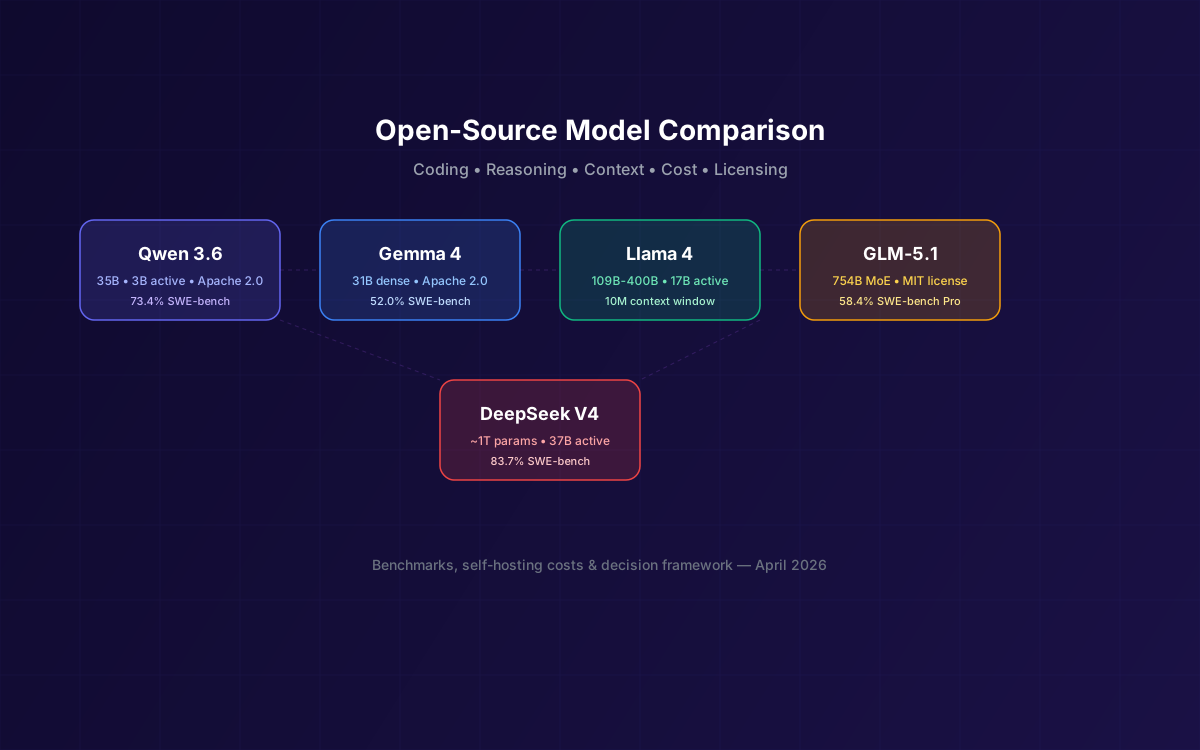
April 2026 is the most competitive month in open-source AI history. Six major labs now ship models that compete with or match proprietary alternatives: Alibaba (Qwen 3.6), Google (Gemma 4), Meta (Llama 4), Zhipu AI (GLM-5.1), DeepSeek (V4), and Mistral (Small 4). The question isn't whether open-weight models are good enough anymore - it's which one is right for your specific use case.
This comparison puts Qwen 3.6 head-to-head against the four most relevant open-weight competitors across coding benchmarks, reasoning, context windows, self-hosting costs, licensing, and real-world agentic performance. No marketing fluff - just the numbers and trade-offs that matter for production decisions.
If you want a deep dive on Qwen 3.6 specifically, check our Qwen 3.6 developer guide. For Gemma 4, see our Gemma 4 developer guide. For DeepSeek V4, see our DeepSeek V4 guide.
📋 Table of Contents
- 1.The Contenders: Model Overview
- 2.Architecture Comparison
- 3.Coding Benchmarks: SWE-bench, Terminal-Bench & More
- 4.Reasoning & Knowledge Benchmarks
- 5.Context Window & Output Limits
- 6.Licensing & Commercial Use
- 7.Self-Hosting: Hardware & Cost
- 8.API Pricing Comparison
- 9.Agentic Capabilities & Tool Use
- 10.Decision Framework: Which Model to Choose
- 11.Why Lushbinary for Open-Source Model Integration
1The Contenders: Model Overview
We're comparing five model families, focusing on their most capable open-weight variants as of April 2026.
| Model | Lab | Total Params | Active Params | License |
|---|---|---|---|---|
| Qwen 3.6-35B-A3B | Alibaba | 35B | 3B | Apache 2.0 |
| Gemma 4-31B | 31B | 31B (dense) | Apache 2.0 | |
| Gemma 4-26B-A4B | 26B | 3.8B | Apache 2.0 | |
| Llama 4 Scout | Meta | 109B | 17B | Llama 4 (700M MAU cap) |
| Llama 4 Maverick | Meta | 400B | 17B | Llama 4 (700M MAU cap) |
| GLM-5.1 | Zhipu AI | 754B | ~45B | MIT |
| DeepSeek V4 | DeepSeek | ~1T | ~37B | Custom |
📊 The MoE Efficiency Revolution
Notice the trend: every model except Gemma 4-31B uses Mixture-of-Experts. Qwen 3.6-35B-A3B activates just 3B of its 35B parameters per token - the most aggressive sparsity ratio in this comparison. This means it can run on hardware that would struggle with any of the other models at full precision.
2Architecture Comparison
Each model takes a different architectural approach, and these differences have real implications for deployment and performance.
Qwen 3.6-35B-A3B
Hybrid Gated DeltaNet (linear attention) + Gated Attention + 256-expert MoE. 40 layers. Vision encoder included. Multi-token prediction trained.
Gemma 4-31B
Dense transformer with PLE (Parallel Linear Experts) architecture. Shared KV cache across layers. Native multimodal (vision + audio). 256K context.
Llama 4 Scout/Maverick
Alternating dense + MoE layers. Scout: 16 experts, 109B total. Maverick: 128 experts, 400B total. Both activate 17B. Native multimodal. 10M context (Scout).
GLM-5.1
754B MoE model trained on Huawei Ascend chips. Designed for long-horizon agentic tasks with 600+ iteration optimization loops. 200K context. MIT licensed.
DeepSeek V4
~1 trillion parameter MoE with ~37B active. Engram conditional memory module for persistent context. mHC architecture. 1M token context. Native multimodal generation (text, image, video). Supports 338 programming languages.
3Coding Benchmarks: SWE-bench, Terminal-Bench & More
Coding is where these models diverge most dramatically. Here's the head-to-head comparison on the benchmarks that matter for real-world software engineering.
| Benchmark | Qwen 3.6 35B | Gemma 4 31B | Llama 4 Mav. | GLM-5.1 | DeepSeek V4 |
|---|---|---|---|---|---|
| SWE-bench Verified | 73.4% | 52.0% | ~65% | ~78% | 83.7% |
| SWE-bench Pro | 49.5% | 35.7% | - | 58.4% | ~55% |
| Terminal-Bench 2.0 | 51.5% | 42.9% | - | - | - |
| LiveCodeBench v6 | 80.4% | 80.0% | - | - | - |
| HumanEval | - | - | - | - | 90.0% |
| NL2Repo | 29.4% | 15.5% | - | 42.7% | - |
⚠️ Benchmark Caveats
Not all benchmarks are directly comparable - different labs use different agent scaffolds, temperature settings, and context windows. SWE-bench Verified is the most standardized, but even there, the evaluation harness matters. Dashes (-) indicate the benchmark wasn't reported by that lab. DeepSeek V4 numbers are from pre-release claims and may change.
Key Coding Insights
- DeepSeek V4 leads raw coding benchmarks with 83.7% SWE-bench Verified and 90% HumanEval, but it's a ~1T parameter model requiring massive compute to self-host.
- GLM-5.1 dominates SWE-bench Pro at 58.4% - the hardest coding benchmark - beating even GPT-5.4 (57.7%) and Claude Opus 4.6 (57.3%). It also leads NL2Repo at 42.7%.
- Qwen 3.6-35B-A3B punches far above its weight: 73.4% SWE-bench Verified with only 3B active parameters. It beats Gemma 4-31B (a dense model with 10x the active compute) on nearly every coding metric.
- Gemma 4-31B is strong on competitive coding (LiveCodeBench 80.0%) but weaker on real-world software engineering tasks (SWE-bench 52.0%).
4Reasoning & Knowledge Benchmarks
| Benchmark | Qwen 3.6 35B | Gemma 4 31B | Llama 4 Scout | GLM-5.1 | DeepSeek V4 |
|---|---|---|---|---|---|
| GPQA Diamond | 86.0% | 84.3% | - | - | - |
| MMLU-Pro | 85.2% | 85.2% | - | - | 92.8% |
| AIME 2026 | 92.7% | 89.2% | - | 95.3% | 99.4% |
| HMMT Feb 2026 | 83.6% | 77.2% | - | - | - |
On reasoning, Qwen 3.6-35B-A3B leads the sub-40B weight class with 86.0% GPQA and 92.7% AIME 2026. DeepSeek V4 dominates at the frontier level (99.4% AIME, 92.8% MMLU-Pro), but again, it's a trillion-parameter model. GLM-5.1 is strong on math (95.3% AIME) while being MIT-licensed. The key insight: Qwen 3.6 delivers 90%+ of frontier reasoning at a fraction of the compute.
5Context Window & Output Limits
| Model | Context Window | Max Output | Notes |
|---|---|---|---|
| Qwen 3.6-35B-A3B | 262K (ext. to 1M) | 65,536 | YaRN extension for 1M |
| Qwen 3.6 Plus | 1,000,000 | 65,536 | Native 1M via linear attention |
| Gemma 4-31B | 256,000 | 8,192 | Shared KV cache for efficiency |
| Llama 4 Scout | 10,000,000 | - | Largest context of any open model |
| Llama 4 Maverick | 1,000,000 | - | 128 experts, 400B total |
| GLM-5.1 | 200,000 | - | Optimized for long-horizon tasks |
| DeepSeek V4 | 1,000,000 | - | Engram memory for persistent context |
Llama 4 Scout's 10M token context is in a class of its own - enough to process entire large codebases in a single prompt. But context window size alone doesn't determine usefulness; retrieval accuracy at long ranges matters more. Scout maintains 95%+ retrieval accuracy up to 8M tokens, dropping to 89% at the full 10M limit. Qwen 3.6 Plus and DeepSeek V4 both offer 1M tokens, which covers most practical use cases. Gemma 4's 256K is sufficient for most tasks but limits repository-level analysis.
6Licensing & Commercial Use
Licensing is often the deciding factor for production deployments. Here's the reality:
✅ Truly Open (OSI-compliant)
- Qwen 3.6-35B-A3B - Apache 2.0. No restrictions.
- Gemma 4 (all variants) - Apache 2.0. No restrictions.
- GLM-5.1 - MIT license. No restrictions.
⚠️ Open-Weight (Restricted)
- Llama 4 - Custom license. 700M monthly active user cap. Requires Meta approval above threshold.
- DeepSeek V4 - Custom license. Commercial use allowed but with specific restrictions.
For startups and enterprises that need unrestricted commercial use, Qwen 3.6, Gemma 4, and GLM-5.1 are the safest choices. Llama 4's 700M MAU cap won't affect most companies, but it creates a ceiling that could matter at scale.
7Self-Hosting: Hardware & Cost
Self-hosting cost is directly tied to active parameter count and quantization support. Here's what each model requires:
| Model | FP16 VRAM | INT4 VRAM | Min GPU |
|---|---|---|---|
| Qwen 3.6-35B-A3B | ~70 GB | ~18 GB | 1× RTX 4090 (INT4) |
| Gemma 4-31B | ~62 GB | ~16 GB | 1× RTX 4090 (INT4) |
| Gemma 4-26B-A4B | ~52 GB | ~14 GB | 1× RTX 4090 (INT4) |
| Llama 4 Scout (109B) | ~220 GB | ~55 GB | 2× A100 80GB |
| Llama 4 Maverick (400B) | ~800 GB | ~200 GB | 8× A100 80GB |
| GLM-5.1 (754B) | ~1.5 TB | ~380 GB | 8× H100 80GB |
| DeepSeek V4 (~1T) | ~2 TB | ~500 GB | 16× H100 80GB |
💰 Cost Reality Check
Qwen 3.6-35B-A3B and Gemma 4-26B-A4B are the only frontier-competitive models that run on a single consumer GPU with quantization. On AWS, a g5.2xlarge (1× A10G 24GB) costs ~$1.21/hr - enough for INT4 Qwen 3.6. GLM-5.1 and DeepSeek V4 require multi-node GPU clusters costing $20-50+/hr on cloud.
8API Pricing Comparison
For teams that prefer API access over self-hosting, here's how the pricing stacks up for the proprietary/hosted versions of each model family.
| Model (API) | Input/1M | Output/1M | Platform |
|---|---|---|---|
| Qwen 3.6 Plus (Preview) | $0.00 | $0.00 | OpenRouter (free preview) |
| Qwen 3.6 Plus (Paid) | ~$0.29 | ~$1.65 | Alibaba Bailian |
| Gemma 4-31B | $0.15 | $0.60 | Google AI Studio / Vertex |
| Llama 4 Maverick | $0.20 | $0.60 | Together AI / Fireworks |
| GLM-5.1 | ~$0.50 | ~$2.00 | Zhipu AI API |
| DeepSeek V4 | ~$0.30 | ~$1.20 | DeepSeek API |
9Agentic Capabilities & Tool Use
Agentic AI - models that autonomously use tools, navigate multi-step tasks, and maintain context across long sessions - is the frontier battleground in 2026. Here's how each model handles it.
Qwen 3.6
- ✅ Native function calling
- ✅
preserve_thinkingfor agent loops - ✅ Always-on chain-of-thought
- ✅ MCPMark: 37.0% (35B-A3B)
- ✅ Works with Claude Code, OpenClaw, Qwen Code
Gemma 4
- ✅ Native function calling
- ✅ Thought summaries for context management
- ✅ MCPMark: 18.1% (31B)
- ⚠️ Weaker on multi-step tool chains
- ✅ Works with Ollama, vLLM, MCP servers
GLM-5.1
- ✅ 6,000+ tool calls in single sessions
- ✅ 600+ iteration optimization loops
- ✅ Best long-horizon agentic performance
- ✅ Built a Linux desktop in 8 hours autonomously
- ✅ Works with Claude Code, OpenCode
DeepSeek V4
- ✅ Engram conditional memory
- ✅ 338 programming languages
- ✅ Native multimodal generation
- ✅ Strong function calling
- ⚠️ Self-hosting requires massive compute
10Decision Framework: Which Model to Choose
There's no single "best" model - the right choice depends on your constraints. Here's a decision framework:
🏆 Best for self-hosted coding agents on consumer hardware
Qwen 3.6-35B-A3B - 73.4% SWE-bench with only 3B active params. Runs on a single RTX 4090. Apache 2.0. Best performance-per-watt in this comparison.
🏆 Best for maximum coding performance (API)
DeepSeek V4 - 83.7% SWE-bench Verified, 90% HumanEval. Cheapest frontier-level API at ~$0.30/$1.20 per million tokens.
🏆 Best for long-horizon autonomous tasks
GLM-5.1 - #1 on SWE-bench Pro (58.4%). Sustains 600+ iteration loops with 6,000+ tool calls. MIT licensed.
🏆 Best for massive context (entire codebases)
Llama 4 Scout - 10M token context window. 95%+ retrieval accuracy up to 8M tokens. Good for repository-level analysis.
🏆 Best for multimodal + edge deployment
Gemma 4 - Native vision + audio across all sizes. E2B variant runs on phones. Apache 2.0. Best ecosystem support (TensorFlow, JAX, PyTorch).
🏆 Best free option right now
Qwen 3.6 Plus (Preview) - Free on OpenRouter during preview. 1M context, 78.8% SWE-bench, always-on reasoning. No API key friction.
11Why Lushbinary for Open-Source Model Integration
Choosing a model is step one. Deploying it reliably in production - with proper routing, fallbacks, cost optimization, and monitoring - is where most teams need help. Lushbinary has deployed every model in this comparison for production workloads.
- Multi-model routing architectures (route by task complexity, cost, and latency)
- Self-hosted deployments on AWS with vLLM, SGLang, and Spot Instances
- MCP server development for custom tool integrations
- Agentic coding pipeline design with OpenClaw, Hermes, and Claude Code
- Cost analysis: we'll tell you exactly what each model costs for your workload
🚀 Free Consultation
Not sure which model fits your use case? Lushbinary will evaluate your requirements, benchmark the top candidates against your actual workload, and recommend the optimal model + deployment strategy — no obligation.
❓ Frequently Asked Questions
Which open-source model is best for coding in April 2026?
For coding, GLM-5.1 leads SWE-Bench Pro at 58.4%, followed by Qwen 3.6-35B-A3B at 49.5% and Gemma 4-31B at 35.7%. For self-hosting efficiency, Qwen 3.6-35B-A3B offers the best performance-per-compute with only 3B active parameters.
How does Qwen 3.6 compare to Llama 4 and DeepSeek V4?
Qwen 3.6 Plus (78.8% SWE-bench) competes with DeepSeek V4 (83.7% SWE-bench) and outperforms Llama 4 Maverick on coding tasks. Llama 4 Scout offers a 10M token context window but lower coding scores. DeepSeek V4 leads on raw benchmarks but requires significantly more compute.
What is the cheapest frontier-level open-source model to self-host?
Qwen 3.6-35B-A3B is the most cost-efficient to self-host, with only 3B active parameters from 35B total. It runs on a single RTX 4090 with INT4 quantization. Gemma 4-26B-A4B is similar at 3.8B active parameters.
Which model has the largest context window?
Llama 4 Scout leads with a 10 million token context window. Qwen 3.6 Plus and DeepSeek V4 both support 1 million tokens. GLM-5.1 supports 200K tokens, and Gemma 4 supports 256K tokens natively.
Are these models truly open-source?
Qwen 3.6-35B-A3B and Gemma 4 are under Apache 2.0 with full commercial freedom. GLM-5.1 is under MIT license. Llama 4 uses Meta's custom license with a 700M MAU cap. DeepSeek V4 uses a custom license. Only Apache 2.0 and MIT qualify as truly open-source by OSI standards.
📚 Sources
- Qwen 3.6-35B-A3B Model Card - Hugging Face
- Qwen3.6-Plus: Towards Real World Agents - Alibaba Cloud
- Gemma 4 - Google DeepMind
- Llama 4 - Meta AI
- GLM-5.1 - Zhipu AI
Content was rephrased for compliance with licensing restrictions. Benchmark data sourced from official model cards and lab publications as of April 2026. Some DeepSeek V4 benchmarks are from pre-release claims. Pricing may change - always verify on vendor websites.
Need Help Choosing the Right AI Model?
Lushbinary evaluates, deploys, and optimizes open-source AI models for production. Let us benchmark the options against your actual workload.
Ready to Build Something Great?
Get a free 30-minute strategy call. We'll map out your project, timeline, and tech stack - no strings attached.
Prefer email? Reach us directly: