
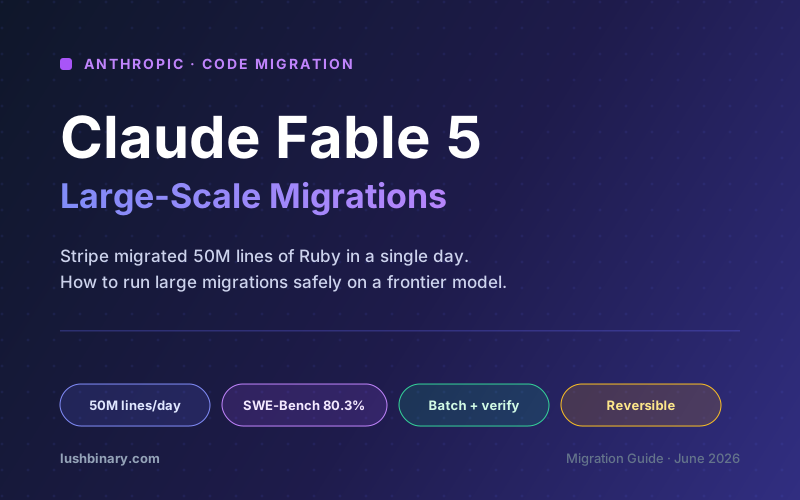
Large code migrations are where most engineering roadmaps go to die. A framework upgrade, a language version bump, or an API migration that touches thousands of files is tedious, risky, and easy to defer for another quarter. Claude Fable 5, Anthropic's first publicly available Mythos-class model, changes that math.
The headline example from the June 9, 2026 launch: Anthropic says Stripe used Fable 5 to complete a migration across a 50-million-line Ruby codebase in a single day, work that would otherwise have taken a full engineering team over two months. That is not a parlor trick. It reflects a model that leads the public benchmark board on agentic coding (SWE-Bench Pro 80.3%) and is purpose-built for long-running, self-verifying work.
This guide is a practical playbook for running a large migration on Fable 5: where it fits, how to architect the harness, how to keep it safe for production, and what it costs. For the model fundamentals, start with our Claude Fable 5 developer guide.
📌 What This Guide Covers
1Why Migrations Are Suddenly Tractable
Migrations have always been a poor fit for AI assistants. They span too many files to fit in a chat window, the edits are interdependent, and a single missed case breaks the build. What changed with Fable 5 is a combination of three capabilities that finally line up:
- Sustained long-horizon work - Anthropic built Fable 5 for tasks that run for hours or days inside an agent harness, maintaining state and recovering from errors without a human in the loop.
- A real coding lead - 80.3% on SWE-Bench Pro, more than 11 points above Opus 4.8, and more than double Opus 4.8 on the harder FrontierCode Diamond split (29.3% vs 13.4%). On long jobs that per-step edge compounds.
- Self-verification - at the highest effort setting it reflects on and validates its own output, which is what lets it grind through thousands of edits without drifting.
💡 The Stripe data point in context
A 50-million-line migration in a day is the best case, on a codebase with strong test coverage and a team that knew how to drive the model. Treat it as proof the approach scales, not as a promise that every migration collapses to a single day. Coverage, test quality, and edge-case density set your real timeline.
2Which Migrations Fit Fable 5
The sweet spot is work that is repetitive across many files but needs judgment in the edge cases, exactly where pure scripts (codemods) fall short and pure humans burn out:
- Framework and version upgrades - major-version jumps with breaking API changes, deprecations, and config rewrites.
- Language and runtime migrations - moving a service to a new language, or modernizing legacy syntax across a large codebase.
- API and SDK migrations - swapping a vendor SDK, updating a breaking REST or GraphQL contract, or moving off a deprecated internal library.
- Dependency modernization - resolving a cluster of interdependent upgrades that a simple bump would break.
Migrations that are not a good fit: anything with weak or no test coverage (the model has nothing to verify against), one-off architectural redesigns that need product decisions, and changes where correctness cannot be checked automatically. For those, Fable 5 can assist a human, but it should not run unattended.
3Migration Harness Architecture
A successful migration is not one giant prompt. It is a harness: Fable 5 plans and owns hard decisions, batches of files are migrated and verified, and state persists so a multi-hour run can resume. Here is the shape:
The planner runs on Fable 5 because deciding how to batch the work and handling the genuinely hard cases is where its reasoning pays off. Routine batch edits route to Opus 4.8 at half the price. Every batch is verified deterministically before it commits, and failures loop back for a retry or escalate to Fable 5. State persists so a long run resumes instead of restarting. This is the same fan-out-and-verify pattern that powers any long-horizon agent; our long-horizon agents guide covers it in depth.
4Keeping It Safe for Production
Letting a model rewrite thousands of files is only safe with hard guardrails. Fable 5's self-verification is a strong default, not a substitute for these:
- Deterministic gates on every batch - the test suite, type checker, linter, and build must pass before a batch is accepted. These catch most regressions for free.
- Reversible batches - migrate in small, independently revertable commits so any bad batch is a quick rollback, not a forensic exercise.
- Human approval before merge - the agent prepares and verifies; a human approves the merge to main. Reversibility should gate autonomy.
- Parallel-run where possible - keep old and new code paths live behind a flag so you can compare behavior in production before cutting over.
- Coverage first - if a critical area lacks tests, add them before migrating it. The model can help write those tests as a first phase.
⚠️ Watch for the safeguard fallback
If the codebase touches security tooling, cryptography, or similar, Fable 5's cybersecurity classifier may route those turns to Opus 4.8 and tell you. Instrument it so a silent handoff does not skew results on sensitive modules. Our safety split guide explains the mechanics.
5Cost and Timeline
The economics are the easiest part of the pitch: even a few thousand dollars of API spend is trivial against the senior-engineering months a large migration consumes. Here is the detailed breakdown, including the token math and a realistic project timeline.
Get Detailed Cost Breakdown
Fill in your details to unlock pricing and cost information.
6Why Lushbinary
A migration on a frontier model is powerful and unforgiving of a weak harness. Lushbinary runs AI-driven migrations and modernizations with the verification gates and rollback discipline production demands, across healthcare, fintech, SaaS, and e-commerce.
- Migration harness design - planner, batch workers, deterministic gates, and resumable state tuned to your codebase.
- Model routing - Fable 5 for planning and hard cases, Opus 4.8 for routine batches, with cost ceilings.
- Coverage and safety - test backfill, reversible batching, and human approval gates before cutover.
- AWS infrastructure - the compute, isolation, and monitoring to run long migrations safely.
🚀 Free Consultation
Sitting on a migration you keep deferring? We will scope it, estimate the API and timeline cost, and design the harness and safety gates to run it on Fable 5, with no obligation.
7Frequently Asked Questions
Can Claude Fable 5 really migrate a large legacy codebase?
Anthropic reports that launch partner Stripe used Fable 5 to complete a migration across a 50-million-line Ruby codebase in a single day, work that would otherwise have taken an engineering team over two months. Fable 5 leads the public benchmark board on agentic coding (SWE-Bench Pro 80.3%) and is built for long-running, self-verifying work, which is exactly what large migrations need. It still requires a disciplined harness and human review gates.
How much does a Fable 5 code migration cost in API spend?
Fable 5 costs $10 per million input tokens and $50 per million output tokens, double Opus 4.8. A single agentic task using 200K input and 50K output tokens runs about $4.50 before caching. A full migration fans into thousands of such calls, so the API bill can reach hundreds to low thousands of dollars, which is still small against the senior-engineering months it replaces. Prompt caching cuts input cost by up to 90%.
Should the whole migration run on Fable 5?
No. The cost-effective pattern uses Fable 5 as the planner and for hard, ambiguous changes, and routes mechanical batch edits to Opus 4.8 at half the price. Reserve the premium model for the steps where its higher pass rate compounds across the migration.
Is an AI-driven migration safe for production code?
It can be, with the right guardrails. Run the full test suite, type checker, and build on every batch, require human approval before merging to main, migrate in reversible batches, and keep the old and new paths running in parallel where possible. At the highest effort setting Fable 5 validates its own work, but deterministic checks and human gates are still mandatory for production.
What kinds of migrations is Fable 5 best at?
Framework and language version upgrades, API and SDK migrations, dependency modernization, and mechanical-but-pervasive refactors where the change is repetitive across many files but needs judgment in the edge cases. These play to Fable 5's strength: sustained, self-verifying work across a long horizon.
📚 Sources
- Anthropic - Claude Fable 5 and Claude Mythos 5
- Anthropic - Claude Opus 4.8 (routing baseline and pricing)
Content was rephrased for compliance with licensing restrictions. The Stripe migration result, benchmark figures, pricing, and safeguard behavior are sourced from Anthropic's June 9, 2026 announcement. Harness and cost estimates are Lushbinary's own and will vary with codebase size, test coverage, and edge-case density. Model capabilities and pricing may change - always verify on Anthropic's website.
Planning a Large Migration?
Lushbinary runs AI-driven migrations on Claude Fable 5 with the verification and rollback gates production needs. Let's scope yours.
Ready to Build Something Great?
Get a free 30-minute strategy call. We'll map out your project, timeline, and tech stack - no strings attached.
Prefer email? Reach us directly: