
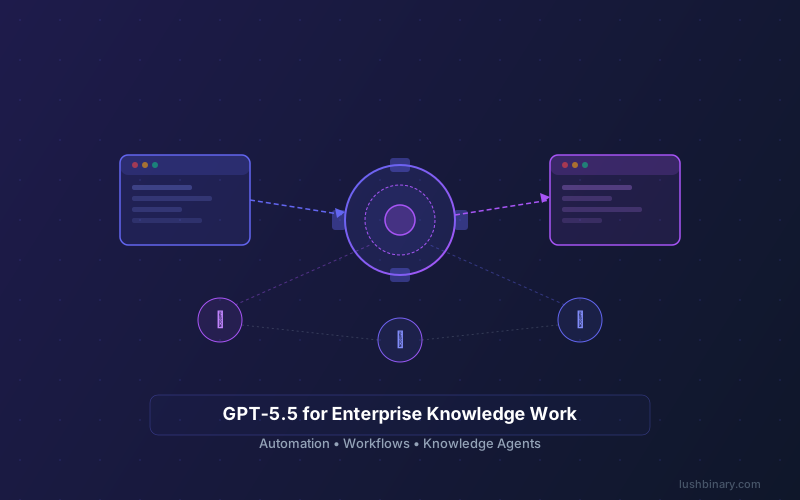
OpenAI released GPT-5.5 on April 23, 2026 — codenamed "Spud" — and it's the first fully retrained base model since GPT-4.5. This isn't another incremental fine-tune of the GPT-5 family. It's a ground-up rebuild designed to automate the kind of knowledge work that enterprises have been trying to delegate to AI for years: multi-document analysis, cross-application workflows, autonomous computer operation, and complex reasoning chains that span hours of human effort.
The numbers tell the story. GPT-5.5 scores 84.9% on GDPval, a benchmark that tests performance across 44 knowledge-work occupations. It hits 78.7% on OSWorld-Verified for autonomous desktop operation and 82.7% on Terminal-Bench 2.0 for complex command-line workflows. For enterprise teams evaluating AI-driven automation, these aren't abstract benchmarks — they map directly to the tasks your analysts, engineers, and operations teams handle every day.
The competitive context matters too. Anthropic's Claude ARR surged from $9 billion to $30 billion, and OpenAI has been in "Code Red" mode since December 2025. GPT-5.5 is their response — a model built not just for chat, but for replacing entire workflows. This guide breaks down what that means for enterprise teams, how the benchmarks translate to real work, and how to plan your integration strategy.
📑 Table of Contents
- Why GPT-5.5 Changes Enterprise AI
- Benchmark Breakdown: Knowledge Work Scores
- Computer Use: OSWorld & Desktop Automation
- Multi-App Workflow Orchestration
- GPT-5.5 Pro: Extended Reasoning for Complex Tasks
- Token Efficiency & Cost Analysis
- The Super-App Vision: ChatGPT + Codex + Atlas
- Migration Path from GPT-5.4
- Why Lushbinary for Enterprise GPT-5.5 Integration
- Frequently Asked Questions
1Why GPT-5.5 Changes Enterprise AI
Enterprise AI adoption has followed a predictable pattern since 2023: companies deploy chatbots, build RAG pipelines, and automate narrow tasks like email summarization or document classification. The limitation has always been the same — models could handle individual tasks well, but couldn't orchestrate the kind of multi-step, multi-application workflows that make up actual knowledge work.
GPT-5.5 changes this equation in three fundamental ways. First, it can autonomously operate computer environments — navigating GUIs, clicking buttons, filling forms, and switching between applications without human intervention. Second, it understands the context of entire workflows, not just individual prompts, meaning it can plan a ten-step process and execute it end-to-end. Third, its token efficiency improvements mean that complex multi-turn workflows that would have been prohibitively expensive with GPT-5.4 are now economically viable at enterprise scale.
The timing is significant. OpenAI has been in "Code Red" since December 2025, driven by Anthropic's explosive growth from $9 billion to $30 billion ARR. Claude has been winning enterprise deals, particularly in regulated industries where Anthropic's safety-first positioning resonates. GPT-5.5 is OpenAI's direct response — a model that doesn't just match Claude on individual tasks but leapfrogs it on the multi-app orchestration that enterprise buyers actually need.
🔑 Key Distinction
GPT-5.5 is the first fully retrained base model since GPT-4.5. Every model from GPT-5.0 through GPT-5.4 was built on top of the same foundation. Spud represents a new architecture trained from scratch, which is why the capability jumps are so significant across every benchmark category.
For a technical deep-dive into GPT-5.5's developer-facing capabilities including omnimodal processing and agentic coding, see our GPT-5.5 developer guide.
2Benchmark Breakdown: Knowledge Work Scores
The headline number is 84.9% on GDPval — a benchmark that tests AI performance across 44 distinct knowledge-work occupations. This isn't a synthetic test of reasoning ability. GDPval evaluates whether a model can actually do the work that professionals in those roles perform daily: drafting legal briefs, analyzing financial statements, writing technical documentation, creating marketing strategies, and managing project timelines.
Here's how GPT-5.5's benchmark scores map to enterprise use cases:
| Benchmark | Score | What It Measures | Enterprise Relevance |
|---|---|---|---|
| GDPval | 84.9% | 44 knowledge-work occupations | General enterprise task automation |
| Tau2-bench Telecom | 98.0% | Telecom domain tasks without prompt tuning | Industry-specific automation out of the box |
| OSWorld-Verified | 78.7% | Autonomous computer environment operation | Desktop automation & GUI interaction |
| Terminal-Bench 2.0 | 82.7% | Complex command-line workflows | DevOps, sysadmin, data pipeline tasks |
| SWE-Bench Pro | 58.6% | Real-world GitHub issue resolution | Software engineering & bug fixing |
GDPval: The Knowledge Work Benchmark
GDPval is particularly important for enterprise evaluation because it tests breadth, not just depth. An 84.9% score across 44 occupations means GPT-5.5 can handle the majority of tasks in roles like financial analysts, HR specialists, marketing managers, legal assistants, and project coordinators. This doesn't mean it replaces those roles — it means it can handle the routine, time-consuming portions of those jobs, freeing professionals to focus on judgment-intensive work.
Tau2-bench: Zero-Shot Industry Performance
The 98.0% score on Tau2-bench Telecom is remarkable because it was achieved without prompt tuning. This means GPT-5.5 can handle industry-specific tasks out of the box, without the custom prompt engineering and fine-tuning that previous models required. For enterprise teams in telecom, finance, healthcare, and other regulated industries, this dramatically reduces the time and cost of deployment.
SWE-Bench Pro: Real-World Engineering
The 58.6% on SWE-Bench Pro deserves context. This benchmark tests resolution of real GitHub issues — not toy problems, but actual bugs and feature requests from production codebases. While 58.6% is lower than the other scores, it represents a significant capability for enterprise engineering teams. GPT-5.5 can autonomously resolve more than half of real-world software issues, which translates to meaningful productivity gains for development teams. For a detailed comparison of how this stacks up against competing models, see our GPT-5.5 vs Claude Opus 4.7 comparison.
3Computer Use: OSWorld & Desktop Automation
GPT-5.5's 78.7% score on OSWorld-Verified represents a breakthrough for enterprise automation. OSWorld tests whether an AI can autonomously operate a full computer environment — navigating graphical interfaces, clicking buttons, filling out forms, managing files, and switching between applications. This is the capability that bridges the gap between "AI that answers questions" and "AI that does work."
In practical terms, a 78.7% OSWorld score means GPT-5.5 can reliably handle tasks like:
- CRM data entry — navigating Salesforce or HubSpot to create records, update fields, and generate reports without API integration
- Spreadsheet workflows — opening Excel or Google Sheets, applying formulas, creating pivot tables, and formatting reports
- Email management — reading, categorizing, drafting responses, and filing emails across Outlook or Gmail
- Document processing — opening PDFs, extracting data, cross-referencing with other documents, and populating templates
- Internal tool navigation — operating custom enterprise applications that don't have APIs, using the GUI just like a human operator would
💡 Why This Matters for Enterprise
Many enterprise workflows depend on legacy applications that don't have APIs. Traditional automation (RPA tools like UiPath or Automation Anywhere) requires brittle scripts that break when UIs change. GPT-5.5's computer use capability understands the semantic meaning of interfaces, making it far more resilient to UI updates and capable of handling unexpected dialogs or error states.
Terminal-Bench 2.0: Command-Line Mastery
The 82.7% score on Terminal-Bench 2.0 complements the desktop automation story. This benchmark tests complex command-line workflows — the kind of multi-step terminal operations that DevOps engineers, system administrators, and data engineers perform daily. Tasks include chaining shell commands, parsing log files, managing server configurations, running database queries, and orchestrating deployment pipelines.
For enterprise IT teams, this means GPT-5.5 can handle:
- Log analysis — parsing and correlating logs across multiple services to identify root causes
- Infrastructure management — executing multi-step server provisioning, configuration updates, and health checks
- Data pipeline operations — running ETL scripts, validating data quality, and troubleshooting pipeline failures
- Security auditing — scanning configurations, checking compliance, and generating audit reports from the command line
4Multi-App Workflow Orchestration
The real enterprise value of GPT-5.5 emerges when you combine its knowledge work capabilities with computer use and terminal mastery. This creates something that previous models couldn't deliver: end-to-end workflow automation that spans multiple applications, interfaces, and data sources.
Consider a typical enterprise workflow that currently requires a human analyst to coordinate across five or six tools:
# Example: Quarterly Business Review Preparation
1. Pull sales data from Salesforce (GUI navigation)
2. Export financial metrics from NetSuite (GUI navigation)
3. Run SQL queries against the data warehouse (terminal)
4. Create analysis in Excel with pivot tables (desktop app)
5. Draft executive summary in Google Docs (desktop app)
6. Build presentation slides in PowerPoint (desktop app)
7. Email the package to stakeholders (email client)
# GPT-5.5 can orchestrate this entire workflow
# autonomously, switching between apps as needed
This kind of multi-app orchestration is where GPT-5.5's combination of benchmarks converges. The 84.9% GDPval score means it understands the business context. The 78.7% OSWorld score means it can operate the applications. The 82.7% Terminal-Bench score means it can handle the data infrastructure. And the 98.0% Tau2-bench score means it can do this in industry-specific contexts without custom prompt engineering.
Enterprise Workflow Categories
Based on GPT-5.5's benchmark profile, here are the enterprise workflow categories where it delivers the highest ROI:
| Workflow Category | Key Capabilities Used | Estimated Time Savings |
|---|---|---|
| Financial Reporting | GDPval + OSWorld + Terminal | 60-80% of analyst time |
| Customer Support Ops | Tau2-bench + OSWorld | 40-60% of agent time |
| DevOps Automation | Terminal-Bench + SWE-Bench | 50-70% of ops tasks |
| Legal Document Review | GDPval + OSWorld | 50-65% of review time |
| Sales Operations | GDPval + OSWorld + Tau2-bench | 45-65% of admin tasks |
The key insight for enterprise buyers is that GPT-5.5 doesn't just automate individual tasks — it automates the transitions between tasks. The context-switching overhead that makes knowledge work slow and error-prone is exactly what GPT-5.5 eliminates when it orchestrates across applications.
5GPT-5.5 Pro: Extended Reasoning for Complex Tasks
GPT-5.5 Pro is the extended-reasoning variant, available exclusively to Pro ($100/mo and $200/mo), Business ($25/user/mo), and Enterprise subscribers. While the standard GPT-5.5 handles most enterprise tasks efficiently, GPT-5.5 Pro is designed for problems that require deeper analysis, longer reasoning chains, and more careful consideration of edge cases.
In enterprise contexts, GPT-5.5 Pro excels at:
- Multi-document synthesis — analyzing dozens of contracts, reports, or regulatory filings to identify patterns, conflicts, and risks that span across documents
- Complex financial modeling — building multi-scenario financial models that account for interdependencies, market conditions, and regulatory constraints
- Strategic planning — evaluating market entry strategies, competitive positioning, and resource allocation across multiple business units
- Technical architecture review — analyzing system designs for scalability bottlenecks, security vulnerabilities, and compliance gaps across complex distributed systems
- Regulatory compliance analysis — mapping regulatory requirements across jurisdictions and identifying gaps in current compliance posture
⚡ Pro vs Standard: When to Use Each
Use standard GPT-5.5 for routine knowledge work, data entry, report generation, and straightforward multi-app workflows. Switch to GPT-5.5 Pro when the task requires reasoning across many variables, synthesizing conflicting information, or producing analysis that would take a senior professional several hours. The extended reasoning adds latency, so route appropriately.
Access Tiers for GPT-5.5 Pro
| Plan | Price | GPT-5.5 | GPT-5.5 Pro |
|---|---|---|---|
| Plus | $20/mo | ✅ Yes | ❌ No |
| Pro ($100) | $100/mo | ✅ Yes | ✅ Yes |
| Pro ($200) | $200/mo | ✅ Yes | ✅ Yes |
| Business | $25/user/mo | ✅ Yes | ✅ Yes |
| Enterprise | Custom | ✅ Yes | ✅ Yes |
6Token Efficiency & Cost Analysis
One of GPT-5.5's most impactful enterprise features isn't a new capability — it's efficiency. GPT-5.5 uses fewer tokens than GPT-5.4 for equivalent tasks. This means that even if the per-token price is higher, the total cost per completed task is lower. For enterprise teams running thousands of API calls daily, this translates to significant budget savings.
Cost Comparison: GPT-5.4 vs GPT-5.5
While GPT-5.5 API pricing hasn't been announced yet (OpenAI says "very soon"), we can model the economics based on GPT-5.4 pricing and the known token efficiency improvements:
| Metric | GPT-5.4 | GPT-5.5 (Projected) |
|---|---|---|
| Input Price | $2.50/1M tokens | TBD (expected similar or slightly higher) |
| Output Price | $15.00/1M tokens | TBD (expected similar or slightly higher) |
| Tokens per Task | Baseline | Significantly fewer (est. 20-40% reduction) |
| Per-Token Latency | Baseline | Matches GPT-5.4 |
| Net Cost per Task | Baseline | Lower total cost despite higher per-token price |
The math works like this: if GPT-5.5 uses 30% fewer tokens to complete the same task, even a 10-15% increase in per-token pricing still results in a net cost reduction of 15-20% per task. For an enterprise running 100,000 API calls per day, that's a meaningful budget impact.
Latency Considerations
GPT-5.5 matches GPT-5.4's per-token latency, which is critical for enterprise applications where response time matters. But because it uses fewer tokens per task, the end-to-end latency for completing a task is actually lower. A workflow that required 5,000 output tokens with GPT-5.4 might only need 3,500 with GPT-5.5, resulting in noticeably faster completion times.
💰 Enterprise Cost Optimization Tip
When GPT-5.5 API access launches, don't just swap model names. Re-benchmark your existing workflows to measure actual token consumption differences. Many teams find that GPT-5.5's improved understanding means they can simplify their system prompts and reduce few-shot examples, compounding the token savings beyond the model's inherent efficiency gains.
Note that GPT-5.2 Thinking is retiring on June 5, 2026. If your enterprise workflows currently depend on that model, plan your migration to GPT-5.5 or GPT-5.5 Pro before the deprecation date. For detailed pricing analysis of the current generation, see our GPT-5.4 developer guide.
7The Super-App Vision: ChatGPT + Codex + Atlas
OpenAI is building a unified "super-app" that merges ChatGPT, Codex, and the Atlas browser agent into a single desktop application. GPT-5.5's agentic capabilities are the engine that makes this vision possible. Understanding this roadmap is critical for enterprise teams planning their AI strategy, because it signals where OpenAI sees the future of AI-powered work.
The super-app concept addresses a fundamental friction in current AI workflows: context fragmentation. Today, enterprise users switch between ChatGPT for analysis, Codex for coding, and separate browser tools for research. Each switch loses context, requires re-prompting, and breaks the flow of work. The super-app eliminates this by providing a single interface where GPT-5.5 can:
- Browse and research — the Atlas browser agent can navigate websites, extract data, fill forms, and interact with web applications autonomously
- Write and debug code — Codex integration provides a full development environment with file management, terminal access, and version control
- Analyze and create — ChatGPT's conversational interface handles document creation, data analysis, image generation, and strategic planning
- Orchestrate across all three — a single prompt can trigger a workflow that researches a topic on the web, writes code to process the data, and creates a presentation summarizing the findings
Enterprise Implications
For enterprise teams, the super-app has several strategic implications. First, it reduces the number of AI tools employees need to learn and manage. Instead of training teams on ChatGPT, Codex, and various browser automation tools separately, organizations can standardize on a single interface. Second, it creates a unified audit trail — all AI-assisted work happens in one place, making compliance and governance significantly easier.
Third, and most importantly for IT leaders, it shifts the competitive landscape. The super-app is OpenAI's answer to the fragmented AI tool market. Rather than competing with point solutions, they're building a platform that subsumes multiple tool categories. Enterprise teams should evaluate whether their current multi-vendor AI strategy will be more or less cost-effective than consolidating on OpenAI's platform once the super-app launches.
🔮 Strategic Consideration
The super-app strategy is a direct response to Anthropic's enterprise momentum. Claude's ARR growth from $9B to $30B was driven largely by enterprise deals. OpenAI's super-app aims to create platform lock-in that makes it harder for enterprises to switch to Claude or Gemini for individual use cases. Factor this into your vendor strategy.
8Migration Path from GPT-5.4
If your enterprise is currently running GPT-5.4 in production, the migration to GPT-5.5 should be straightforward once API access is available. Here's a practical migration plan:
Phase 1: Preparation (Now)
- Audit current usage — document all GPT-5.4 API calls, including system prompts, tool definitions, and average token consumption per workflow
- Baseline your metrics — record current cost per task, latency, and quality scores so you can measure GPT-5.5 improvements accurately
- Update your SDK — ensure you're on the latest OpenAI SDK version, which will include GPT-5.5 model identifiers when API access launches
- Plan for GPT-5.2 Thinking retirement — if any workflows depend on GPT-5.2 Thinking, migrate them before the June 5, 2026 deprecation date
Phase 2: Testing (When API Launches)
- Shadow testing — run GPT-5.5 in parallel with GPT-5.4 on a subset of production traffic to compare quality, latency, and token consumption
- Simplify prompts — GPT-5.5's improved understanding often means you can reduce system prompt complexity and remove few-shot examples, further reducing token usage
- Test computer use workflows — if you plan to leverage OSWorld-level capabilities, build and test desktop automation workflows in a sandboxed environment
- Evaluate GPT-5.5 Pro routing — identify which workflows benefit from extended reasoning and set up routing logic to direct complex tasks to GPT-5.5 Pro
Phase 3: Rollout
- Gradual traffic shift — move 10% → 25% → 50% → 100% of traffic to GPT-5.5, monitoring quality and cost at each stage
- Update token budgets — tighten token limits based on GPT-5.5's actual consumption patterns, which should be lower than GPT-5.4 baselines
- Implement new capabilities — once stable on GPT-5.5, begin building workflows that leverage computer use and multi-app orchestration capabilities that weren't possible with GPT-5.4
// Model routing configuration for migration
// Start with GPT-5.4 as primary, GPT-5.5 as shadow
const MIGRATION_CONFIG = {
primary: "gpt-5.4",
shadow: "gpt-5.5", // Enable when API available
shadowTrafficPct: 0.10, // Start at 10%
proRouting: {
model: "gpt-5.5-pro", // Extended reasoning
triggerOn: [
"multi-document-synthesis",
"complex-financial-modeling",
"regulatory-compliance",
],
},
fallback: "gpt-5.4-mini", // Cost-effective fallback
};
The most important thing to remember: GPT-5.5 is a new base model, not a fine-tuned variant. This means behavior differences from GPT-5.4 may be more significant than typical version upgrades. Thorough testing is essential before full production rollout. For technical integration patterns, see our GPT-5.5 developer guide.
9Why Lushbinary for Enterprise GPT-5.5 Integration
Deploying GPT-5.5 for enterprise knowledge work isn't just about swapping a model name in your API calls. It requires rethinking workflows, building orchestration layers, implementing safety guardrails, and optimizing for cost at scale. Lushbinary has been building production AI integrations since the GPT-4 era, and we've shipped enterprise GPT-5.x deployments across financial services, healthcare, legal tech, and SaaS platforms.
Here's what we bring to an enterprise GPT-5.5 project:
- Workflow automation architecture — we design the orchestration layer that connects GPT-5.5's computer use, terminal, and knowledge work capabilities into end-to-end automated workflows
- Multi-model routing — intelligent routing between GPT-5.5, GPT-5.5 Pro, Claude, and Gemini based on task complexity, cost constraints, and quality requirements
- Cost optimization — prompt engineering, caching strategies, token budget management, and batch processing to keep API costs predictable and within budget
- Enterprise safety & compliance — output moderation, audit logging, data loss prevention, and compliance controls aligned with SOC 2, HIPAA, and industry-specific requirements
- Migration planning — structured migration from GPT-5.4 or competing models with shadow testing, gradual rollout, and rollback capabilities
- AWS infrastructure — production deployment on AWS with auto-scaling, monitoring, alerting, and cost controls purpose-built for AI workloads
🚀 Free Enterprise Consultation
Ready to automate enterprise knowledge work with GPT-5.5? Lushbinary specializes in production AI integrations for enterprise teams. We'll assess your current workflows, identify the highest-ROI automation opportunities, recommend the right architecture, and give you a realistic timeline and budget — no obligation. Whether you're migrating from GPT-5.4, building new computer-use workflows, or evaluating GPT-5.5 Pro for complex reasoning tasks, we've done it before.
10Frequently Asked Questions
How does GPT-5.5 automate enterprise knowledge work?
GPT-5.5 scores 84.9% on GDPval, a benchmark testing 44 knowledge-work occupations including legal analysis, financial modeling, and technical writing. It can autonomously operate desktop environments (78.7% OSWorld-Verified), execute complex command-line workflows (82.7% Terminal-Bench 2.0), and handle multi-app orchestration across enterprise tools.
What is GPT-5.5 Pro and who can access it?
GPT-5.5 Pro is an extended-reasoning variant designed for complex multi-step enterprise tasks. It is available exclusively to ChatGPT Pro ($100/mo and $200/mo), Business ($25/user/mo), and Enterprise subscribers. It excels at tasks requiring deep analysis, multi-document synthesis, and long-horizon planning.
How much does GPT-5.5 cost for enterprise teams?
GPT-5.5 is available through ChatGPT Plus ($20/mo), Pro ($100/mo or $200/mo), Business ($25/user/mo), and Enterprise (custom pricing). API access is pending safety work and expected very soon. GPT-5.5 uses fewer tokens than GPT-5.4 for equivalent tasks, resulting in lower total cost despite potentially higher per-token pricing.
Can GPT-5.5 operate desktop applications autonomously?
Yes. GPT-5.5 scores 78.7% on OSWorld-Verified, which tests autonomous computer environment operation including navigating GUIs, clicking buttons, filling forms, and switching between applications. Combined with 82.7% on Terminal-Bench 2.0, it can handle both graphical and command-line workflows.
What is OpenAI's super-app and how does it relate to GPT-5.5?
OpenAI is building a unified 'super-app' that merges ChatGPT, Codex, and the Atlas browser agent into a single desktop application. GPT-5.5's agentic capabilities power this vision, enabling seamless multi-app workflows where the AI can browse the web, write code, analyze data, and manage files within one interface.
📚 Sources
- OpenAI Research — Introducing GPT-5.5
- OpenAI API Pricing (GPT-5.4 reference rates)
- OpenAI — Codex Flexible Pricing for Teams
- OpenAI — ChatGPT Plans and Pricing
- OpenAI — Lockdown Mode and Elevated Risk Labels
- OSWorld — Benchmarking Multimodal Agents for Open-Ended Tasks
Content was rephrased for compliance with licensing restrictions. Pricing, benchmarks, and feature details sourced from official OpenAI announcements and documentation as of April 23, 2026. Pricing and availability may change — always verify on the vendor's website.
Ready to Automate Enterprise Knowledge Work with GPT-5.5?
From multi-app workflow orchestration to production safety guardrails, Lushbinary builds enterprise AI integrations that ship. Let's talk about your GPT-5.5 project.
Ready to Build Something Great?
Get a free 30-minute strategy call. We'll map out your project, timeline, and tech stack - no strings attached.
Prefer email? Reach us directly: