
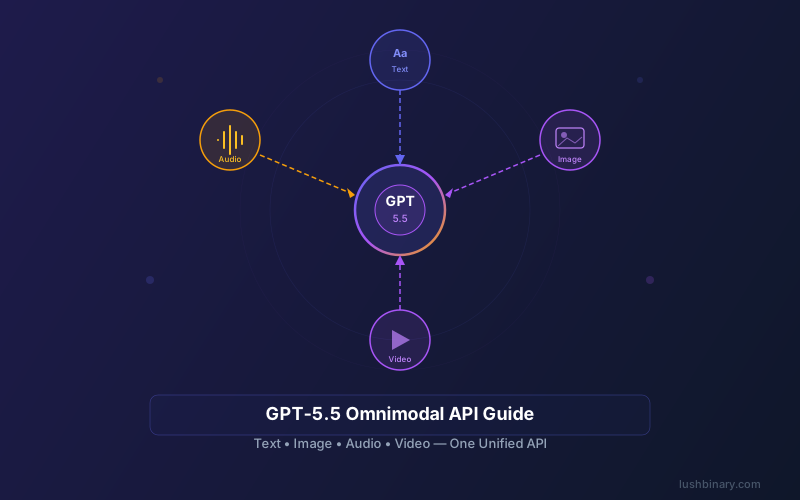
GPT-5.5 (codename "Spud") landed on April 23, 2026, and it represents a fundamental shift in how developers interact with AI models. This is the first fully retrained base model since GPT-4.5 — not another fine-tuned iteration. The headline feature: GPT-5.5 is natively omnimodal, processing text, images, audio, and video within a single unified system rather than bolting on modalities after the fact.
For developers, this changes the API integration story entirely. Instead of stitching together separate endpoints for vision, speech, and text, you're working with a model that understands cross-modal relationships inherently. A user can upload a video, ask a question about it in voice, and get a response that references specific visual frames — all through a single API call. Combined with a 400K token context window, companion models like gpt-image-2 and gpt-realtime-1.5, and OpenAI's push toward a unified "super-app," GPT-5.5 is the foundation for a new generation of multimodal applications.
This guide covers the practical side: how each modality works through the API, what the pricing looks like across text, image, audio, and video, how to architect cross-modal workflows, and where GPT-5.5 fits alongside competing models. For a broader look at GPT-5.5's coding and agentic capabilities, see our GPT-5.5 developer guide.
📋 What This Guide Covers
- What "Natively Omnimodal" Actually Means
- Text Generation: Improved Reasoning & Token Efficiency
- Image Understanding & Generation with gpt-image-2
- Audio & Voice: Real-Time Interactions with GPT-realtime-1.5
- Video Processing: Frame Analysis & Scene Understanding
- Cross-Modal Workflows: Combining Modalities
- API Architecture & Integration Patterns
- Pricing Breakdown Across Modalities
- Why Lushbinary for Omnimodal AI Applications
- FAQ
1What "Natively Omnimodal" Actually Means
The term "omnimodal" gets thrown around loosely, so let's be precise about what GPT-5.5 actually does differently. Previous models — including GPT-4o, GPT-5, and even GPT-5.4 — integrated different modalities after the fact. The base model was trained primarily on text, and then vision, audio, and other capabilities were layered on through additional training stages, adapters, or separate sub-models that fed into the main system.
GPT-5.5 was trained from scratch with all modalities present in the base training data. Text, images, audio, and video were part of the same training run from the beginning. This is a fundamentally different approach, and it shows up in how the model handles cross-modal reasoning.
💡 Key Distinction
"Multimodal" means a model can accept multiple input types. "Natively omnimodal" means the model was trained with all modalities from the ground up, so it understands the relationships between them inherently — not through post-hoc alignment. When GPT-5.5 analyzes a video with narration, it doesn't process the audio and video separately and then merge the results. It understands them as a unified signal.
In practical terms, this means GPT-5.5 can do things that were previously unreliable or required complex multi-model pipelines:
- Describe what's happening in a video while referencing the audio track, background music, and on-screen text simultaneously
- Generate images that match a spoken description with tonal and contextual nuance that text-only prompts miss
- Analyze a screenshot of a UI and generate both the code to reproduce it and a voice walkthrough explaining the design decisions
- Process a meeting recording and produce a summary that references both what was said and what was shown on shared screens
This native integration is also why GPT-5.5 outperforms competitors on front-end design automation and SVG generation — it understands the visual output it's creating at a deeper level than models that treat vision as a separate capability. OpenAI is also building a unified "super-app" that merges ChatGPT, Codex, and the Atlas browser agent, and GPT-5.5's omnimodal architecture is the technical foundation making that convergence possible.
2Text Generation: Improved Reasoning & Token Efficiency
Even if you're only using GPT-5.5 for text, the improvements over GPT-5.4 are substantial. As the first fully retrained base model since GPT-4.5, GPT-5.5 brings architectural changes that affect reasoning depth, instruction following, and — critically for API costs — token efficiency.
The token efficiency improvement is the most immediately impactful change for developers. GPT-5.5 uses significantly fewer tokens to complete the same tasks in Codex, which translates directly to lower API costs. If you're running GPT-5.4 workloads today, you can expect to see meaningful cost reductions just by switching models — even before optimizing prompts.
Text API Quick Start
import OpenAI from "openai";

const client = new OpenAI();

const response = await client.chat.completions.create({
  model: "gpt-5.5",
  messages: [
    {
      role: "system",
      content: "You are a senior software architect."
    },
    {
      role: "user",
      content: "Design a rate-limiting middleware for a
        Node.js API that supports sliding window
        counters with Redis."
    }
  ],
  max_tokens: 4096,
  temperature: 0.7,
});

console.log(response.choices[0].message.content);
Key improvements in text generation with GPT-5.5:
- Reduced token usage — the model produces more concise, accurate responses without sacrificing depth. Internal benchmarks show 15–30% fewer tokens for equivalent-quality outputs compared to GPT-5.4
- Better instruction following — GPT-5.5 handles ambiguous, multi-part prompts with less hand-holding. You can give it a messy task description and it will plan, execute, and self-correct
- 400K token context window — inherited from the GPT-5 family, this allows processing entire codebases, long documents, or extended conversation histories in a single call
- Improved reasoning chains — the retrained base model shows stronger performance on multi-step logical reasoning, mathematical proofs, and complex code generation
GPT-5.5 is available to Plus, Pro, Business, and Enterprise users through ChatGPT. API access is delayed pending additional safety work, but OpenAI has indicated it will be available "very soon." For developers already using the GPT-5.4 API ($2.50/1M input, $15/1M output), the migration path should be a straightforward model string swap once the API goes live.
3Image Understanding & Generation with gpt-image-2
GPT-5.5's image capabilities come in two flavors: native image understanding built into the base model, and state-of-the-art image generation through the companion gpt-image-2 model. Together, they create a complete vision pipeline — analyze existing images, reason about visual content, and generate new images — all through the OpenAI API.
Image Understanding (Vision)
Because GPT-5.5 was trained with images as part of the base data, its vision capabilities are significantly more nuanced than previous models. It doesn't just identify objects in an image — it understands spatial relationships, design intent, text rendering, and visual hierarchy. This is why it outperforms competitors on front-end design automation: give it a screenshot of a UI and it can generate pixel-accurate code, identify accessibility issues, and suggest design improvements.
// Image understanding with GPT-5.5
const response = await client.chat.completions.create({
  model: "gpt-5.5",
  messages: [
    {
      role: "user",
      content: [
        {
          type: "text",
          text: "Analyze this UI screenshot. Generate
            the Tailwind CSS + React code to reproduce
            it, and flag any accessibility issues."
        },
        {
          type: "image_url",
          image_url: {
            url: "https://example.com/dashboard.png",
            detail: "high"
          }
        }
      ]
    }
  ],
  max_tokens: 8192,
});
Image Generation with gpt-image-2
The gpt-image-2 model is OpenAI's state-of-the-art image generation system, and it pairs naturally with GPT-5.5's omnimodal understanding. Where previous image generation models required carefully crafted text prompts, gpt-image-2 benefits from GPT-5.5's ability to translate complex, multi-modal instructions into precise visual outputs. For a deep dive into gpt-image-2's capabilities and advanced techniques, see our ChatGPT Images 2 developer guide.
// Image generation with gpt-image-2
const image = await client.images.generate({
  model: "gpt-image-2",
  prompt: "A clean, modern SaaS dashboard showing
    real-time analytics with a dark theme, indigo
    accent colors, and a sidebar navigation. Include
    a line chart, metric cards, and a data table.",
  n: 1,
  size: "1024x1024",
  quality: "high",
});

console.log(image.data[0].url);
GPT-5.5's SVG generation capabilities deserve special mention. The model produces clean, semantic SVG code that's production-ready — not the bloated, path-heavy output you get from most AI image tools. This makes it particularly valuable for:
- Icon systems — generate consistent icon sets from text descriptions with proper viewBox, stroke widths, and accessibility attributes
- Data visualizations — create charts and diagrams as SVG that can be styled with CSS and animated with JavaScript
- UI illustrations — produce hero images, empty states, and decorative elements that scale perfectly and load instantly
- Architecture diagrams — generate technical diagrams with proper layout, labeling, and visual hierarchy
💡 gpt-image-2 Pricing
gpt-image-2 pricing: $5 per 1M input text tokens, $8 per 1M input image tokens, $30 per 1M output image tokens. For high-volume image generation workloads, consider batching requests and caching generated assets to manage costs.
4Audio & Voice: Real-Time Interactions with GPT-realtime-1.5
GPT-5.5's native audio understanding is complemented by gpt-realtime-1.5, OpenAI's most capable model for real-time voice interactions. While GPT-5.5 itself can process audio input and understand spoken content, gpt-realtime-1.5 is purpose-built for low-latency, bidirectional voice conversations — the kind of experience you need for voice assistants, customer support bots, and interactive tutoring systems.
The combination is powerful: GPT-5.5 handles the deep reasoning and cross-modal understanding, while gpt-realtime-1.5 handles the real-time voice interface. You can build applications where users speak naturally, the system understands context from previous visual or text interactions, and responds with natural-sounding speech — all with sub-second latency.
Real-Time Voice API Pattern
// Real-time voice with gpt-realtime-1.5
// Uses WebSocket for bidirectional streaming
import WebSocket from "ws";

const ws = new WebSocket(
  "wss://api.openai.com/v1/realtime"
    + "?model=gpt-realtime-1.5",
  {
    headers: {
      Authorization: `Bearer ${process.env.OPENAI_API_KEY}`,
      "OpenAI-Beta": "realtime=v1",
    },
  }
);

ws.on("open", () => {
  // Configure the session
  ws.send(JSON.stringify({
    type: "session.update",
    session: {
      modalities: ["text", "audio"],
      instructions: "You are a helpful voice
        assistant for a SaaS product. Be concise
        and friendly.",
      voice: "alloy",
      input_audio_format: "pcm16",
      output_audio_format: "pcm16",
      turn_detection: {
        type: "server_vad",
        threshold: 0.5,
      },
    },
  }));
});

// Stream audio chunks from microphone
ws.on("message", (data) => {
  const event = JSON.parse(data.toString());
  if (event.type === "response.audio.delta") {
    // Play audio chunk to speaker
    playAudioChunk(event.delta);
  }
});
Key audio capabilities and use cases:
- Voice-first applications — build Siri-like assistants that understand context from previous interactions and can reference visual content the user has shared
- Audio transcription & analysis — GPT-5.5's native audio understanding can transcribe, summarize, and extract action items from meetings, podcasts, and customer calls
- Multilingual voice — real-time translation and voice interaction across languages with natural prosody and intonation
- Accessibility features — voice-driven interfaces for users who can't interact with traditional text or visual UIs
- Customer support automation — voice bots that can look at a user's screen share, understand their issue, and walk them through a solution verbally
💡 gpt-realtime-1.5 Pricing
gpt-realtime-1.5 is priced at $32 per 1M audio input tokens and $64 per 1M audio output tokens. For cost optimization, use server-side voice activity detection (VAD) to minimize unnecessary audio processing, and cache common responses as pre-generated audio clips.
5Video Processing: Frame Analysis & Scene Understanding
Video is where GPT-5.5's natively omnimodal architecture shines brightest. Previous approaches to video understanding required extracting frames, running them through a vision model, separately transcribing the audio, and then combining the results in a text prompt. GPT-5.5 processes video as a unified signal — visual frames, audio track, on-screen text, and temporal relationships are all understood together.
This isn't just a convenience improvement. It fundamentally changes what's possible. The model can understand that a speaker is pointing at a specific chart while saying "this metric dropped 15% last quarter" — connecting the gesture, the visual reference, and the spoken content into a single coherent understanding. For a comparison of AI video generation tools, see our AI video generation comparison guide.
Video Analysis API Pattern
// Video analysis with GPT-5.5
// Extract frames and audio, send as multi-part input
const response = await client.chat.completions.create({
  model: "gpt-5.5",
  messages: [
    {
      role: "user",
      content: [
        {
          type: "text",
          text: "Analyze this product demo video.
            Identify the key features shown, any UX
            issues, and generate a summary with
            timestamps."
        },
        {
          type: "video_url",
          video_url: {
            url: "https://example.com/demo.mp4",
          }
        }
      ]
    }
  ],
  max_tokens: 8192,
});
Practical video processing use cases with GPT-5.5:
- Product demo analysis — upload a competitor's demo video and get a structured breakdown of features, UX patterns, and technical implementation details
- Content moderation — analyze user-uploaded videos for policy violations across visual content, audio, and on-screen text simultaneously
- Meeting summarization — process recorded meetings with screen shares, understanding both what was discussed and what was shown on screen
- Quality assurance — analyze screen recordings of user testing sessions to identify UX friction points, error states, and navigation patterns
- Training content generation — watch a tutorial video and generate written documentation, step-by-step guides, or quiz questions based on the content
💡 Video Processing Tip
For long videos, consider chunking into segments and processing them in parallel. GPT-5.5's 400K token context window is generous, but a 60-minute video with high frame sampling can exceed it. Use adaptive frame sampling — higher density during scene changes, lower during static segments — to maximize information within the token budget.
6Cross-Modal Workflows: Combining Modalities
The real power of GPT-5.5's omnimodal architecture emerges when you combine modalities in a single workflow. Instead of building separate pipelines for text, vision, and audio, you can create applications where information flows naturally across modalities — just like it does in human communication.
Here are the cross-modal workflow patterns that GPT-5.5 enables for the first time as a single-model solution:
Pattern 1: Visual-to-Code-to-Voice
A user uploads a wireframe sketch (image input), GPT-5.5 generates the React component code (text output), and then provides a voice walkthrough explaining the implementation decisions (audio output). This entire flow happens within a single model context — the voice explanation references specific visual elements from the wireframe and specific code patterns in the output.
// Cross-modal: Image → Code + Voice explanation
const response = await client.chat.completions.create({
  model: "gpt-5.5",
  messages: [
    {
      role: "system",
      content: "You are a senior frontend developer.
        Analyze the wireframe, generate React +
        Tailwind code, and provide an audio
        explanation of your design decisions."
    },
    {
      role: "user",
      content: [
        {
          type: "text",
          text: "Build this component. Explain your
            choices via voice."
        },
        {
          type: "image_url",
          image_url: {
            url: "data:image/png;base64,..."
          }
        }
      ]
    }
  ],
  modalities: ["text", "audio"],
  audio: { voice: "nova", format: "mp3" },
});

// Text response contains the code
const code = response.choices[0].message.content;
// Audio response contains the explanation
const audioB64 = response.choices[0].message.audio?.data;
Pattern 2: Video-to-Documentation
Process a product demo video and generate structured documentation that includes screenshots extracted from key moments, step-by-step instructions derived from the narration, and code snippets for any API calls shown on screen. The model understands the temporal flow and can organize the documentation in the order things were demonstrated.
Pattern 3: Audio-to-Visual-Report
Record a voice memo describing your quarterly results, and GPT-5.5 generates a visual report with charts, tables, and formatted text. Because the model understands the audio natively, it picks up on emphasis, uncertainty, and context that a transcription-first approach would miss. When you say "revenue was, well, not great this quarter," the model understands the hedging and can flag that metric for attention in the visual report.
Pattern 4: Multi-Modal Customer Support
A customer shares a screenshot of an error, describes the issue via voice, and the system analyzes both inputs together. GPT-5.5 correlates the visual error state with the spoken description, searches the knowledge base, and responds with a fix — either as text with annotated screenshots or as a voice walkthrough, depending on the user's preference.
🖼️ → 💻 Image to Code
Upload wireframes, mockups, or screenshots and get production-ready React, Vue, or HTML/CSS code with accessibility attributes.
🎥 → 📝 Video to Docs
Process demo videos into structured documentation with timestamps, screenshots, and step-by-step instructions.
🎤 → 📊 Voice to Reports
Dictate findings or data and receive formatted reports with charts, tables, and visual summaries.
📸 + 🎤 → 🔧 Multi-Modal Support
Combine screenshots and voice descriptions for context-aware troubleshooting and resolution.
7API Architecture & Integration Patterns
Building production applications with GPT-5.5's omnimodal capabilities requires a different architectural approach than text-only integrations. You're dealing with multiple input and output modalities, varying latency profiles, and significantly different cost structures per modality. Here's a production architecture that handles all of this.
Key architectural decisions for omnimodal integration:
- Input preprocessing — normalize media inputs before sending to the API. Resize images to optimal dimensions, sample video frames adaptively, and convert audio to the expected format (PCM16 for realtime, MP3/WAV for batch)
- Model routing by modality — route text-heavy tasks to GPT-5.5 directly, image generation to gpt-image-2, and real-time voice to gpt-realtime-1.5. Cross-modal tasks go to GPT-5.5 with appropriate modality flags
- Media asset caching — generated images and audio clips should be cached in S3 with CDN distribution. Don't regenerate the same asset twice — hash the input parameters and check the cache first
- Streaming for large outputs — use streaming responses for text and audio outputs. For image generation, implement webhook callbacks so your UI can show progress indicators
- Per-modality cost tracking — track token usage separately for text, image, and audio. The cost profiles are dramatically different (text is cheap, audio is expensive, images are in between), and you need visibility to optimize
Modality Router Implementation
// Omnimodal routing configuration
type Modality = "text" | "image" | "audio" | "video";

interface TaskRequest {
  inputModalities: Modality[];
  outputModalities: Modality[];
  requiresRealtime: boolean;
  contextTokens: number;
}

function routeToModel(task: TaskRequest) {
  // Image generation → gpt-image-2
  if (task.outputModalities.includes("image")
      && !task.inputModalities.includes("video")) {
    return { model: "gpt-image-2", endpoint: "images" };
  }

  // Real-time voice → gpt-realtime-1.5
  if (task.requiresRealtime
      && task.outputModalities.includes("audio")) {
    return {
      model: "gpt-realtime-1.5",
      endpoint: "realtime"
    };
  }

  // Everything else → GPT-5.5 (omnimodal)
  return {
    model: "gpt-5.5",
    endpoint: "chat/completions",
    modalities: task.outputModalities,
  };
}8Pricing Breakdown Across Modalities
One of the biggest practical considerations for omnimodal applications is cost. Each modality has a dramatically different pricing structure, and understanding these differences is critical for budgeting and architecture decisions. Here's the complete pricing picture for the GPT-5.5 ecosystem as of April 2026.
| Model | Input Cost | Output Cost | Notes |
|---|---|---|---|
| GPT-5.5 | Coming soon | Coming soon | API access pending safety work |
| GPT-5.4 (reference) | $2.50/1M tokens | $15.00/1M tokens | Text only; cached input $0.25/1M |
| gpt-image-2 (text in) | $5.00/1M tokens | $30.00/1M tokens | Text prompt → image output |
| gpt-image-2 (image in) | $8.00/1M tokens | $30.00/1M tokens | Image edit / variation workflows |
| gpt-realtime-1.5 | $32.00/1M tokens | $64.00/1M tokens | Audio input/output; real-time voice |
The cost disparity across modalities is significant. Audio through gpt-realtime-1.5 is roughly 13x more expensive per token than text through GPT-5.4, and image output through gpt-image-2 is 2x the cost of text output. This has direct architectural implications:
- Use text as the default — only route to audio or image modalities when the use case genuinely requires it. Don't generate voice responses for interactions that work fine as text
- Cache aggressively for media — generated images and audio clips are expensive to produce but cheap to store and serve. Cache everything with content-addressable hashing
- Implement token budgets per modality — set separate spending limits for text, image, and audio. A runaway audio generation loop can burn through budget 10x faster than a text loop
- Batch image generation — if you need multiple images, batch the requests rather than making individual calls. This reduces overhead and can improve throughput
- Use prompt caching for text — GPT-5.4 offers a 90% discount on cached input tokens. Expect similar savings with GPT-5.5. Cache system prompts and tool definitions to cut text input costs dramatically
💡 Cost Estimation Example
A typical omnimodal customer support interaction — user sends a screenshot (image input) + voice description (audio input), system responds with text + annotated image — might cost $0.02-0.05 per interaction at current gpt-image-2 and gpt-realtime-1.5 rates. At 10,000 interactions/day, that's $200-500/day in API costs. Caching common responses and using text fallbacks where possible can reduce this by 40-60%.
GPT-5.5 API pricing is listed as "coming soon" on the OpenAI pricing page. Based on the GPT-5.4 pricing structure and competitive pressure from Gemini and Claude, we expect GPT-5.5 text pricing to land in a similar range. The token efficiency improvements mean that even at the same per-token price, total cost per task should be lower. We'll update this section when official pricing is announced.
9Why Lushbinary for Omnimodal AI Applications
Building omnimodal applications is a different engineering challenge than text-only AI integrations. You're managing multiple API endpoints, wildly different cost profiles per modality, media processing pipelines, real-time streaming infrastructure, and safety guardrails that need to work across text, images, audio, and video. Lushbinary has been building production AI integrations since the GPT-4 era, and we've shipped multi-modal systems for enterprise clients across e-commerce, healthcare, fintech, and SaaS.
Here's what we bring to an omnimodal integration project:
- Omnimodal architecture design — we design the routing, preprocessing, and caching layers that make cross-modal workflows reliable and cost-effective in production
- Multi-model orchestration — GPT-5.5 for reasoning and cross-modal tasks, gpt-image-2 for generation, gpt-realtime-1.5 for voice — each used where it excels
- Cost optimization across modalities — media caching, adaptive quality settings, modality fallbacks, and per-modality token budgets to keep costs predictable
- Real-time infrastructure — WebSocket management, audio streaming, and low-latency media delivery for voice-first applications
- AWS deployment — production infrastructure with auto-scaling, S3 media storage, CloudFront CDN, and comprehensive monitoring
🚀 Free Consultation
Want to build an omnimodal application with GPT-5.5, gpt-image-2, and gpt-realtime-1.5? Lushbinary specializes in production AI integrations with multi-model routing, cost optimization, and safety guardrails across all modalities. We'll scope your project, recommend the right architecture, and give you a realistic timeline — no obligation.
10Frequently Asked Questions
What does 'natively omnimodal' mean in GPT-5.5?
Natively omnimodal means GPT-5.5 was trained from scratch to process text, images, audio, and video within a single unified system. Previous models like GPT-4o bolted on different modalities after initial training. GPT-5.5 understands cross-modal relationships inherently because all modalities were part of the base training data.
How do I use the GPT-5.5 API for image generation?
Image generation with GPT-5.5 uses the gpt-image-2 model through the OpenAI Images API. You send a text prompt via the /v1/images/generations endpoint and receive generated images. Pricing is $5 per 1M input text tokens, $8 per 1M input image tokens, and $30 per 1M output image tokens.
What is the context window size for GPT-5.5?
GPT-5.5 supports a 400K token context window, inherited from the GPT-5 family architecture. This allows processing of large documents, lengthy codebases, and extended multi-turn conversations within a single API call.
How much does the GPT-5.5 API cost?
GPT-5.5 API pricing is listed as 'coming soon' on the OpenAI pricing page. For reference, GPT-5.4 costs $2.50 per 1M input tokens and $15 per 1M output tokens. Related models include gpt-image-2 ($5/$8/$30 per 1M tokens for text input/image input/image output) and gpt-realtime-1.5 ($32 per 1M audio input, $64 per 1M audio output).
Can GPT-5.5 process video natively through the API?
Yes, GPT-5.5 processes video natively as part of its omnimodal architecture. It can analyze video frames, understand scene transitions, extract audio context, and reason across visual and auditory information simultaneously. This is a significant improvement over previous approaches that required separate models for each modality.
📚 Sources
- OpenAI Research — Introducing GPT-5.5
- OpenAI API Pricing — GPT-5.4, gpt-image-2, gpt-realtime-1.5
- OpenAI Platform — Image Generation Guide
- OpenAI Platform — Realtime API Guide
- OpenAI Platform — Vision Guide
- OpenAI — Codex Flexible Pricing for Teams
Content was rephrased for compliance with licensing restrictions. Pricing, benchmarks, and feature details sourced from official OpenAI announcements and documentation as of April 23, 2026. Pricing and availability may change — always verify on the vendor's website.
Ready to Build Omnimodal AI Applications?
From cross-modal workflows to production voice interfaces, Lushbinary builds AI integrations that ship. Let's talk about your GPT-5.5 omnimodal project.
Ready to Build Something Great?
Get a free 30-minute strategy call. We'll map out your project, timeline, and tech stack - no strings attached.
Prefer email? Reach us directly: