
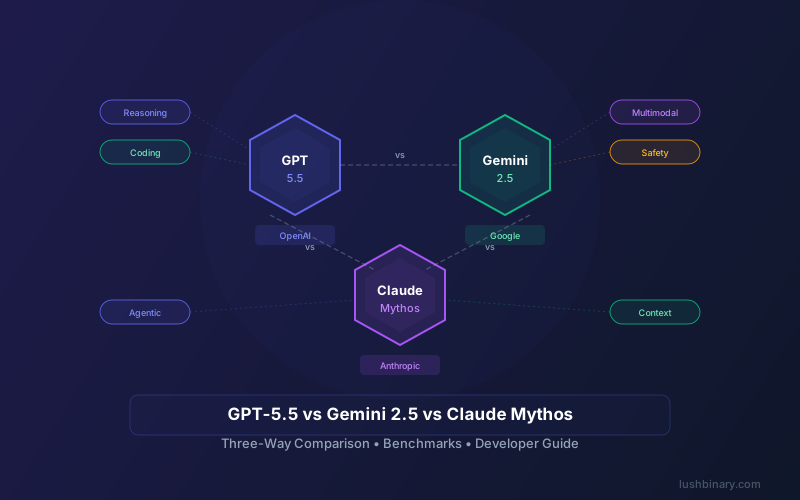
April 2026 reshaped the frontier model landscape in a single month. OpenAI launched GPT-5.5 (codename "Spud") on April 23 — the first fully retrained base model since GPT-4.5. Google shipped Gemini 3.1 Pro with doubled reasoning scores and a 2M token context window. And Anthropic dropped Claude Mythos Preview, which immediately claimed the top spot on SWE-bench Verified at 93.9%.
Three models, three different philosophies, three different strengths. GPT-5.5 bet on omnimodal architecture and agentic autonomy. Gemini 3.1 Pro doubled down on reasoning and cost efficiency. Claude Mythos went all-in on coding dominance and cybersecurity. The question isn't which one is "best" — it's which one is best for your specific workload.
This guide breaks down every dimension that matters: benchmarks, coding performance, reasoning, multimodal capabilities, agentic workflows, pricing, and real-world decision frameworks. We'll also cover the multi-model routing strategy that the smartest engineering teams are already adopting.
What This Guide Covers
- The Three-Way Race: April 2026 Landscape
- Benchmark Head-to-Head Comparison
- Coding Performance: SWE-Bench, Terminal-Bench & Aider
- Reasoning & Knowledge: GPQA, ARC-AGI & GDPval
- Multimodal Capabilities Compared
- Agentic Workflows & Computer Use
- Pricing & Token Economics
- Decision Framework: Which Model for Which Task
- Multi-Model Routing Strategy
- Why Lushbinary for Multi-Model AI Architecture
1The Three-Way Race: April 2026 Landscape
The competitive dynamics in April 2026 are unlike anything the AI industry has seen. Anthropic's annual recurring revenue surged from $9B to $30B, fueled by enterprise adoption of Claude for coding and security workloads. OpenAI has been in "Code Red" mode since December 2025, responding to Claude's gains in the B2B segment with an aggressive release cadence that culminated in GPT-5.5. Google, meanwhile, quietly shipped Gemini 3.1 Pro with reasoning improvements that doubled its predecessor's ARC-AGI-2 score.
GPT-5.5 (codename "Spud") arrived on April 23, 2026 as the first fully retrained base model since GPT-4.5. This isn't another incremental fine-tune of the GPT-5 family — it's a ground-up rebuild with natively omnimodal architecture. Text, images, audio, and video are processed in a single unified system, not bolted on as separate modules. OpenAI designed it specifically for agentic multi-tool orchestration, and the benchmarks reflect that focus.
Gemini 3.1 Pro doubled the reasoning performance of Gemini 3.0 Pro on ARC-AGI-2, hitting 77.1%. It retained the 2M token context window that makes it the go-to model for massive document ingestion and long-form analysis. Google also expanded its agentic capabilities with code-based SVG animation, improved agentic workflows, and deeper Vertex AI integration for enterprise deployments.
Claude Mythos Preview entered the arena as Anthropic's most capable model yet, part of the new Capybara tier. Its 93.9% on SWE-bench Verified isn't just a new record — it's a significant gap over every other model. Anthropic paired it with Project Glasswing, an AI cybersecurity defense initiative that positions Mythos as the first frontier model purpose-built for security-critical workloads. Claude Opus 4.7, still available alongside Mythos, continues to deliver strong coding performance with SWE-bench scores in the high 80s%.
The Big Picture
Each company is optimizing for a different axis. OpenAI is betting on autonomous agents and omnimodal intelligence. Google is betting on reasoning depth and cost-efficient scale. Anthropic is betting on coding precision and cybersecurity. Understanding these strategic bets is the key to choosing the right model for your workload.
2Benchmark Head-to-Head Comparison
Benchmarks don't tell the whole story, but they're where every serious comparison starts. Here's how all three frontier models stack up across the evaluations that matter most for developers and enterprise teams. Green highlights indicate the leader in each category.
| Benchmark | GPT-5.5 | Gemini 3.1 Pro | Claude Mythos |
|---|---|---|---|
| SWE-bench Verified | ~85% | 80.6% | 93.9% |
| SWE-bench Pro | 58.6% | ~54% | ~68% |
| Terminal-Bench 2.0 | 82.7% | ~68% | ~74% |
| GDPval (Knowledge Work) | 84.9% | ~75% | ~79% |
| OSWorld-Verified | 78.7% | ~60% | ~66% |
| GPQA Diamond | ~93% | 94.3% | ~93% |
| ARC-AGI-2 | ~55% | 77.1% | ~60% |
| Tau2-bench Telecom | 98.0% | ~85% | ~91% |
| Context Window | 1M tokens | 2M tokens | ~200K tokens |
Key Takeaway
No single model dominates across the board. Claude Mythos leads coding (SWE-bench). GPT-5.5 leads agentic tasks (OSWorld, GDPval, Tau2-bench, Terminal-Bench). Gemini 3.1 Pro leads reasoning (ARC-AGI-2, GPQA Diamond) and context capacity (2M tokens). The optimal strategy depends entirely on your workload mix.
3Coding Performance: SWE-Bench, Terminal-Bench & Aider
Coding is the battleground where these three models diverge most sharply. Each excels at a different type of development work, and understanding those differences is critical for choosing the right tool.
Claude Mythos: The Code Quality Champion
Claude Mythos Preview's 93.9% on SWE-bench Verified is not a marginal improvement — it's a generational leap. For context, Claude Opus 4.7 scored in the high 80s%, and GPT-5.5 sits around 85%. Mythos resolves real-world GitHub issues with a consistency that no other model matches. It understands interconnected codebases, produces changes that pass existing test suites, and handles complex multi-file refactoring with remarkable precision.
Anthropic positioned Mythos as the model you reach for when code quality is non-negotiable. Its self-verification behavior — proactively checking output for logical faults before returning results — means fewer broken PRs and less back-and-forth during code review. For teams shipping production code where every merge matters, Mythos is the clear frontrunner.
GPT-5.5: The Autonomous Engineer
GPT-5.5's coding strength lies in autonomous workflow execution. Its 82.7% on Terminal-Bench 2.0 — which tests complex command-line workflows requiring planning, iteration, and tool coordination — is state-of-the-art. On SWE-bench Pro, it scores 58.6%, which is solid but trails Mythos significantly. Where GPT-5.5 shines is in the messy, multi-step engineering tasks that require navigating ambiguity, coordinating across tools, and keeping going without constant human guidance.
In Codex, GPT-5.5 uses significantly fewer tokens than GPT-5.4 for equivalent tasks while matching GPT-5.4's per-token latency. This token efficiency translates directly to lower costs and faster completion times for agentic coding workflows. Early testers reported that GPT-5.5 could merge branches with hundreds of frontend and refactor changes into a substantially changed main branch in a single shot.
Gemini 3.1 Pro: The Versatile Coder
Gemini 3.1 Pro scores 80.6% on SWE-Bench, placing it solidly in the frontier tier without leading it. Its real coding advantage is the 2M token context window, which lets it ingest entire codebases that would overflow other models. For large-scale code analysis, migration planning, and understanding sprawling monorepos, Gemini's context capacity is unmatched.
Google also introduced code-based SVG animation capabilities in Gemini 3.1 Pro, enabling it to generate interactive visual content programmatically. Combined with its Vertex AI integration, Gemini is particularly strong for teams already invested in the Google Cloud ecosystem who need a capable coding model at a lower price point.
Choose Mythos for:
- Complex multi-file refactoring
- Production-critical code generation
- GitHub issue resolution
- Code review automation
- Security-sensitive codebases
Choose GPT-5.5 for:
- Multi-step CLI workflows
- Autonomous coding with tools
- Large branch merges
- Codex-powered engineering
- Token-efficient batch tasks
Choose Gemini for:
- Whole-codebase analysis
- Migration planning
- Budget-conscious coding
- SVG/visual code generation
- Google Cloud integrations
4Reasoning & Knowledge: GPQA, ARC-AGI & GDPval
Reasoning benchmarks measure how well a model handles novel problems that require genuine understanding rather than pattern matching. This is where Gemini 3.1 Pro makes its strongest case.
Gemini 3.1 Pro's 77.1% on ARC-AGI-2 represents a doubling of Gemini 3.0 Pro's reasoning performance on this benchmark. ARC-AGI-2 tests abstract reasoning — the ability to identify patterns and apply them to novel situations without explicit training. This is the closest thing we have to measuring genuine "fluid intelligence" in AI systems, and Gemini's lead here is substantial.
On GPQA Diamond, which tests graduate-level scientific knowledge across physics, chemistry, and biology, Gemini 3.1 Pro leads at 94.3%. GPT-5.5 and Claude Mythos both score around 93%, making this a tight race. The practical difference at these levels is minimal — all three models can handle expert-level scientific reasoning with high reliability.
GPT-5.5 dominates on GDPval at 84.9%, which evaluates AI agents across 44 different occupations on real-world knowledge work tasks. This benchmark measures practical utility rather than abstract reasoning — can the model actually do the work that knowledge workers do? GPT-5.5's lead here reflects its design philosophy: optimized for getting real tasks done autonomously rather than solving abstract puzzles.
The pattern is clear. Gemini 3.1 Pro excels at abstract and scientific reasoning. GPT-5.5 excels at applied knowledge work. Claude Mythos sits between them on reasoning benchmarks but pulls ahead dramatically when the task involves writing or analyzing code. For research-heavy workloads requiring deep scientific reasoning, Gemini has the edge. For practical business automation, GPT-5.5 leads. For anything code-adjacent, Mythos wins.
5Multimodal Capabilities Compared
Multimodal processing — the ability to understand and generate across text, images, audio, and video — is where GPT-5.5's architectural advantage becomes most apparent.
GPT-5.5 is natively omnimodal. Text, images, audio, and video are processed in a single unified system, not separate modules stitched together. This architectural decision means GPT-5.5 can reason across modalities naturally — understanding a video while reading overlaid text while processing spoken narration, all in one pass. For applications that need to process mixed-media content (think: analyzing a recorded meeting with slides, or understanding a product demo video), GPT-5.5's unified architecture provides a qualitative advantage that's hard to replicate with bolt-on multimodal systems.
Gemini 3.1 Pro handles text, images, and video with its 2M token context window, making it capable of ingesting extremely long video content or massive image sets. Google's new code-based SVG animation capability adds a creative dimension — Gemini can generate interactive visual content programmatically, which is useful for data visualization, UI prototyping, and educational content. However, Gemini's multimodal processing is not as deeply integrated as GPT-5.5's native omnimodal architecture.
Claude Mythos focuses primarily on text and image understanding, with particular strength in code-related visual tasks like reading screenshots, understanding UI mockups, and analyzing architectural diagrams. Anthropic has not prioritized audio or video processing in the same way as OpenAI or Google, instead investing in depth of understanding within its supported modalities. For teams whose multimodal needs center on document and code analysis, this focused approach works well.
| Capability | GPT-5.5 | Gemini 3.1 Pro | Claude Mythos |
|---|---|---|---|
| Text Processing | ✓ | ✓ | ✓ |
| Image Understanding | ✓ | ✓ | ✓ |
| Audio Processing | ✓ Native | Limited | ✗ |
| Video Understanding | ✓ Native | ✓ | ✗ |
| Cross-Modal Reasoning | Unified | Modular | Text+Image |
| SVG/Visual Generation | Basic | Code-based Animation | Basic |
The bottom line: if your application processes mixed media (video calls, multimedia content, audio+visual workflows), GPT-5.5 is the only model with truly native support across all four modalities. If you need to process extremely long video or generate visual content programmatically, Gemini 3.1 Pro is the strongest option. If your multimodal needs are primarily text-and-image (which covers most developer workflows), all three models perform well, and the decision should be based on other factors.
6Agentic Workflows & Computer Use
Agentic AI — models that can plan, use tools, check their work, and operate autonomously — is the fastest-growing category in enterprise AI. All three models have agentic capabilities, but GPT-5.5 was designed for this from the ground up.
GPT-5.5 scores 78.7% on OSWorld-Verified, which measures whether a model can operate real computer environments autonomously — clicking buttons, navigating interfaces, filling forms, and coordinating across applications. It hits 98.0% on Tau2-bench Telecom for complex customer-service workflows requiring multi-step reasoning and tool use. And its 84.9% on GDPval demonstrates broad competence across 44 different occupations.
In Codex, GPT-5.5 handles engineering work ranging from implementation and refactors to debugging, testing, and validation. It generates documents, spreadsheets, and presentations. Combined with computer use capabilities, it can see what's on screen, click, type, navigate interfaces, and move across tools with precision. OpenAI reports that 85%+ of the company uses Codex with GPT-5.5 weekly across engineering, finance, comms, marketing, data science, and product management.
Gemini 3.1 Pro expanded its agentic capabilities with improved workflow orchestration through Vertex AI. Google's approach emphasizes structured agentic patterns — well-defined tool schemas, predictable execution flows, and tight integration with Google Cloud services. For teams building agents within the Google ecosystem (Cloud Functions, BigQuery, Vertex AI pipelines), Gemini's agentic integration is seamless. Its 2M token context window also means agents can maintain much longer conversation histories and working memory than competitors.
Claude Mythos takes a different approach to agentic work. Rather than competing on general-purpose computer use, Anthropic focused Mythos on cybersecurity-specific agentic workflows through Project Glasswing. This includes automated threat detection, vulnerability analysis, incident response coordination, and security audit automation. For security teams, this specialization is more valuable than general-purpose computer use. Claude's broader agentic capabilities (via Claude Code and the API) remain strong for coding-specific agent workflows.
Agentic Workflow Comparison
GPT-5.5 is the generalist agent — best for cross-functional automation, computer use, and knowledge work. Gemini 3.1 Pro is the structured agent — best for Google Cloud workflows and long-context agent memory. Claude Mythos is the specialist agent — best for coding automation and cybersecurity defense. Most production deployments will benefit from routing different agent tasks to different models.
7Pricing & Token Economics
Pricing is where the three-way comparison gets particularly interesting. The per-token rates vary dramatically, but the actual cost per completed task depends on token efficiency, retry rates, and context usage patterns.
| Model | Input / 1M | Output / 1M | Context | Best For |
|---|---|---|---|---|
| GPT-5.5 | Coming soon | Coming soon | 1M | Agentic tasks |
| GPT-5.4 (ref.) | $2.50 | $15.00 | 1M | Cost-effective general |
| Gemini 3.1 Pro | $1.25 | $10.00 | 2M | High-volume, long-context |
| Claude Mythos | Premium tier | Premium tier | ~200K | Critical coding |
| Claude Opus 4.7 | $5.00 | $25.00 | 1M | Complex coding |
Gemini 3.1 Pro is the clear winner on raw pricing. At $1.25 per million input tokens and $10 per million output tokens, it's 2-5x cheaper than the competition depending on the comparison. Combined with its 2M token context window, Gemini offers the best cost-per-capability ratio for high-volume workloads that don't require the absolute best coding or agentic performance.
GPT-5.5 API pricing is listed as "coming soon," but we can reference GPT-5.4 at $2.50/$15 per million tokens as a baseline. GPT-5.5 will likely command a premium, but OpenAI's emphasis on token efficiency is significant: if GPT-5.5 uses 30-40% fewer tokens than GPT-5.4 for equivalent tasks (as early reports suggest), the effective cost per task could be competitive despite higher per-token rates.
Claude Mythos sits in Anthropic's premium Capybara tier, with pricing expected to reflect its position as the top coding model. Claude Opus 4.7 at $5/$25 per million tokens provides a known reference point. For teams where coding quality directly impacts revenue (fewer bugs, faster shipping, less rework), the premium pricing can deliver positive ROI through reduced engineering time and higher code quality.
Cost Optimization Tip
Don't optimize for per-token cost alone. A model that costs 2x per token but completes tasks in half the tokens (fewer retries, more concise output) is actually cheaper. GPT-5.5's token efficiency improvements and Mythos's higher first-pass success rate both reduce effective cost per task. The cheapest model per token is rarely the cheapest model per completed task.
8Decision Framework: Which Model for Which Task
Rather than asking "which model is best," the right question is "which model is best for this specific task?" Here's a practical decision framework based on the benchmark data and real-world performance characteristics of each model.
| Task Type | Best Model | Why |
|---|---|---|
| Complex code generation & refactoring | Claude Mythos | 93.9% SWE-bench Verified, self-verification |
| Agentic multi-tool orchestration | GPT-5.5 | 78.7% OSWorld, 84.9% GDPval |
| Abstract reasoning & scientific research | Gemini 3.1 Pro | 77.1% ARC-AGI-2, 94.3% GPQA Diamond |
| Computer use & UI automation | GPT-5.5 | Native screen interaction, 78.7% OSWorld |
| Cybersecurity & threat analysis | Claude Mythos | Project Glasswing, security-focused design |
| Long-document analysis (100K+ tokens) | Gemini 3.1 Pro | 2M context window, lowest per-token cost |
| Multimodal (audio + video + text) | GPT-5.5 | Natively omnimodal architecture |
| Customer service automation | GPT-5.5 | 98.0% Tau2-bench Telecom |
| Budget-conscious high volume | Gemini 3.1 Pro | $1.25/$10 pricing, 2M context |
| CLI workflows & DevOps | GPT-5.5 | 82.7% Terminal-Bench 2.0 |
| Code review & security audit | Claude Mythos | Highest code quality, Glasswing security |
| SVG animation & visual content | Gemini 3.1 Pro | Code-based SVG animation capability |
The pattern that emerges is consistent: GPT-5.5 dominates agentic and autonomous workflows. Claude Mythos dominates coding and security. Gemini 3.1 Pro dominates reasoning, long-context, and cost-sensitive workloads. There is no single "best" model — there's only the best model for your specific task distribution.
For a deeper dive into the GPT-5.5 vs Claude comparison specifically, see our GPT-5.5 vs Claude Opus 4.7 head-to-head comparison. For the earlier three-way comparison that preceded Mythos, check out our Claude Mythos vs GPT-5.4 vs Gemini 3.1 Pro analysis.
9Multi-Model Routing Strategy
The smartest engineering teams in 2026 aren't choosing one model — they're building routing layers that send each task to the optimal model. Here's a practical three-model routing architecture.
// Multi-model routing pseudocode
function routeTask(task: Task): Model {
if (task.type === 'coding' && task.complexity === 'high')
return 'claude-mythos' // 93.9% SWE-bench
if (task.type === 'security' || task.type === 'code-review')
return 'claude-mythos' // Project Glasswing
if (task.type === 'agentic' || task.type === 'computer-use')
return 'gpt-5.5' // 78.7% OSWorld
if (task.type === 'multimodal' && task.hasAudioOrVideo)
return 'gpt-5.5' // Native omnimodal
if (task.contextLength > 1_000_000)
return 'gemini-3.1-pro' // 2M context
if (task.type === 'reasoning' && task.domain === 'scientific')
return 'gemini-3.1-pro' // 94.3% GPQA Diamond
if (task.budgetSensitive)
return 'gemini-3.1-pro' // $1.25/$10 pricing
return 'gpt-5.4' // Default: cost-effective general
}
The routing layer doesn't need to be complex. A simple classifier that examines the task type, complexity, context length, and budget constraints can route 80%+ of requests to the optimal model. The remaining edge cases can fall through to a sensible default (GPT-5.4 for cost-effectiveness, or GPT-5.5 for quality).
Key Routing Principles
- Route by task type, not by preference. Let the benchmarks guide routing decisions. Claude Mythos for coding, GPT-5.5 for agentic work, Gemini for reasoning and long-context.
- Implement fallback chains. If Claude Mythos is rate-limited or unavailable, fall back to Claude Opus 4.7 for coding tasks. If GPT-5.5 is unavailable, fall back to GPT-5.4 for agentic tasks.
- Monitor cost per completed task, not cost per token. A model that costs more per token but completes tasks in fewer attempts is often cheaper overall.
- Use cheaper models for simple tasks. Don't send a simple text classification to Claude Mythos when GPT-5.4 mini or Claude Haiku can handle it at 1/10th the cost.
- Cache aggressively. All three providers offer prompt caching with 50-75% discounts. For repeated patterns (system prompts, few-shot examples), caching is the single biggest cost lever.
For teams already running a two-model setup (typically GPT + Claude), adding Gemini 3.1 Pro as a third option for long-context and budget-sensitive tasks can reduce overall API costs by 20-40% without sacrificing quality on the tasks that matter most.
10Why Lushbinary for Multi-Model AI Architecture
Choosing between GPT-5.5, Gemini 3.1 Pro, and Claude Mythos is just the first decision. Building a production-grade multi-model routing system that classifies tasks intelligently, manages costs across three providers, handles failovers gracefully, and scales with your business requires deep expertise across all three ecosystems.
Lushbinary has shipped production integrations with every major frontier model — from GPT-5.5 to Claude Opus 4.7 to Gemini 3.1 Pro. We design multi-model routing architectures, optimize token costs across providers, implement safety guardrails, and deploy on AWS with proper monitoring, logging, and fallback chains.
Our approach starts with your workload. We analyze your task distribution, identify which tasks map to which model, build the routing layer, and instrument everything so you can see exactly what each model is costing you and how it's performing. No vendor lock-in, no guessing — just data-driven model selection that optimizes for both quality and cost.
🚀 Free Multi-Model Architecture Consultation
Not sure whether GPT-5.5, Gemini 3.1 Pro, Claude Mythos, or a multi-model routing setup is right for your project? Lushbinary will audit your workload, recommend the optimal model routing strategy across all three providers, and give you a realistic cost estimate — no obligation.
❓ Frequently Asked Questions
Which frontier model is best for coding in 2026: GPT-5.5, Gemini 3.1 Pro, or Claude Mythos?
Claude Mythos Preview leads coding benchmarks with 93.9% on SWE-bench Verified, making it the strongest choice for complex code generation and multi-file refactoring. GPT-5.5 excels at agentic coding workflows with 82.7% on Terminal-Bench 2.0 and strong token efficiency. Gemini 3.1 Pro scores 80.6% on SWE-Bench and offers the best value with its 2M token context window and lower pricing.
How does GPT-5.5 compare to Gemini 3.1 Pro and Claude Mythos on benchmarks?
GPT-5.5 leads on agentic benchmarks (84.9% GDPval, 78.7% OSWorld-Verified, 98.0% Tau2-bench Telecom). Gemini 3.1 Pro leads on reasoning (77.1% ARC-AGI-2, 94.3% GPQA Diamond). Claude Mythos leads on coding (93.9% SWE-bench Verified). Each model dominates a different category, making multi-model routing the optimal strategy.
What is Claude Mythos and how does it relate to Project Glasswing?
Claude Mythos Preview is Anthropic's latest frontier model in the Capybara tier, achieving 93.9% on SWE-bench Verified - the highest score of any model. Project Glasswing is Anthropic's AI cybersecurity defense initiative integrated with Mythos, providing advanced threat detection and security analysis capabilities.
Which model is cheapest for high-volume API usage?
Gemini 3.1 Pro is the most cost-effective at $1.25 per million input tokens and $10 per million output tokens, with a 2M token context window. GPT-5.4 offers a middle ground at $2.50/$15. GPT-5.5 API pricing is coming soon but is expected to be premium. For cost-sensitive workloads, a multi-model routing strategy that sends simple tasks to cheaper models is recommended.
Should I use one model or multiple models for my AI application?
Multi-model routing is the recommended approach for production applications. Route coding tasks to Claude Mythos, agentic workflows and computer use to GPT-5.5, long-context and budget tasks to Gemini 3.1 Pro, and simple queries to cheaper models like GPT-5.4 mini or Claude Haiku. This optimizes cost, quality, and latency across different task types.
Sources
- OpenAI — Introducing GPT-5.5
- OpenAI API Pricing
- Google DeepMind — Gemini 3.1 Pro
- Anthropic — Claude Models Documentation
- Anthropic — Claude Mythos Preview & Project Glasswing
- Google Cloud — Vertex AI Gemini Documentation
Content was rephrased for compliance with licensing restrictions. Benchmark data sourced from official OpenAI, Google DeepMind, and Anthropic publications as of April 2026. Pricing and benchmarks may change — always verify on the vendor's website.
Build With the Right AI Models
Whether you need GPT-5.5 for agentic workflows, Claude Mythos for precision coding, Gemini 3.1 Pro for cost-efficient reasoning, or a multi-model architecture that uses all three — Lushbinary will design, build, and deploy it.
Ready to Build Something Great?
Get a free 30-minute strategy call. We'll map out your project, timeline, and tech stack - no strings attached.
Prefer email? Reach us directly: