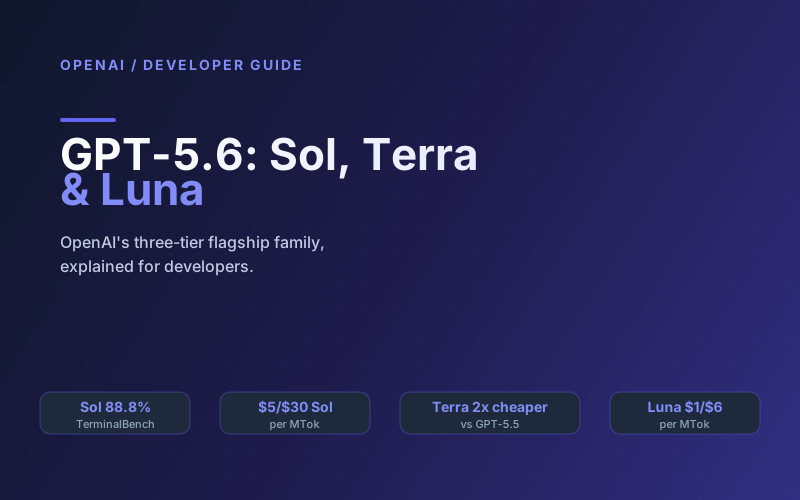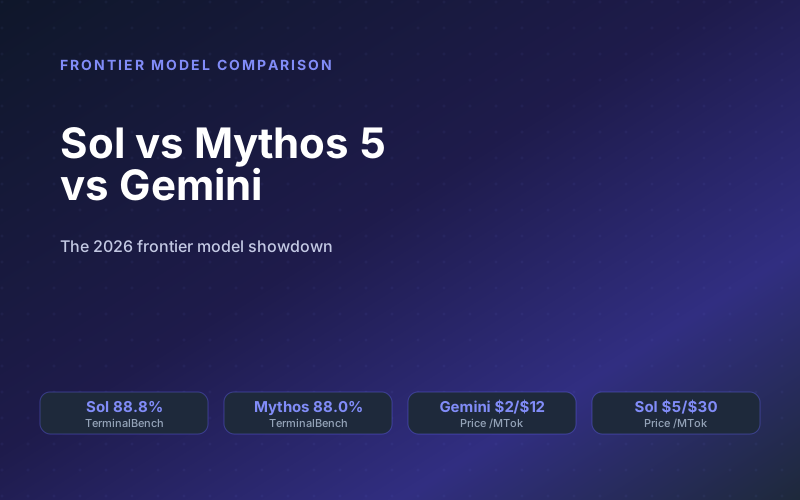

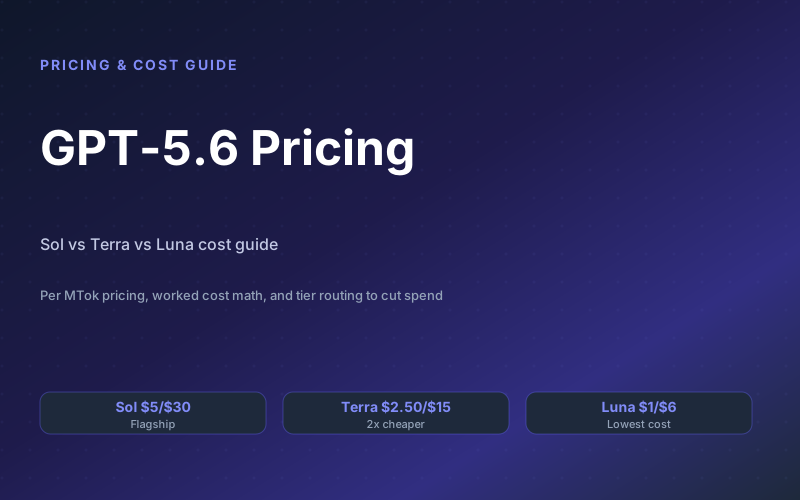

GPT-5.6 arrived on June 26, 2026 as a limited preview, and the headline most teams care about is not the benchmark chart, it is the bill. OpenAI shipped the model with three priced tiers: Sol at $5 input and $30 output per million tokens, Terra at $2.50 and $15, and Luna at $1 and $6. There is also a Sol Ultra compute-intensive mode that costs more than Sol, though OpenAI has not published an exact Sol Ultra price.
Picking the wrong tier is the fastest way to turn a reasonable AI feature into a runaway line item. The gap between the cheapest and most expensive priced tier is 5x on both input and output. That is the difference between a $25 per day workload and a $125 per day workload for the exact same token volume.
This guide gives you the full pricing table, the formula to compute your own spend, worked examples with the arithmetic shown, a tier-routing strategy that routinely cuts cost by more than half, and an honest comparison against Claude Fable 5, Claude Opus 4.8, and Gemini 3.1 Pro. Every number is either sourced or derived in front of you.
What This Guide Covers
- GPT-5.6 pricing at a glance: Sol, Terra, Luna, competitors
- How to read per-MTok pricing
- Worked cost examples with the formula
- Tier-routing strategy to cut cost
- Prompt and context efficiency tips
- When Terra beats Sol on value
- When Luna is enough
- Cost versus competitors
- Why Lushbinary for AI cost engagements
1GPT-5.6 Pricing at a Glance
Here is the full priced lineup alongside the relevant competitors, all in dollars per million tokens (per MTok). GPT-5.6 figures come from the June 26, 2026 limited preview announcement.
| Model / tier | Input ($/MTok) | Output ($/MTok) | Position |
|---|---|---|---|
| GPT-5.6 Sol | $5.00 | $30.00 | Flagship reasoning |
| GPT-5.6 Sol Ultra | Not published | Not published | Compute-intensive mode |
| GPT-5.6 Terra | $2.50 | $15.00 | Balanced, half of Sol |
| GPT-5.6 Luna | $1.00 | $6.00 | Lowest cost |
| Claude Fable 5 | $10.00 | $50.00 | Anthropic flagship |
| Claude Opus 4.8 | ~$5.00 | ~$25.00 | Near Sol on price |
| Gemini 3.1 Pro | $2.00 | $12.00 | Aggressive on price |
On capability, the TerminalBench 2.1 agentic coding numbers reported at launch line up roughly with price tier:
- Sol Ultra: 91.9 percent
- Sol: 88.8 percent
- Claude Mythos 5: 88.0 percent
- Luna: 82.5 percent
- Claude Opus 4.8: 78.9 percent
Preview caveat
GPT-5.6 shipped under a limited rollout. The US government requested a restricted preview and OpenAI complied, while warning that this is not the norm for future launches. Prices and access may shift as the preview widens, so treat these figures as a launch snapshot.
2How to Read Per-MTok Pricing
API pricing is quoted per million tokens, abbreviated per MTok. Two numbers matter: the input price you pay for everything you send (your prompt, system instructions, retrieved context, conversation history) and the output price you pay for everything the model generates. Output is almost always the more expensive axis, here 6x the input price on every GPT-5.6 tier.
Because the two axes are priced differently, your real cost depends on your input and output mix. A retrieval-heavy app that stuffs large documents into the prompt and asks for a short answer is input-dominant. A drafting or code-generation app that gets a short instruction and writes a long response is output-dominant. The single formula below captures both cases.
daily cost = T * (a * P_in + (1 - a) * P_out) / 1,000,000
T = total tokens per day
a = input fraction (so 1 - a is the output fraction)
P_in = input price per MTok
P_out = output price per MTok
The term in parentheses, a * P_in + (1 - a) * P_out, is your blended price per MTok. Compute it once for your traffic mix and every cost projection becomes a single multiplication.
3Worked Cost Examples
Take a concrete workload: 10,000,000 tokens per day at a 70 percent input and 30 percent output split (so a = 0.7). Here is the blended price and daily cost for each tier, with the arithmetic shown.
Workload: T = 10,000,000 tokens/day, a = 0.7
Sol: 0.7 * 5 + 0.3 * 30 = 3.5 + 9 = 12.5 per MTok
daily = 10,000,000 * 12.5 / 1,000,000 = $125.00/day
Terra: 0.7 * 2.5 + 0.3 * 15 = 1.75 + 4.5 = 6.25 per MTok
daily = 10,000,000 * 6.25 / 1,000,000 = $62.50/day
Luna: 0.7 * 1 + 0.3 * 6 = 0.7 + 1.8 = 2.5 per MTok
daily = 10,000,000 * 2.5 / 1,000,000 = $25.00/day
Over a 30-day month that is Sol at 125 * 30 = $3,750, Terra at 62.5 * 30 = $1,875, and Luna at 25 * 30 = $750. Same token volume, same workload, a $3,000 per month spread between the top and bottom priced tier.
The 2x ratio is not a coincidence
Terra is exactly half of Sol here, $62.50 versus $125, and Luna is one fifth, $25 versus $125. The Sol-to-Terra 2x ratio holds at any input and output split, because every Terra price is exactly half the matching Sol price. Halving both P_in and P_out halves the blended price for every value of a, so Terra is always half of Sol on the identical workload.
One more scenario to show the formula handles a different mix. Suppose a code-generation feature is output-dominant: the same 10,000,000 tokens per day but a 30 percent input and 70 percent output split (a = 0.3).
Workload: T = 10,000,000 tokens/day, a = 0.3
Sol: 0.3 * 5 + 0.7 * 30 = 1.5 + 21 = 22.5 per MTok
daily = 10,000,000 * 22.5 / 1,000,000 = $225.00/day
Terra: 0.3 * 2.5 + 0.7 * 15 = 0.75 + 10.5 = 11.25 per MTok
daily = 10,000,000 * 11.25 / 1,000,000 = $112.50/day
Note the same halving: Terra at $112.50 is exactly half of Sol at $225. Note also how much more an output-heavy mix costs, $225 versus $125 for the input-heavy version on Sol. Shifting work to be more input-bound, for example by asking for structured short answers instead of long prose, is itself a cost lever.
4Tier-Routing Strategy to Cut Cost
The single biggest savings lever is sending each request to the cheapest tier that can do the job, instead of defaulting everything to Sol. Most production traffic is a mix of easy and hard tasks, and the easy majority does not need flagship reasoning.
Suppose that same 10,000,000 tokens per day at the 70/30 input mix gets split by difficulty: 10 percent of volume genuinely needs Sol, 30 percent is fine on Terra, and 60 percent runs well on Luna. Here is the blended daily cost, using the per-tier blended prices computed above (12.5, 6.25, 2.5).
Sol 10%: 1,000,000 * 12.5 / 1,000,000 = $12.50/day
Terra 30%: 3,000,000 * 6.25 / 1,000,000 = $18.75/day
Luna 60%: 6,000,000 * 2.5 / 1,000,000 = $15.00/day
total = 12.50 + 18.75 + 15.00 = $46.25/day
versus all-Sol $125.00/day, a saving of $78.75/day (63 percent)
Over a 30-day month that routed mix is 46.25 * 30 = $1,387.50 against all-Sol at $3,750. The routing logic that delivers it is straightforward:
- Default to Luna. Make the cheapest capable tier your baseline, not your fallback.
- Escalate on signal. Promote a request to Terra or Sol only when a classifier, a confidence threshold, or a retry after a failed result says the task is hard.
- Reserve Sol Ultra. Keep the compute-intensive mode for the small set of genuinely hard agentic or long-horizon runs where the unpublished premium is worth it.
- Measure the mix. Track what fraction of traffic lands on each tier and revisit the split monthly. Workloads drift.
5Prompt and Context Efficiency Tips
Tier selection sets your unit price. Token discipline shrinks the unit count. Both multiply, so a team that routes well and trims tokens compounds the savings.
- Trim system prompts. A verbose system prompt is re-billed as input on every single turn. Cut repeated boilerplate and move stable instructions into a concise, reused template.
- Retrieve less, more precisely. Stuffing 20 documents into context when 3 would do is a direct input-cost multiplier. Tune retrieval to return fewer, higher-relevance chunks.
- Cap output length. Output is 6x input on every tier. Ask for structured, bounded responses instead of open-ended essays where the use case allows it.
- Summarize long histories. In multi-turn agents, replace the full transcript with a rolling summary so input does not grow without bound.
- Lean on reported efficiency gains. OpenAI reports GPT-5.6 is about 10 to 15 percent more token-efficient than GPT-5.5 on comparable tasks. Treat that as a reported figure, not a guarantee, and validate against your own traffic.
For a deeper treatment of context engineering and agentic workflows on the prior generation, see our GPT-5.5 developer guide, most of which carries over to 5.6.
6When Terra Beats Sol on Value
Terra is the default workhorse for most production traffic. Since it is exactly half the price of Sol on any mix, the question is simply whether Sol's extra reasoning depth changes the outcome enough to justify paying double. For a large share of real tasks it does not.
- Standard agentic loops with clear tools and well-scoped steps, where the bottleneck is orchestration, not raw reasoning.
- Customer-facing assistants answering grounded questions over your own documentation.
- Code edits and reviews on familiar codebases where the change is localized rather than architecture-level.
- Content and report generation from structured inputs, where quality is good enough and the 2x premium is pure margin loss.
The discipline is to A/B a slice of traffic on Terra versus Sol and look at outcome metrics, not vibes. If task success is statistically flat, Terra at half the cost is the correct default and Sol becomes the escalation path.
7When Luna Is Enough
Luna at $1 input and $6 output is one fifth of Sol's cost on the 70/30 example, and it still scored 82.5 percent on TerminalBench 2.1. For high-volume, well-bounded work that is plenty. Luna is the right call for:
- Classification, tagging, and routing of incoming requests
- Structured extraction from documents and forms
- Summarization and first-pass drafting before a human edit
- Bulk transforms, reformatting, and data cleanup at scale
- High-traffic chat where most turns are simple lookups
The trap to avoid is over-provisioning. Teams reach for the flagship because it feels safer, then pay 5x for tasks a cheaper tier handles identically. Start at Luna, measure where it actually fails, and escalate only those cases.
8Cost Versus Competitors
GPT-5.6 does not price in a vacuum. Here is how a single tier compares to the main alternatives on the same 10,000,000 tokens per day at the 70/30 input mix, with each blended price computed the same way.
| Model | Blended $/MTok (70/30) | Cost at 10M/day |
|---|---|---|
| Claude Fable 5 | 0.7*10 + 0.3*50 = 22.0 | $220.00/day |
| GPT-5.6 Sol | 0.7*5 + 0.3*30 = 12.5 | $125.00/day |
| Claude Opus 4.8 | 0.7*5 + 0.3*25 = 11.0 | $110.00/day |
| GPT-5.6 Terra | 0.7*2.5 + 0.3*15 = 6.25 | $62.50/day |
| Gemini 3.1 Pro | 0.7*2 + 0.3*12 = 5.0 | $50.00/day |
| GPT-5.6 Luna | 0.7*1 + 0.3*6 = 2.5 | $25.00/day |
The takeaways: Claude Fable 5 is the most expensive flagship by a wide margin. Sol lands just above Opus 4.8 on this mix ($125 versus $110), and the two are close enough that capability on your specific tasks should decide between them. Terra undercuts every flagship-tier option here, and Gemini 3.1 Pro plus Luna anchor the value end.
For a fuller head-to-head on the prior OpenAI generation against Anthropic and Google, see our Opus 4.8 vs GPT-5.5 vs Gemini cost and performance comparison.
9Why Lushbinary for AI Cost Engagements
At Lushbinary we treat AI API spend the way we treat cloud spend: as an engineering problem with a measurable answer. The difference between an all-Sol bill and a routed mix is often more than half your monthly cost, and capturing it is mostly disciplined plumbing.
- GPT-5.6 spend audits with per-feature and per-tier breakdowns
- Tier-routing layers that default to Luna and escalate to Terra, Sol, and Sol Ultra on real signals
- Prompt and context trimming to shrink token counts without hurting quality
- Cross-vendor routing across GPT-5.6, Claude, and Gemini so each task runs on the cheapest capable model
- Budget dashboards and alerts wired into your existing observability stack
Frequently Asked Questions
How much does GPT-5.6 cost per million tokens?
At launch GPT-5.6 has three priced tiers per million tokens: Sol at $5 input and $30 output, Terra at $2.50 input and $15 output, and Luna at $1 input and $6 output. There is also a Sol Ultra compute-intensive mode that costs more than Sol, but OpenAI has not published an exact Sol Ultra price yet. Pricing is sourced from the June 26, 2026 limited preview announcement and may change.
How do I calculate my daily GPT-5.6 cost?
Use daily cost = T * (a * P_in + (1 - a) * P_out) / 1,000,000, where T is total tokens per day, a is the input fraction, and P_in and P_out are the per-million-token prices. For 10,000,000 tokens per day at a 70 percent input and 30 percent output split on Sol, the blended price is 0.7 * 5 + 0.3 * 30 = 12.5, so daily cost is 10,000,000 * 12.5 / 1,000,000 = $125 per day.
Is Terra really half the cost of Sol?
Yes, and the 2x ratio holds at any input and output mix. Every Terra price is exactly half the matching Sol price ($2.50 is half of $5, $15 is half of $30). Because both halves of the blended price are scaled by one half, the blended Terra price is always half the blended Sol price regardless of the input and output split. On the same 10M token per day workload Terra is $62.50 per day versus Sol at $125 per day.
When is Luna good enough instead of Sol?
Luna fits high-volume, well-scoped work: classification, extraction, routing, summarization, first-pass drafting, and bulk transforms. On the 10M token per day example Luna costs $25 per day, one fifth of Sol at $125. Reserve Sol or Sol Ultra for the smaller slice of tasks that need top reasoning depth on hard agentic or long-horizon work.
How does GPT-5.6 pricing compare to Claude and Gemini?
Claude Fable 5 is roughly $10 input and $50 output per million tokens, Claude Opus 4.8 about $5 input and $25 output, and Gemini 3.1 Pro about $2 input and $12 output. GPT-5.6 Sol at $5 and $30 sits near Opus 4.8 on input and slightly above on output, Terra undercuts both on most mixes, and Luna is the cheapest of the named flagship-family options. Gemini 3.1 Pro remains very competitive on price.
What context window does GPT-5.6 support?
OpenAI has not officially confirmed the context window for GPT-5.6 during the limited preview. GPT-5.5 offered a 1M token context, so a similar window is expected but unconfirmed. Treat context length as provisional until OpenAI publishes the final model card.
Sources
- OpenAI: GPT-5.6 announcement and pricing
- The Verge: OpenAI's GPT-5.6 limited preview
- Wikipedia: GPT-5.6
Content was rephrased for compliance with licensing restrictions. Pricing and benchmark data sourced from official OpenAI announcements and reputable tech press as of June 27, 2026. Figures may change, always verify with the vendor.
Cut Your GPT-5.6 Bill in Half
Lushbinary audits your AI spend and wires tier routing across Sol, Terra, and Luna so every request runs on the cheapest capable tier. Tell us about your workload and we will map the savings.
Ready to Build Something Great?
Get a free 30-minute strategy call. We'll map out your project, timeline, and tech stack - no strings attached.
Prefer email? Reach us directly: