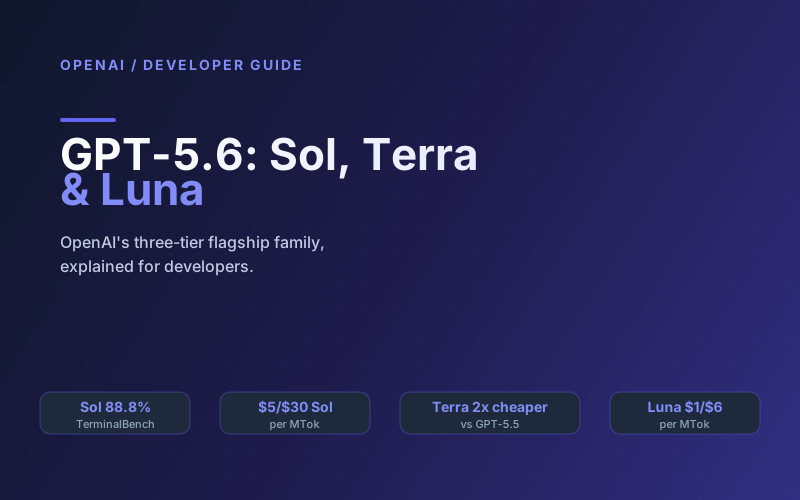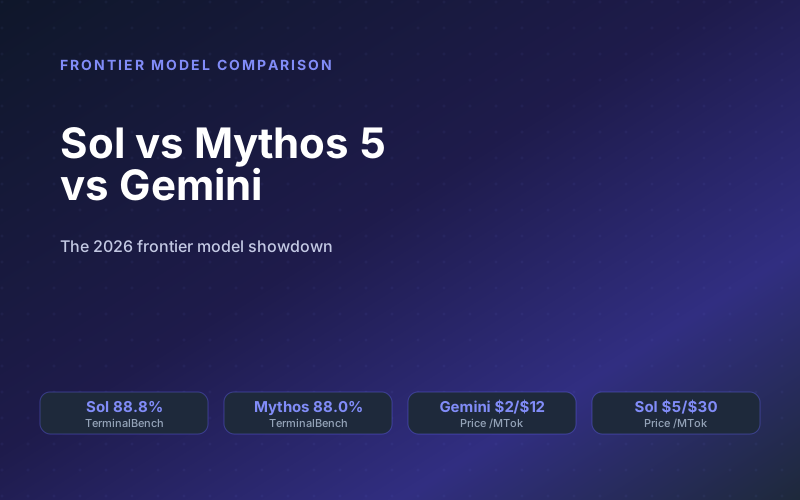

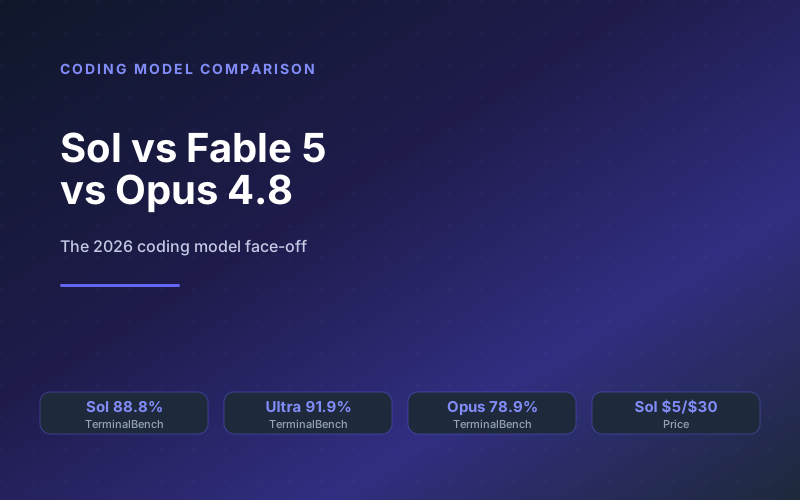

On June 26, 2026, OpenAI announced GPT-5.6 and its flagship coding mode, Sol, as a limited preview. The number that grabbed every engineering team's attention was 88.8% on TerminalBench 2.1, the benchmark that measures agentic, terminal-driven coding work. That put Sol at the top of the published coding leaderboard, ahead of Claude Opus 4.8 at 78.9% and competitive with the strongest models in the field.
This guide compares three models that real engineering teams are weighing for coding agents right now: GPT-5.6 Sol, Claude Fable 5, and Claude Opus 4.8. The focus is narrow and practical: agentic coding quality, long-horizon behavior, cost per task, context for large repositories, and whether you can actually call the model today. One note up front: the official TerminalBench 2.1 chart now scores Claude Fable 5 at 84.3%, tied with GPT-5.6 Terra, so we cite that published figure rather than a guessed one. We use only verified numbers and keep everything else qualitative or attributed.
The short version: Sol wins the benchmark, Opus 4.8 wins on availability and cost balance, and Fable 5 remains a strong coder that now carries the highest price tag of the three. Where you land depends on access, budget, and how autonomous your coding agents need to be.
What This Guide Covers
- The Three Coding Contenders: Quick Overview
- TerminalBench 2.1 Coding Results
- Agentic & Long-Horizon Coding Behavior
- Pricing & Cost Per Task
- Context Windows for Large Codebases
- Availability & Access Caveats
- Use-Case Decision Matrix
- Real-World Workflow Recommendations
- Why Lushbinary for Coding-Agent Strategy
1The Three Coding Contenders: Quick Overview
GPT-5.6 is OpenAI's newest line, following GPT-5.5. It ships in tiers: Sol is the flagship, Terra and Luna sit below it, and Sol Ultra is a compute-intensive mode that pushes benchmark scores higher at higher cost. Claude Fable 5 and Claude Opus 4.8 are both Anthropic coding models, with Opus 4.8 generally available and Fable 5 holding the premium price point.
| GPT-5.6 Sol | Claude Fable 5 | Claude Opus 4.8 | |
|---|---|---|---|
| Company | OpenAI | Anthropic | Anthropic |
| Role | Flagship coding mode | Premium coding model | Generally available premium |
| Public Access | Limited preview | Available | Generally available |
| TerminalBench 2.1 | 88.8% | 84.3% | 78.9% |
2TerminalBench 2.1 Coding Results
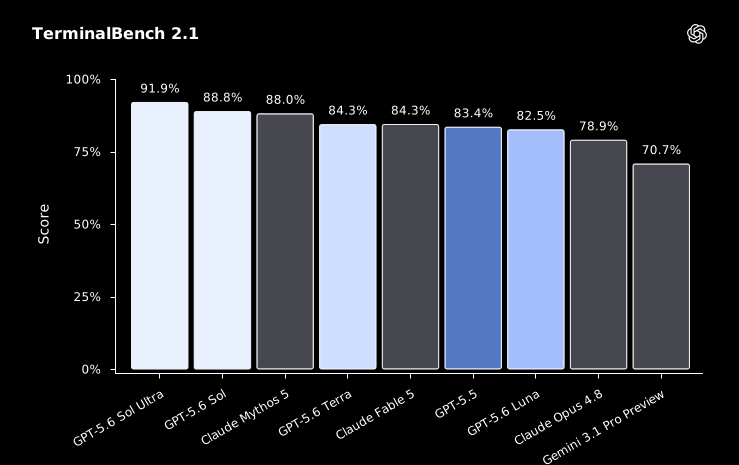
TerminalBench 2.1 tests agentic, terminal-driven engineering work: running commands, editing code, debugging, and completing multi-step tasks without a human in the loop. This is the benchmark OpenAI led with for Sol, and it is the most relevant published number for anyone building autonomous coding agents.
| Model | TerminalBench 2.1 |
|---|---|
| GPT-5.6 Sol Ultra | 91.9% |
| GPT-5.6 Sol | 88.8% |
| Claude Mythos 5 | 88.0% |
| GPT-5.6 Terra | 84.3% |
| Claude Fable 5 | 84.3% |
| GPT-5.5 | 83.4% |
| GPT-5.6 Luna | 82.5% |
| Claude Opus 4.8 | 78.9% |
| Gemini 3.1 Pro Preview | 70.7% |
Key Takeaway
Sol leads Claude Opus 4.8 by about 10 points on TerminalBench 2.1, which is a real gap on the hardest autonomous tasks. Sol Ultra stretches that to 91.9%, but that mode spends more compute per task. On the official TerminalBench 2.1 chart, GPT-5.6 Terra matches Claude Fable 5, both at 84.3%, so the two land in the same spot on this axis, well behind Sol but ahead of Opus 4.8 at 78.9%.
OpenAI also reports token efficiency gains of roughly 10 to 15% over GPT-5.5, framed as a reported improvement rather than an independently verified one. For coding agents that loop many times over a task, fewer tokens per step compounds into lower cost and faster runs. For a deeper look at the prior generation's autonomous coding setup, see our GPT-5.5 Codex autonomous coding agents guide.
3Agentic & Long-Horizon Coding Behavior
A benchmark score is a snapshot. What matters for production coding agents is how a model behaves across a long task: holding context, recovering from failed commands, and knowing when to stop. Here the three models have distinct personalities, even where published numbers run out.
- GPT-5.6 Sol: built for tool-using agentic chains. The TerminalBench 2.1 lead and the reported token-efficiency gains point to strong multi-step execution where the model issues commands, reads output, and adjusts. Sol Ultra raises the ceiling for the hardest tasks at higher compute cost.
- Claude Opus 4.8: a proven long-horizon coder with a confirmed 1M token context and prompt caching. At 78.9% on TerminalBench 2.1 it trails Sol, but its public availability makes it the model most teams can actually deploy in a long-running agent today.
- Claude Fable 5: a strong coding model that ties GPT-5.6 Terra at 84.3% on TerminalBench 2.1. It trails Sol on the benchmark but remains a credible choice for teams already standardized on it.
Practical Note
For autonomous agents that run unattended for many steps, raw benchmark wins matter less than reliability and access. A model you can call with a stable rate limit and a confirmed context window often beats a slightly stronger model locked behind a preview. That is the central tradeoff between Sol and Opus 4.8 right now.
4Pricing & Cost Per Task
Coding agents are token-hungry, so price per million tokens turns into real money fast. Sol is premium, but it undercuts Claude Fable 5 by roughly half, while Claude Opus 4.8 is priced close to Sol and cheaper on output.
| Model | Input (per MTok) | Output (per MTok) |
|---|---|---|
| GPT-5.6 Sol | $5 | $30 |
| GPT-5.6 Terra | $2.50 | $15 |
| GPT-5.6 Luna | $1 | $6 |
| Claude Opus 4.8 | ~$5 | ~$25 |
| Claude Fable 5 | $10 | $50 |
Per-token prices are abstract, so here is a worked cost-per-task example. Take a single long-horizon coding task that reads a chunk of a repository and writes a moderate amount of code: 200,000 input tokens and 40,000 output tokens. The cost formula is (input_tokens × P_in + output_tokens × P_out) / 1,000,000. Applying it to each model:
| Model | Price (in / out) | Cost per task | Note |
|---|---|---|---|
| GPT-5.6 Luna | $1 / $6 | $0.44 | Budget tier for simple edits |
| GPT-5.6 Terra | $2.50 / $15 | $1.10 | Mid tier, matches Fable 5 at 84.3% on TerminalBench 2.1 |
| Claude Opus 4.8 | ~$5 / ~$25 | $2.00 | Generally available premium tier |
| GPT-5.6 Sol | $5 / $30 | $2.20 | Flagship, limited preview |
| Claude Fable 5 | $10 / $50 | $4.00 | Highest priced of the group |
Cost Context
On this 200K-in / 40K-out task, Sol costs $2.20 and Claude Opus 4.8 costs $2.00, so they land within 10% of each other. Claude Fable 5 costs $4.00, roughly double Sol on the same workload, which matches the rule of thumb that Sol is about half the price of Fable 5. Output ratio matters: the more a task writes versus reads, the more Sol's $30 output rate works against it relative to Opus 4.8's $25. Recompute with your own token split before standardizing.
5Context Windows for Large Codebases
- GPT-5.6 Sol: context is not officially confirmed. GPT-5.5 offered up to 1M tokens, and GPT-5.6 is expected to match that, but treat the figure as unconfirmed until OpenAI states it. For large-repository agents, plan against the confirmed number you can verify, not the expected one.
- Claude Opus 4.8: confirmed 1M token context, with prompt caching to cut cost on repeated context. For agents that load a big slice of a codebase on every step, caching is a direct cost lever.
- Claude Fable 5: a capable large-context coder in the same Anthropic family. We avoid quoting a specific window we cannot verify here and recommend checking Anthropic's current model card before committing.
6Availability & Access Caveats
A benchmark you cannot call is just trivia. Access is the sharpest differentiator between these three coding models.
GPT-5.6 Sol
Limited preview as of June 26, 2026. The US government requested a limited rollout, which OpenAI followed while cautioning that restrictions should not be the norm.
Claude Opus 4.8
Generally available with public API access at about $5/$25. The most deployable of the three for coding agents that need stable access today.
Claude Fable 5
Available as Anthropic's premium coding model at $10/$50. Strong on coding, but the highest priced option in this matchup.
Regulatory Note
The US government requested a limited rollout for GPT-5.6. OpenAI complied while publicly warning that such restrictions should not become standard practice. For engineering teams, the lesson is to design coding agents around access that can change, with a generally available fallback like Opus 4.8 wired in from day one.
7Use-Case Decision Matrix
The right coding model depends on your constraints. Because Sol is a gated preview, the best choice often comes down to what you can actually access and how much you are willing to spend per task:
| Use Case | Best Model | Why |
|---|---|---|
| Hardest autonomous coding tasks | GPT-5.6 Sol (or Sol Ultra) | 88.8% TerminalBench 2.1, 91.9% in Ultra mode |
| Generally available premium coding | Claude Opus 4.8 | Public access at about $5/$25, 78.9% TerminalBench 2.1 |
| Long-running agents with big context | Claude Opus 4.8 | Confirmed 1M token context with prompt caching |
| Cost-sensitive coding at scale | GPT-5.6 Terra or Luna | $2.50/$15 and $1/$6 per MTok, Terra ties Fable 5 at 84.3% |
| Existing Claude Fable 5 workflows | Claude Fable 5 | Strong coding model, but priced highest at $10/$50 |
For the generally available matchup in more depth, our Claude Opus 4.8 vs GPT-5.5 benchmarks and pricing guide covers the public options, and our Claude Fable 5 vs GPT-5.5 vs Gemini 3.1 Pro comparison puts Fable 5 against the wider field.
8Real-World Workflow Recommendations
With the top coding models so close on quality and so different on price and access, committing to one model is the wrong default. A routing layer lets each coding request go to the model that fits its difficulty, budget, and availability.
- Default tier: run most coding-agent steps on Claude Opus 4.8. It is generally available, priced close to Sol, and ships a confirmed 1M context with caching.
- Cheap tier: route lint fixes, small edits, and boilerplate to GPT-5.6 Luna ($1/$6) or Terra ($2.50/$15) to control cost, since Terra matches Fable 5 at 84.3% on TerminalBench 2.1.
- Premium tier: reserve GPT-5.6 Sol, or Sol Ultra, for the hardest autonomous tasks once preview access opens up, and keep Opus 4.8 as the fallback when the gated model is unreachable.
- Measure cost per task, not per token: recompute the 200K-in / 40K-out style estimate with your real input/output split before you standardize, because output-heavy work shifts the ranking.
9Why Lushbinary for Coding-Agent Strategy
Picking a coding model is the easy part. Wiring it into a production coding agent with sensible routing, cost controls, a confirmed context budget, and a fallback for gated previews is the work that actually ships. Lushbinary helps engineering teams evaluate Sol, Fable 5, Opus 4.8, and the rest against real coding workloads, then build the routing and observability layer that keeps quality high and spend predictable.
Whether you are testing a limited-preview model or standardizing on a generally available one like Opus 4.8, we help you avoid lock-in and keep your coding agents productive as the frontier keeps moving.
Frequently Asked Questions
Which model is best for agentic coding in 2026?
On TerminalBench 2.1, GPT-5.6 Sol leads at 88.8%, with Sol Ultra reaching 91.9% in compute-intensive mode. GPT-5.6 Terra and Claude Fable 5 tie at 84.3%, and Claude Opus 4.8 scores 78.9%. For raw agentic coding, Sol is on top, but Opus 4.8 is the model you can actually call today.
How much does GPT-5.6 Sol cost compared to Claude Fable 5 and Opus 4.8?
Sol is priced at $5 input and $30 output per million tokens, roughly half the price of Claude Fable 5 at $10/$50. Claude Opus 4.8 sits at about $5/$25, which makes it slightly cheaper than Sol on output-heavy coding work and far cheaper than Fable 5. On a typical long-horizon coding task, Sol and Opus 4.8 land close together while Fable 5 costs noticeably more.
Can I use GPT-5.6 Sol for coding right now?
Not generally. GPT-5.6 launched June 26, 2026 as a limited preview, and the US government requested a limited rollout. OpenAI complied while warning that such restrictions should not become the norm. For teams that need access today, Claude Opus 4.8 is generally available, which often matters more than a few benchmark points.
What is the context window of GPT-5.6 for large codebases?
OpenAI has not officially confirmed a context window for GPT-5.6. GPT-5.5 offered up to 1M tokens, and GPT-5.6 is widely expected to match that, but treat the figure as unconfirmed until OpenAI states it. Claude Opus 4.8 offers a confirmed 1M token context with prompt caching, which is the safer bet for very large repositories today.
Is the Sol benchmark lead worth it over Opus 4.8 for real projects?
It depends on access and budget. Sol leads Opus 4.8 by about 10 points on TerminalBench 2.1, which is meaningful on the hardest autonomous tasks. But Sol is a gated preview and Opus 4.8 is public at a similar or lower price. For most production coding agents in mid 2026, Opus 4.8 is the practical pick, with Sol reserved for the hardest jobs once access opens up.
Sources
- OpenAI
- The Verge: OpenAI GPT-5.6 preview and the administration request
- MacRumors: OpenAI GPT-5.6 Sol
- Wikipedia: GPT-5.6
Content was rephrased for compliance with licensing restrictions. Pricing and benchmark data sourced from official OpenAI announcements and reputable tech press as of June 27, 2026. Figures may change, always verify with the vendor.
Build Coding Agents on the Right Model
Lushbinary helps engineering teams choose between Sol, Fable 5, and Opus 4.8, then build the routing, cost controls, and fallbacks that keep coding-agent workflows fast, reliable, and affordable.
Ready to Build Something Great?
Get a free 30-minute strategy call. We'll map out your project, timeline, and tech stack - no strings attached.
Prefer email? Reach us directly: