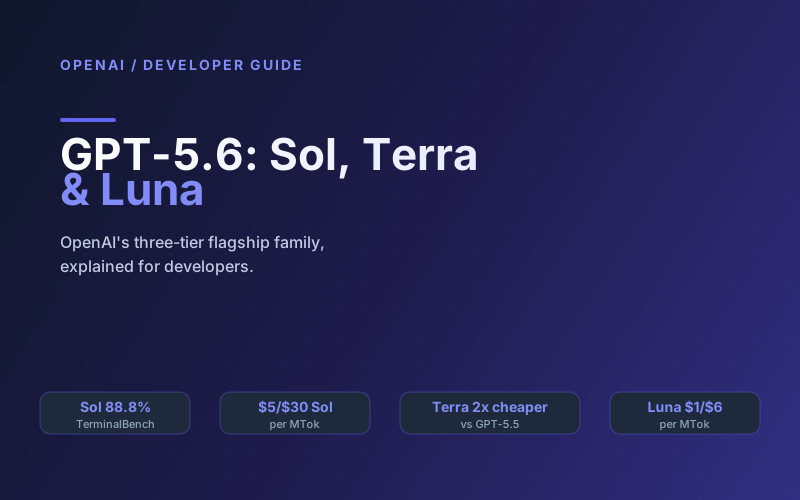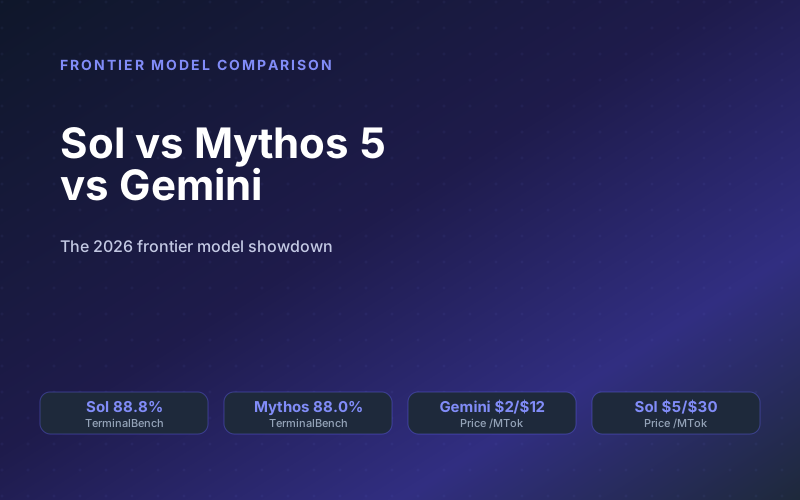

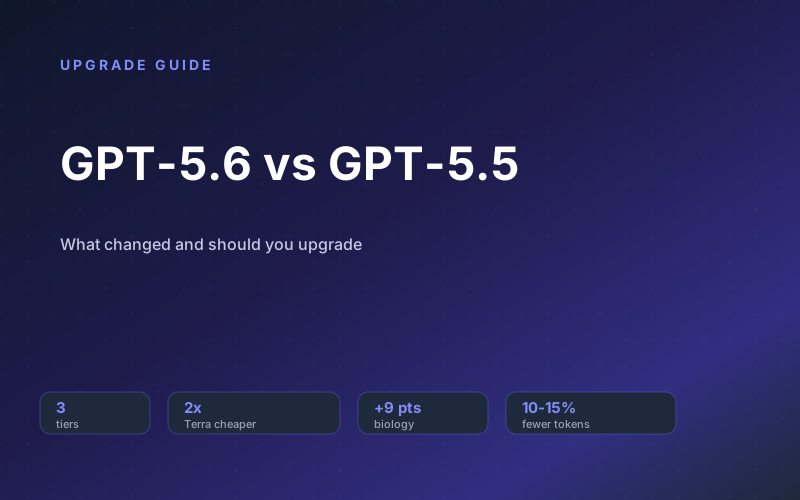

OpenAI announced GPT-5.6 on June 26, 2026, just over two months after GPT-5.5 landed on April 23. For teams already running GPT-5.5 in production, the obvious question is whether a point release this fast is worth the churn of re-validating prompts, evals, and cost models. The short answer: the economics and benchmarks make a compelling case, but availability is the real gate.
The headline change is structural. GPT-5.5 was effectively a single flagship with quality tiers. GPT-5.6 splits into three named models, Sol, Terra, and Luna, plus a compute-intensive Sol Ultra mode. That restructuring is not cosmetic: it lets you map workloads to a tier instead of dialing one model up and down, and the mid tier (Terra) is where most teams will find their savings.
This guide walks through what changed, the verified benchmark and pricing deltas, the limited-preview caveat you cannot ignore, and a concrete checklist for deciding whether to move now or wait.
The upgrade verdict in one paragraph
If you can get access, upgrade the cost-sensitive parts of your stack to Terra first: it targets GPT-5.5-class quality at roughly half the cost ($2.50 input, $15 output per million tokens). Reserve Sol and Sol Ultra for your hardest agentic and reasoning work, where the TerminalBench 2.1 gains matter. The one blocker is availability: GPT-5.6 is a limited preview after a US government request for a restricted rollout, so a full cutover may not be possible yet.
What This Guide Covers
1What Changed at a Glance
Before the deep dive, here is the side-by-side. The most consequential rows are the lineup structure and the mid-tier price, because together they change how you allocate spend.
| Dimension | GPT-5.5 | GPT-5.6 |
|---|---|---|
| Lineup | Single flagship with quality tiers | Three tiers: Sol, Terra, Luna, plus Sol Ultra mode |
| Released | April 23, 2026 | June 26, 2026 (limited preview) |
| Top output price | Up to $30 per million tokens | Sol at $30 per million tokens |
| Mid-tier value | Single price point | Terra at about half the cost for similar quality |
| TerminalBench 2.1 | Lower than Sol | Sol 88.8%, Sol Ultra 91.9% |
| Biology evaluations | Baseline | About 9 points higher (SecureBio) |
| Token efficiency | Baseline | Reported 10 to 15% better |
| Context window | 1 million tokens | Not officially confirmed, expected to match |
2The New Three-Tier Structure
GPT-5.5 asked you to take one capable model and trade quality for cost through configuration. GPT-5.6 gives you three distinct models, each with its own price and target workload. This is the change with the biggest day-to-day impact on architecture and budgeting.
- Sol is the new flagship for the hardest reasoning and agentic tasks, priced at $5 input and $30 output per million tokens.
- Terra is the mid tier, positioned as competitive with GPT-5.5 quality at roughly half the cost, at $2.50 input and $15 output per million tokens. Terra matches Claude Fable 5, both at 84.3% on TerminalBench 2.1, and edges the prior GPT-5.5 at 83.4%.
- Luna is the efficient tier at $1 input and $6 output per million tokens, for high-volume, lower-complexity calls.
- Sol Ultra is a compute-intensive mode that pushes Sol further on the hardest problems, at the cost of more compute per request.
The practical pattern is to route by task difficulty rather than flipping a single knob. If you previously ran one GPT-5.5 configuration everywhere, you can now send routine extraction and classification to Luna, your main product workloads to Terra, and your hardest autonomous coding to Sol or Sol Ultra. For background on how GPT-5.5 handled autonomous coding, see our GPT-5.5 Codex agents guide.
3Benchmark Gains: TerminalBench 2.1
TerminalBench 2.1 measures agentic, terminal-driven coding tasks, the kind of work that maps directly to autonomous engineering agents. Here is how the GPT-5.6 tiers land against notable competitors.
| Model | TerminalBench 2.1 |
|---|---|
| GPT-5.6 Sol Ultra | 91.9% |
| GPT-5.6 Sol | 88.8% |
| Claude Mythos 5 | 88.0% |
| GPT-5.6 Terra | 84.3% |
| Claude Fable 5 | 84.3% |
| GPT-5.5 | 83.4% |
| GPT-5.6 Luna | 82.5% |
| Claude Opus 4.8 | 78.9% |
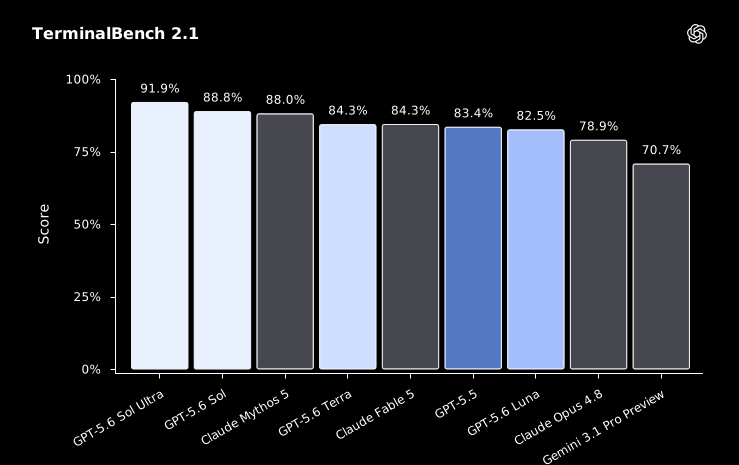
Sol at 88.8 percent edges past Claude Mythos 5 at 88.0 percent, and Sol Ultra extends the lead to 91.9 percent. Just as notable, the efficient Luna tier at 82.5 percent beats Claude Opus 4.8 at 78.9 percent, which means even the budget option is competitive on agentic coding. If you want the head-to-head against the prior OpenAI flagship, our Claude Opus 4.8 vs GPT-5.5 comparison sets the prior baseline.
4Biology and Safety Evaluation Gains
OpenAI reported gains on the SecureBio evaluation suite, with GPT-5.6 scoring about 9 points higher than GPT-5.5. These numbers reflect capability on biology-related reasoning, which is also why the rollout drew regulatory attention (covered below).
| SecureBio evaluation | GPT-5.6 |
|---|---|
| VCT | 53.5% |
| Molecular Biology | 60.0% |
| Human Pathogen Capabilities | 68.4% |
| World-Class Bio | 68.3% |
For most application developers these scores are not a direct buying signal, but they do explain the cautious launch. A roughly 9 point jump in sensitive-domain capability is exactly the kind of change that invites a measured rollout rather than a broad one.
5Reported Token Efficiency
Efficiency, framed as reported
OpenAI reports GPT-5.6 is about 10 to 15 percent more token efficient than GPT-5.5 on comparable tasks. This is a reported figure, not an independently verified one, so treat it as a directional gain and measure it on your own workloads before banking the savings.
Token efficiency compounds with the lower Terra price. If Terra both costs about half as much per token as GPT-5.5 and uses 10 to 15 percent fewer tokens to reach the same answer, the effective cost reduction on a fixed task is larger than the sticker price alone suggests. The honest caveat: efficiency gains are workload-specific, so validate against your real traffic rather than a vendor average.
6Pricing Changes
Pricing is where the upgrade case is strongest. GPT-5.5 reached up to $30 output per million tokens at its highest tier. GPT-5.6 keeps a $30 output ceiling at the Sol flagship but adds two cheaper tiers below it, including the GPT-5.5-class Terra.
| Model | Input / MTok | Output / MTok |
|---|---|---|
| GPT-5.6 Sol | $5 | $30 |
| GPT-5.6 Terra | $2.50 | $15 |
| GPT-5.6 Luna | $1 | $6 |
| Claude Fable 5 | $10 | $50 |
| Claude Opus 4.8 | ~$5 | ~$25 |
Terra is the story: at $2.50 input and $15 output per million tokens, it targets GPT-5.5-class quality for roughly half the cost, and Terra matches Claude Fable 5, both at 84.3% on TerminalBench 2.1, and edges the prior GPT-5.5 at 83.4%. Claude Fable 5 lists at $10 input and $50 output. Sol is the new top, matching the prior $30 output ceiling while Luna covers high-volume work at $1 input and $6 output. Against Claude Opus 4.8 at about $5 input and $25 output, the GPT-5.6 lineup gives you more granular cost control.
7Availability and the Limited Preview Caveat
Read this before planning a cutover
GPT-5.6 launched on June 26, 2026 as a limited release across ChatGPT and Codex. The US government requested a restricted rollout of all three tiers. OpenAI complied and publicly stated that such restrictions should not become the norm. Broad availability is not guaranteed, so confirm your access before scheduling a migration.
This is the single biggest reason a GPT-5.6 upgrade is not a simple drop-in today. The benchmarks and pricing argue for moving, but if you cannot reliably call the tiers you need at the scale you need, a phased plan beats a hard cutover. Track OpenAI announcements for when the preview widens, and keep your GPT-5.5 path warm as a fallback.
8Who Should Upgrade Now vs Wait
Upgrade now if
- You have preview access and a large GPT-5.5 spend that Terra could roughly halve.
- Your workload is dominated by agentic coding where the Sol and Sol Ultra TerminalBench gains pay off.
- You already have an eval harness to validate quality before shifting traffic.
Wait if
- You lack reliable preview access and cannot risk a partial rollout in production.
- You depend on a confirmed context window number that GPT-5.6 has not yet published.
- Your GPT-5.5 deployment is stable, cost is acceptable, and you have no pressing quality gap.
9Migration and Upgrade Checklist
When access is in hand, treat the move like any frontier-model migration: validate, route, and roll out gradually.
- Confirm tier access. Verify your account can call Sol, Terra, and Luna at the volume you need before planning a cutover.
- Map workloads to tiers. Route routine calls to Luna, mainline product traffic to Terra, and hardest reasoning or agentic work to Sol or Sol Ultra.
- Re-run your eval suite. Confirm prompt formats still parse and structured outputs still validate on each tier you adopt.
- Re-baseline cost. Measure real token usage to confirm the reported 10 to 15 percent efficiency gain on your own traffic, then recompute spend with Terra and Luna pricing.
- Do not hard-code a context window. The GPT-5.6 context window is unconfirmed, so avoid designing around a specific number until OpenAI states it.
- Keep GPT-5.5 as a fallback. Because GPT-5.6 is a limited preview, retain your GPT-5.5 path so a routing layer can fail back cleanly.
- Roll out gradually. Canary a slice of traffic, watch cost, latency, and quality dashboards, then ramp.
10Why Lushbinary for the Upgrade
A clean GPT-5.6 upgrade needs three things: eval coverage to catch regressions, a routing layer that maps workloads to Sol, Terra, and Luna, and a gradual rollout plan with a GPT-5.5 fallback while the preview is limited. Lushbinary has moved production workloads across every major frontier model and can plan your GPT-5.5 to 5.6 cutover so the savings land without surprises.
Free consultation
Weighing a GPT-5.6 move? Lushbinary will review your prompts, evals, and cost profile, map your workloads to the right tiers, and plan a safe migration with a GPT-5.5 fallback, no obligation.
Frequently Asked Questions
Should I upgrade from GPT-5.5 to GPT-5.6?
If you can get access, the value case is strong. The new Terra tier matches GPT-5.5 quality at roughly half the cost, Sol pushes benchmarks higher, and OpenAI reports about 10 to 15 percent better token efficiency. The catch is availability: GPT-5.6 launched June 26, 2026 as a limited preview after the US government requested a restricted rollout, so plan for staged access rather than an instant cutover.
What is new in GPT-5.6 compared to GPT-5.5?
GPT-5.6 replaces GPT-5.5's single flagship plus tiers with a three-tier lineup: Sol (top), Terra (mid, competitive with GPT-5.5 at about half the cost), and Luna (efficient), plus a compute-intensive Sol Ultra mode. Sol reaches 88.8 percent on TerminalBench 2.1 (91.9 percent with Sol Ultra) versus 88.0 percent for Claude Mythos 5, biology evaluation scores rise about 9 points over GPT-5.5, and reported token efficiency improves around 10 to 15 percent.
Is GPT-5.6 cheaper than GPT-5.5?
For comparable quality, yes. The Terra tier is priced at $2.50 input and $15 output per million tokens, which is about half the cost of GPT-5.5 at similar quality. The new top tier, Sol, lists at $5 input and $30 output per million tokens. Luna is the budget option at $1 input and $6 output. GPT-5.5 reached up to $30 output at its highest tier.
Can I use GPT-5.6 today?
Access is limited. GPT-5.6 shipped on June 26, 2026 as a limited release across ChatGPT and Codex. The US government requested a restricted rollout of all three tiers, OpenAI complied, and the company said publicly that such restrictions should not become the norm. Treat broad production availability as not yet guaranteed and verify your account access before committing.
Does GPT-5.6 keep the 1 million token context window?
GPT-5.5 shipped with a 1 million token context window. OpenAI has not officially confirmed the GPT-5.6 context window at launch. It is expected to match the prior generation, but that figure is unconfirmed, so do not design around a specific GPT-5.6 context number until OpenAI states it.
Sources
- OpenAI
- 9to5Mac - OpenAI upgrading ChatGPT and Codex with GPT-5.6 in limited release
- The Verge - OpenAI GPT-5.6 preview and government request
- TechCrunch - OpenAI limits GPT-5.6 rollout after government request
- Wikipedia - GPT-5.6
Content was rephrased for compliance with licensing restrictions. Pricing and benchmark data sourced from official OpenAI announcements and reputable tech press as of June 27, 2026. Figures may change, always verify with the vendor.
Plan Your GPT-5.6 Upgrade With Confidence
Lushbinary plans and runs your GPT-5.6 upgrade and migration, with tier routing, eval coverage, and a GPT-5.5 fallback so your cost and quality stay predictable.
Ready to Build Something Great?
Get a free 30-minute strategy call. We'll map out your project, timeline, and tech stack - no strings attached.
Prefer email? Reach us directly: