
Every September, a new iOS ships and every app owner asks the same question: do I need to do anything? After WWDC 2026 the honest answer is "a few things, and one of them is on a clock." iOS 27 will not break most apps overnight, but the platform shifted in ways that change what users expect and what Siri can do with your app.
This is a decision-maker's playbook, not a code tutorial. It translates the WWDC 2026 announcements into a prioritized list of what to do with your existing app, what it is likely to cost by scope, and what you can safely defer. If you want the deep engineering detail on any item, we link to the focused guides.
The short version: plan an App Intents migration before the SiriKit deprecation window closes, decide whether an on-device AI feature fits your product now that inference can be free, and budget a small compatibility and design pass for the refined Liquid Glass look.
On this page
1The timeline you are working against
Apple's release cadence gives you a predictable runway:
- June 8, 2026: Developer betas of iOS 27, iPadOS 27, macOS 27 Golden Gate, watchOS 27, tvOS 27, and visionOS 27 shipped.
- Mid-July 2026: Public beta expected, the point where your real users start running the new OS.
- September 2026: General release alongside the new iPhone lineup, when adoption ramps quickly.
iOS 27 supports the same devices as iOS 26, starting from the iPhone 11, so you are not losing a meaningful slice of your install base. The practical deadline for a polished update is the public beta in July, because that is when bug reports and reviews start reflecting how your app behaves on iOS 27.
2What to do, in priority order
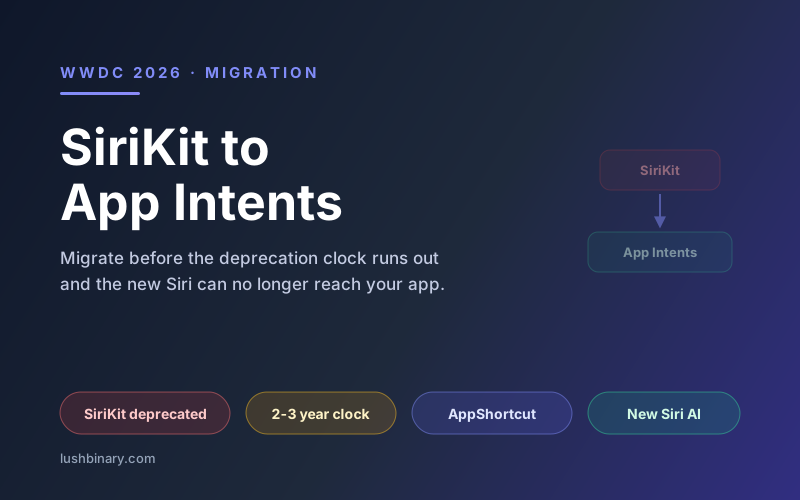
1. Plan the App Intents migration (highest priority). SiriKit is formally deprecated. The new reasoning-capable Siri can only call into apps that expose App Intents, and SiriKit-based voice integration is on a roughly two-to-three-year removal clock. This is the one item with a real deadline. The mechanics are in our SiriKit to App Intents migration guide.
2. Decide on an on-device AI feature. The economics changed enough that a feature you previously skipped on cost grounds may now be free to run. More on that below.
3. Run a compatibility and Liquid Glass pass. iOS 27 refines last year's Liquid Glass design rather than reinventing it, so this is polish, not a rebuild. Test your custom UI, controls, and any heavily styled screens against the new look.
4. Update widgets, Shortcuts, and Action button entries. These ride on App Intents too, so they improve as a byproduct of step one. For the full list of platform changes, see our WWDC 2026 developer overview.
3The new AI math for product owners
The reason AI features were risky to ship was cost. A popular feature on a per-token cloud API could quietly run up a large monthly bill before it proved its value. WWDC 2026 changed that calculus in two ways:
- On-device inference is free. The Foundation Models framework runs Apple's on-device model locally at no API cost, and it works offline.
- Cloud inference can be free too. Developers in the App Store Small Business Program with fewer than 2 million first-time downloads get Apple Foundation Models on Private Cloud Compute with no cloud API cost.
That means a summarize, draft, classify, or extract feature can ship at zero marginal inference cost for most apps. The question flips from "can we afford this?" to "does this make the product better?" We cover the details in our Private Cloud Compute guide and Foundation Models framework guide.
4What an iOS 27 update costs
The right number depends entirely on scope, from a light compatibility pass to a full App Intents migration plus a new AI feature. The breakdown below shows typical ranges for each level of work so you can budget realistically. Unlock it to see the detail.
Get Detailed Cost Breakdown
Fill in your details to unlock pricing and cost information.
5What you can safely defer
- A full UI redesign. iOS 27 is a refinement year for Liquid Glass, so a polish pass is enough; a rebuild can wait.
- Foldable layout work, unless you have a specific reason. The adaptive layout APIs are in the SDK, but no foldable iPhone has shipped, so adopting early is optional insurance, not a requirement.
- visionOS support, unless spatial computing is core to your product. It remains a focused, optional platform for most teams.
- Third-party frontier AI. Start with free on-device and Private Cloud Compute. Only reach for a paid Claude or Gemini route if the feature genuinely needs frontier capability.
6Plan your iOS 27 update with Lushbinary
Lushbinary helps app owners turn a WWDC announcement into a concrete, budgeted plan. We audit your app, flag the App Intents work that is on a deadline, identify AI features that now make sense at zero inference cost, and ship the update before adoption ramps in September. You get a prioritized roadmap, not a pile of optional ideas.
🚀 Free Consultation
Not sure what your app actually needs for iOS 27? We'll audit it, separate the must-do from the nice-to-have, and give you a scoped estimate with a realistic timeline and no obligation.
❓ Frequently Asked Questions
Do I need to update my app for iOS 27?
Most apps will keep running on iOS 27 without changes. The updates that matter are App Intents (required for the new Siri to use your app, with SiriKit deprecated), adopting the on-device AI features users now expect, and testing the refined Liquid Glass design. None are emergencies, but the App Intents migration is on a two-to-three-year clock.
When does iOS 27 release?
Developer betas began on June 8, 2026, the day of the WWDC keynote. A public beta is expected in mid-July 2026, with the general release anticipated in September 2026 alongside the new iPhone lineup. iOS 27 supports the same devices as iOS 26, starting from the iPhone 11.
How much does it cost to update an app for iOS 27?
It depends on scope. A compatibility pass and Liquid Glass polish is a small project. An App Intents migration plus a new on-device AI feature is a larger one. Unlock the cost breakdown in this article for typical ranges by scope, or request a free scoped estimate.
What is the biggest WWDC 2026 change for existing apps?
App Intents becoming the mandatory surface for Siri, with SiriKit deprecated. If your app exposes actions to Siri through SiriKit, those will eventually stop working with the assistant, and the new reasoning-capable Siri can only call into apps that expose App Intents.
Should I add AI features to my app now?
If your users would benefit, yes, because the cost dropped sharply. The Foundation Models framework gives free on-device inference, and qualifying small developers get free Private Cloud Compute access. That removes the per-token cost that used to make AI features risky to ship.
Sources
- Apple Newsroom - Apple unveils next generation of Apple Intelligence and Siri AI
- MacRumors - Apple Outlines Major AI and Developer Tool Updates
- The Verge - WWDC 2026: All the news from Apple's developers conference
Content was rephrased for compliance with licensing restrictions. Cost ranges are Lushbinary planning estimates based on typical project scopes and are not quotes. Release timelines and platform details sourced from official Apple materials and WWDC 2026 coverage as of June 2026, and may change - always verify on Apple's developer site.
Get a Scoped iOS 27 Update Plan
Tell us about your app and we'll send back a prioritized plan with a realistic budget and timeline.
Ready to Build Something Great?
Get a free 30-minute strategy call. We'll map out your project, timeline, and tech stack - no strings attached.
Prefer email? Reach us directly: