
For the last three years, "the latest AI trend" usually meant a new model with a bigger benchmark score. In 2026, the headline is different and far more consequential for anyone actually building software: AI stopped being a feature you bolt on and became an operating layer that plans, calls tools, and finishes work with limited supervision. The interesting questions are no longer "which model is smartest" but "how do I get an agent into production without it leaking data, burning my budget, or making a decision no one can audit."
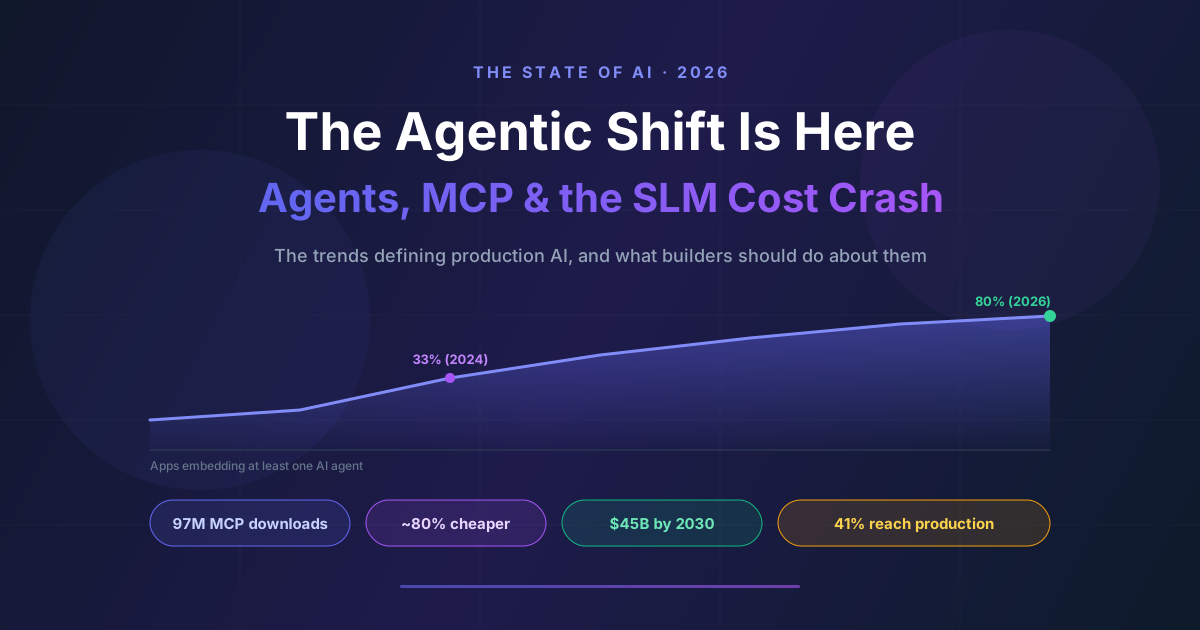
The data backs this up. Per Gartner, roughly 80% of enterprise applications shipped or updated in Q1 2026 embed at least one AI agent, up from about 33% in 2024. Yet industry surveys show only around 41% of those agent deployments actually reach production. That gap, between enthusiasm and shipped systems, is where the real 2026 story lives.
This guide cuts through the hype and covers the seven AI trends that genuinely matter for builders this year: the agentic shift, the rise of Model Context Protocol, small language models eating agentic workloads, multi-agent orchestration, the inference cost crash, reasoning and test-time compute, and the governance reckoning. For each, we give the numbers, the source, and the practical move you should make.
📋 Table of Contents
- The Agentic Shift: From Chatbots to Coworkers
- MCP: The USB-C of AI Tooling
- Small Language Models Eat Agentic Workloads
- Multi-Agent Orchestration Goes Mainstream
- The Inference Cost Crash
- Reasoning & Test-Time Compute
- The Governance Reckoning
- What Builders Should Actually Do in 2026
- Why Lushbinary for Your AI Build
- FAQ
1The Agentic Shift: From Chatbots to Coworkers
The defining trend of 2026 is the move from assistants that answer questions to agents that complete work. An agent plans a sequence of steps, calls external tools, observes the results, and adapts, all toward a goal you defined once. This is the difference between asking a model "how do I reconcile these invoices" and handing it the invoices, the accounting API, and the instruction to reconcile them.
The adoption curve is steep. Beyond Gartner's finding that around 80% of enterprise apps now embed an agent, an IBM study reported that more than 60% of CEOs say their organization is actively adopting AI agents. The market reflects the momentum too: the World Economic Forum cites projections of the agentic AI market reaching roughly $45 billion by 2030, up from about $8.5 billion in 2026.
💡 The signal under the hype
Adoption is near-universal, but production is not. The teams winning in 2026 are not the ones with the most agents, they are the ones who picked a small number of high-value workflows, instrumented them with evaluation and guardrails, and shipped. Breadth is easy. A single reliable agent in production is the hard, valuable thing.
If you are starting now, resist the urge to "agentify" everything. Pick one workflow with a clear success metric, a bounded set of tools, and a human checkpoint, and make that one rock solid before expanding.
2MCP: The USB-C of AI Tooling
If agents are the trend, the Model Context Protocol (MCP) is the plumbing that made the trend practical. Originally open-sourced by Anthropic in November 2024, MCP is a standard way for any AI model to connect to tools, data sources, and APIs through a single interface, replacing brittle, one-off integrations. Think of it as the USB-C port for AI: one connector, any device.
The growth has been extraordinary. By March 2026, MCP reached roughly 97 million monthly SDK downloads and more than 10,000 active server implementations, with backing from every major cloud provider and a governance structure under the Linux Foundation. When a protocol gets that kind of cross-vendor adoption that fast, it stops being a bet and becomes table stakes.
⚠️ The flip side: MCP is now an attack surface
Standardized tool access also standardizes risk. An agent that can call any MCP server is only as safe as the servers it trusts and the permissions you grant. Treat MCP connectors like you would any third-party integration: scope credentials tightly, audit tool calls, and never expose a write-capable server without explicit human approval in the loop.
If you build internal tools, exposing them over MCP is quickly becoming the way to make them usable by any AI client. We cover the build side in our MCP developer guide and the productization angle in our guide to shipping an MCP server as a SaaS.
3Small Language Models Eat Agentic Workloads
A counterintuitive 2026 trend: the model that runs most of your agent should probably be small. Agentic workloads are dominated by repetitive, narrow steps, classify this, extract that, decide the next tool, and those steps do not need a trillion-parameter frontier model. Small language models (SLMs) handle them faster, cheaper, and often with comparable accuracy on the specific task.
The economics are the whole point. A frontier model call can cost orders of magnitude more than a small-model call for the same token count. When an agent makes dozens of internal calls per user request, routing the easy ones to a small model is the difference between a demo and a sustainable product. The emerging best practice is a tiered routing layer: a small model handles the majority of steps and escalates only genuinely hard reasoning to a larger model.
We go deep on this pattern in our small language models for agentic AI cost guide and on routing mechanics in the LLM gateway and model routing guide.
4Multi-Agent Orchestration Goes Mainstream
Once a single agent works, the obvious next step is multiple agents that specialize and collaborate: a planner that breaks down the goal, workers that execute sub-tasks in parallel, and a critic that checks the output. In 2026 this moved from research demos to production architecture, and research on multi-agent reasoning has shown it can improve compute efficiency, not just raw quality, by letting smaller specialized agents divide work instead of one large model doing everything.
The trap is over-engineering. Multi-agent systems add coordination overhead, latency, and new failure modes (agents arguing in loops, duplicated work, context drift). Start with one agent. Add a second only when a clear specialization or parallelism win justifies it. Our multi-agent orchestration patterns guide covers the patterns that hold up in production.
5The Inference Cost Crash
One of the most builder-friendly trends of 2026 is that inference got dramatically cheaper. Industry trackers reported inference costs falling on the order of 80% for comparable capability over roughly a year, driven by more efficient model architectures, better serving stacks, open-weight competition, and hardware gains. What cost a fortune to run in 2024 is now affordable enough to put in the hot path of a consumer product.
The cost curve is not uniform, though. Frontier reasoning models that spend more compute at inference time can be expensive per request, while small and open-weight models have fallen the furthest. This is exactly why routing matters: the cost crash rewards architectures that send most traffic to the cheap tier and reserve the expensive tier for the few requests that need it.
✅ Practical move
Re-price your AI features at current rates before assuming a use case is too expensive. Estimates that killed a project in 2024 are often wrong by an order of magnitude in 2026. Build a quick cost model with today's per-token pricing and a realistic tier split before you decide.
6Reasoning & Test-Time Compute
The other half of the model story is reasoning. Instead of answering instantly, reasoning models spend extra compute "thinking" at inference time, exploring intermediate steps before they respond. This test-time scaling has become a primary axis of improvement, sometimes more impactful than making the base model bigger, and it is why agents handling multi-step tasks have gotten markedly more reliable.
The tradeoff is latency and cost: more thinking means more tokens and slower responses. The 2026 design pattern is to apply reasoning selectively, use a fast model for routine turns and switch on extended reasoning only for the hard planning or verification steps where it pays off. Treat "how much to think" as a tunable parameter, not an always-on setting.
Pairing reasoning with strong evaluation matters more than ever. A model that thinks longer can also be confidently wrong in more elaborate ways, which makes an eval-driven development workflow essential for catching regressions.
7The Governance Reckoning
Here is the trend that decides whether the others pay off. With agentic adoption above 80% of US enterprises but only around 41% of deployments reaching production, governance has become the leading reason projects stall. Once an AI system can take actions, not just generate text, the stakes change: a wrong action can delete data, send the wrong email, or make a financial commitment.
The teams getting agents to production treat governance as infrastructure, not paperwork. In practice that means:
- Guardrails on actions: explicit allow-lists for what an agent can do, human approval for anything destructive or irreversible
- Evaluation harnesses: automated tests that catch regressions before they ship, run on every prompt or model change
- Audit trails: every tool call, input, and decision logged so you can reconstruct what happened and why
- Scoped permissions: agents get the minimum access needed, with credentials that can be revoked instantly
- Clear ownership: a named human accountable for each agent in production
We have written practical playbooks for the two hardest pieces: production guardrails that prevent data loss and prompt injection defense, which is the attack that most often turns a helpful agent into a liability.
8What Builders Should Actually Do in 2026
Trends are only useful if they change what you build. Here is the short version of how these seven map to decisions:
| Trend | What to do about it |
|---|---|
| Agentic shift | Pick one high-value workflow and ship it well, not ten half-built ones |
| MCP | Expose internal tools over MCP, scope credentials, audit every call |
| Small models | Default to a small model, escalate to frontier only when needed |
| Multi-agent | Start with one agent, add specialists only when justified |
| Cost crash | Re-cost AI features at 2026 pricing before ruling them out |
| Reasoning | Turn on extended reasoning selectively for hard steps only |
| Governance | Build guardrails, evals, and audit logs from day one |
The through-line is discipline over hype. The technology is ready. The differentiator in 2026 is execution: scoping tightly, measuring relentlessly, and putting guardrails around anything that can take an action.
9Why Lushbinary for Your AI Build
Reading about trends is easy. Shipping an agent that survives contact with real users, real data, and a real budget is the hard part, and it is exactly what we do. Lushbinary has built production AI integrations since the GPT-4 era, across healthcare, fintech, SaaS, and e-commerce, and we bring the discipline that separates a demo from a system you can trust.
Here is how we help teams turn these trends into shipped product:
- Agent architecture: we scope the right workflow, design the tool layer over MCP, and build the orchestration so it is reliable, not just impressive in a demo
- Cost-aware model routing: small-model defaults with frontier escalation, so your unit economics work at scale
- Guardrails and evaluation: action allow-lists, prompt injection defense, audit logging, and eval harnesses that catch regressions before your users do
- AWS infrastructure: production deployment with VPC isolation, encryption, monitoring, and autoscaling that holds up under load
- Pragmatic roadmaps: we tell you which trends apply to your problem and which are noise for your use case
🚀 Free Consultation
Want to put one of these trends into production without the false starts? Lushbinary specializes in AI agents, MCP integrations, and cost-efficient AI infrastructure. We'll scope your project, recommend the right architecture, and give you a realistic timeline with no obligation.
10Frequently Asked Questions
What is the biggest AI trend in 2026?
The shift from chatbots to autonomous agents. Per Gartner, around 80% of enterprise applications shipped or updated in Q1 2026 embedded at least one AI agent, up from roughly 33% in 2024. The conversation has moved from whether to deploy agents to which workflows justify the operating overhead and governance.
What is Model Context Protocol (MCP) and why does it matter?
MCP is an open standard, originally released by Anthropic in November 2024, that gives AI models a universal interface to connect with tools, data sources, and APIs. It reached roughly 97 million monthly SDK downloads by March 2026 and is now governed under the Linux Foundation, making it the de facto integration layer for agentic AI, often described as the USB-C or HTTP of the agent era.
Are small language models replacing large language models in 2026?
Not entirely, but for agentic workloads small language models (SLMs) are taking over the high-frequency, narrow tasks because they are faster and far cheaper. The common 2026 pattern is a routing layer that sends most calls to a small model and escalates only hard reasoning steps to a frontier model, which can cut inference spend dramatically while keeping quality on the tasks that matter.
Why do most enterprise AI agent projects stall?
Governance, evaluation, and integration, not model quality. Industry data for 2026 indicates agentic AI adoption crossed 80% of US enterprises, yet only around 41% of deployments reached production. Projects stall on missing guardrails, weak evaluation harnesses, unclear ownership, and the difficulty of connecting agents safely to real systems.
How big is the agentic AI market expected to get?
The World Economic Forum cites projections that the agentic AI market could reach roughly $45 billion by 2030, up from about $8.5 billion in 2026. Growth estimates vary by analyst, but every major source points to a multi-fold expansion driven by enterprises moving agents from pilots into core workflows.
📚 Sources
- World Economic Forum - Agentic, Physical & Sovereign AI
- IBM - What Is an Agentic Enterprise?
- Model Context Protocol - Official Site
- CIO - Why Model Context Protocol Is on Every Executive Agenda
- Forrester - The State of Agentic AI in 2026
- arXiv - Multi-Agent Reasoning Improves Compute Efficiency
Content was rephrased for compliance with licensing restrictions. Adoption statistics, market projections, and MCP download figures sourced from official reports and vendor announcements as of June 2026. Figures vary by analyst and may change - always verify against the primary source before making decisions.
Ready to Ship Real AI, Not Another Demo?
From agentic workflows and MCP integrations to cost-efficient model routing, Lushbinary builds AI systems that hold up in production. Let's talk about turning these trends into your next launch.
Ready to Build Something Great?
Get a free 30-minute strategy call. We'll map out your project, timeline, and tech stack - no strings attached.
Prefer email? Reach us directly: