
The frontier-cloud narrative says agentic AI gets better as models get bigger. NVIDIA's own research disagrees. The argument, now backed by a wave of production deployments, is blunt: most agentic AI work in 2026 does not need a frontier model. It needs a small, fast, well-orchestrated model. The teams that internalize this early save dramatic amounts of money, latency, and complexity while shipping systems that are arguably more reliable.
Small language models, or SLMs, are having their moment because the economics are overwhelming and the capability gap on narrow tasks has closed. An agent that parses a command, calls a tool, and formats a response is doing work a 7B model handles perfectly. Paying frontier prices and frontier latency for that is waste. The interesting architecture is heterogeneous: small models for the repetitive bulk, a frontier model reserved for the genuinely hard steps.
This guide makes the case for SLMs in agentic systems, defines what counts as small, walks through where they win and where they do not, covers the leading models and hardware in 2026, and lays out a practical migration path from an all-frontier stack to a cost-aware hybrid. If you are running up an LLM bill on an agent that mostly does routine work, this is for you.
📐 What This Guide Covers
1What Counts as a Small Language Model
There is no official parameter cutoff, and chasing one misses the point. A useful working definition in 2026: a small language model is one that runs efficiently on a single GPU, a workstation, or even on-device, while still being capable enough for the task at hand. In practice that lands models roughly in the 1B to 35B parameter range, including dense models and compact mixture-of-experts designs where only a few billion parameters are active per token.
The label is about deployment footprint and latency, not raw size. A 27B model that NVIDIA reports outperforming previous-generation 120B and 400B counterparts is "small" in the way that matters: it fits on accessible hardware and answers fast. The capability bar for agentic tasks has dropped low enough that a model you can run yourself now does work that required a frontier API a year ago.
💡 The Definition That Matters
A model is "small" if you can deploy it on hardware you control, at the latency your product needs, without a per-token API bill. That operational definition predicts the economics better than any parameter count.
2The Case: Why SLMs Fit Agentic Workloads
NVIDIA researchers laid out the position directly in their paper "Small Language Models Are the Future of Agentic AI": SLMs are sufficiently powerful, inherently more suitable, and necessarily more economical for many invocations in agentic systems. The reasoning rests on what agents actually do all day.
Agentic work is dominated by repetitive, predictable, and highly specialized tasks: parsing commands, generating structured output, producing summaries, classifying intent, extracting fields, and routing to the next step. These are exactly the tasks SLMs handle well, and they can be fine-tuned to meet strict formatting and behavioral requirements far more reliably than a general-purpose giant told to "please return valid JSON." A specialized small model that always returns the right schema beats a frontier model that returns it ninety-eight percent of the time.
| Agent Task | Good Fit? | Why |
|---|---|---|
| Intent classification and routing | SLM | Narrow, high-volume, easy to fine-tune |
| Structured extraction and JSON output | SLM | Format adherence improves with fine-tuning |
| Tool calling on a fixed toolset | SLM | Predictable, repetitive, latency-sensitive |
| Summarization of bounded input | SLM | Well within small-model capability |
| Open-ended planning and decomposition | Frontier | Benefits from broad reasoning ability |
| Ambiguous reasoning, high cost of error | Frontier | Rare mistakes are expensive here |
There are operational advantages beyond capability. Small models can run on-device or on-premises, which keeps sensitive data inside your boundary and removes the cloud round-trip from your latency budget. Microsoft's Fara line, a 7B agentic model purpose-built for computer use via screenshots, is a concrete example: an agent that drives a browser without shipping every screen to a third-party API. For regulated industries, on-device inference is not just cheaper, it can be the only compliant option.
⚠️ Honest Caveat
SLMs are not a universal replacement. General conversational depth, broad world knowledge, and hard multi-step reasoning still favor frontier models. The NVIDIA position is heterogeneous systems, not small-only. The win is matching model size to task, not swapping everything for the smallest option.
3The Economics of Small vs Frontier
The cost argument is where the SLM case becomes hard to ignore. Consider an agent handling 1 million routine invocations per day, each consuming roughly 2,000 input and 500 output tokens. On a frontier model priced around $5 per million input and $25 per million output tokens, the math is:
Frontier model, 1M calls/day:
  input:  1,000,000 x 2,000 tokens = 2.0B tokens
  output: 1,000,000 x   500 tokens = 0.5B tokens

  input cost:  2,000 M-tokens x $5  = $10,000/day
  output cost:   500 M-tokens x $25 = $12,500/day
  -----------------------------------------------
  total: ~$22,500/day  (~$675,000/month)
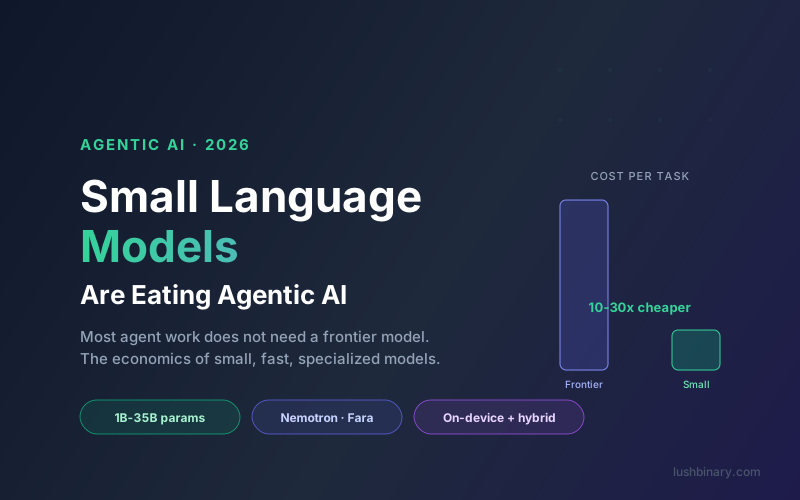
Now move the routine work to a self-hosted small model. The cost structure changes shape entirely: you pay for GPU time, not per token. A handful of GPUs serving a quantized SLM can sustain that volume for a fixed monthly hardware or instance cost in the low thousands, often one to two orders of magnitude cheaper than the per-token bill above. Even a hosted SLM endpoint, priced at a fraction of frontier rates, slashes the number. This is why analysts describe the SLM economics for repetitive agent tasks as a 10x-to-30x advantage.
💡 The Real Number to Track
Cost per successful task, not cost per token. A small model that costs a tenth as much but needs an occasional frontier fallback for hard cases still wins decisively on blended cost per completed task. Always compute the blended number for your actual task mix rather than comparing sticker prices.
Beyond dollars, smaller models cut latency and energy use. Faster responses improve the user experience for interactive agents, and lower power draw matters at scale. For a deeper look at controlling LLM spend across a whole stack, see our LLM gateway and model routing guide.
4Leading SLMs and Hardware in 2026
The open-weight SLM landscape matured fast. The notable families and purpose-built agentic models in 2026 include:
- NVIDIA Nemotron - the Nemotron family of open models in Nano, Super, and Ultra sizes is positioned as an efficient, high-accuracy base for agentic applications, with the smaller sizes tuned to run on accessible hardware.
- Microsoft Fara - a 7B agentic model purpose-built for computer use via screenshots, designed to run on-device, with iterative releases pushing how far small models can drive real browser tasks.
- Qwen compact models - smaller members of the Qwen family, including compact mixture-of-experts variants, where reported results show recent small models matching or beating much larger previous-generation models on agentic tasks.
- Gemma - Google's open-weight family with sizes that fit edge and on-device deployment, covered in depth in our Gemma 4 edge deployment guide.
On hardware, the story is that capable agentic models now run on gear teams already have. NVIDIA highlights small models running on RTX PCs and workstation-class systems for accelerated local agentic AI. For on-device, the bar is even lower, with the smallest models targeting laptops and phones. The practical implication: you can prototype an SLM agent on a single workstation before committing to any cloud spend.
For self-hosting in production, the usual stack is a serving framework like vLLM or Ollama with quantized weights, sized to your throughput. Our best open-source LLMs for AI agents comparison walks through current model choices and deployment tradeoffs in detail.
5The Heterogeneous Architecture
The endgame is not small-only or frontier-only. It is a heterogeneous system that uses each model where it is strongest. A frontier model plans and handles the hard, ambiguous cases. Small models handle the high-volume specialized steps. A router decides which is which per request.
The router is the linchpin. It can be a tiny classifier model, a set of rules on task type, or a confidence threshold where the small model escalates to the frontier model when unsure. The escalation pattern is especially robust: try the cheap model first, and only pay for the expensive one when the cheap one signals low confidence. This keeps quality high while keeping the frontier share, and therefore the cost, small.
6Migrating From All-Frontier to Hybrid
You do not rip out your frontier model on day one. You move workloads over in priority order, measuring quality at each step.
- Profile your calls. Categorize every agent invocation by task type and volume. The highest-volume, most repetitive categories are your migration targets.
- Build an eval set. Capture real inputs and expected outputs for each target task. You cannot safely swap a model without a way to measure regression.
- Pilot a small model on one task. Pick the highest volume task, run a candidate SLM against the eval set, and fine-tune if needed to hit your format and accuracy bar.
- Add an escalation path. When the small model is uncertain, fall back to the frontier model. Log every escalation to tune the threshold.
- Expand by task. Move the next category over once the first is stable. Keep the frontier model for planning and the long tail of hard cases.
- Watch blended cost per task. Track the real number, not token prices, and confirm the savings are landing.
⚠️ Do Not Skip the Eval Set
The single most common SLM migration failure is swapping a model without measurement and discovering quality regressions in production. Build the eval harness first. Our eval-driven development guide covers exactly how.
7Why Lushbinary for SLM-Powered Agents
Moving from an all-frontier agent to a cost-aware hybrid is an engineering project: profiling, fine-tuning, building a router, standing up self-hosted inference, and proving quality holds. Lushbinary does this work. We build agentic systems that match model size to task, run small models on infrastructure you control, and reserve frontier calls for the cases that need them.
- Cost profiling and model selection - we find the workloads that are overpaying and pick the right small model for each
- Fine-tuning - we tune small models to your exact output format and behavior so they beat a general giant on your task
- Self-hosted inference - vLLM or Ollama deployments on AWS or on-premises, sized to your throughput and latency targets
- Routing and escalation - the hybrid architecture that keeps quality high while cutting cost
🚀 Free Consultation
Paying frontier prices for routine agent work? Lushbinary will profile your LLM spend, identify the workloads that should move to small models, and give you a realistic savings estimate and migration plan, with no obligation.
8Frequently Asked Questions
What is a small language model (SLM)?
A small language model is a language model small enough to run efficiently on a single consumer or workstation-class GPU, or even on-device, while still being capable enough for many tasks. In 2026 practice that usually means models in the roughly 1B to 35B parameter range. The label is about deployment footprint and latency, not a hard parameter cutoff.
Why are small language models a good fit for AI agents?
Most agentic work is repetitive and narrow: parsing commands, calling tools, producing structured output, summarizing, and routing. SLMs are well-suited to these specialized, predictable tasks, can be fine-tuned to strict formats, and cost far less per call. NVIDIA research argues SLMs are sufficiently powerful, more operationally suitable, and more economical for the majority of agent invocations.
Are small language models cheaper than frontier models?
Yes, often dramatically. Running a small model locally or on a modest GPU avoids per-token API pricing entirely, and even hosted SLM endpoints cost a fraction of frontier models. The economics for high-volume, repetitive agent tasks favor small models by a wide margin, which is why heterogeneous systems that mix SLMs with an occasional frontier call are becoming the default.
When should you still use a large frontier model?
Use a frontier model for open-ended reasoning, hard multi-step planning, ambiguous natural-language understanding, and tasks where a rare mistake is expensive. The practical pattern is heterogeneous: a frontier model handles planning and the hard cases, while small models handle the high-volume specialized steps.
What are examples of small language models for agents in 2026?
Notable examples include NVIDIA's Nemotron Nano models, Microsoft's Fara line of on-device computer-use agents, and compact open-weight models from the Qwen and Gemma families. Many run on NVIDIA RTX PCs or workstation hardware, enabling local agentic AI without sending data to a cloud API.
📚 Sources
- NVIDIA Research - Small Language Models Are the Future of Agentic AI
- NVIDIA Developer Blog - How Small Language Models Are Key to Scalable Agentic AI
- Microsoft Research - Fara-7B: An Efficient Agentic Model for Computer Use
- Harvard Business Review - The Case for Using Small Language Models
Content was rephrased for compliance with licensing restrictions. Model claims, parameter ranges, and research positions sourced from official NVIDIA, Microsoft, and HBR publications as of May 2026. Cost examples are illustrative calculations based on representative public pricing, always model your own task mix and verify current vendor pricing.
Cut Your Agent's LLM Bill
Lushbinary builds heterogeneous agent systems that use small models for the bulk of the work and frontier models only where they earn their cost. Let's talk about your stack.
Ready to Build Something Great?
Get a free 30-minute strategy call. We'll map out your project, timeline, and tech stack - no strings attached.
Prefer email? Reach us directly: