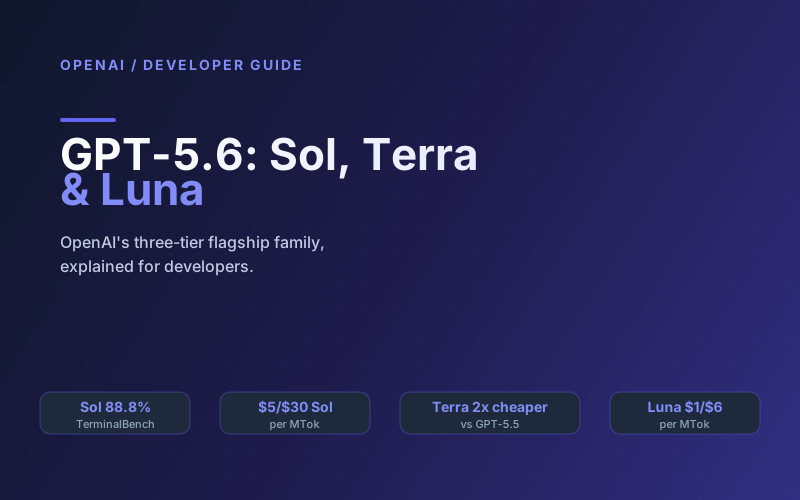


GPT-5.6 arrived on June 26, 2026 as a limited preview, reaching ChatGPT and Codex before the wider API. Instead of a single flagship, it ships as a family of tiers: Sol for the hardest work, Terra for balanced production traffic, and Luna for high-volume simple calls, plus a compute-intensive Sol Ultra mode for frontier runs. For teams already shipping on GPT-5.5, the upgrade is mostly a pricing and routing decision rather than a rewrite.
The headline reason to move is cost. GPT-5.5 charged up to $30 output per million tokens at its top tier. GPT-5.6 Terra lands at $2.50 input and $15 output, which OpenAI frames as competitive with GPT-5.5 at roughly two times lower cost, and Luna goes lower still at $1 and $6. OpenAI also reports token efficiency gains of about 10 to 15 percent over GPT-5.5, a figure worth confirming against your own traffic before you bank on it.
This guide is hands-on. It covers why to migrate, what actually changes in the API surface, how to map your current GPT-5.5 usage to the right 5.6 tier, working Python and TypeScript examples on the OpenAI SDK, a routing layer with a GPT-5.5 fallback, the eval work to do before cutover, the preview and regulatory caveats you cannot ignore, and a concrete rollout checklist.
Table of Contents
- Why Migrate: Tiers, Cost, and Gains
- What Changes in the API
- Tier Selection: Mapping From GPT-5.5 Usage
- Python Example on the OpenAI SDK
- TypeScript and JavaScript Example
- Fallback and Routing Across Tiers
- Testing and Eval Before Cutover
- The Limited-Preview and Regulatory Caveat
- Rollout Checklist
- Why Lushbinary for GPT-5.6 Migrations
1Why Migrate: Tiers, Cost, and Gains
GPT-5.5, released on April 23, 2026, ran as a strong single model with output priced up to $30 per million tokens at its top tier. GPT-5.6 breaks that into tiers so you pay for the capability each task actually needs instead of routing everything through one expensive endpoint. That is the core of the migration: you are not swapping one model for another, you are matching workloads to tiers.
There are three reasons the move pays off:
- Cost. Terra at $2.50 input and $15 output is positioned as competitive with GPT-5.5 at roughly two times lower cost. Luna at $1 and $6 is cheaper still for simple, high-volume calls. If most of your GPT-5.5 traffic was not truly frontier-level, a large share of it can move to Terra or Luna.
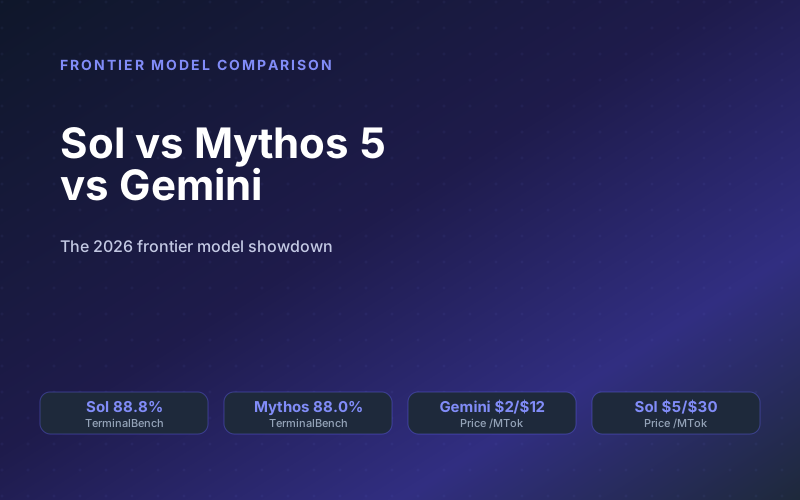
- Capability at the top. On TerminalBench 2.1, Sol scores 88.8 and Sol Ultra reaches 91.9, ahead of Claude Mythos 5 at 88.0, Luna at 82.5, and Claude Opus 4.8 at 78.9. The hardest agentic and coding tasks get a real lift when routed to Sol.
- Token efficiency. OpenAI reports roughly 10 to 15 percent better token efficiency over GPT-5.5. We frame that as a reported figure, not a measured guarantee. If it holds on your traffic, it compounds with the lower per-token price.
One number we are deliberately not quoting is the GPT-5.6 context window. GPT-5.5 offered up to 1M tokens, and a comparable window is expected for 5.6, but it is not officially confirmed during the preview. Do not hardcode a 5.6 context limit until the documentation states one.
2What Changes in the API
The request and response shapes carry over from GPT-5.5. You still use the OpenAI SDK, the same auth, and the same response handling. The thing that changes is the model identifier, and that is where care is required.
Model identifiers are not confirmed during preview
The exact GPT-5.6 API model id strings are not published publicly during the limited preview. Throughout this guide we use the clearly labeled placeholders gpt-5.6-sol, gpt-5.6-terra, and gpt-5.6-luna. Confirm the real strings in the OpenAI documentation and replace the placeholders before you ship.
The practical defense against an unconfirmed identifier is centralization. Put every model string in one config module so a single edit updates the whole codebase when the real ids land. Tiers map to three named roles:
- Sol (placeholder
gpt-5.6-sol): the top reasoning and agentic-coding tier, with Sol Ultra as a compute-intensive mode for the most demanding runs. - Terra (placeholder
gpt-5.6-terra): the balanced default for most production traffic. - Luna (placeholder
gpt-5.6-luna): the low-cost tier for high-volume, latency-sensitive, simpler calls.
3Tier Selection: Mapping From GPT-5.5 Usage
Audit your current GPT-5.5 calls and bucket them by what the task actually demands. Most teams find that a minority of calls need frontier reasoning and the majority are balanced or simple. Use this mapping as a starting point, then validate it with the eval pass in section 7.
| GPT-5.5 usage pattern | GPT-5.6 tier | Input / Output per MTok | Notes |
|---|---|---|---|
| Hard reasoning, agentic coding, long tool chains | Sol | $5 / $30 | Highest TerminalBench 2.1 score at 88.8 |
| Frontier runs needing maximum compute | Sol Ultra | Sol pricing, heavier compute | Compute-intensive mode, 91.9 on TerminalBench 2.1 |
| Balanced production traffic, most GPT-5.5 calls | Terra | $2.50 / $15 | Competitive with GPT-5.5 at roughly 2x lower cost |
| High-volume, latency-sensitive, simple calls | Luna | $1 / $6 | Cheapest tier, 82.5 on TerminalBench 2.1 |
A useful rule of thumb: start every workload on Terra, then promote to Sol only the tasks where your eval shows a measurable quality gap, and demote to Luna the tasks where Luna passes your checks. That keeps the expensive tier reserved for work that earns it.
4Python Example on the OpenAI SDK
A minimal call using the official OpenAI Python SDK. The model string is a placeholder, so confirm the real id before running this in production.
from openai import OpenAI

client = OpenAI()  # reads OPENAI_API_KEY from the environment

# NOTE: "gpt-5.6-terra" is a placeholder id for the limited preview.
# Confirm the exact GPT-5.6 model string in the OpenAI documentation
# before deploying, and keep it in one config module.
MODEL_TERRA = "gpt-5.6-terra"

response = client.responses.create(
    model=MODEL_TERRA,
    input="Summarize the steps to migrate a service from GPT-5.5 to GPT-5.6.",
)

print(response.output_text)
If your current code uses the chat completions interface, you can keep it and only change the model argument. Migrating to the responses interface is optional, not required for the tier change.
5TypeScript and JavaScript Example
The same call in TypeScript using the OpenAI Node SDK. JavaScript is identical once you drop the type annotations.
import OpenAI from "openai";

const client = new OpenAI(); // reads OPENAI_API_KEY from the environment

// Placeholder id for the preview. Confirm the real GPT-5.6 string
// in the OpenAI docs, then store all model ids in one config file.
const MODEL_TERRA = "gpt-5.6-terra";

const response = await client.responses.create({
  model: MODEL_TERRA,
  input: "Draft a rollout checklist for the GPT-5.6 migration.",
});

console.log(response.output_text);
Keep the model ids out of scattered call sites. A single models.ts or models.py that exports the tier strings means the day the real GPT-5.6 ids ship, you change one file and every request follows.
6Fallback and Routing Across Tiers
During the preview, availability is not guaranteed, so a routing layer that picks a 5.6 tier by difficulty and falls back to GPT-5.5 on failure is the safe pattern. This keeps you on the cheaper, better tiers when they are reachable and protects you from a hard outage when they are not.
import OpenAI from "openai";

const client = new OpenAI();

// All placeholder ids except the 5.5 fallback. Confirm 5.6 strings
// in the OpenAI docs. "gpt-5.5" stays as the safety net for the preview.
const TIERS = {
  hard: "gpt-5.6-sol",
  balanced: "gpt-5.6-terra",
  cheap: "gpt-5.6-luna",
  fallback: "gpt-5.5",
} as const;

type Difficulty = "hard" | "balanced" | "cheap";

export async function route(prompt: string, difficulty: Difficulty) {
  const order = [TIERS[difficulty], TIERS.fallback];
  for (const model of order) {
    try {
      return await client.responses.create({ model, input: prompt });
    } catch (err) {
      console.warn("model " + model + " failed, trying next tier", err);
    }
  }
  throw new Error("all tiers failed for this request");
}
Add a timeout and a small retry budget per tier so a slow Sol response does not block the fallback. Log which tier ultimately served each request, because that data is what tells you whether the preview is stable enough to retire the GPT-5.5 fallback.
7Testing and Eval Before Cutover
Do not promote any tier to production on price alone. Build a small eval set of 20 to 40 representative tasks from your real traffic: a hard reasoning case, an agentic coding job, a few balanced summarization or extraction calls, and several simple classifications. Write a deterministic check for each, then run GPT-5.5 and each candidate 5.6 tier across the set and compare pass rates and cost.
- Quality parity. For each task class, confirm the chosen tier matches or beats GPT-5.5 on your checks before you move production traffic to it.
- Cost per task. Record tokens in and out per task so you can verify the reported 10 to 15 percent efficiency gain and the tier price difference on your own workload, not in the abstract.
- Tier downgrade candidates. Any task class where Luna passes your checks is a candidate to move off Terra or Sol for a direct saving.
Eval before cutover, not after
The cheapest tier that passes your eval wins. Running the comparison before you switch is what turns a tier change into a measured decision instead of a guess. Keep the eval set in version control so you can rerun it as OpenAI ships preview improvements in place.
8The Limited-Preview and Regulatory Caveat
GPT-5.6 shipped as a limited release. It reached ChatGPT and Codex first, and a broad API rollout is still pending. There is also a regulatory dimension: a US government request led OpenAI to limit the rollout of all three tiers, and OpenAI complied while warning that such restrictions should not be the norm. The practical effect is that API access and timing can vary by account and region.
Plan for restricted access
Do not assume your account has GPT-5.6 API access just because the announcement is public. Gate the new tiers behind a feature flag, keep GPT-5.5 as the live fallback, and confirm availability for your account and region before you cut production traffic over. The fallback path in section 6 is what makes restricted access a non-event rather than an outage.
9Rollout Checklist
Work through this list in order. Each step is reversible, so you can stop at any point without breaking production.
- Confirm GPT-5.6 API access for your account and region, and read the exact model id strings from the OpenAI documentation.
- Centralize all model ids in one config module and replace the placeholders with the confirmed strings.
- Bucket current GPT-5.5 calls into hard, balanced, and simple using the tier mapping table.
- Build the eval set and run GPT-5.5 against each candidate 5.6 tier for quality and cost.
- Add the routing layer with a GPT-5.5 fallback, timeouts, and per-tier retry budgets.
- Put the new tiers behind a feature flag and roll out to a small slice of traffic first.
- Watch cost dashboards and tier-served logs, then widen the rollout tier by tier.
- Retire the GPT-5.5 fallback only once the preview is stable for your account and the eval still passes.
10Why Lushbinary for GPT-5.6 Migrations
Lushbinary runs model migrations as a service. For GPT-5.6 that means mapping your GPT-5.5 traffic to the right tiers, building the eval harness that proves quality parity before cutover, and wiring the routing layer that keeps a GPT-5.5 fallback live through the preview.
- Tier mapping tailored to your traffic so the expensive Sol tier is reserved for tasks that earn it
- Eval harness on your real tasks to confirm Terra or Luna match GPT-5.5 before you switch
- Routing and fallback so restricted preview access never becomes a production outage
- Cost dashboards calibrated to the new tier pricing so budget alerts stay accurate
- A single config layer for model ids so the confirmed GPT-5.6 strings drop in with one edit
For deeper background, see our GPT-5.5 developer guide and the GPT-5.6 pricing and cost optimization guide.
Sources
- OpenAI
- 9to5Mac: OpenAI upgrading ChatGPT and Codex with GPT-5.6 in limited release
- TechCrunch: OpenAI limits GPT-5.6 rollout after government request
- Wikipedia: GPT-5.6
Content was rephrased for compliance with licensing restrictions. Pricing and benchmark data sourced from official OpenAI announcements and reputable tech press as of June 27, 2026. Figures may change, always verify with the vendor.
Frequently Asked Questions
Is the GPT-5.6 API available to everyone yet?
Not as of late June 2026. GPT-5.6 launched on June 26, 2026 as a limited preview that reached ChatGPT and Codex first. A broad API rollout is still pending. Build your migration now, but keep GPT-5.5 wired in as the live fallback until your account has confirmed GPT-5.6 API access.
What are the exact GPT-5.6 model identifiers for the API?
The public model id strings are not confirmed during the preview. Treat any value in this guide, such as gpt-5.6-sol, gpt-5.6-terra, and gpt-5.6-luna, as a clearly labeled placeholder. Read the exact identifier from the OpenAI documentation before you hardcode it, and centralize the strings in one config file so a single edit updates every call site.
Which GPT-5.6 tier replaces my current GPT-5.5 usage?
Map by workload, not by name. Most balanced production traffic fits Terra at $2.50 input and $15 output per million tokens, which OpenAI positions as competitive with GPT-5.5 at roughly two times lower cost. Send your hardest reasoning and agentic coding to Sol at $5 and $30, and route high-volume simple calls to Luna at $1 and $6.
How much cheaper is GPT-5.6 than GPT-5.5?
It depends on the tier you choose. GPT-5.5 charged up to $30 output per million tokens at its top tier. Terra at $2.50 and $15 is described as roughly two times cheaper for comparable work, and Luna at $1 and $6 is cheaper still for simpler calls. OpenAI also reports token efficiency gains of about 10 to 15 percent over GPT-5.5, which compounds the savings. Verify both the price and the efficiency claim against your own traffic.
Should I drop GPT-5.5 the moment GPT-5.6 is available?
No. Run an eval pass on your own tasks first, roll out tier by tier, and keep GPT-5.5 as a fallback in your routing layer. The limited preview and the regulatory access situation mean availability can change, so a clean fallback path protects you from a hard outage.
Move to GPT-5.6 Without Breaking Production
Lushbinary runs your GPT-5.6 migration end to end: tier mapping, eval, routing with a GPT-5.5 fallback, and cost dashboards tuned to the new pricing.
Ready to Build Something Great?
Get a free 30-minute strategy call. We'll map out your project, timeline, and tech stack - no strings attached.
Prefer email? Reach us directly: