
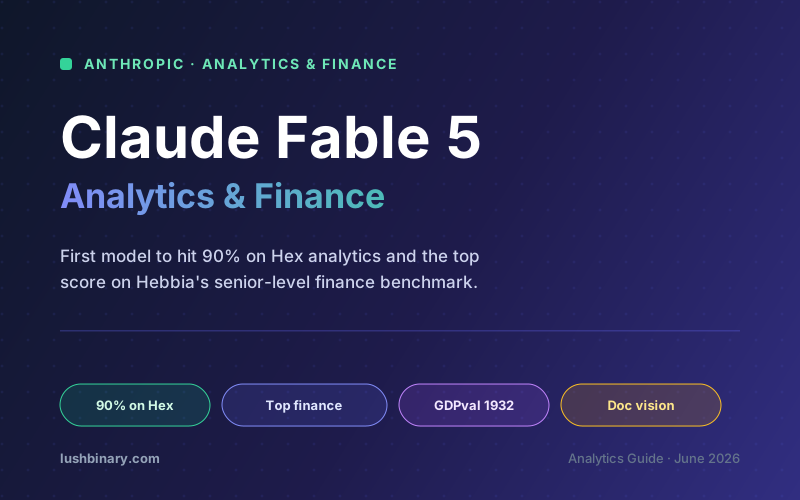
Analytics and finance are where Claude Fable 5 quietly posted some of its most impressive launch numbers. Released June 9, 2026 as Anthropic's first publicly available Mythos-class model, it became the first model to score 90% on Hex's benchmark of complex, long-running analytical tasks, and it recorded the highest score of any model on Hebbia's senior-level finance benchmark.
Those results are not a coincidence. Analytics and finance work is exactly the kind of multi-step, document-heavy, verify-as-you-go task Fable 5 was built for: pull data, transform it, reason over it, check the math, and explain the conclusion. It tops the GDPval-AA professional knowledge-work board at 1932 and reads charts and tables with strong document vision.
This guide covers where Fable 5 fits in an analytics or finance stack, the architecture for a reliable analysis agent, the verification and data-governance you cannot skip, and the cost math. For the model fundamentals, see our Claude Fable 5 developer guide.
📌 What This Guide Covers
1The Analytics and Finance Numbers
A few launch results stand out for data teams specifically:
| Result | What it means |
|---|---|
| 90% on Hex analytics | First model to clear 90% on Hex's suite of complex, long-running analytical tasks. |
| Top Hebbia finance score | Highest score of any model on Hebbia's senior-level finance benchmark at launch. |
| GDPval-AA 1932 | Leads the professional knowledge-work board (Opus 4.8 1890, GPT-5.5 1769, Gemini 3.1 Pro 1314). |
| Spreadsheets vs Opus 4.8 | Beats Opus 4.8 at every effort level and finishes runs 25 to 30% faster. |
| Document vision | State-of-the-art at reading charts and tables, useful for PDF-bound financial documents. |
The common thread is sustained, multi-step reasoning with self-checking. Analytics is rarely a single query; it is a chain of steps where an error early on poisons everything downstream. A model that validates its own work as it goes is worth more here than one that is marginally faster.
2High-Value Use Cases
Where the capability translates into real leverage:
Analytics agents
Natural-language questions that turn into multi-step SQL, transform steps, and a written explanation with the caveats stated.
Financial document review
Extracting and reasoning over filings, contracts, and statements, using strong document vision for PDFs and tables.
Spreadsheet automation
Building, auditing, and explaining models, where Fable 5 beats Opus 4.8 at every effort level and runs faster.
Due diligence and research
Long-horizon synthesis across many sources where a missed detail is expensive and self-verification matters.
💡 Match the model to the task
Fable 5 earns its premium on complex, multi-step analysis. For a simple aggregate query or a quick chart, a cheaper, faster model is the better fit. Its high time-to-first-token also makes it a poor choice for an interactive dashboard where users expect instant responses; run it asynchronously and surface results when ready.
3Analysis Agent Architecture
A reliable analysis agent gives Fable 5 the tools to fetch and verify data, and keeps a clear boundary between what the model proposes and what actually touches your warehouse:
The model reads from a read-only connection so it cannot mutate source data, runs validation (reconciliations, sanity bounds, schema checks) before it trusts a number, and returns an explained result with a human review gate on anything that drives a decision. The explanation is not optional: an analytics answer you cannot audit is a liability, not an asset.
4Verification and Trust
Fable 5's self-verification is a strong default, but financial and analytical output demands more than a model's own confidence. Build trust in layers:
- Deterministic checks - reconcile totals, enforce unit and currency consistency, and bound-check results against known ranges. These catch hallucinated numbers cheaply.
- Show the work - require the agent to surface the queries it ran and the assumptions it made, so a human can audit the path, not just the answer.
- Human sign-off on decisions - the agent informs; people decide. Keep a person in the loop for anything that moves money or feeds a board deck.
- Track accuracy over time - run an eval harness against questions with known answers so you can quantify reliability rather than trust a vibe.
Our eval-driven development guide covers how to measure an analysis agent's accuracy systematically instead of relying on spot checks.
5Data Governance and Cost
Two practical constraints shape any finance or analytics deployment on Fable 5: data handling and spend.
⚠️ Mandatory 30-day data retention
All Fable 5 traffic carries a mandatory 30-day retention requirement. Anthropic says it will not use the data for training or any non-safety purpose, logs all human access, and deletes it after 30 days unless a safety or legal hold applies. Teams handling regulated financial data should review that window before routing sensitive records through the model. Our safety split guide covers the retention rule in detail.
On cost, an analytics run is often input-heavy (lots of data and context) with a modest written output. A run consuming 500,000 input and 100,000 output tokens costs 0.5 * 10 + 0.1 * 50 = $10.00 on Fable 5 before caching. A stable schema, instruction prefix, and reference context captured under the 90% prompt-caching discount cut the input portion sharply on repeated runs, which is common in scheduled reporting.
For the full cost-optimization playbook, see our Fable 5 API and cost-optimization guide.
6Why Lushbinary
An analytics or finance agent is only useful if its numbers are trustworthy. Lushbinary builds analysis systems with the verification, governance, and audit trails that data and finance teams require, across fintech, SaaS, and enterprise.
- Analysis agent design - read-only data access, validation layers, and explained, auditable output.
- Verification and evals - accuracy tracking against known answers so reliability is measured, not assumed.
- Data governance - retention-aware architecture and access controls for regulated data.
- Cost control - prompt-cache strategy and model routing to keep scheduled reporting affordable.
🚀 Free Consultation
Want an analytics or finance agent your team can actually trust? We will design the data access, verification, and governance to run it on Fable 5, with no obligation.
7Frequently Asked Questions
Is Claude Fable 5 good for data analysis?
Yes. At launch Fable 5 became the first model to score 90% on Hex's benchmark of complex, long-running analytical tasks, and it tops the GDPval-AA knowledge-work board at 1932. It is built for multi-step, self-verifying work, which suits analytics pipelines that pull data, transform it, reason over it, and check the result. It is slow to first token, so use it for substantive analysis rather than quick lookups.
How does Claude Fable 5 perform on finance tasks?
Anthropic reports Fable 5 posted the highest score of any model on Hebbia's senior-level finance benchmark at launch, and it leads the GDPval-AA professional knowledge-work measure at 1932. That makes it a strong fit for financial analysis, due diligence, and document-heavy reasoning, provided you add verification and keep a human in the loop for decisions.
Can Claude Fable 5 work with spreadsheets?
Anthropic says Fable 5 beats Opus 4.8 on spreadsheet tasks at every effort level while finishing runs 25 to 30% faster. Combined with strong document vision (reading charts and tables), it can build, audit, and reason over spreadsheets, though outputs touching financial decisions should always be verified.
Should I send sensitive financial data to Claude Fable 5?
Factor in the mandatory 30-day data retention that applies to all Fable 5 traffic. Anthropic says it will not use the data for training or any non-safety purpose, logs all human access, and deletes it after 30 days unless a safety or legal hold applies. Teams with strict data-handling requirements should review that window before routing regulated financial data through the model.
How much does running analytics on Fable 5 cost?
Fable 5 costs $10 per million input tokens and $50 per million output tokens. An analytics run consuming 500K input and 100K output tokens costs 0.5 times 10 plus 0.1 times 50, which is $10.00 before caching. The 90% prompt-caching discount on a stable data schema or instruction prefix cuts the input portion sharply on repeated runs.
📚 Sources
- Anthropic - Claude Fable 5 and Claude Mythos 5
- Artificial Analysis - Claude Fable 5 / Mythos benchmarks
Content was rephrased for compliance with licensing restrictions. The Hex, Hebbia, GDPval-AA, spreadsheet, and pricing figures are sourced from Anthropic's June 9, 2026 announcement and Artificial Analysis's independent evaluation. Architecture and governance recommendations are Lushbinary's own. Model capabilities, pricing, and retention policy may change - always verify on Anthropic's website.
Building an Analytics or Finance Agent?
Lushbinary builds trustworthy analysis systems on Claude Fable 5 with verification, governance, and audit trails. Let's talk.
Ready to Build Something Great?
Get a free 30-minute strategy call. We'll map out your project, timeline, and tech stack - no strings attached.
Prefer email? Reach us directly: