
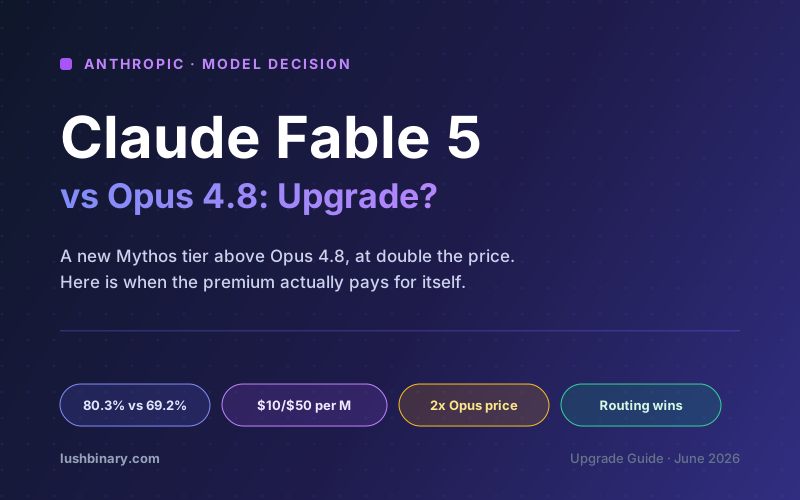
When Anthropic released Claude Fable 5 on June 9, 2026, it did not replace Claude Opus 4.8. It opened a new tier above it. Fable 5 is the first publicly available model in Anthropic's Mythos class, a step above the Opus line, and it is state of the art on nearly every benchmark it was tested on. It also costs exactly double: $10/$50 per million tokens against Opus 4.8's $5/$25.
That pricing forces a decision every team running on Anthropic now has to make: which work justifies the premium, and which is fine on Opus 4.8? The wrong answer in either direction is expensive. Default everything to Fable 5 and you double your bill for marginal gains on easy tasks. Default everything to Opus 4.8 and you leave real capability on the table for the hard, long-horizon work where Fable 5's lead compounds.
This guide is a decision framework, not a hype piece. It compares the two models head to head on capability, price, speed, and safety, then gives you a concrete routing strategy. For the full model fundamentals, start with our Claude Fable 5 developer guide.
📌 What This Guide Covers
1Two Tiers, Not Two Versions
The most important thing to understand is that Fable 5 is not Opus 4.9 with a different label. For two years Anthropic ran a three-step ladder of Haiku, Sonnet, and Opus. Mythos is a fourth step above all of them, and Fable 5 is the version of that step the public can actually use.
That framing changes how you read the price. You are not paying twice for a slightly better Opus. You are paying for a jump to a new tier, delivered with a safety system the older tiers never needed. Fable 5 and the restricted Claude Mythos 5 are the same underlying model, separated only by a safety layer added at inference time. Opus 4.8 sits a clear rung below both, and notably, it is the model Fable 5's safeguards fall back to when a request is blocked.
2Benchmarks Head to Head
On Anthropic's published benchmark table, Fable 5 leads Opus 4.8 across the board, with the lead widening as tasks get longer and more complex. These are the figures that matter for a real upgrade decision:
| Benchmark | Fable 5 | Opus 4.8 | Gap |
|---|---|---|---|
| SWE-Bench Pro (agentic coding) | 80.3% | 69.2% | +11.1 pts |
| FrontierCode Diamond (hard coding) | 29.3% | 13.4% | 2.2x |
| GDPval-AA (knowledge work, ELO) | 1932 | 1890 | +42 |
| Blueprint Bench 2 (spatial reasoning) | 38.6% | 14.5% | 2.7x |
| OSWorld-Verified (computer use) | 85.0% | 83.4% | +1.6 pts |
The shape of this table is the whole story. On computer use the two models are nearly tied, because that benchmark caps out and leaves little room to separate. On hard, open-ended coding (FrontierCode Diamond) the gap balloons to more than double. The harder and longer the task, the more Fable 5 pulls ahead. That is exactly the pattern you would expect from a higher tier, and it tells you where the premium is justified.
💡 The compounding effect
An 11-point pass-rate edge on a single step looks modest. Across a long autonomous job with hundreds of steps, a higher per-step success rate compounds: fewer dead ends, fewer retries, fewer human rescues. That compounding, not the headline number, is what justifies Fable 5 on long-horizon work. See our long-horizon agents guide.
3Price, Speed, and the Real Tradeoff
Capability is only half the decision. The other half is what you give up to get it: money and latency.
| Attribute | Fable 5 | Opus 4.8 |
|---|---|---|
| Input price | $10 / M tokens | $5 / M tokens |
| Output price | $50 / M tokens | $25 / M tokens |
| Built-in hard safeguards | Yes (fallback to Opus 4.8) | No |
| Latency profile | High time-to-first-token, deep reasoning | Faster, better for interactive use |
| Data retention | Mandatory 30-day retention | Standard policy |
Worked example: a task that consumes 200,000 input tokens and produces 50,000 output tokens costs 0.2 * 10 + 0.05 * 50 = $4.50 on Fable 5 and 0.2 * 5 + 0.05 * 25 = $2.25 on Opus 4.8 before any caching. Across thousands of such calls in production, that 2x factor is the number your finance team will notice.
Speed is the quieter tradeoff. Independent benchmarking from Artificial Analysis put Fable 5's output speed in the middle of the pack and its time-to-first-token far above the peer median, a direct consequence of the heavy chain-of-thought reasoning it runs before answering. This is a model built for deep, long-horizon work, not snappy back-and-forth chat. If your use case is an interactive assistant where users wait on every keystroke, Opus 4.8 is the better experience regardless of the benchmark gap.
4When Fable 5 Is Worth It
Reach for Fable 5 when the cost of a wrong answer outweighs the token bill and the work genuinely benefits from its capability edge:
- Long-horizon autonomous coding - large refactors, framework migrations, and multi-day feature builds where a higher per-step pass rate compounds. Anthropic cites a launch partner that compressed a migration across a 50-million-line codebase into a single day.
- Hard, open-ended reasoning - the FrontierCode Diamond and spatial-reasoning gaps show Fable 5 is in a different class on problems with no clean path.
- High-stakes knowledge work - complex analysis, legal reasoning, and finance tasks where Fable 5 tops the public board and a missed detail is costly.
- Self-verifying agents - at the highest effort setting Fable 5 reflects on and validates its own output, which makes unattended operation more practical.
5When Opus 4.8 Is the Right Call
Opus 4.8 is not the consolation prize. It is the closest follower to a new-tier model, at half the price and with faster responses. Keep workloads on Opus 4.8 when:
- The task is routine or high-volume - summaries, classification, simple edits, and well-scoped changes where Opus 4.8's quality is already more than enough.
- Latency matters - interactive chat and anything a user waits on in real time, where Fable 5's reasoning overhead hurts the experience.
- You are cost-constrained at scale - when volume is high and the per-task difficulty is low, the 2x premium rarely pays off.
- You hit a safeguarded domain - if your traffic touches cybersecurity, biology, or chemistry, Fable 5 will route it to Opus 4.8 anyway. Calling Opus 4.8 directly avoids paying the Fable 5 rate for an Opus 4.8 answer.
6A Routing Strategy That Uses Both
The teams that get the economics right do not pick one model. They route by task difficulty and stakes. A simple, effective pattern:
A lightweight router classifies each request by difficulty and stakes, sends the hard, high-value work to Fable 5, and keeps the routine bulk on Opus 4.8. The dashed line is the safeguard fallback Anthropic builds in: when Fable 5 trips a classifier, it hands the response to Opus 4.8 automatically. The same routing instinct that powers a good agent applies here. Our API and cost-optimization guide covers the prompt-caching math and implementation detail.
7Why Lushbinary
Choosing between frontier tiers is a cost and architecture decision as much as a capability one. Lushbinary helps teams design multi-model systems that put the expensive model only where it earns its keep, across healthcare, fintech, SaaS, and e-commerce.
- Model routing design - difficulty and stakes-based routing between Fable 5 and Opus 4.8 with measurable cost ceilings.
- Evaluation harnesses - so the model choice is backed by your own task data, not vendor benchmarks.
- Cost instrumentation - per-task spend tracking, prompt-cache strategy, and budget alerts.
- AWS infrastructure - production deployment with VPC isolation, encryption, and monitoring.
🚀 Free Consultation
Not sure whether your workload justifies Fable 5? We will benchmark it against Opus 4.8 on your own tasks and design a routing strategy that balances quality and cost, with no obligation.
8Frequently Asked Questions
Is Claude Fable 5 worth double the price of Opus 4.8?
It depends on the workload. Fable 5 costs $10/$50 per million tokens against $5/$25 for Opus 4.8, exactly double. On long, complex, high-stakes work where a higher pass rate compounds across hundreds of steps, the premium pays for itself by finishing tasks a cheaper model would fail. For routine chat and high-volume simple tasks, Opus 4.8 is the better default.
How much better is Fable 5 than Opus 4.8 on coding?
On SWE-Bench Pro, Fable 5 scores 80.3% against 69.2% for Opus 4.8, an 11-point lead. On the harder FrontierCode Diamond split it scores 29.3% versus 13.4%, more than double. The gap compounds across the many steps of a long autonomous job, which is where it matters most.
Should I switch all my traffic from Opus 4.8 to Fable 5?
No. The most cost-effective pattern is routing: send hard reasoning, long-horizon agentic work, and high-stakes tasks to Fable 5, and keep routine, high-volume, latency-sensitive traffic on Opus 4.8. Fable 5 also has a higher time-to-first-token, so it is a poor fit for interactive chat regardless of cost.
Does Fable 5 ever fall back to Opus 4.8?
Yes. Fable 5 ships with safety classifiers for cybersecurity, biology, chemistry, and model distillation. When a request trips one, the response is handed to Opus 4.8 and the user is told. Anthropic reports this fallback fires in under 5% of sessions, so for more than 95% of normal use you get the full Mythos-class model.
Is Opus 4.8 being discontinued now that Fable 5 is out?
No. Opus 4.8 remains the closest follower to Fable 5 on benchmarks, costs half as much, responds faster, and is the model Fable 5 itself falls back to for safeguarded requests. It stays a core part of a multi-model strategy rather than a deprecated option.
📚 Sources
- Anthropic - Claude Fable 5 and Claude Mythos 5
- Artificial Analysis - Claude Fable 5 / Mythos independent benchmarks
Content was rephrased for compliance with licensing restrictions. Benchmark figures, pricing, and safeguard behavior sourced from Anthropic's June 9, 2026 announcement and Artificial Analysis's independent evaluation. Routing recommendations are Lushbinary's own. Model capabilities and pricing may change - always verify on Anthropic's website.
Picking the Right Frontier Model?
Lushbinary designs multi-model routing that balances Fable 5 capability with Opus 4.8 economics. Let's scope your workload.
Ready to Build Something Great?
Get a free 30-minute strategy call. We'll map out your project, timeline, and tech stack - no strings attached.
Prefer email? Reach us directly: