
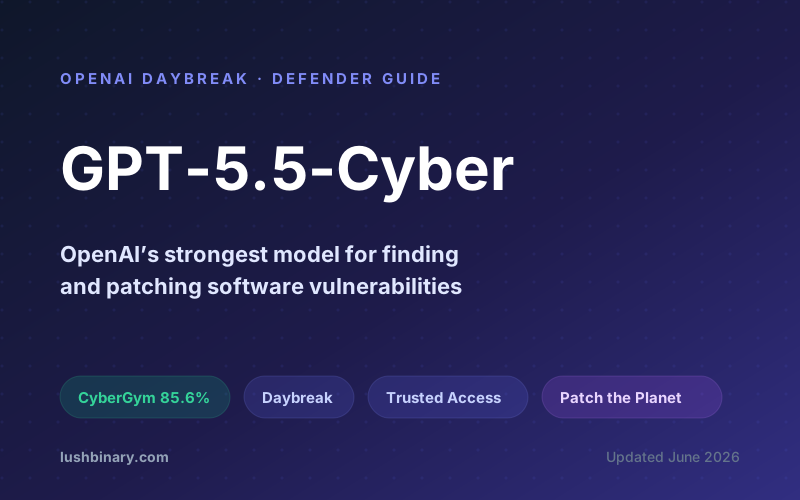
On June 22, 2026, OpenAI shipped the full version of GPT-5.5-Cyber, the most capable defensive cybersecurity model it has released to date. The pitch is direct: this is OpenAI's "strongest model yet for finding and helping patch software vulnerabilities," able to sustain deep analysis across large codebases, validate issues in a controlled environment, and then write and test the fix. It posts a state-of-the-art 85.6% on the CyberGym benchmark, ahead of GPT-5.5 at 81.8% and Anthropic's Mythos 5 at 83.8%.
But GPT-5.5-Cyber is not a model you can just hit from the API. It ships inside OpenAI's Daybreak program behind a governance layer called Trusted Access for Cyber, and it arrived alongside three other announcements: an upgraded Codex Security plugin, a 25+ company partner program, and Patch the Planet, an open-source bug-fixing effort built with Trail of Bits. Understanding how these pieces fit together is the difference between treating GPT-5.5-Cyber as a headline and actually using it to reduce risk.
This guide breaks down what GPT-5.5-Cyber is, how the Daybreak program works, who can get access and how, where it fits in a real defensive workflow, and what security teams should do next. For a head-to-head on raw capability, see our companion GPT-5.5-Cyber vs Claude Mythos 5 comparison.
🛡️ What This Guide Covers
- What GPT-5.5-Cyber Actually Is
- The Daybreak Program: Four Moving Parts
- Trusted Access for Cyber: How the Gate Works
- Codex Security: From Findings to Fixes
- Patch the Planet & the Trail of Bits Partnership
- A Real Defensive Workflow with GPT-5.5-Cyber
- How to Get Access (and Whether You Need It)
- Limitations & What to Watch For
- Why Lushbinary for AI-Assisted Security
- FAQ
1What GPT-5.5-Cyber Actually Is
GPT-5.5-Cyber is a specialized model built on top of GPT-5.5, OpenAI's flagship base model that launched on April 23, 2026. Where GPT-5.5 is a generalist that happens to be strong at security work, GPT-5.5-Cyber is tuned specifically for the defensive cybersecurity loop: reading large, unfamiliar codebases, reasoning about how a vulnerability could be triggered, confirming it in a sandbox, and producing a patch that actually compiles and passes tests.
OpenAI describes it as its "strongest model yet for finding and helping patch software vulnerabilities," with the ability to "sustain deeper analysis across large codebases." That last phrase matters. The hard part of real vulnerability research is not spotting an obvious bug in a 50-line snippet, it is holding enough of a million-line project in working memory to trace a tainted input from an entry point through several layers of indirection to the place it becomes exploitable. GPT-5.5-Cyber is built to keep that context.
💡 The Headline Number
GPT-5.5-Cyber set a new state of the art on CyberGym, a benchmark that measures whether an AI agent can reproduce known vulnerabilities in real-world software. It scored 85.6%, compared with 81.8% for the base GPT-5.5 model and 83.8% for Anthropic's Mythos 5. The 3.8 point jump over GPT-5.5 is the value the cyber-specific tuning adds.
Two release facts are worth pinning down. First, GPT-5.5-Cyber started as a permissive-only preview earlier in 2026 before the full version arrived on June 22. Second, it is not a public, self-serve model. It is delivered through a continued limited release to trusted defenders, which we unpack in the access section below. If you have used GPT-5.5 through ChatGPT or the API, you have not used GPT-5.5-Cyber.
The strategic backdrop is a race with Anthropic. Anthropic's Mythos line pushed hard on AI-driven vulnerability discovery, and OpenAI's response has been to pair raw capability with a defender- first distribution model. If you are evaluating both vendors, our Claude Mythos vs GPT-5.5 benchmarks and pricing breakdown covers the general-purpose models behind these cyber variants.
2The Daybreak Program: Four Moving Parts
GPT-5.5-Cyber did not ship alone. It is one component of Daybreak, OpenAI's broader cybersecurity initiative aimed at helping organizations secure software at machine speed. The June 22, 2026 expansion bundled four things together, and the model only makes sense in the context of the other three.
| Component | What It Does | Who It Is For |
|---|---|---|
| GPT-5.5-Cyber | Most capable model for vulnerability discovery, validation, and patch generation | Verified defenders, critical infrastructure |
| Codex Security plugin | Embeds the discovery-to-patch workflow into developer tooling | Engineering and AppSec teams |
| Cyber Partner Program | Lets security vendors build trusted access into their products | 25+ security firms and several governments |
| Patch the Planet | Finds and fixes bugs in critical open-source projects | Open-source maintainers (via Trail of Bits) |
The through-line is a deliberate shift in emphasis. For the last few years the AI security story has been about discovery: can a model find bugs faster than humans? OpenAI and Anthropic now agree that finding flaws is no longer the bottleneck. The bottleneck is shipping the fix. Every piece of the Daybreak expansion is oriented around closing that gap, from the Codex plugin generating patches to Patch the Planet landing them in real repositories.
For defenders, that reframing is the most useful takeaway of the whole launch. We dug into why patch velocity is now the real metric in our patch velocity vulnerability management guide.
3Trusted Access for Cyber: How the Gate Works
The single most important thing to understand about GPT-5.5-Cyber is that you reach it through Trusted Access for Cyber (TAC), the governance model that sits underneath all of Daybreak. TAC exists because a model good enough to find and exploit vulnerabilities is dual-use by definition. The same capability that helps a defender patch FreeBSD helps an attacker weaponize it. OpenAI's answer is proportional safeguards: more capability is paired with more verification.
In practice TAC defines two tiers of access for two different classes of user:
| Tier | Model | Typical Tasks |
|---|---|---|
| Most defenders | GPT-5.5 with TAC | Secure code review, patching, threat modeling, generalized blue teaming |
| Verified defenders | GPT-5.5-Cyber | Deep analysis of critical infrastructure, sustained vulnerability research |
OpenAI is explicit that for most teams, GPT-5.5 with TAC is the right level of capability. It handles the vast majority of legitimate defensive workflows while keeping the model's broad strengths and safety posture intact. GPT-5.5-Cyber is the escalation path for organizations protecting critical infrastructure that genuinely need the most capable model with more permissive behavior.
⚠️ Authorization Is the Whole Point
Trusted Access is intended for authorized defensive work on systems, applications, accounts, networks, or data that you own, operate, or are explicitly authorized to test or analyze. This is not a technicality. The verification and scoping are what make the elevated capability available at all, and using it outside that scope violates the terms of access.
OpenAI says its approach to TAC was shaped by conversations with cybersecurity and national security leaders across federal and state government and major commercial entities. The result is a model that is deliberately harder to get than a normal API key, with the friction serving as a feature rather than a bug.
4Codex Security: From Findings to Fixes
The Codex Security plugin is how GPT-5.5-Cyber's capabilities reach an actual engineering workflow. The June update extended the plugin to cover the full pipeline: discovering vulnerabilities in existing systems, validating them, and generating patches, while also working to prevent new vulnerabilities from reaching production in the first place.
That two-sided design is the part teams should pay attention to. There is the reactive side, hunting through your existing codebase for latent flaws, and the proactive side, catching issues at code-review time before they merge. Both run on the same underlying models, which means the patterns the system learns from your historic bugs feed directly into the guardrails it applies to new code.
What the Codex Security pipeline covers
- Discover: scan existing repositories for latent vulnerabilities across large codebases
- Validate: confirm a finding is real in a controlled environment rather than flagging a guess
- Patch: generate and test a fix that compiles and preserves existing behavior
- Prevent: review incoming code so new vulnerabilities never reach production
OpenAI has already put these models to work on high-stakes targets, using them to discover and generate patches for critical vulnerabilities in major browsers, network infrastructure, and operating systems including FreeBSD and the Linux kernel. That is the credibility signal: the same toolchain offered to defenders has been exercised against some of the most scrutinized code on the internet. For teams thinking about how to fold this into autonomous coding pipelines safely, our AI agent security guide for production covers the guardrails to put around it.
5Patch the Planet & the Trail of Bits Partnership
Patch the Planet is the most ambitious and most public part of the launch. Built in partnership with the well-known security firm Trail of Bits, it is an effort to find bugs in critical open-source projects and then help maintainers ship fixes. The name is a wink at "Hack the Planet," the rallying cry from the 1995 film Hackers, reframed around defense.
The mechanism is designed to respect how open source actually works. Security researchers use OpenAI's top models and Codex Security to identify vulnerabilities and review findings before they ever reach a maintainer, reducing the triage burden that AI bug-hunting tools would otherwise dump on volunteer teams. Fixes are disclosed through each project's existing channels rather than a parallel process.
📦 Initial Patch the Planet Participants
cURL, NATS Server, pyca/cryptography, Sigstore, aiohttp, the Go project, freenginx, Python, and python.org. If your stack depends on any of these, downstream security improvements from this program will reach you whether or not you ever touch GPT-5.5-Cyber directly.
Trail of Bits CEO and cofounder Dan Guido framed it as an internet-scale effort to help open source get ahead of AI bug-hunting tools, and to help the community see the upside of AI coding tools rather than only the risks. That is the real tension Patch the Planet targets: the same models that let defenders patch faster also let attackers find bugs faster, so the only sustainable answer is to get fixes landed before exploits spread.
6A Real Defensive Workflow with GPT-5.5-Cyber
Stripped of the announcements, here is how GPT-5.5-Cyber slots into a defensive program. The model is strongest when it owns the loop from a suspected weakness to a tested patch, with a human reviewing the gates in between.
- Scope and authorize: define exactly which systems and repositories are in scope under your Trusted Access terms before anything runs
- Discover: let the model sustain analysis across the full codebase to surface candidate vulnerabilities, not just the obvious ones
- Validate: confirm each candidate in a controlled environment so you are triaging real issues, not model hallucinations
- Generate and test a patch: have the model produce a fix and run it against the test suite to confirm it compiles and holds behavior
- Human review: a security engineer signs off before the patch is disclosed or merged, keeping a person on the accountability path
The human-in-the-loop step is not optional ceremony. A model that writes patches autonomously can also introduce subtle regressions or mask the root cause, so the review gate is where you catch that. If you are formalizing this for leadership, our CISO board-readiness guide for AI cyber risk maps the governance questions a board will ask.
7How to Get Access (and Whether You Need It)
There are three realistic paths to using Daybreak capability, and most organizations should start at the bottom of this list, not the top.
- GPT-5.5 with Trusted Access for Cyber. This is the right starting point for the vast majority of defenders. It covers secure code review, patching, threat modeling, and blue teaming, and it requires qualifying for TAC rather than the deeper verification GPT-5.5-Cyber demands.
- The Daybreak Cyber Partner Program. If you buy security tooling rather than build it, the cleanest route to GPT-5.5-Cyber capability is through one of the 25+ partner vendors embedding trusted access into their products. You inherit their verification and integration work.
- Direct GPT-5.5-Cyber access. Reserved for verified defenders responsible for critical infrastructure, with identity verification under TAC. This is the narrowest path and is scoped to organizations that genuinely need the most capable model.
💡 Honest Guidance
Do not chase GPT-5.5-Cyber direct access as a status symbol. For most teams, GPT-5.5 with TAC plus the Codex Security plugin delivers the outcome that matters, which is more vulnerabilities found and patched faster, without the verification overhead. Escalate to GPT-5.5-Cyber only when your defensive workload actually outgrows the broadly available model.
8Limitations & What to Watch For
GPT-5.5-Cyber is a major step forward, but a benchmark score is not a security program. A few caveats are worth holding onto.
- CyberGym measures reproduction, not novelty. The 85.6% reflects the model's ability to reproduce known vulnerabilities. That is genuinely useful for regression and triage, but it is not the same as proving the model can build verifier- confirmed end-to-end exploit chains on the hardest novel targets.
- Access friction is real. The verification that makes GPT-5.5-Cyber safe to release also means you cannot just turn it on. Plan for a qualification process, not an instant API key.
- Patches still need human review. Generated fixes can compile and pass tests while missing the real root cause. Keep a security engineer on the sign-off path.
- Dual-use never goes away. The defensive framing is sincere, but the underlying capability is the same one attackers want. Your own usage logging, scoping, and access controls matter as much as OpenAI's.
None of this diminishes the launch. It just means GPT-5.5-Cyber is a force multiplier for a disciplined team, not a replacement for one. The organizations that benefit most already have a vulnerability management process and are using the model to run it faster.
9Why Lushbinary for AI-Assisted Security
Getting value out of GPT-5.5-Cyber, GPT-5.5 with TAC, or the Codex Security plugin is less about the model and more about the workflow you wrap around it. Lushbinary helps engineering and security teams integrate AI-assisted vulnerability discovery and patch generation into real pipelines, with the logging, scoping, and human-review gates that keep the capability defensive.
We build secure-by-default backends, design AI agent guardrails, and stand up the CI integrations that turn a model's findings into merged, tested fixes. Whether you are evaluating Daybreak access or just want to use AI to cut your patch backlog, we can scope a path that fits your stack and your compliance posture.
🚀 Free Consultation
Want to put AI to work on your security backlog without opening new risk? Lushbinary designs AI-assisted vulnerability and patching workflows with the right guardrails. We'll review your stack, recommend the right level of model access, and map a realistic rollout with no obligation.
10Frequently Asked Questions
What is GPT-5.5-Cyber?
GPT-5.5-Cyber is OpenAI's most capable defensive cybersecurity model, built on GPT-5.5 and fully released on June 22, 2026 as part of the Daybreak program. It finds vulnerabilities, validates them in a controlled environment, and writes and tests patches across large codebases. It scored 85.6% on CyberGym, ahead of GPT-5.5 (81.8%) and Anthropic's Mythos 5 (83.8%).
How do I get access to GPT-5.5-Cyber?
Through a limited release to trusted defenders, mainly organizations securing critical infrastructure, with identity verification under Trusted Access for Cyber. Most teams should instead use GPT-5.5 with TAC, and security vendors can reach the model through the Daybreak Cyber Partner Program.
What is OpenAI's Daybreak program?
Daybreak is OpenAI's cybersecurity initiative for securing software at machine speed. The June 22, 2026 expansion added an updated Codex Security plugin, the full GPT-5.5-Cyber model, the Daybreak Cyber Partner Program (25+ security firms and several governments), and Patch the Planet, an open-source patching effort with Trail of Bits.
What is Patch the Planet?
An OpenAI initiative built with Trail of Bits to find and fix vulnerabilities in widely used open-source projects, pairing AI-assisted research with human review and disclosing fixes through each project's existing channels. Initial participants include cURL, NATS Server, pyca/cryptography, Sigstore, aiohttp, the Go project, freenginx, Python, and python.org.
Is GPT-5.5-Cyber a hacking tool?
No. It is a defensive model gated behind Trusted Access for Cyber and intended for authorized work on systems you own, operate, or are explicitly authorized to test. Identity verification and proportional safeguards are designed to keep its capabilities with legitimate defenders.
Should my team use GPT-5.5 or GPT-5.5-Cyber?
For most defenders, GPT-5.5 with Trusted Access for Cyber is the right level and covers secure code review, patching, threat modeling, and blue teaming. GPT-5.5-Cyber is for verified defenders on critical infrastructure who need the most capable model. Start with GPT-5.5 plus TAC and escalate only if your workflows require it.
Sources
- OpenAI: Daybreak, securing every organization in the world
- OpenAI: Scaling Trusted Access for Cyber with GPT-5.5 and GPT-5.5-Cyber
- OpenAI Help Center: Trusted Access for Cyber overview
- TechCrunch: OpenAI launches Patch the Planet for open-source bugs
- The Hacker News: OpenAI expands Daybreak with GPT-5.5-Cyber
Content was rephrased for compliance with licensing restrictions. Benchmark figures, program details, and access terms sourced from official OpenAI announcements and reputable security reporting as of June 2026. Details may change - always verify on OpenAI's website.
Build a Defensible AI Security Workflow
Tell us about your codebase and security goals. We'll help you put GPT-5.5-class models to work on vulnerability discovery and patching, with the guardrails to keep it defensive.
Ready to Build Something Great?
Get a free 30-minute strategy call. We'll map out your project, timeline, and tech stack - no strings attached.
Prefer email? Reach us directly: