
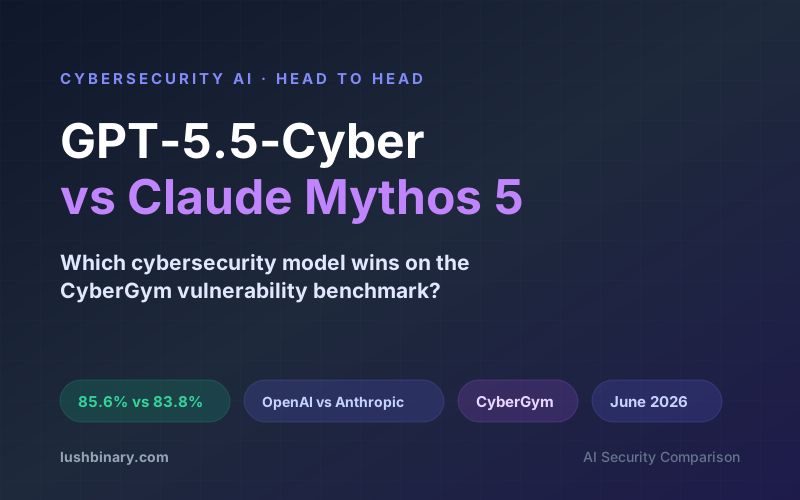
The two most capable cybersecurity models in 2026 now have a clear scoreboard. On June 22, OpenAI released the full version of GPT-5.5-Cyber and pointed straight at Anthropic: its new model scores 85.6% on the CyberGym benchmark, ahead of Anthropic's Mythos 5 at 83.8% and OpenAI's own base GPT-5.5 at 81.8%. After a year of Anthropic setting the pace on AI-driven vulnerability discovery, OpenAI is claiming the top of the chart.
But a 1.8 point benchmark lead is not a buying decision. These models differ far more in how you get them, how they are governed, and what workflow they are built around than in raw score. One is a limited release to verified defenders; both wrap their most capable cyber behavior in safety-led access controls. Picking the right one means looking past the headline number.
This comparison breaks down the benchmark, the access and governance models, the patching workflow, the partner ecosystems, and a practical decision framework. For a deeper look at GPT-5.5-Cyber on its own, see our GPT-5.5-Cyber and Daybreak defender guide.
⚔️ What This Comparison Covers
1GPT-5.5-Cyber vs Mythos 5 at a Glance
| Dimension | GPT-5.5-Cyber | Claude Mythos 5 |
|---|---|---|
| Vendor | OpenAI | Anthropic |
| CyberGym score | 85.6% | 83.8% |
| Base model | GPT-5.5 (81.8% on CyberGym) | Claude Mythos family |
| Primary emphasis | End-to-end discover, validate, patch | AI-driven vulnerability discovery |
| Access model | Trusted Access for Cyber, limited release to verified defenders | Safety-led, gated rollout |
| Workflow tooling | Codex Security plugin, Daybreak program | Claude Code and Anthropic security tooling |
| Open-source effort | Patch the Planet (with Trail of Bits) | Vendor-led disclosure programs |
The one-line read: GPT-5.5-Cyber currently leads on the headline benchmark and ships with a more explicit end-to-end patching toolchain, while both vendors converge on the same core idea, which is that frontier cyber capability must be paired with strict access governance. The interesting decisions live in the rows below the score.
2The CyberGym Benchmark, Read Honestly
CyberGym tests whether an AI agent can reproduce known vulnerabilities in real-world software. The full ranking from the launch looks like this:
Three things are worth saying plainly. First, the cyber-specific tuning matters: GPT-5.5-Cyber beats its own base model by 3.8 points, which is the value of specialization rather than just scale. Second, the gap over Mythos 5 is 1.8 points, close enough that benchmark noise, harness differences, and task selection can move it. Treat it as "GPT-5.5-Cyber is at least competitive and currently ahead," not "GPT-5.5-Cyber wins by a mile."
⚠️ What CyberGym Does Not Measure
CyberGym measures reproducing known vulnerabilities. It is a strong proxy for triage and regression work, but it is not a test of whether a model can autonomously build verifier-confirmed exploit chains on the hardest novel targets, and it says nothing about patch quality. A model can top CyberGym and still write a fix that papers over the root cause.
For the general-purpose capabilities behind these cyber variants, including coding and reasoning benchmarks, our Claude Mythos vs GPT-5.5 benchmarks and pricing comparison goes deeper on the base models.
3Access & Governance: The Real Differentiator
This is where the two diverge in a way that actually affects your rollout. GPT-5.5-Cyber is delivered through OpenAI's Trusted Access for Cyber (TAC), the governance model underpinning Daybreak. It defines two tiers: GPT-5.5 with TAC for most defenders, covering secure code review, patching, threat modeling, and blue teaming, and GPT-5.5-Cyber itself for verified defenders protecting critical infrastructure, gated behind identity verification.
Anthropic took a parallel safety-led path with its Mythos line, constraining the most capable cyber behavior behind its own controls. Both vendors landed on the same principle independently: a model good enough to find and exploit vulnerabilities is dual-use, so more capability is paired with more verification.
💡 Practical Consequence
With either vendor, you will not flip on the most permissive cyber model with a credit card. Plan for a qualification and scoping process, and expect that for most teams the broadly available tier, GPT-5.5 with TAC on the OpenAI side, is the realistic day-one option. The verification friction is the same on both sides, so it should not be the deciding factor between them.
If you need to bring this to a board or risk committee, our CISO board-readiness guide for AI cyber risk covers the governance questions both models raise.
4Discovery vs End-to-End Patching
The clearest product difference is workflow emphasis. Anthropic's Mythos line built its reputation on discovery, finding flaws faster than human researchers. OpenAI is leaning into the next step, arguing that finding bugs is no longer the bottleneck, shipping the fix is. Its Codex Security plugin was updated to cover the full pipeline: discover, validate, generate a patch, and prevent new vulnerabilities from reaching production.
Notably, both vendors now agree on this framing. The race has shifted from "who finds more" to "who closes the loop," and GPT-5.5-Cyber's end-to-end patching story is OpenAI's bet that the loop is where defenders feel the most pain.
GPT-5.5-Cyber strengths
- Leads CyberGym at 85.6%
- Explicit discover-to-patch toolchain via Codex Security
- Proven on browsers, network infra, FreeBSD, Linux kernel
- Open-source push through Patch the Planet
Claude Mythos 5 strengths
- Highly competitive CyberGym score at 83.8%
- Strong, established vulnerability-discovery reputation
- Fits teams standardized on Claude and Claude Code
- Safety-first framing that resonates with risk teams
If your pain is a backlog of unpatched findings rather than a shortage of findings, the end-to-end emphasis is the more useful framing. Our patch velocity guide explains why that backlog is the metric that actually moves risk.
5Ecosystem, Partners & Open Source
Beyond the model, each vendor is building a distribution and trust ecosystem. OpenAI's Daybreak Cyber Partner Program brings in 25+ security firms and several governments, letting vendors embed trusted access into their own products so you can reach GPT-5.5-Cyber capability without qualifying directly. On the open-source side, Patch the Planet, built with Trail of Bits, targets critical projects including cURL, NATS Server, pyca/cryptography, Sigstore, aiohttp, the Go project, freenginx, Python, and python.org.
Anthropic has run its own vendor partnerships and responsible- disclosure efforts around the Mythos line. The strategic difference is visibility: OpenAI has packaged its open-source contribution as a named, public program with a recognizable security partner, which is as much a trust-building move as a technical one.
For most buyers, the partner ecosystem matters more than the open- source program. If your existing security vendor is in the Daybreak partner network, that is often the smoothest path to this class of capability regardless of which model tops the benchmark this quarter.
6Pricing & Availability Reality
Be skeptical of any article that quotes a tidy per-token price for these cyber tiers. Neither GPT-5.5-Cyber nor the most capable Mythos cyber behavior is sold as a standard self-serve API product with public pricing. GPT-5.5-Cyber is a limited release to verified defenders, and the broadly available route is GPT-5.5 with Trusted Access. Anthropic similarly gates its top cyber capability.
⚠️ Budget for Process, Not a Price Tag
The real cost of these models is the qualification, scoping, and integration work, plus the enterprise or partner agreement, not a published list price. When you compare vendors, compare the access path and the workflow tooling. The per-token cost of the underlying base model is a rounding error next to the engineering cost of wiring the discover-to-patch loop into your pipeline correctly.
The honest takeaway: both models are procurement decisions, not API signups. Treat them like enterprise security tooling and the comparison becomes about fit and trust, not a spreadsheet of token prices.
7Which One Should You Choose?
A short decision framework, since the benchmark gap is too small to decide on its own:
- Choose GPT-5.5-Cyber if you want the current CyberGym leader, you value the explicit discover-to-patch toolchain in Codex Security, or your security vendor is in the Daybreak partner network.
- Choose Claude Mythos 5 if you are already standardized on Anthropic and Claude Code, you weight its safety-first reputation heavily, or its discovery strengths map to your primary use case.
- Choose the broadly available tier first in almost all cases. GPT-5.5 with Trusted Access for Cyber, plus a disciplined human-review process, will deliver most of the value while you decide whether you genuinely need the most permissive model.
- Do not choose on benchmark alone. A 1.8 point CyberGym gap should not override ecosystem fit, existing contracts, or your team's familiarity with one vendor's tooling.
The teams that win with either model already have a vulnerability management process and are using AI to run it faster, not hoping the model invents one for them.
8Why Lushbinary for AI Security Integration
Whether you land on GPT-5.5-Cyber, Claude Mythos 5, or the broadly available tier of either, the value comes from the workflow you build around the model. Lushbinary helps engineering and security teams integrate AI-assisted vulnerability discovery and patch generation into real CI pipelines, with the scoping, logging, and human-review gates that keep the capability defensive and auditable.
We are model-agnostic. We will help you evaluate the access paths, stand up the integrations, and design guardrails that satisfy your compliance posture, so the decision between OpenAI and Anthropic becomes a detail rather than a blocker.
🚀 Free Consultation
Deciding between GPT-5.5-Cyber and Claude Mythos 5? Lushbinary builds model-agnostic AI security workflows. We'll review your stack, compare the realistic access paths, and map a rollout with the right guardrails, no obligation.
9Frequently Asked Questions
Is GPT-5.5-Cyber better than Claude Mythos 5?
On CyberGym, which measures reproducing known vulnerabilities, GPT-5.5-Cyber scored 85.6% versus 83.8% for Mythos 5, with base GPT-5.5 at 81.8%. The 1.8 point lead is real but narrow, so the better choice usually comes down to access model, ecosystem, and workflow fit rather than the score alone.
What is the difference between GPT-5.5-Cyber and Claude Mythos 5?
Both are frontier cyber models. GPT-5.5-Cyber is OpenAI's defensive model in the Daybreak program, gated by Trusted Access for Cyber and built around an end-to-end discover-validate-patch workflow with Codex Security. Anthropic's Mythos line emphasizes vulnerability discovery with its own safety-led rollout. The biggest practical difference is distribution and governance.
How much do GPT-5.5-Cyber and Claude Mythos 5 cost?
Neither sells its most permissive cyber tier as a standard self-serve API with public per-token pricing. GPT-5.5-Cyber is a limited release to verified defenders under Trusted Access, with GPT-5.5 plus Trusted Access as the broad path. Budget for a qualification process and enterprise or partner agreements rather than a published price.
Which model should I choose for vulnerability management?
If you are invested in OpenAI tooling and want a tight discover-to-patch loop, GPT-5.5-Cyber with Codex Security fits and currently leads CyberGym. If you are standardized on Anthropic or prioritize its safety framing, Mythos 5 is highly competitive. For most teams, start with the broadly available tier plus a disciplined human-review process.
Can these cyber models replace a security team?
No. They accelerate finding and patching vulnerabilities, but CyberGym measures reproducing known issues, not securing a system end to end. Generated patches can compile and pass tests while missing the root cause, so a human engineer must review and sign off. These models are force multipliers, not replacements.
Sources
- OpenAI: Daybreak, securing every organization in the world
- The Decoder: GPT-5.5-Cyber outperforms Anthropic's Mythos on cyber benchmark
- Neowin: GPT-5.5-Cyber tops Claude Mythos 5 in vulnerability benchmark
- OpenAI Help Center: Trusted Access for Cyber overview
Content was rephrased for compliance with licensing restrictions. Benchmark figures and access terms sourced from official OpenAI announcements and reputable security reporting as of June 2026. Model capabilities and availability may change - always verify on the vendor's website.
Pick the Right Cyber Model for Your Stack
Tell us your security goals and current tooling. We'll help you compare GPT-5.5-Cyber and Claude Mythos 5 against your real workflow and build the integration around it.
Ready to Build Something Great?
Get a free 30-minute strategy call. We'll map out your project, timeline, and tech stack - no strings attached.
Prefer email? Reach us directly: