
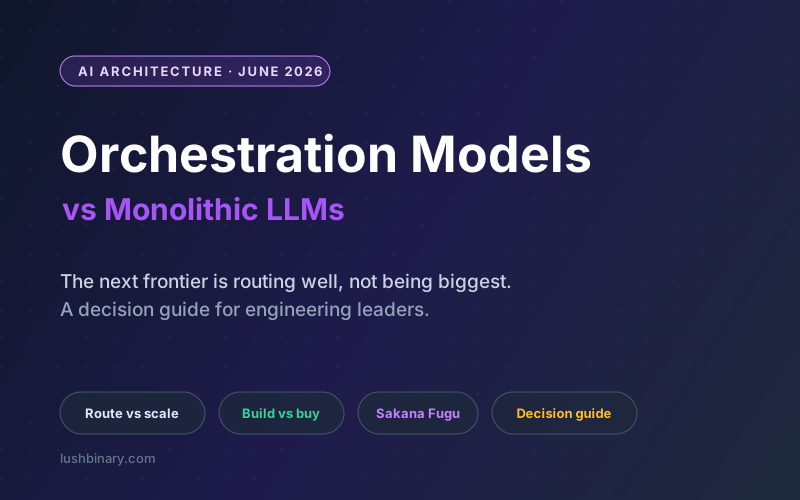
For most of the last few years, the question every engineering leader asked about AI was simple: which single model is best? Sakana AI's June 22, 2026 launch of Sakana Fugu reframes it. Fugu is an orchestration model, a language model trained to coordinate a pool of other models, and its pitch is that the next frontier is less about owning the biggest model and more about routing well across many strong ones.
That is a real architectural fork, and it lands on your roadmap whether or not you adopt Fugu specifically. Do you standardize on one capable model and keep your stack simple, or move to a system that conducts many models and accept the complexity and cost profile that comes with it?
This is a decision guide, not a sales pitch for either side. We cover what an orchestration model actually is, where it beats a monolithic LLM, where a single model still wins, the build-versus-buy tradeoff against a DIY router, and a way to evaluate the shift without betting the roadmap on launch-day hype.
What This Guide Covers
- Two Ways to Get to a Good Answer
- What Changed: Orchestration as a Learned Skill
- Where Orchestration Models Win
- Where a Monolithic Model Still Wins
- Build Your Own Router vs Buy an Orchestration Model
- The Hidden Costs on Both Sides
- How to Evaluate the Shift
- Why Lushbinary for the Decision
1Two Ways to Get to a Good Answer
A monolithic LLM answers from a single set of weights. You send a prompt, one model responds, and the quality, latency, and cost are properties of that model. It is simple to reason about and simple to bill.
An orchestration model puts a coordinator in front of a pool. For an easy prompt it can answer directly. For a hard one it assembles specialists, often described as a planner, an executor, and a verifier, and synthesizes their work into one reply. You still call one endpoint, but behind it a team forms and dissolves per request. That is the design Sakana Fugu ships, explained in our Sakana Fugu orchestration model guide.
2What Changed: Orchestration as a Learned Skill
Routing between models is not new. Teams have used LLM gateways and rule-based routers for a while, and we have written about LLM gateways and model routing and multi-agent orchestration patterns. What is new is that the coordinator itself is a trained model rather than a config file.
That distinction matters in practice. A rule-based router picks a model by your heuristics. A learned orchestrator can decompose a task, decide how many specialists to involve, verify intermediate results, and call itself recursively on hard subparts, picking up collaboration patterns you might not think to encode. The cost is that the behavior is less transparent, which raises the bar on evaluation and observability.
3Where Orchestration Models Win
- Mixed workloads. When one product spans chat, coding, math, and research, no single model is best at all of them. Routing to the right specialist per request lifts the average.
- Hard, multi-step tasks. Plan, execute, verify loops tend to beat a single pass on complex jobs, and a learned orchestrator runs that loop for you.
- Provider diversification. A pool spanning several providers reduces dependence on any one underlying model, which matters when access can change for commercial or policy reasons.
- Less plumbing to maintain. You get coordinated behavior without building and tuning your own multi-agent system.
The provider-diversification point is not theoretical right now. We unpack how it played out around export controls in the Fugu Ultra vs Fable 5 and Mythos comparison.
4Where a Monolithic Model Still Wins
- Predictable latency and cost. A single model has a known token profile per request. An orchestration call can fan out internally, so its latency and token use vary more.
- Narrow, well-understood tasks. If you do one thing, a tuned single model plus a little of your own routing is cheaper to reason about than a general coordinator.
- Data residency and deployment control. A hosted orchestration API over a third-party pool may not meet residency or air-gap needs. An open-weight model you run yourself can. See our open-weight model comparison.
- Debuggability. One model and one prompt are easier to trace than a request that fanned out across several models.
Decision shortcut
If your workload is varied and quality on hard tasks is the priority, an orchestration model is worth a pilot. If your workload is narrow, latency-bound, or residency-constrained, a single model, possibly one you host, is usually the cleaner answer.
5Build Your Own Router vs Buy an Orchestration Model
| Factor | Build your own router | Buy an orchestration model |
|---|---|---|
| Control | Full control of routing, cost, and data flow | Coordination is the vendor's, less visibility |
| Time to value | Slower, you build and tune the logic | Fast, one API call to start |
| Maintenance | Ongoing, you own the routing quality | Vendor maintains the orchestrator |
| Cost shape | You optimize directly | Internal fan-out can raise per-request tokens |
For most teams this is not strictly either-or. A pragmatic pattern is to put an orchestration model behind a thin routing layer you control: you decide which traffic goes to the orchestrator versus a single model, you keep a fallback, and you own the cost and data policy at the boundary.
6The Hidden Costs on Both Sides
Orchestration is not free quality. The main hidden cost is token fan-out: a single hard request can call several models and verify intermediate work, so it can use more tokens than one call to one model. As of June 2026, Fugu Ultra pay-as-you-go is listed at about $5 per million input tokens and $30 per million output tokens, so a request that fans out adds up faster than the rate alone suggests.
The monolithic side has its own hidden cost: you pay it in engineering when a single model is not strong enough across your task mix and you end up hand-building the very routing an orchestration model would have done. The honest comparison weighs vendor token spend against your own team's time.
7How to Evaluate the Shift
Treat launch benchmarks as a reason to test, not a conclusion. A disciplined evaluation looks like this:
- Build a representative eval set from your real tasks, not a public benchmark. Our eval-driven development guide covers how.
- Run an orchestration model and your current single model on the same set. Score quality, latency, and cost per task, not just accuracy.
- Measure the token fan-out explicitly so the cost comparison reflects production, not a single happy-path call.
- Keep the orchestration model behind a swappable interface during the pilot so a poor result is a config change, not a rewrite.
If the orchestration model wins on the tasks that matter and the cost is acceptable at your volume, expand it. If a single model is within range and far simpler, the simpler system is usually the better long-term bet.
8Why Lushbinary for the Decision
This is the kind of architecture call where the wrong default quietly costs you for a year: over-engineering a routing system you did not need, or shipping a single model that cannot keep up with your task mix. We help engineering teams make it with evidence.
Lushbinary designs model strategy and the infrastructure under it: evaluation harnesses, routing layers you control, cost observability, and provider-agnostic architectures that survive a vendor or policy change. We will run the orchestration-versus-monolith comparison on your workload and give you a recommendation you can defend.
🚀 Free Consultation
Weighing an orchestration model against a single LLM? Lushbinary will scope an evaluation, run it on your real tasks, and give you a data-backed recommendation with no obligation.
❓ Frequently Asked Questions
What is an orchestration model?
An orchestration model is a language model trained to coordinate other models rather than answer everything itself. Sakana Fugu routes, delegates, verifies, and synthesizes across a pool of LLMs behind a single API, so the caller sees one model but a team does the work.
How is it different from an LLM gateway or router?
A gateway or router uses rules and classifiers you configure to pick a model. An orchestration model learns coordination as a skill and is itself a model, so it can decompose tasks, assign roles, verify work, and call itself recursively without you writing that logic.
When should I use a monolithic LLM instead?
Use a single model when latency and cost predictability matter most, when the task is narrow and well understood, or when you need data residency and deployment control that a hosted orchestration API over a third-party pool cannot give you.
Should I build my own router or buy an orchestration model?
Build your own when you need full control and have the team to maintain it. Buy when you want frontier-level quality across mixed tasks without standing up multi-agent plumbing. Many teams run both: an orchestration model behind a thin routing layer they control.
Does an orchestration model reduce vendor lock-in?
It can reduce dependence on any single underlying model since the pool can span providers, but you then depend on the orchestration provider. Real resilience comes from keeping it behind your own swappable interface with a fallback.
Sources
Content was rephrased for compliance with licensing restrictions. Product details and pricing sourced from official Sakana AI materials as of June 2026. Pricing and availability may change, so verify on Sakana's website.
Make the Model-Architecture Call With Evidence
We will run an orchestration-versus-monolith evaluation on your real workload and hand you a recommendation you can stand behind.
Ready to Build Something Great?
Get a free 30-minute strategy call. We'll map out your project, timeline, and tech stack - no strings attached.
Prefer email? Reach us directly: